

Mastering AI Automation for LLM Visibility and Reputation
Your AI reputation isn’t a ranking. It’s a rate.
Ask an AI platform the same local question several times, and you’ll often get different businesses each time. In BrightLocal’s study of about 200,000 localized searches, a business that appeared once showed up again in only about half of later attempts. Here is how to measure that, improve it honestly, and automate the upkeep.
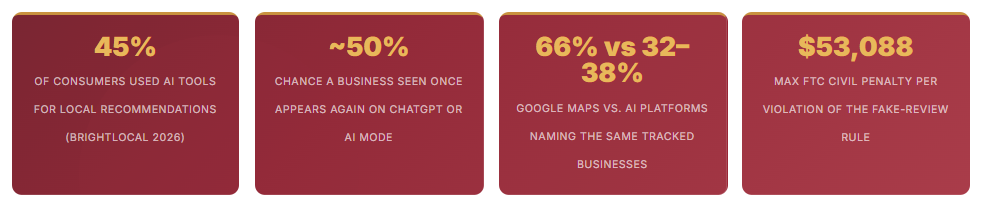
At a glance: 45% of consumers used AI tools for local recommendations (BrightLocal 2026) · ~50% chance a business seen once appears again on ChatGPT or AI Mode · 66% vs 32–38%: Google Maps vs. AI platforms naming the same tracked businesses · $53,088 max FTC civil penalty per violation of the fake-review rule
What You’ll Find in This Article
- A story about a moving company that appeared in ChatGPT on Monday and vanished on Thursday, and what it revealed about how AI recommendations actually behave
- What BrightLocal’s study of about 200,000 localized AI searches found: why one check tells you almost nothing, and why your mention rate is the number to track
- Why you can’t edit what an AI says about you but can edit what it reads, and where the major platforms get their local information
- The Source Map: seven places AI automation lives in visibility and reputation (your website, profiles and listings, review requests, review replies, third-party mentions, answer monitoring, and crawl access), each with what to automate, what to keep human, and where to start
- The legal and platform lines you must not cross: the FTC’s fake-review rule and Google’s policies on incentives and rating manipulation
- Six best practices, five little-known gems, and a direct next step
Monday He Was There. Thursday He Wasn’t.
A 35-Person Moving Company
The owner of a 35-person moving company decided to find out what ChatGPT said about his business. On Monday, he asked for the best local movers for a three-bedroom house move, and his company was the second name on the list. He took a screenshot and sent it to his sales manager. On Thursday, a customer mentioned she had found a competitor “through ChatGPT.” He asked the same question again, and his company was missing. He asked a third time, and it was back, though with a service area he doesn’t actually cover.
His first instinct was that something had broken. Nothing had. What he ran into was that AI answers to local questions vary from run to run, and a single look tells you almost nothing. Over the next two months, his marketing manager set up a weekly routine that asked a fixed set of customer-style questions on each platform and logged who got named. The pattern wasn’t flattering: he appeared about half the time on one platform and rarely on another. Tracing the gaps led to boring, fixable causes. A listing with an old service area, a second phone number on a directory, and a handful of reviews that had sat unanswered for months.
None of the fixes involved gaming anything. They were corrections and upkeep, plus a steady, honest request for reviews after real jobs. Over the following quarter, the log showed his name appearing more often, and the same method that found the problems showed the fixes were working. He stopped treating the AI answer as a verdict and started treating it as a measurement.
That story is the argument of this article. An AI recommendation is not a ranking you hold; it’s an outcome that varies, assembled from sources you can see and fix. The businesses making progress have stopped asking “where do we rank?” and started asking “how often are we named, and is what’s said true?”
A Single Check Tells You Almost Nothing
BrightLocal published a study on September 16, 2026 that analyzed about 200,000 localized searches across ChatGPT, Google AI Mode, and Google AI Overviews, covering roughly 1,300 business locations and about 1.9 million AI citations. BrightLocal sells AI visibility tracking, and the businesses studied were ones tracked in its own tool, so treat the results as strong evidence about how these platforms behave rather than a census of all businesses. The study covered ChatGPT, Google AI Mode, and Google AI Overviews; other platforms may behave differently.
Running the same prompt repeatedly produced different lists. The average overlap between result sets on repeat searches was just 20% to 33% (ChatGPT 23%, AI Mode 21%, AI Overviews 33%). A business that appeared once showed up again in about half of later attempts: 50% for ChatGPT and AI Mode and 58% for AI Overviews. Between 71% and 80% of businesses appeared in half of the attempts or fewer.
The practical meaning is that your AI visibility is a rate, not a rank. A baseball player isn’t judged on one at-bat, and a business shouldn’t be judged on one screenshot. The useful number is your mention rate: how often you are named across many runs, platforms, and locations. That comparison is our own framing, but it follows directly from how variable the answers are.
The platforms also disagree with each other and with Google Maps. Google Maps mentioned a tracked business in 66% of searches, versus 32 to 38% for the AI platforms (AI Overviews 38%, ChatGPT 33%, AI Mode 32%). Google’s AI Mode and AI Overviews shared only about 29% of the businesses they named, and ChatGPT overlapped just 19 to 20% with either. Even moving the searcher across town changed the results: overlap between points in the same town was 36.2% for ChatGPT, 46.9% for AI Mode, and 47.4% for AI Overviews.
Mention rate in a tracked business’s searches, BrightLocal (September 2026): Google Maps 66% · AI Overviews 38% · ChatGPT 33% · Google AI Mode 32%

20%–33% average overlap between result sets when the same prompt is repeated. ~50% chance a business seen once appears again (50% ChatGPT and AI Mode, 58% AI Overviews). 29% of named businesses are shared by Google’s own AI Mode and AI Overviews. 2.5–4.1 average businesses named per answer, so the list is short and every slot counts.
What this does not mean: that rankings and reviews have stopped mattering. BrightLocal’s own conclusion is that most of the tactics that work for local SEO also work for AI visibility. What changes is how you measure the result: across many runs, not one screenshot.
The Biggest Question Most Businesses Ask Us
Because companies can no longer rely on traffic from their sole efforts in Google (remember, it is no longer a search engine moving traffic to the Blue Links – it is an AI Answers Machine DESIGNED TO KEEP THOSE ASKING QUESTIONS ON GOOGLE!) The question being asked of us at MediaBus Marketing most often is, “Is my business, my brand, my products and services even VISIBLE to the likes of ChatGPT or Claude or the rest?”
The simple answer is, more than likely, nothing of your business is visible to them, because as the game of optimization has changed from Google-only, there is a drastic necessity for there to be Optimizations for each LLM in the formats and content they want to see you, and WHERE they want to see your information and content. Remember it is now Search Everywhere Optimization, and the Gaps that are where you are currently in establishing your Authority Score (and how each LLM calculates that Score) is what you need to work on to get the needed Inclusion, Citation and Recommendation that will bring you the volumes of traffic, more qualified than ever, to your website, sales page, and to earn you the revenues and profits you need to stay in business.
You Can’t Edit the Answer, But You Can Edit the Sources
Google’s documentation explains the mechanism for its own AI features. They use retrieval-augmented generation, relying on core Search ranking systems to retrieve relevant, up-to-date pages from Google’s index, and then reviewing the specific information on those pages to produce a response. The system also fans out into related queries to gather more context. In other words, an AI answer is built from pages it retrieved, and what those pages say about you shapes what it says.
But that is only for Google’s AI Answers… You have the sheer billions of inquiries that are happening daily on ChatGPT, the thoroughness and power of Perplexity.AI, as well as all the volume of actions, builds, questions, and research being done on Anthropic’s Claude. SEO no longer means Search Engine Optimization – It means Search Everywhere Optimization!
BrightLocal’s citation analysis shows what those pages tend to be. Business websites supplied 42% of the AI citations, and 93% of the unique domains cited were business sites. Google Business Profile accounted for about 28.6% of citations and Yelp about 9.5%. Another set of items that the Large Language Models look to establish the Authority, Credibility and Trustworthiness, that this BrighLocal Study completely ignored is what YouTube, Reddit (and Quora) as well as 3rd Party Media Mentions and Inclusions move the needle for your Brand to be included in the answers being given. BrightLocal only found that Google’s AI platforms lean heavily on Google Business Profile while ChatGPT hardly uses it, and that all three platforms rely (somewhat) on Yelp.
Two sentences from the primary sources explain why this matters. BrightLocal’s consumer survey advises businesses to check the sources AI tools reference and, if something is wrong, ask for a correction. And Google notes that generative models predict likely words rather than retrieve facts, so their outputs can contain inaccuracies. Put together, the sensible response to a wrong AI answer is to find and fix the page it was likely built from, not to argue with the model.
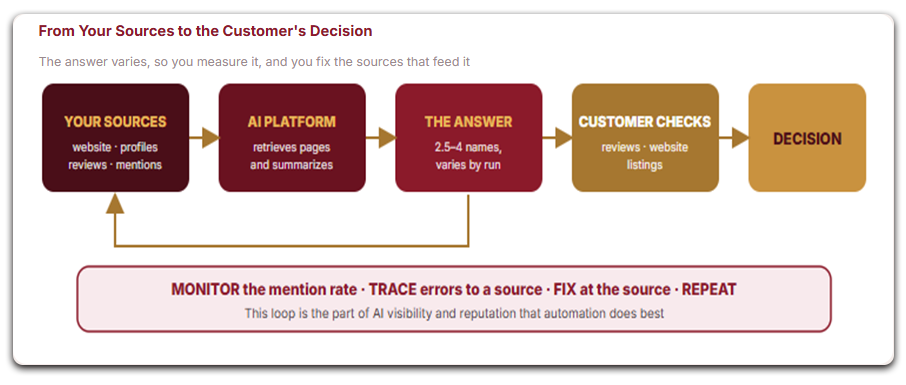
The loop at the bottom of that diagram is where automation earns its keep. Running the same questions every week, logging the answers, and comparing them over time is tedious for a person and trivial for a scheduled system. People are still needed to judge what’s wrong and to fix it.
MMG’s LLM AI Visibility Audit
That is why you need to have, at least on a monthly basis, a gauge of how your sources are doing for the LLM you are targeting to optimize for. Of course, there are some Best Practices that benefit your company in doing that are also, across the LLM board, good for establishing your Authority on the topics you are desiring to show up for.
CHECK OUT WHAT THE LLM AI VISIBILITY AUDIT is designed to do for your business!
The Source Map: The Top Seven Best Practices
Visibility and reputation work breaks into seven places where automation can help, from the pages you fully control to the technical gate that decides whether crawlers can read them at all. Each place below has a definition, what AI can automate, what should stay human, and a suggested starting level from the Autonomy Ladder in our pillar article, Mastering AI Automation for LLM Success. Level 1 means AI drafts and a person decides. Level 2 means fixed steps run automatically, with people reviewing exceptions. The starting levels are MMG working guidance, not research findings. For the broader marketing context, see Mastering AI Automation: Marketing & Content.

In the Age of AI
You Gain the Advantage over Those Who Don't Step Up
The Rules of the Road:
What You Must Never Automate
The easiest mistake in this field is automating the wrong thing. The FTC’s Consumer Review Rule, 16 CFR Part 465, took effect on October 21, 2024. It prohibits fake or false reviews, including AI-generated ones (the FTC said so explicitly in its explanation of the rule), buying reviews or giving incentives conditioned on a particular sentiment, undisclosed reviews by company insiders, review suppression through threats or intimidation, and fake social media indicators. The FTC can seek civil penalties, which it cited on December 22, 2025, as up to $53,088 per violation, when it sent warning letters to 10 companies over fake reviews and incentives for five-star ratings.
Google’s own policies draw a stricter line for reviews on its platform. Its Maps policy says incentivized reviews, meaning reviews influenced by a payment, discount, free goods or services, or any other benefit, are not allowed and will be removed. It also defines rating manipulation as any attempt to directly or indirectly influence a place’s star rating through fake or misleading content, including coercing or pressuring customers for specific ratings or reviews. BrightLocal notes that review incentives violate the guidelines of platforms like Google and Yelp, and that an incentive for a positive review could bring a fine under the FTC rule.
FTC staff guidance from January 2022, written for platforms that feature reviews rather than as a rule, includes a plain-language principle that bears directly on automation: don’t ask for reviews only from people you think will leave positive ones. In practice, that means a review-request workflow should go to every customer after a completed job, not to a filtered subset.
6 Best Practices for AI Visibility & Reputation Automation
Little-Known Gems
The Perspective Shift
A reputation used to be what people said when you weren’t in the room. Now it’s also what a machine says when you aren’t in the room, and it’s assembled from whatever you left lying around.
That’s good news for anyone willing to do the unglamorous work. The machine isn’t mysterious, and it isn’t fixed. It reads your website, your listings, your reviews, and what others say about you, and it summarizes them differently each time. Make those sources true, consistent, and current, earn your reviews honestly, and measure the result as a rate over weeks. That is a habit, and it can be automated.
Bottom Line: Let’s Find Your Mention Rate
You don’t need a large project to begin. You need an honest answer to one question: across many runs, on several platforms, how often is your business named, and is what’s said about it true?
MediaBus Marketing Group helps business owners and executives measure how AI platforms describe their business…
Find Out If You Are Invisible to the Big 5!
We can tell you where your brand stands today, and we’ll help you see what to fix first.
📞 · Get Your Audit Started Below · ✉
Frequently Asked Questions
Q1: Why does ChatGPT recommend my business one time and not the next?
Because AI answers to local questions vary from run to run. In BrightLocal’s study of about 200,000 localized searches, the average overlap between result sets on repeat searches was 20 to 33%, and a business that appeared once showed up again in about half of later attempts on ChatGPT and AI Mode. Answers also differ by platform and by the searcher’s location. That’s why a single check isn’t reliable, and why tracking how often you’re named across many runs (your mention rate) is more useful than any one screenshot.
Q2: Can we automate asking customers for reviews, and what’s off limits?
Yes, you can automate the invitation. BrightLocal found that 78% of consumers were asked for a review in the past year and that most of those asked went on to leave one, and it recommends automating requests by email or text. The limits are about the content and selection, not the asking. The FTC’s Consumer Review Rule prohibits fake or AI-generated reviews, buying reviews, and incentives conditioned on a particular sentiment. Google’s policy goes further and bars incentivized reviews of any kind and pressuring customers for specific ratings. FTC staff guidance from 2022 also advises against asking only the people you expect to be positive, so send requests to every customer after a completed job.
Q3: Can AI write our review replies?
AI can draft them, but a person should edit and post them. BrightLocal’s survey found that 89% of consumers expect owners to respond to reviews, 19% expect a same-day reply, and 50% are put off by templated or generic responses. It suggests AI-assisted responses are fine as a starting point if they stay genuine and tailored to the feedback. Anything involving refunds, safety, or legal issues should go to a person from the start.
Q4: If we rank well on Google Maps, are we safe in AI answers?
Not necessarily. In BrightLocal’s data, Google Maps named a tracked business in 66% of searches, versus 32 to 38% for ChatGPT, AI Mode, and AI Overviews. The platforms also disagreed with each other: AI Mode and AI Overviews shared only about 29% of the businesses they named. BrightLocal’s takeaway is that most local SEO tactics also help AI visibility, but you should track both Maps rankings and AI mentions rather than assume one predicts the other.
Q5: What should we check first this week?
Start with three quick checks. First, write 15 to 20 questions a real customer would ask, run each several times on the major AI platforms, and note how often you’re named and what’s said. Second, check that your name, address, phone, hours, and services match across your website, Google Business Profile, Yelp, Facebook, and your main directories. Third, confirm that your robots.txt and firewall aren’t blocking search crawlers such as OAI-SearchBot, since OpenAI says sites opted out of it won’t be shown in ChatGPT search answers. These steps cost little and reveal where the sources feeding the AI need work.
Action Items:
Sources Cited in This Article
All sources were read on October 3, 2026. BrightLocal, “What 200k local AI searches tell us about what businesses get recommended, and why your website matters” (September 16, 2026; about 200,000 localized searches on ChatGPT, Google AI Mode, and Google AI Overviews, about 1,300 locations, about 1.9 million citations; BrightLocal sells AI visibility tracking) · BrightLocal Local Consumer Review Survey 2026 (published February 11, 2026; 1,002 US adults via SurveyMonkey) and its AI-focused report (March 10, 2026; AI-user findings are from a 455-respondent subset) · BrightLocal consumer search behavior report (July 9, 2026; 1,227 US consumers who searched for a local business online in the prior three months) · Federal Trade Commission, Trade Regulation Rule on the Use of Consumer Reviews and Testimonials, 16 CFR Part 465 (effective October 21, 2024) · FTC Business Blog, “A warning letter (or ten) for businesses: comply with the FTC’s Consumer Review Rule” (December 22, 2025) · FTC, “Featuring Online Customer Reviews: A Guide for Platforms” (January 2022 staff guidance) · Google Maps User Generated Content Policy Help: “Rating Manipulation” and “Incentivized or Biased Reviews” · Google Search Central, “Optimizing your website for generative AI features on Google Search” (last updated July 10, 2026) and “Google Search’s guidance on using generative AI content on your website” (last updated October 1, 2026) · OpenAI, “Overview of OpenAI Crawlers” documentation.
SHARE THIS STORY ANYWHERE YOU LIKE
SHARE THIS STORY ANYWHERE
Mastering AI Automations for LLM Visibility and Reputation
Mastering AI Automation for LLM Visibility and Reputation Your AI reputation isn't a ranking. It's a rate. Ask [...]
Mastering AI Automation for Marketing and Content
Mastering AI Automation for Marketing and Content AI automated the typing. It didn't automate the knowing. Among B2B [...]
Mastering AI Automation for LLM Success
Mastering AI Automation for LLM Success Ten places AI automation lives in your business, and the three levels [...]