

Mastering AI Automation for Marketing and Content
AI automated the typing. It didn’t automate the knowing.
Among B2B marketers using AI for content, 87% say productivity improved. Only 39% say content performance did. This is a map of the seven places marketing automation pays off, and the one input no tool can supply for you.

At a glance: 95% of B2B marketers say their organizations use AI (CMI 2026) · 87% of AI content users say productivity improved · 39% say content performance improved · ~7× more likely to qualify a lead contacted within an hour vs. an hour later (HBR 2011)
What You’ll Find in This Article
- A story about a company that multiplied its content output and got the same number of phone calls
- The Caveats for Small and Large Businesses to Consider
- The gap hiding in the data: 87% of marketers using AI for content report higher productivity, but only 39% report better content performance
- Google’s own definition of “commodity content,” and the three-question test it suggests for anything AI helps you write
- The Marketing Loop: seven places AI automation lives in marketing (Listen, Plan, Make, Send, Follow Up, Learn, Be Found), each defined, with what to automate, what to keep human, and where to start
- Why the stage with the best-documented payoff- answering leads fast- gets far less AI attention than writing does
- Six best practices, five little-known gems, and a direct next step
He Tripled His Content. The Phone Rang the Same.
A 60-Person Commercial Cleaning Company
At the start of the year, the owner of a 60-person commercial cleaning company decided his marketing needed volume. He turned on an AI writing tool, connected it to a scheduler, and went from one blog post and a few social posts a week to something closer to a dozen pieces. The content was clean, on-topic, and consistent. By summer, his dashboard showed more pages and a modest rise in traffic. His phone rang about as often as it always had.
What changed was small. A crew supervisor, annoyed about a floor-finish job that went wrong at a medical office, recorded a four-minute voice memo about what happened, how his team caught it, and what they now check before every strip-and-wax. The marketing manager ran the transcript through the same AI tool and edited the draft with the supervisor reading over her shoulder. It was the first piece in months that a prospect mentioned on a sales call. The tool hadn’t changed. The input had.
Looking back, nothing in the first six months of content contained anything a competitor couldn’t have published under their own logo. The one piece that did cost four minutes of a supervisor’s time.
That story is the argument of this article. AI is very good at typing marketing: drafting, reformatting, scheduling, summarizing. It cannot know what your crew knows, what your customers keep asking, or what you learned the hard way. The businesses getting results from marketing automation have worked out which parts of marketing to automate and which input to protect.
Caveats – Consistently Creating Content for Marketing Purposes Are the First Steps
For small businesses in particular, the actual creating of any type of content, no matter the kind or format, is the battle. Because you are doing multiple jobs while you are growing your business to the point of being able to hire others on, you can find it nearly impossible to sit down and write, create, generate, or otherwise design information that draws on your expertise, on the services and products that you offer, and the philosophy of doing business that actually draws new customers to you, and old clients back to you.
Automating Your Marketing and Content: Utilizing AI is the Move
This is the best benefit for those who are hard-pressed for time to accomplish the essential things, like Marketing Content. Gaining the assistance of AI Automations by working through your processes, placing them in a proven workflow, and getting the AI Agent trained to do as you want it to ( generate first drafts of your content, in the brand voice you have established, with the graphics/videos/posts to accompany all of that) is the smartest move you can make.
By the way, we at MediaBus Marketing can help you with Adopting, Integrating and Implementing your AI Agentic Automations – Click Here to set up a Discovery Call.
A recent article about doing this type of thing as a small business owner can be found here –Can Our AI Project Manager Stop Tasks from Falling Through the Cracks? – or another aspect of it can be found here –How to Seamlessly Integrate AI Tools into Existing Tech Stacks
An Aside for the Larger Businesses About AI’s Capabilities
When your company is at the point of having trained, and may I even dare say, experts in their job and manning the touchpoints and operations of your company – you still have to take into consideration, beyond the actual content topics and vehicles, how you can govern the use of AI within your ranks. You must consider the AI policies that will keep your business safe from errors of AI hallucinations, proprietary info leakage, and the quality brand voice standards you want to uphold.
That additional, and most important, level is a must when you are looking to unleash the power of AI within your corporation.
Here’s an article on that too –Are You and Your Team AI-Ready? The Cultural and Data Checklist
Faster Is Not the Same as Better
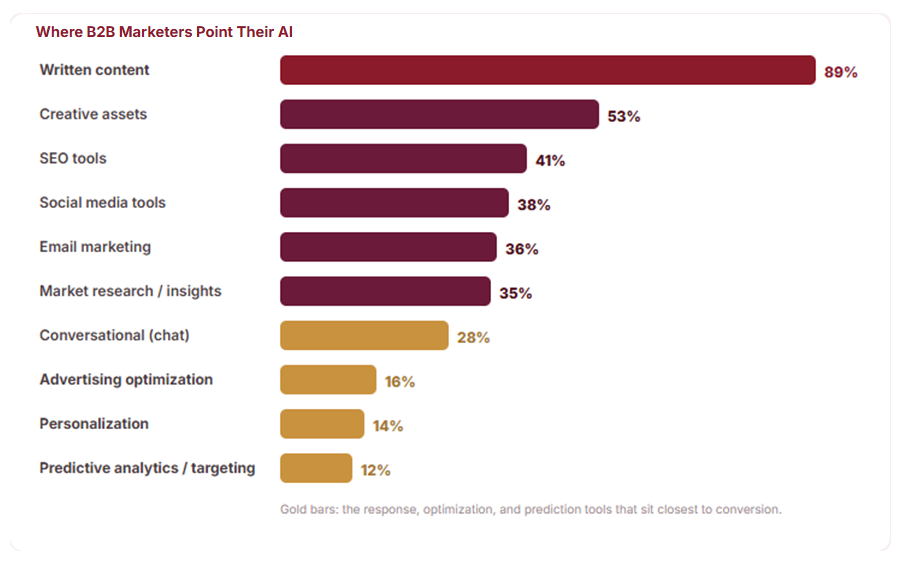
The Content Marketing Institute and MarketingProfs surveyed 1,015 B2B marketers, mostly in North America, between June and August 2025, and published the results in October 2025. Of those, 95% said their organizations use AI-powered applications, and AI tools for generating or optimizing written content were the most common application, cited by 89%. Nearly half of respondents (46%) work at companies with fewer than 100 employees, so this is not only an enterprise story. Because CMI surveys B2B marketers, consumer-facing businesses may see different results.
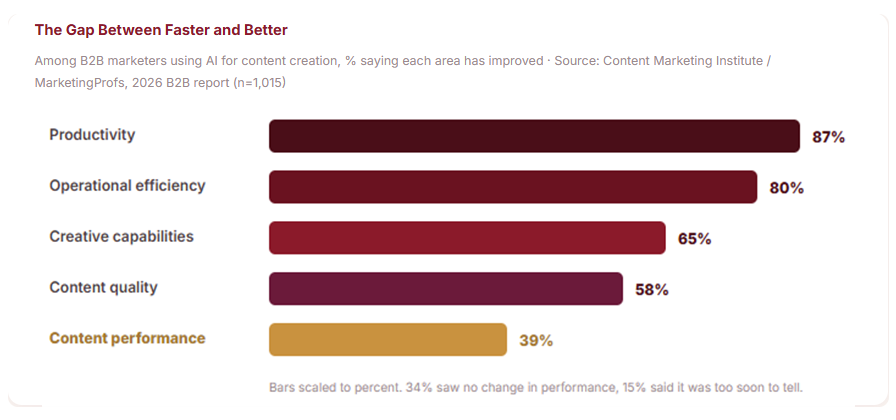
Among marketers using AI for content creation, 87% said productivity improved, and 80% said operational efficiency improved. The numbers fall as the measures get closer to results: 65% said creative capabilities improved, 58% said content quality improved (while 12% said it got worse), and 39% said content performance improved. For performance, 34% reported no change, 5% a decrease, 7% were unsure, and 15% said it was too soon to tell. CMI’s own summary of the pattern is that, for the most part, “AI helps marketers type faster, not think better.”
The same survey shows where the 2026 money is heading. When asked which top-three areas they planned to increase, 45% named AI-powered marketing tools, the most common answer. Only 9% named human resources, meaning salaries, training, and development, the last item on the list. Yet when marketing teams that rated themselves effective explained what moved the needle, more than half pointed to content relevance and quality (65%) and team skills and capabilities (53%). Self-reported survey data has limits, and these results may improve as teams mature, since 68% say they are still exploring or developing their AI approach.
The gap, among AI content users: productivity improved 87% · operational efficiency 80% · creative capabilities 65% · content quality 58% · content performance 39%
The reading that matters: speed is real, and worth having. But when an AI tool makes every draft faster, the scarce thing is no longer words. It is something worth saying, and a way to tell whether saying it worked.
What Google Means by “Commodity Content”
Google Search Central’s guide to optimizing for generative AI features, last updated July 10, 2026, says traditional SEO best practices still apply for their results on Gemini because its AI features are built on its core ranking and quality systems. It also says that creating unique, compelling, and useful content will likely influence your presence in generative AI search over the long run more than any other suggestion in the guide.
The guide draws a line between commodity and non-commodity content. Commodity content is based on common knowledge that could come from anyone and adds little unique insight. Non-commodity content offers an expert or first-hand take that goes beyond the ordinary. Google’s example contrasts a generic list of tips for first-time homebuyers with a first-person account of waiving an inspection and saving money, including a look inside the sewer line. The guide also tells site owners not to recycle what others have already said, or what a generative AI model could easily produce.
Google’s separate guidance on AI-generated content, last updated October 1, 2026, adds the guardrails. Generative AI can be useful for researching a topic and adding structure to original content. Using it to generate many pages without adding value for users may violate Google’s spam policy on scaled content abuse. And because generative models predict likely words rather than retrieve facts, Google calls it critical to manually fact-check and review all AI-generated content before publishing, including title elements, meta descriptions, structured data, and image alt text.
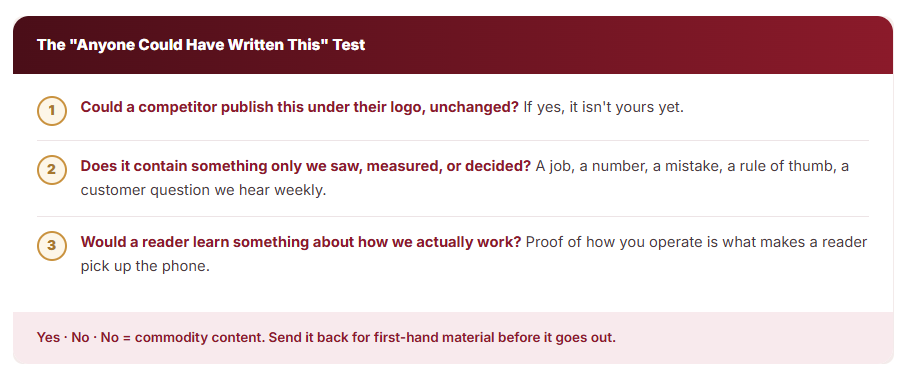
Those two documents suggest a simple test, which is our own working method rather than a Google rule. Before publishing anything AI helped you write, ask the three questions below. If the answers come back yes, no, no, the piece is commodity content, and the fix is a better input, not a better prompt.
The Marketing Loop:
Seven Places AI Automation Lives
Most owners hear “marketing automation” and picture a content machine. A marketing function actually has seven places where automation can pay off: six stages that form a loop, plus one outward-facing stage that keeps you visible to search engines and AI platforms. McKinsey’s 2026 State of AI survey found that respondents most often attribute AI-driven revenue gains to marketing and sales, so this is a function where getting the sequence right matters.
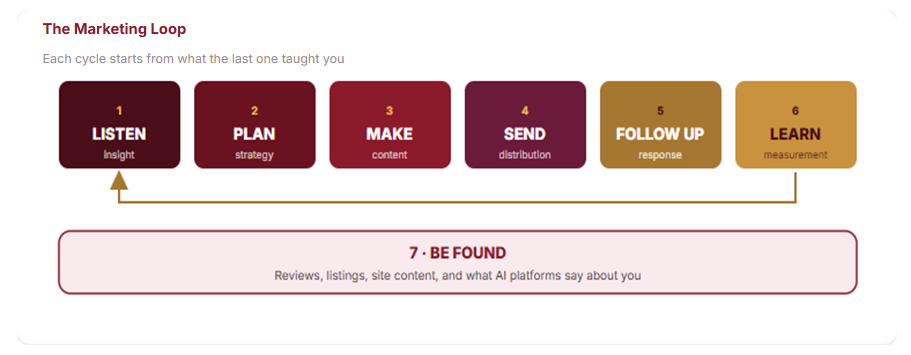
Each stage below gets a definition, what AI can automate, what should stay human, and a suggested starting level from the Autonomy Ladder in our pillar article, Mastering AI Automation for LLM Success. Level 1 means AI drafts and a person decides. Level 2 means fixed steps run automatically, with people reviewing exceptions. The starting levels are MMG working guidance, not research findings.
Which Stage First?
Seven stages is too many to start at once. The three-question score from our pillar article works here too: rate each stage on Pain (what it costs you each month), Ruler (whether you already measure it), and Risk (how bad a mistake would be), and start where Pain and Ruler are high and Risk is low. For many businesses that points to Follow Up, because response time is easy to measure and a slow reply is costly, or to Listen, because summarizing what customers already said carries little risk.
The Follow Up evidence is dated but instructive. In the same 2011 Harvard Business Review work, researchers audited 2,241 US companies by sending each a web-generated test lead. Only 37% responded within an hour, 24% took more than a day, and 23% never responded at all. The study is 15 years old, so treat the numbers as direction rather than a benchmark for today. The point stands that response speed is a marketing outcome you can automate and measure.

In the Age of AI
You Gain the Advantage over Those Who Don't Step Up
6 Best Practices for Marketing & Content Automation
Little-Known Gems
The Perspective Shift
Automate the typing. Protect the knowing. The question isn’t how much of your marketing you can hand to AI. It’s how much of what you know is making it into your marketing.
Nearly every B2B competitor already has a tool that drafts a decent article in seconds, since 95% of marketers in CMI’s survey say their organizations use AI. The businesses that stand out will be the ones whose articles contain something only they could have said, and whose phones get answered while the interest is still warm. Both of those are choices made by people, and neither can be purchased as a subscription.
Bottom Line: Let’s Find Your Four-Minute Voice Memo
You don’t need to rebuild your marketing to begin. You need one honest look at which of the seven stages is costing you the most, and one conversation about what your people know that your marketing isn’t saying yet.
MediaBus Marketing Group helps business owners and executives decide where marketing automation belongs…
Capture the first-hand knowledge that makes content worth reading, and build the response and reporting systems that turn attention into customers.
Tell us where your marketing stands today, and we’ll help you see what comes first.
📞 · Connect with Us Below · ✉
AI Marketing Automation FAQs
Q1: Is it acceptable to use AI to write our marketing content?
Yes, with conditions. Google’s guidance says generative AI can be useful for researching a topic and adding structure to original content, but using it to generate many pages without adding value for users may violate its spam policy on scaled content abuse. Google also says it is critical to manually fact-check and review AI-generated content before publishing, including titles, meta descriptions, structured data, and image alt text. In practice, that means using AI to draft from your own first-hand material and having a person verify the result before it goes out.
Q2: What should we automate first in our marketing?
Score the seven stages (Listen, Plan, Make, Send, Follow Up, Learn, Be Found) on Pain, Ruler, and Risk, and start where Pain and Ruler are high, and Risk is low. Pain is what the stage costs you each month, Ruler is whether you already measure it, and Risk is how damaging a mistake would be. For many businesses, Follow Up is a strong first choice because response time is easy to measure, and Listen is a low-risk one because summarizing what customers already said doesn’t publish anything. Content production, the stage most teams automate first, can be the least differentiating place to start.
Q3: How do we keep AI-assisted content from sounding like everyone else’s?
Change the input rather than the prompt. Feed the AI material only your business has, such as a supervisor’s voice memo, a recorded sales call, project notes, or customer questions you hear every week, and then edit the result with the person who knows the subject. Before publishing, run the “Anyone Could Have Written This” test: could a competitor post it under their logo unchanged, does it contain something only you saw or decided, and would a reader learn how you actually work? Google’s guidance on non-commodity content points the same way: first-hand, expert perspective matters more than volume.
Q4: Will AI-generated content hurt our Google visibility?
Google’s current guidance does not ban AI-assisted content, but it warns that generating many pages without adding value for users may violate its scaled content abuse policy. It also says that creating separate content for every query variation primarily to manipulate rankings or AI responses is a violation and an ineffective long-term strategy. Its guide to generative AI search says unique, useful content will likely matter more over time than any other tactic it describes. The risk comes from publishing volume without value, not from using AI to help produce something worth reading.
Q5: How do we know whether our marketing automation is working?
Measure outcomes rather than output. Before turning anything on, record a baseline for qualified conversations, response time to new inquiries, and cost per lead, then review the same numbers after 90 days. CMI’s survey found that among marketers using AI for content, 39% say performance improved while 22% say it’s too soon to tell or are unsure, which suggests many teams never set a baseline. For visibility in Google’s AI features, Google points site owners to the Generative AI performance report in Search Console. If a stage has no number attached to it, treat the result as unproven.
Action Items:
Sources Cited in This Article
All sources were read on October 3, 2026. Content Marketing Institute and MarketingProfs, “B2B Content and Marketing Trends: Insights for 2026” (published October 8, 2025; 1,015 B2B marketers, mostly North America; fielded June 24 to August 14, 2025; sponsored by Storyblok; self-reported survey data) · Google Search Central, “Optimizing your website for generative AI features on Google Search” (last updated July 10, 2026) · Google Search Central, “Google Search’s guidance on using generative AI content on your website” (last updated October 1, 2026) · Oldroyd, McElheran, and Elkington, “The Short Life of Online Sales Leads,” Harvard Business Review, March 2011 (audit of 2,241 US companies; separate study of 1.25 million leads at 29 B2C and 13 B2B US companies) · BrightLocal Local Consumer Review Survey 2026 (1,002 US adults) and its AI-focused report, March 2026 · McKinsey Global Survey, “The state of AI in 2026: On the road to ROI” (August 25, 2026).
SHARE THIS STORY ANYWHERE YOU LIKE
SHARE THIS STORY ANYWHERE

Mastering AI Automations for LLM Visibility and Reputation
Mastering AI Automation for LLM Visibility and Reputation Your AI reputation isn't a ranking. It's a rate. Ask [...]

Mastering AI Automation for Marketing and Content
Mastering AI Automation for Marketing and Content AI automated the typing. It didn't automate the knowing. Among B2B [...]

Mastering AI Automation for LLM Success
Mastering AI Automation for LLM Success Ten places AI automation lives in your business, and the three levels [...]