

From Invisible to Indespensable – Your Full Playbook Every Small Business Needs Right Now
Everything This Series Has Taught You, Unified Into One Sequenced, Actionable System — Built for the Small Business Owner Who Is Ready to Stop Planning and Start Compounding
WHAT YOU’LL FIND IN THIS ARTICLE
This is the penultimate article in the MMG AI Visibility Series — and the most important one. Every concept documented across this series has been building toward this moment: the moment where the individual elements stop being separate tactics and become a unified, compounding system. This article assembles the complete AI Visibility Strategy Framework — the exact sequence, the priority order, the metrics that confirm each layer is working, and the integration logic that makes the whole greater than the sum of its parts. Whether you have read every article in this series or arrived here first, this framework tells you exactly what to build, in what order, and how to know when it is working. Here is what is inside:
- Why a framework matters more than any individual tactic — the integration logic that creates compounding returns
- The Five-Layer AI Visibility Architecture — the complete system mapped from foundation to measurement
- Layer-by-layer implementation — the specific actions, the sequence, and the time investment for each
- The MMG Priority Matrix — what to do first, second, and third, given limited time and budget
- The measurement system — the complete dashboard of metrics that confirms the strategy is compounding
- The 90-day execution calendar — week-by-week for the first quarter
- The compounding model — how each layer accelerates every other layer over time
- The single most important insight that makes the difference between businesses that build AI authority and those that do not
THE PROBLEM WITH TACTICS WITHOUT A FRAMEWORK
Here’s how it usually goes when a business owner or the founder of a company discover the Getting Eyes on Site has changed to that of LLM AI visibility.
They read an article about GEO (Generative Engine Optimization). Usually, just covers the surface-level issues. They restructured a few content pieces. They check if ChatGPT mentions them — when it does not — and they move on, concluding either that the work does not help or that the problem is too complex to address.
They are not wrong that individual tactics in isolation produce mediocre results. They are wrong about the conclusion they derive from such lackluster efforts.
Companies are recognizing the urgency — 69% of CMOs and CEOs now say AI visibility is a top priority for 2026. The solution is not to chase traffic that no longer aligns with buyer preferences. Marketers must rebuild the revenue engine around visibility, not clicks. Forrester
The businesses building durable AI visibility are not the ones that applied the best individual tactic. They are the ones that built a system: a set of interlocking layers, each one reinforcing every other, each one building the authority that makes the next layer more effective than it would be on its own.
This article showcases that system. Every element from every article in this series is assembled into the framework that makes each one compound.
The craftsman who masters one tool and one tool alone builds limited things. The craftsman who understands how each tool relates to every other — which must come first, which sharpens the edge of the one that follows — builds things of lasting value. This framework is the understanding of how the tools relate.
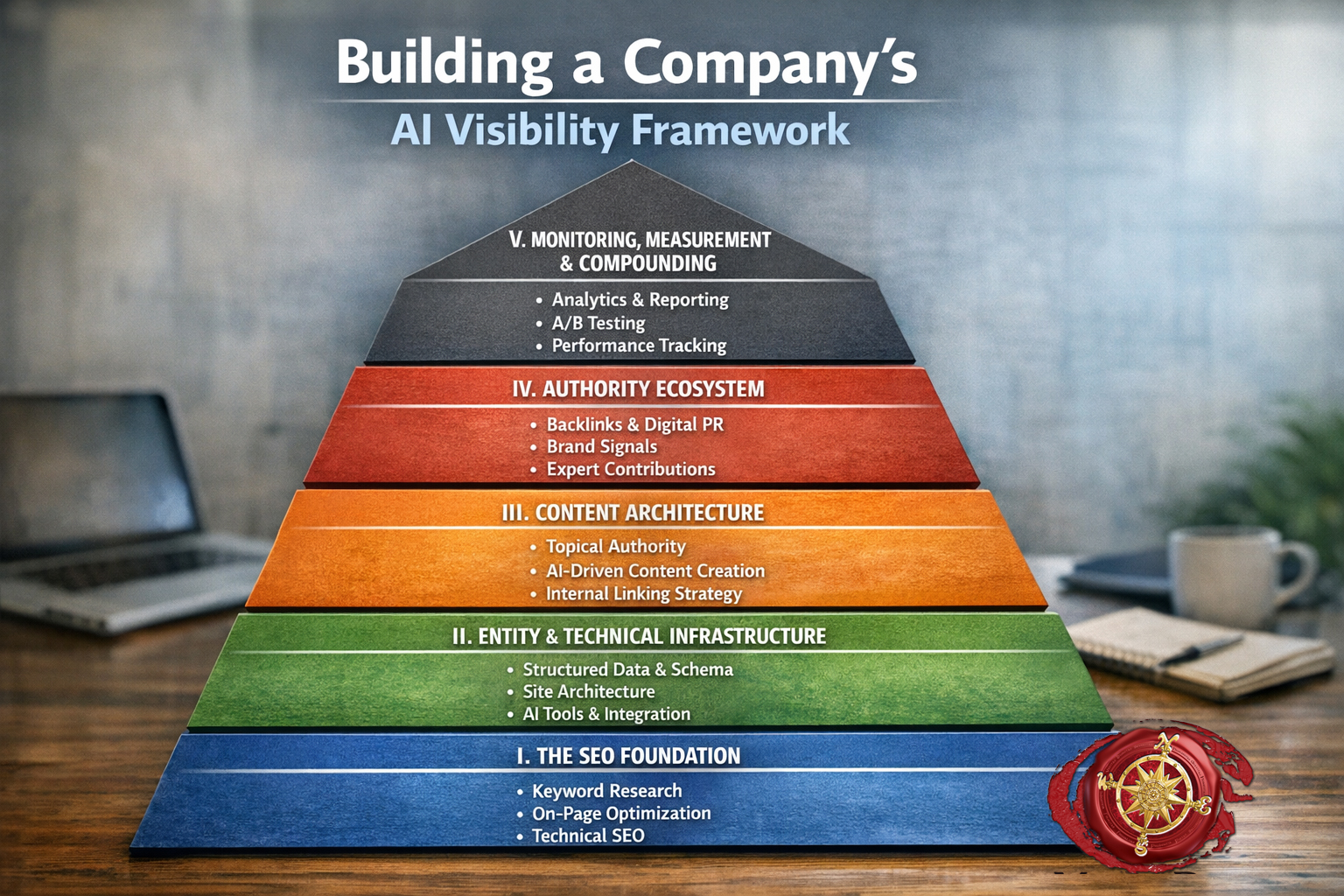
THE FIVE-LAYER AI VISIBILITY ARCHITECTURE
Before the implementation details, the architecture. Five layers. Each one is a prerequisite to the one above it. Each one, once built, makes every subsequent layer more effective.
Track Brand Visibility Score, Share of Model,

GA4 AI Traffic, monthly prompt audit.

Uses everything below it to optimize.Third-party mentions, press releases,
review volume, community presence.
Makes Layers 1-3 more credible to AI.GEO-structured articles, FAQ libraries,
brand-embedded content, freshness protocol.
Gives AI crawlers content worth citing.robots.txt, schema, SSR, entity consistency,
Google + Bing submission, IndexNow.
Ensures AI can find, access, and recognize you.Technical health, domain authority,
page speed, mobile optimization, indexation.
The prerequisite for everything above.The architecture rule: You cannot skip layers. A business with excellent GEO content architecture and no SEO foundation will be invisible to the Google-fed systems that power Gemini and ChatGPT’s web search. A business with perfect technical infrastructure and no authority ecosystem will fail the credibility test that determines whether AI systems recommend it confidently. Build in sequence. Each layer earns the right to build the next one.
In the Age of AI
You Gain the Advantage over Those Who Don't Step Up
HERE WE GO, LET’S START BUILDING
The MMG Priority Matrix- What To Do When You Cannot Do Everything
Most small businesses cannot execute all five layers simultaneously. This matrix tells you exactly what to prioritize given different starting conditions.
If you are starting from zero:
Week 1-2: robots.txt configuration + Cloudflare check + Google/Bing sitemap submission (Layer 2 emergency)
Week 3-4: Index top five existing articles for GEO compliance — add answer-first openings, FAQ sections, schema markup (Layer 3 quick wins)
Month 2: Complete entity consistency audit — same name/description everywhere (Layer 2 entity)
Month 2-3: First press release for next milestone (Layer 4 earned media)
Month 3: Set up GA4 AI Traffic Channel and run baseline prompt audit (Layer 5)
If you have existing SEO momentum:
You have Layer 1. Your priority is Layers 2 and 3 simultaneously, then Layer 4 aggressively.
Week 1: robots.txt + JavaScript render test + Schema implementation (Layer 2)
Week 2-3: Retrofit your ten highest-traffic articles to GEO standard (Layer 3)
Month 2: FAQ library of twenty entries minimum with FAQPage schema (Layer 3)
Month 2-3: First press release + first trade publication pitch (Layer 4)
Month 3: Measurement dashboard live (Layer 5)
If you have a budget for acceleration:
Invest in two things: a content sprint (produce twelve to fifteen GEO-structured articles across your topical authority map in sixty days) and a third-party mention building program (press release distribution through recognized newswire + trade publication outreach). These two investments compound faster than anything else in the framework.
THE 90-DAY EXECUTION CALENDAR
THE COMPOUNDING MODEL — WHY THIS BUILDS FASTER THAN IT STARTS
Here is the mechanism that makes this framework worth the investment, and why starting sooner produces outcomes disproportionately better than starting later.
Month 1: robots.txt opens the door. AI crawlers begin accessing content they were blocked from. Citation frequency begins improving for existing GEO-ready content.
Month 2: Retrofitted articles begin appearing in AI retrieval pools. FAQ library entries begin being extracted as citation units. Press release creates hundreds of third-party corroboration events simultaneously.
Month 3: Entity recognition strengthens as AI systems encounter your business name in more authoritative contexts. The co-occurrence pattern begins — AI learns to associate your brand with your category from accumulated signals.
Month 4-6: Third-party mention record grows. AI systems encounter your name in earned media, review platforms, industry publications, and community forums — the sources they weigh most heavily for recommendation confidence. Citation frequency accelerates because the entity recognition, the content extractability, and the third-party authority all reinforce each other simultaneously.
Months 6-12: Compounding becomes visible in the metrics. Brand Visibility Score climbs. GA4 AI Traffic Channel shows month-over-month growth. Branded search volume trends upward. The competitive gap between your AI visibility and competitors who have not built the framework widens with every passing month.
Businesses that master GEO today are building a 3- to 5-year sustainable competitive advantage over their competitors, as the learning curve and the accumulation of historical data create significant barriers to entry.
The businesses that build the framework now are not just twelve months ahead of those who start later. They are building an authority asset whose compounding curve makes the gap harder to close over time, regardless of budget.
THE SINGLE MOST IMPORTANT INSIGHT IN THE ENTIRE SERIES
Everything in this playbook framework — every technical configuration, every structured article, every press release, every entity record — is in service of one thing.
The AI system’s confidence in recommending you.
Not your rankings. Not your traffic. Not your click-through rates. The AI’s confidence.
When a buyer asks ChatGPT who the best consultant in your category is, the AI does not run a Google search. It reaches into everything it knows — its training data, its retrieval index, its knowledge of which brands have been mentioned most frequently and most authoritatively across the most trusted sources — and synthesizes a recommendation.
The businesses it recommends confidently are the businesses it has encountered repeatedly, consistently, and authoritatively. The businesses it hedges on or omits are the ones it has encountered infrequently, inconsistently, or only through self-promotional sources.
AI doesn’t guess. It references the businesses it understands clearly, consistently, and repeatedly. The process of building AI visibility is the process of becoming a business that AI systems understand clearly, consistently, and repeatedly.
That is what this framework builds. Layer by layer. Month by month. With each press release, each GEO-structured article, each FAQ entry, each review, each entity record — you are making one more deposit into the authority account that AI systems draw from when they decide who to name.
The businesses that understand this are not optimizing for AI. They are building something genuinely worth recommending — and then ensuring the infrastructure exists for AI systems to recognize and surface that value.
That is not a tactic. That is a Full LLM Visibility Roadmap.
THE BOTTOM LINE
You have read the complete series. You understand the shift. You know the tools. You have the framework.
There is only one thing left…
Execution.
With 98% of companies using AI seeing a measurable ROI, the time for observation is over. 2026 is the year of execution. Not perfect execution. Not fully-resourced execution. Not execution that waits for certainty before it begins.
Just the next action. The robots.txt check you can do in ten minutes. The Bing Webmaster Tools account can be set up in five. The first article you can read this afternoon. The first press release you can write when your next milestone occurs.
The framework compounds from the first action. Not from the moment the strategy is complete. From the moment the first action is taken.
There is an ancient law that governs all progress: the seed does not become a tree by waiting for the perfect season. It becomes a tree by being planted. By surviving the first frost. By drawing water from wherever water can be found. And then — slowly at first, then unmistakably — by growing into something that cannot be missed.
Plant the seed. The growth is not optional. The planting is.
At MediaBus Marketing Group, we have spent twenty-five years helping businesses in regional markets build the kind of presence that compounds — first in traditional SEO, now in the AI visibility layer that is becoming the primary surface through which buyers discover and choose the businesses they trust.
We build the complete five-layer framework for our clients — from the technical foundation through the authority ecosystem — with the measurement discipline that connects every action to its outcome and every outcome to the revenue it produces.
Because your success is exactly how we measure ours.
Let us map your current position across all five layers of the AI Visibility Architecture — identify exactly where the gaps are, what the priority sequence is for your specific business and market, and build the program that starts compounding from day one.
This is not a marketing engagement. This is the infrastructure investment that determines how your business gets found, evaluated, and chosen for the next decade.
The framework is here. The window is open. The only question is when you begin.
AI VISIBILITY FAQs
FAQ 1 — What is the AI Visibility Strategy Framework, and how does it differ from a standard SEO strategy?
The AI Visibility Strategy Framework that we at MMG have set out is a five-layer system for building compounding authority across the specific signals that AI systems use to identify, recognize, and recommend businesses. It differs from a standard SEO strategy in scope, objective, and mechanism.
A standard SEO strategy optimizes your website to rank in a list of search results. It focuses on keyword targeting, backlink acquisition, and page-level technical optimization. Success is measured in rankings and organic traffic. The framework operates at the page level. What does this page rank for?
The AI Visibility Strategy Framework operates at the entity level, i.e., does AI know who this business is, trust its authority, and have sufficient corroboration from third-party sources to recommend it confidently? It spans five layers: the SEO foundation that AI systems use as a credibility proxy, the entity and technical infrastructure that ensures AI crawlers can access and recognize the business, the GEO-structured content architecture that makes content extractable and citable at the passage level, the authority ecosystem of third-party earned media and community presence that drives the 89% of AI citations that come from sources other than the business’s own website, and the measurement system that tracks Brand Visibility Score, Share of Model, and AI-referred traffic.
The most significant structural difference: SEO is primarily an owned-media discipline. You optimize your own website. AI visibility is fundamentally a cross-web discipline — the majority of the signals that determine whether AI recommends you confidently originate outside your website in third-party sources you must build relationships with and earn placements in. The framework addresses both.
FAQ 2 — In what sequence should a small business implement the five layers of the AI Visibility Framework?
The sequence is non-negotiable for efficiency, though the layers overlap and reinforce each other.
Layer 1 first — the SEO foundation — because every AI platform that draws from Google’s index (which includes Gemini, Microsoft Copilot, and ChatGPT’s web search) uses Google rankings as a primary credibility signal. Research confirms that 43.2% of pages ranking number one in Google are cited by ChatGPT — 3.5 times higher than pages ranking outside Google’s top 20. No amount of GEO work compensates for a technically broken website that Google does not index properly.
Layer 2, second — entity and technical foundation — because access is a prerequisite to citation. If AI crawlers are blocked by your robots.txt configuration (which Cloudflare’s default settings may have caused automatically without your knowledge), the best content in your industry sits invisible to the retrieval systems that power AI recommendations. This layer must be completed before any content or authority work produces AI visibility results.
Layer 3 third — content architecture — because accessible, unoptimized content is not much better than inaccessible content for AI retrieval purposes. GEO-structured content that passes the Island Test, uses answer-first architecture, and includes FAQ schema with statistics generates citations. Generic, well-SEO’d content that lacks these specific structural elements gets retrieved by AI crawlers and not cited.
Layer 4 fourth — authority ecosystem — because content without third-party corroboration is trusted less than content with it. The authority ecosystem layer (press releases, trade publications, reviews, community presence) builds the external credibility signals that make AI systems confident enough to recommend you rather than hedging or omitting you.
Layer 5 ongoing from Month 3 — measurement — because without measurement, optimization is impossible. The metrics in Layer 5 (Brand Visibility Score, Share of Model, GA4 AI Traffic Channel, branded search volume, content freshness index) provide the feedback loop that tells you what is working and where to invest more.
FAQ 3 — What are the most common mistakes businesses make when building an AI visibility strategy?
Five mistakes account for the majority of AI visibility failures for small businesses.
The first and most common mistake is skipping the technical infrastructure check. Businesses assume their website is accessible to AI crawlers and invest weeks building GEO-structured content — while Cloudflare silently blocks every AI crawler from their site. Check yourdomain.com/robots.txt and your Cloudflare settings before investing any time in content or authority work.
The second mistake is investing exclusively in owned content while ignoring the authority ecosystem. Websites are 23% of the AI’s picture of a business. The other 77% comes from third-party sources. Businesses that produce excellent GEO content on their own websites without building earned media placements, review volume, and trade publication presence have built a strong foundation with nothing above it.
The third mistake is treating GPTBot and OAI-SearchBot as the same thing. GPTBot collects training data with a 1,255:1 crawl-to-refer ratio and no citation benefit. OAI-SearchBot powers ChatGPT search citations. They are completely separate bots. Businesses that block all OpenAI crawlers for content protection reasons accidentally eliminate their ChatGPT search visibility. Block training crawlers. Explicitly allow search and user-action crawlers.
The fourth mistake is writing GEO content without brand embedding. The Ghost Citation problem — where AI uses your content as a reference source while naming competitors in the recommendation — occurs when content provides insights without attributing them to your business. Every piece of GEO content must embed your brand name explicitly alongside your category throughout the body, not just in headings and author attribution.
The fifth mistake is measuring with the wrong metrics. Businesses that evaluate their AI visibility investment only through GA4 referral sessions are measuring approximately 20% of ChatGPT’s actual recommendation influence — the fraction that includes clickable links. The other 80% of AI mentions influence buyer decisions without generating trackable clicks. Brand Visibility Score from monthly prompt audits and branded search volume trends together capture a more complete picture of what the strategy is actually producing.
FAQ 4 — How long does it take to see measurable results from an AI visibility strategy, and what should I expect at each stage?
The timeline is predictable because the mechanism is knowable. Each layer produces specific outcomes at specific timeframes — and the compounding begins from the first action, not from the moment the strategy is complete, via MediaBus Marketing’s direction.
Days one through thirty — emergency configuration results: correcting robots.txt and Cloudflare settings typically produces measurable improvement in AI crawler visits within forty-eight hours, visible in server logs. Existing GEO-structured content that was previously blocked may begin appearing in AI search citations within days of opening access. This is the highest-leverage intervention available at any stage — completely free, takes one afternoon, and can immediately unlock citation potential that was being blocked.
Days thirty through ninety — content and entity results: retrofitted articles begin appearing in AI retrieval pools. FAQ library entries begin being extracted as citation units. First press release creates hundreds of third-party corroboration events simultaneously. AI systems begin encountering your entity information in a consistent, cross-platform format. Initial Brand Visibility Score improvements are typically measurable within sixty days of implementing Layers 2 and 3.
Months three through six — authority ecosystem results: the third-party mention record grows. AI systems encounter your business name in earned media, review platforms, and industry publications — the sources they weigh most heavily for recommendation confidence. Citation frequency begins accelerating because entity recognition, content extractability, and third-party authority reinforce each other simultaneously. Share of Model gains against competitors who have not built the framework becomes visible.
Months six through twelve — compounding: all five layers are operating. The framework compounds. Each new piece of GEO content builds on stronger entity recognition. Each new press release builds on a growing earned media record. Brand Visibility Score improvements become consistent and measurable. GA4 AI Traffic Channel shows month-over-month growth. The competitive gap widens with every business that has not started.
FAQ 5 — What metrics should I track to know whether my AI visibility strategy is working?
Six metrics constitute the complete AI visibility measurement dashboard. Each one captures a different dimension of performance that the others cannot replicate.
Brand Visibility Score (BVS) is the primary metric: the percentage of standardized prompts in which your business appears, tested monthly across all five major AI platforms using identical prompts. A 10% or more quarter-over-quarter improvement confirms the program is compounding. BVS measures the frequency dimension — how often you appear when relevant questions are asked.
Share of Model (SoM) provides the competitive context: your brand’s percentage of total category citations compared to your three primary competitors, measured from the same monthly prompt audit. SoM moving upward means you are gaining AI recommendation share from competitors regardless of your absolute BVS number. A rising BVS with falling SoM means your market is growing faster than your share of it.
GA4 AI Traffic Channel captures the measurable revenue signal: sessions, engaged sessions, and conversions from chatgpt.com, perplexity.ai, gemini.google.com, claude.ai, and grok.com as a custom channel grouping. This captures the 20% of AI mentions that include clickable citations and provides a floor measurement of AI-influenced revenue. Growing month over month confirms the program is producing traffic of the highest intent quality.
Branded search volume trend provides the zero-click attribution bridge: buyers who receive your name in an AI response and then search your brand name produce branded organic sessions attributable to AI influence that GA4 will never attribute to AI directly. Rising branded search volume alongside rising AI Traffic Channel sessions confirms that AI recommendations are influencing buyers who never click a citation link.
Content freshness index tracks the percentage of your top twenty pillar content pieces updated within the past ninety days. AI citation systems favor fresh content — pages more than fourteen days old without updates show a 23% decline in citation frequency. A freshness index below 80% is a signal to accelerate your content maintenance cadence.
AI citation accuracy monitors not just whether you appear but how accurately you are described. Run the Direct Brand Query prompt monthly, specifically to audit whether the AI’s description of your business matches your current positioning, services, and credentials. Inaccurate AI descriptions — which originate from outdated content, inconsistent directory information, or unaddressed misinformation — damage your recommendation quality even as citation frequency increases.
Action Items:
SHARE THIS STORY ANYWHERE YOU LIKE
SHARE THIS STORY ANYWHERE
Mastering AI Automations for LLM Visibility and Reputation
Mastering AI Automation for LLM Visibility and Reputation Your AI reputation isn't a ranking. It's a rate. Ask [...]
Mastering AI Automation for Marketing and Content
Mastering AI Automation for Marketing and Content AI automated the typing. It didn't automate the knowing. Among B2B [...]
Mastering AI Automation for LLM Success
Mastering AI Automation for LLM Success Ten places AI automation lives in your business, and the three levels [...]