

Mastering AI Automation for Customer Service and Support
Build the exit before you build the bot.
Customers aren’t against AI in customer service. They’re against being trapped by it. In Gartner’s 2026 survey, half said interactions are easier when companies use GenAI, and 87% said an option to reach a human is essential. This is a map of seven places AI can automate your support, and the one feature that decides whether it helps or hurts: the way out.
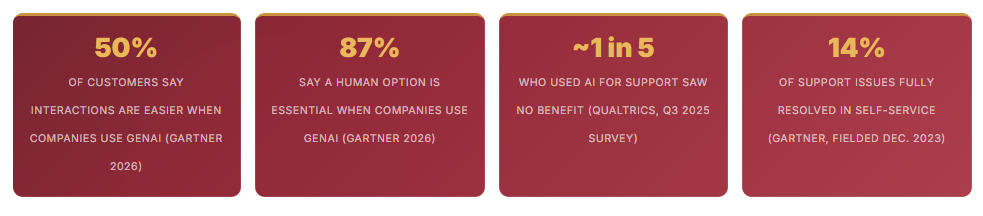
At a glance: 50% of customers say interactions are easier when companies use GenAI (Gartner 2026) · 87% say a human option is essential when companies use GenAI (Gartner 2026) · ~1 in 5 who used AI for support saw no benefit (Qualtrics, Q3 2025 survey) · 14% of support issues fully resolved in self-service (Gartner, fielded Dec. 2023)
What You’ll Find in This Article
- A story about a retailer whose chatbot was “handling” most chats while customers quietly stopped trying
- What customers actually say about AI support: they aren’t against AI, they’re against dead ends, and what Gartner and Qualtrics found
- Why “deflection” is the wrong scoreboard, and what to measure instead
- Two real cases: Klarna’s AI assistant and its sequel, and the Air Canada ruling on who is responsible for what a bot says
- The Support Map: seven places AI automation lives in customer service (Answer, Act, Triage, Hand Off, Assist, Wrap Up, Learn), each with what to automate, what to keep human, and where to start
- The launch checklist: six questions to answer before any customer-facing AI goes live, including Utah’s disclosure rules
- Six best practices, five little-known gems, and a direct next step
The Dashboard Said “Handled.” The Customer Was Gone.
An Online Retailer of Specialty Outdoor Gear
The owner of an online retailer launched a support chatbot and checked the dashboard every morning. Most chats, it said, were “handled without an agent.” He counted that as a win. Then his operations manager did something he hadn’t: she read a week of transcripts. At 2 a.m. one night, a customer wrote that her order was marked delivered but wasn’t on her porch. The bot sent her the shipping policy. She typed “agent.” The bot offered the shipping policy again. She typed “agent” a third time, got the policy a third time, and closed the window. She never contacted the company again. As far as the dashboard was concerned, that chat was a success.
The firm changed three things. The bot now answered order-status questions from the live order system instead of from a policy page. Certain words and situations, such as “agent,” “not delivered,” or a third failed answer, sent the customer straight to a person’s queue with the whole conversation attached, and the customer was told when a human would reply. And the owner changed his scoreboard: from “chats handled without an agent” to “problems that didn’t come back” and “minutes until a person”. The bot wasn’t the problem. The missing exit was.
AI can answer a great many customer questions well. But every automated system will meet a customer it can’t help, and the quality of your support is decided at that moment. The businesses getting this right design for failure first.
Customers Aren’t Against AI. They’re Against Being Trapped.
A release of a study from Gartner’s July 2024, based on a survey of 5,728 customers fielded in December 2023, found that 64% would prefer companies didn’t use AI in customer service and 53% would consider switching to a competitor if they learned a company planned to. The top concern was that AI would make it harder to reach a person. If that were the whole story, the lesson would be “don’t use AI.” It isn’t the whole story. And quite frankly, the times have changed, even in a mere short 2 years.
Gartner’s newer survey, of 3,566 B2B and B2C customers in February and March 2026, found a split worth noticing. Half of customers said their interactions are easier when companies use GenAI. Yet 87% said it is essential for a company to provide an option to reach a human agent when using GenAI. Among customers unwilling to engage with AI, the most common thing that might change their mind was the ability to switch to a human if needed.
Two findings from the same survey (Gartner, Feb–Mar 2026, n=3,566): interactions are easier when companies use GenAI 50% · a human option is essential when companies use GenAI 87%.
Gartner’s reporting analyst offered a design rule that fits those numbers: don’t make GenAI a mandatory first step for every issue. When customers are forced through several unsuccessful AI interactions before they can reach a person, they are less likely to use the tool again. GenAI works better when it collects information, understands what the customer wants, and attempts resolution only when it is confident, with a clear path to a person.
Gartner’s September 2026 release, drawn from the same 3,566-customer survey, adds a sobering gap. While 49% of customers said they would have been willing to use a chatbot if the company provided one, only 7% used a chatbot or digital assistant in their most recent service interaction. And only 27% said they would be willing to try a chatbot again after a negative experience. Gartner’s analyst describes this as a leaky-bucket problem: one unsuccessful interaction can discourage future use, even as the chatbot improves. His advice is to prioritize reliability over reach, start with targeted and well-tested deployments, and treat chatbots as connectors to human support rather than containment traps, passing along the information already collected.
Willing, actual, and the second chance (Gartner, n=3,566): willing to use a chatbot if provided 49% · actually used one in their most recent interaction 7% · would try one again after a negative experience 27%.
Gartner also found many customers bypassing company chatbots. In their most recent service interaction, customers were approximately three times more likely to use third-party GenAI tools such as ChatGPT, Gemini, or Copilot than a company-provided chatbot. And Gartner found that 58% of customers who use GenAI have used it to complete a task on their behalf, rising to 74% in B2B. Customers want AI that does things, not only AI that answers.
Qualtrics’ 2026 Consumer Experience Trends Report, based on a Q3 2025 survey of 20,001 consumers in 14 countries, found that nearly one in five people who had used AI for customer service saw no benefit from it, a failure rate almost four times higher than for AI use in general. Qualtrics’ report author said too many companies are deploying AI to cut costs rather than to solve problems, and that customers can tell the difference.
The reading that matters: customers will use AI support that helps and leaves a way out. They resist AI that blocks the way to a person. Those are two different products built from the same technology.
Even from these dismal numbers for Customer Service and Chatbots, it points to one main thing… the training of these chatbots, the access to unique information on the subjects people are asking about, and having the guides in their programming for escalation are missing and delinquent. We at MediaBus Marketing truly know what it means when first impressions are everything, and that is why we train those chatbots, AI receptionists, and any inbound communications to be as intuitive and natural as can be done with Generative AI.
“Deflection” Is a Scoreboard That Lies
In the areas of Monitoring and Measuring, the state of Deflection counts the customers who didn’t reach your people. Resolution counts the customers whose problem was actually solved. They sound similar; however, they diverge sharply. Gartner’s August 2024 release found that only 14% of customer service and support issues are fully resolved in self-service, and even for issues customers described as “very simple,” only 36% are fully resolved there. Meanwhile, 73% of customers use self-service at some point in their journey. Most try it. Few finish there. The Satisfaction Factor is not meeting the levels you may want it to.
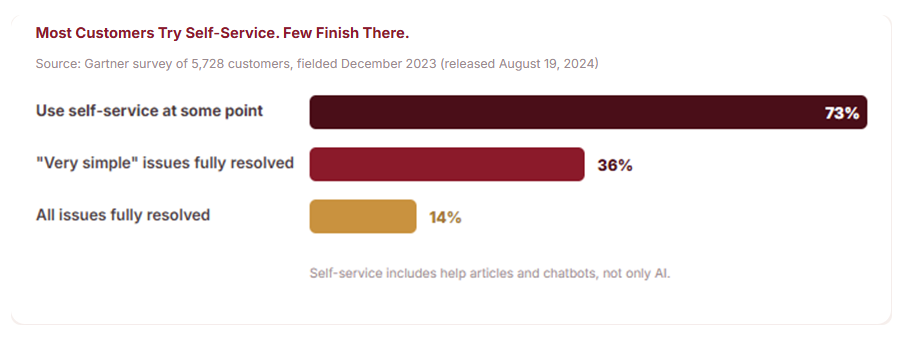
Most customers try self-service. Few finish there (Gartner, n=5,728, fielded Dec. 2023): use self-service at some point 73% · “very simple” issues fully resolved 36% · all issues fully resolved 14%. (Self-service includes help articles and chatbots, not only AI.)
This is why the scoreboard matters. The proper definitions are given. The correct training is included. If you count a chat as a success whenever no agent joined it, then the customer who gave up looks identical to the customer who got an answer. Qualtrics found that only 29% of customers communicate directly with the organization after a bad experience, down 7.5 points since 2021, and that 30% say nothing at all, up nine points. In the same survey, 34% of consumers said they reduce their spending with a company after a negative experience, and 13% cut it entirely. Your transcripts and surveys capture a slice of the unhappy customers, not all of them.
A better scoreboard counts what customers experience: whether the problem came back, how long it took to reach a person when one was needed, and how satisfied people were along each path (bot only, bot then person, person only). Those measures are our working guidance, not research findings, but they point to the thing that deflection hides.
Two Real Cases Worth Studying

In the Age of AI
You Gain the Advantage over Those Who Don't Step Up
The Support Map: Seven Places AI Automation Lives
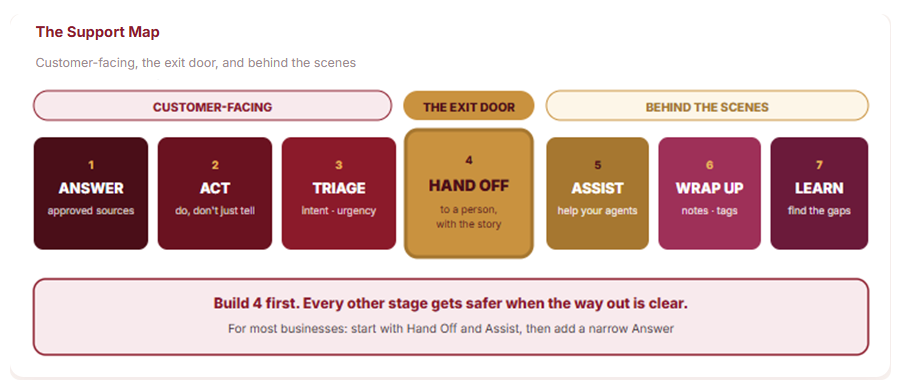
Customer service work breaks into seven places where automation can help. Three face the customer (Answer, Act, Triage). One is the exit door (Hand Off). Three work behind the scenes (Assist, Wrap Up, Learn). Each place below has a definition, evidence where we have it, what AI can automate, what should stay human, and a suggested starting level from the Autonomy Ladder in our pillar article, Mastering AI Automation for LLM Success. Level 1 means AI drafts and a person decides. Level 2 means fixed steps run automatically, with people reviewing exceptions. The starting levels are MMG working guidance, not research findings.
What You Own: The Launch Checklist
A customer-facing AI speaks for your business, so the business is answerable for what it says. Utah’s SB 226, effective May 7, 2025, states that it is not a defense to a violation of a statute enforced by the Division of Consumer Protection that generative AI made the violative statement, undertook the violative act, or was used in furthering the violation. The Division can impose administrative fines of up to $2,500 per violation.
The same law requires a supplier using generative AI in a consumer transaction to disclose that the person is interacting with AI, not a human, if the person clearly and unambiguously asks. A safe harbor applies if the AI itself clearly and conspicuously discloses, at the outset and throughout the interaction, that it is generative AI, not human, or an AI assistant. The law defines generative AI as technology designed to simulate human conversation that generates non-scripted outputs with limited or no human oversight, so whether a particular tool qualifies is a question for counsel. Professionals in regulated, licensed occupations face stricter disclosure for “high-risk” interactions, such as those involving sensitive financial, health, or biometric data, or financial, legal, medical, or mental health advice.
Financial services firms have a further reference point. The CFPB’s 2023 issue spotlight warned that chatbots can give inaccurate information and trap customers in loops without an off-ramp, and the agency’s accompanying blog said that providing customers with inaccurate information can be an unfair, deceptive, or abusive practice. That report is from 2023, and enforcement priorities change, so treat it as a statement of risk, not current policy. If you use AI to place outbound calls, the consent rules we cover in our sales follow-up article apply.
The Launch Checklist: 6 Questions Before Any Customer-Facing AI Goes Live
6 Best Practices for Customer Service Automation
Little-Known Gems
The Perspective Shift
Judge your support AI at the moment it fails. A system that can answer ten thousand questions but can’t let a stuck customer through is not a support system. It’s a wall.
Your AI will be wrong sometimes, and a few customers will always need a person. That isn’t a flaw to be hidden. It’s the design problem to be solved first. The businesses that build a clear, fast, well-informed handoff will get the benefits of AI’s speed and memory, and keep the trust that the right human at the right moment creates.
Bottom Line: Let’s Find Where Your Customers Get Stuck
You don’t need to rebuild your support to begin. You need one honest look at how a customer gets from “this isn’t working” to a person who can help, and how many minutes that takes.
MediaBus Marketing Group helps business owners and executives map where customers get stuck…
Automate the answers, actions, and handoffs that can safely be automated, and keep a person in charge of the policies, the limits, and the exit.
Tell us where your support stands today, and we’ll help you see what to fix first.
📞 · Contact Us Using the Form Below · ✉
Customer Service & Support FAQs
Q1: Do customers actually want AI customer service?
Many are open to it, with conditions. In Gartner’s 2026 survey of 3,566 customers, 50% said interactions are easier when companies use GenAI, but 87% said it’s essential to provide an option to reach a human agent. An earlier Gartner survey, fielded in December 2023, found 64% would prefer companies didn’t use AI in service and 53% would consider switching, with difficulty reaching a person as the top concern. Gartner’s September 2026 release adds that only 27% would try a chatbot again after a negative experience. The consistent message is that AI is acceptable when it helps and doesn’t block access to people.
Q2: Is our business responsible for what our chatbot says?
Generally, yes. In Moffatt v. Air Canada (2024), a British Columbia tribunal rejected the airline’s argument that its chatbot was a separate legal entity, held that the airline was responsible for all information on its website, and found it hadn’t taken reasonable care to ensure the chatbot’s accuracy. That was a tribunal decision, not a court ruling. In Utah, SB 226 states that it is not a defense to a violation of a statute enforced by the Division of Consumer Protection that generative AI made the statement or took the action. This is general information, not legal advice.
Q3: Do we have to tell customers they’re talking to AI?
In Utah, a supplier using generative AI in a consumer transaction must disclose that the person is interacting with AI, not a human, if the person clearly and unambiguously asks. A safe harbor exists if the AI itself clearly and conspicuously discloses at the outset and throughout the interaction that it is AI. Professionals in regulated, licensed occupations face stricter requirements for high-risk interactions. The law’s definition of generative AI turns on non-scripted outputs with limited or no human oversight, and other state and federal rules may apply, so check with counsel. As a practice, disclosing proactively and always answering honestly when asked is the safest approach.
Q4: What should we automate first in customer service?
For most businesses, start with Hand Off and Assist. Hand Off (a clear, fast path to a person with the context attached) makes every other stage safer, and Assist (AI helping your agents) has the strongest evidence: in an NBER study of 5,179 agents at one firm, resolutions per hour rose 14% on average and 34% for the lowest-skill agents. Then add a narrow Answer for low-risk, well-documented questions. Score each of the seven places on Pain, Ruler, and Risk using the method in our pillar article, and start where Pain and Ruler are high, and Risk is low.
Q5: How do we know if our AI support is working?
Measure resolution, not deflection. Track how often a problem comes back, how long it takes to reach a person when one is needed, and satisfaction by path (bot only, bot then person, person only), and read a sample of real transcripts weekly. Gartner found only 14% of issues fully resolved in self-service, and Qualtrics found only 29% of customers tell the company after a bad experience, so a dashboard that counts “handled without an agent” can look healthy while customers leave. These measures are our working guidance, not research findings.
Action Items:
Sources Cited in This Article
Gartner, “Gartner Survey Finds 64% of Customers Would Prefer That Companies Didn’t Use AI For Customer Service” (July 9, 2024; 5,728 customers, fielded December 2023) · Gartner, “Gartner Survey Finds Only 14% of Customer Service Issues Are Fully Resolved in Self-Service” (August 19, 2024) · Gartner, “Gartner Survey Finds 87% of Customers Say Companies Using GenAI for Customer Service Must Provide Access to a Human Agent” (August 4, 2026) and “Gartner Survey Finds Only 27% of Customers Would Try a Chatbot Again After a Negative Experience” (September 2, 2026), both from a survey of 3,566 B2B and B2C customers fielded February–March 2026 · Qualtrics XM Institute, 2026 Consumer Experience Trends Report press release (October 7, 2025) and “Businesses Risk $3 Trillion in Sales From Poor Customer Experiences” (November 12, 2025); 20,001 consumers in 14 countries, Q3 2025 · Klarna’s launch figures (February 27, 2024) as reproduced in OpenAI’s customer story, and Klarna’s May 2025 statements and CEO comments to Bloomberg as reported by Customer Experience Dive (May 9, 2025), Fortune, and Yahoo Finance; all Klarna figures are company-reported · Moffatt v. Air Canada, 2024 BCCRT 149 (February 14, 2024), as analyzed in Business Law Today (American Bar Association, February 2024) · Utah S.B. 226, “Artificial Intelligence Consumer Protection Amendments” (2025 General Session; effective May 7, 2025) · CFPB, “Chatbots in consumer finance” (June 6, 2023) and “The CFPB has entered the chat” (June 7, 2023) · Brynjolfsson, Li, and Raymond, “Generative AI at Work,” NBER Working Paper 31161 (April 2023, revised November 2023; not peer-reviewed in that version).
SHARE THIS STORY ANYWHERE YOU LIKE
SHARE THIS STORY ANYWHERE
AI Operations: Automating Supply Chain, Scheduling & More
AI Operations: Automating Supply Chains, Scheduling, & More The Most Profitable AI in Your Business Is Probably the [...]
Mastering AI Automation for Customer Service and Support
Mastering AI Automation for Customer Service and Support Build the exit before you build the bot. Customers aren't [...]

Mastering AI Automation for Sales and Lead Follow-Up
Mastering AI Automation for Sales and Lead Follow-Up Speed wins you the conversation. Safety wins you the decision. [...]