

Mastering AI Automation for Sales and Lead Follow-Up
Speed wins you the conversation. Safety wins you the decision.
Between 40% and 60% of deals end up lost to buyers who intended to purchase but never acted, according to a study of more than 2.5 million recorded sales conversations, and most of those aren’t buyers who prefer the status quo. They’re buyers more worried about messing up than missing out. This is a map of seven places AI can automate your follow-up, and the one job it shouldn’t be given: chasing.
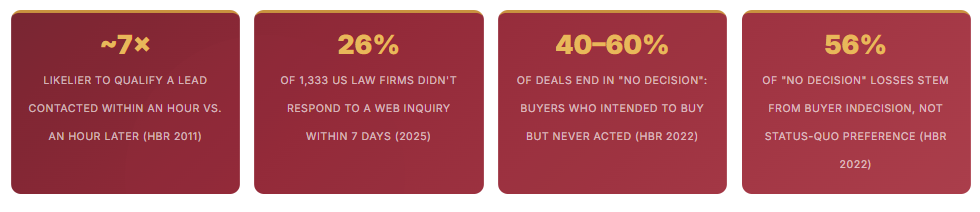
At a glance: ~7× likelier to qualify a lead contacted within an hour vs. an hour later (HBR 2011) · 26% of 1,333 US law firms didn’t respond to a web inquiry within 7 days (2025) · 40–60% of deals end in “no decision”: buyers who intended to buy but never acted (HBR 2022) · 56% of “no decision” losses stem from buyer indecision, not status-quo preference (HBR 2022)
What You’ll Find in This Article
- A story about a firm that cut its response time to minutes and watched its win rate stay flat
- What the famous “five-minute rule” actually is, where it came from, and what recent data shows about how slowly many businesses still respond
- The competitor nobody tracks: why 40–60% of deals end in “no decision,” and why most of those aren’t buyers who like the status quo
- The four-move follow-up that makes it safer to say yes, the win-rate data behind each move, and which parts automation can handle
- The Lead Journey Map: seven places AI automation lives in sales and follow-up (First Response, Qualify & Route, Book, Nurture, Conversation Notes, Quotes & Proposals, Pipeline Watch), each with what to automate, what to keep human, and where to start
- The consent and opt-out rules every automated message has to clear (TCPA and CAN-SPAM)
- Six best practices, five little-known gems, and a direct next step
He Cut Response Time From Two Days to Two Minutes. The Win Rate Didn’t Move.
The owner of an IT services firm had a clear diagnosis: leads were going cold. Web inquiries sat in a shared inbox for a day or two, and by the time anyone replied, prospects had moved on. He fixed it. A form submission now triggered an instant reply with a short, relevant answer and a link to book a call. First response dropped from about two days to about two minutes. Booked discovery calls went up. Proposals went out. And the win rate on those proposals stayed almost exactly where it had been.
His sales lead assumed the firm was losing on price. Then a part-time operations coordinator did something unglamorous: she called thirty proposals that had gone quiet and simply asked what had happened. Most hadn’t gone to a competitor. The answers sounded more like “we’re still thinking,” “our owner wants to run it by someone,” and “we haven’t picked anyone.” The proposals hadn’t lost. They had stalled.
The fix wasn’t faster follow-up. It was different follow-up. The firm added “no decision” as a loss reason. Its call-notes tool began flagging hesitation language such as “I need to think about it” and “let me check with my partner.” A follow-up was drafted for a person to edit: one recommended package instead of three tiers, a short note on why, and a low-risk way to start: a 30-day pilot with an exit clause. The point was no longer to remind the buyer. It was to make the decision safer to make. Fast response got him the conversation. It couldn’t get him the decision.
That story is the argument of this article. Speed is worth having, and automation is unusually good at it. But a firm that only automates speed will keep running into the same wall: a buyer who is interested, available, and unable to say yes. The businesses getting more from AI follow-up have learned to ask what each message is for.
The Five-Minute Rule Is Real, but It’s Not What Most Pages Say It Is
Almost every page on lead response cites the same two numbers: contacting a lead within five minutes rather than thirty makes you about 100 times more likely to reach them and 21 times more likely to qualify them. Those figures come from the Lead Response Management Study by James Oldroyd, published in 2007 in partnership with the sales software vendor InsideSales.com, whose CEO, David Elkington, is described by his own company as a co-author. The study is often called “the MIT study” and is frequently misattributed to Harvard Business Review. The direction is credible, but the multipliers describe phone follow-up to web leads at a handful of companies in the mid-2000s.
When you look closer to what can be the matter, the better-documented study source is a 2011 Harvard Business Review article by Oldroyd, McElheran, and Elkington. Its separate analysis of 1.25 million leads at 29 B2C and 13 B2B US companies found that firms contacting a lead within an hour were nearly seven times as likely to qualify it (meaning a meaningful conversation with a key decision maker) as firms that waited even an hour longer, and more than 60 times as likely as firms that waited 24 hours or more. In the same study, an audit of 2,241 US companies, using test leads submitted through each company’s website, found that 37% responded within an hour, 24% took more than 24 hours, and 23% never responded at all; among companies that did respond within 30 days, the average was 42 hours.
Recent data suggests the problem hasn’t disappeared. Another study examining this issue, Hennessey Digital’s 2025 study, sent fictitious inquiries through the website forms of 1,333 US law firms in the first quarter of 2025 and measured the time to the first personal outreach. The median was 13 minutes; 25% of firms responded in under five minutes (up from 13% in 2021), 56% responded within the hour, and 74% responded within seven days. The other 26% did not respond within seven days. Hennessey is a law-firm marketing agency, and the study covers one industry, so treat it as a benchmark for that field, not for every business. The 2011 audit covered companies across industries, so the two are not directly comparable.
The reading that matters: speed is a floor, not a strategy. It decides who gets the conversation, and it’s one of the easiest things to automate. But a fast reply only opens the door, and what happens after it is where deals are won or stall.
The Competitor Nobody Tracks
When it comes to Sales and Lead Follow-Up, there tend to be a few studies; while we were doing the research for this article, another from Matthew Dixon and Ted McKenna looked apropos. They studied more than 2.5 million recorded sales conversations, spanning both transactional and complex sales, and published the findings in Harvard Business Review in June 2022 and in their book The JOLT Effect that September. They found that anywhere between 40% and 60% of deals end up lost to customers who express their intent to purchase but ultimately fail to act. Not lost to a rival. Not lost on price. Just never decided.
It has been assumed, for decades, that those types of deals died because the rep failed to defeat the buyer’s status quo or pain point. Dixon and McKenna found that explanation covers less than half of them. In their study, 56% of “no decision” losses were a function of customer indecision, compared with 44% that stemmed from the customer’s preference for the status quo. They also found that 87% of sales opportunities contain either moderate or high levels of customer indecision. They attribute indecision to a different psychological effect, omission bias, which is the desire to avoid taking an action that might lead to a loss. In their words, customers are much less worried about missing out than they are about messing up. The three biggest drivers they identify are valuation problems (which option, package, or configuration to choose), lack of information, and outcome uncertainty.
Where “no decision” comes from: 40–60% of deals end up lost to buyers who intended to buy but never acted. Of those losses: over half are lost to buyer indecision 56% · status-quo preference 44%. (Indecision = fear of taking an action that might lead to a loss. 87% of opportunities show moderate or high indecision.)
Here is the implication for automation, and it’s our reading rather than the researchers’. Most follow-up automation is built to remind: “just checking in,” “bumping this to the top of your inbox.” Reminders help when a buyer forgets. They do little for a buyer who is stuck, and they can add pressure to someone who is already hesitating. The more useful question is what a follow-up message can do to make the decision feel safer.

In the Age of AI
You Gain the Advantage over Those Who Don't Step Up
The Four-Move Follow-Up
In their study, Dixon and McKenna found that top reps share four behaviors to overcome indecision, which they termed the JOLT method: judge the level of customer indecision, offer a recommendation, limit the exploration, and take risk off the table. The behaviors and the win rates below come from their HBR article. The automation mapping is our own adaptation, and in every case, a person reviews what goes out.
Across all four moves, the researchers report that with moderately indecisive buyers, high performers converted 57% of deals against 26% for average performers, and with decisive buyers, 69% against 39%. Notice what the moves have in common: none of them is “send another email.” HBR also reports that when sellers used the status quo playbook, which turns up the fear of not buying, on a customer struggling with indecision, win rates fell by 84%. Pressure-style follow-up can backfire.
Information still matters early in a sale, when buyers are exploring. The finding is about the late stage, where more options and more material tend to deepen the hand-wringing. These win rates are the researchers’ observational findings from recorded conversations, not controlled experiments, so your numbers will differ. Automation’s job is to notice the stall, assemble the right material, and draft the message quickly. A person’s job is to decide what to recommend and what risk the firm is willing to carry.
The Lead Journey Map: Seven Places AI Automation Lives
Sales and follow-up work breaks into seven places where automation can help. The first three are speed stages, which win the conversation. The last three are decision stages, which win the decision. Nurture sits between them, holding leads that aren’t ready yet. McKinsey’s 2026 State of AI survey found that respondents most often attribute AI-driven revenue gains to marketing and sales, so the sequence here is worth getting right. Salesforce’s survey found 54% of sales teams already using AI agents and another 34% expecting to do so within two years, though that is a vendor survey.
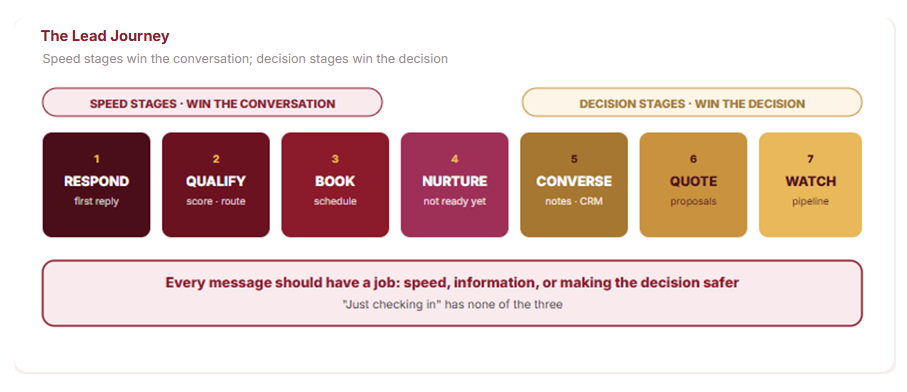
Each place below has a definition, evidence where we have it, what AI can automate, what should stay human, and a suggested starting level from the Autonomy Ladder in our pillar article, Mastering AI Automation for LLM Success. Level 1 means AI drafts and a person decides. Level 2 means fixed steps run automatically, with people reviewing exceptions. The starting levels are MMG working guidance, not research findings. Related reading: Mastering AI Automation: Marketing & Content.
Before Any Automated Message Goes Out
Four Questions for You
Automated follow-up is one of the easier places to create legal exposure, because the same system that sends one message can send ten thousand. The two rule sets that matter most for US follow-up are the Telephone Consumer Protection Act (TCPA), which governs calls and texts, and the CAN-SPAM Act, which governs commercial email. This section summarizes them for general information and is not legal advice.
In a ruling adopted on February 2, 2024, and released on February 8, the FCC confirmed that the TCPA’s restrictions on calls using an “artificial or prerecorded voice” cover current AI technologies that generate human voices. Callers must obtain the prior express consent of the called party to initiate such calls, and prior express written consent if the call introduces an advertisement or contains telemarketing. The ruling adds that such messages must identify the responsible business at the start and, for ads or telemarketing, offer specified opt-out methods. The FCC’s announcement noted that consumers can sue under the TCPA, and the FCC’s chair said state attorneys general can seek damages. The ruling also describes the TCPA as protecting consumers from unwanted calls and text messages, and what a given text requires depends on how it is sent, so ask counsel before automating texts. Hennessey’s 2025 study notes that law firms’ text follow-up grew only slowly, and suggests stricter messaging consent requirements are a likely reason.
For email, the FTC’s CAN-SPAM guide says the law isn’t limited to bulk email, covers any message whose primary purpose is promoting a commercial product or service, and makes no exception for business-to-business email. Each separate email in violation can carry penalties of up to $53,088, and both the company whose product is promoted and the company that sends the message may be held responsible, so you can’t hand the obligation to a software vendor. Opt-out requests must be honored within 10 business days. Any opt-out mechanism you offer must keep working for at least 30 days after you send the message. Commercial email must also carry a disclosure that it is an ad, the sender’s physical postal address, and a way to opt out.
The Consent Checkpoint: Four Questions for Every Automated Sequence
6 Best Practices for Sales & Follow-Up Automation
Little-Known Gems
The Perspective Shift
A buyer who goes quiet isn’t always saying no. Often they’re asking for help making the decision safe. Follow-up isn’t chasing. It’s the work of making yes easier to say.
Automation is excellent at the first half of that work: being there instantly, remembering everything, and noticing the stall. The second half, deciding what to recommend and what risk to carry, belongs to a person. The firms that do both won’t just answer faster than their competitors. They’ll be the ones a hesitant buyer finds easiest to choose.
Bottom Line: Let’s Find Where Your Leads Go Quiet
You don’t need a new sales system to begin. You need one honest look at your last thirty stalled deals: how quickly you responded, what happened after the proposal, and how many ended in “no decision” rather than a competitor.
MediaBus Marketing Group helps business owners and executives map where their leads and deals stall…
Automate the response, tracking, and drafting that can be automated, and keep a person in charge of the recommendations, the terms, and the consent rules.
Tell us where your follow-up stands today, and we’ll help you see what to fix first.
📞 · Connect Below Today · ✉
Sales & Lead Follow-Up FAQs
Q1: How fast should we respond to a new lead?
As fast as you reasonably can, and measured in minutes rather than days. HBR’s 2011 data found that firms contacting a lead within an hour were nearly seven times as likely to qualify it as firms that waited an hour longer. The popular “five minutes” target comes from a 2007 study conducted with a sales software vendor, so treat it as a sensible goal rather than a proven universal threshold. A practical approach is an instant automated acknowledgment, followed by a personal call or message from a named person within minutes during business hours. Measure the time from form submission to first personal outreach, and review it monthly.
Q2: Can AI follow up with leads automatically, and is that legal?
Often yes, with conditions. Email follow-up must meet CAN-SPAM requirements: an honest identification as advertising where applicable, your physical address, and an opt-out honored within 10 business days, with penalties of up to $53,088 per violating email. For calls and texts, the TCPA’s consent rules apply. In February 2024, the FCC ruled that AI-generated voices count as “artificial” under the TCPA, so prior express consent is required, and prior express written consent is required when the call introduces an advertisement or contains telemarketing. Such messages must also identify the business at the start. This is general information, not legal advice, and state and industry rules can add requirements.
Q3: Why do deals stall even when our response time is fast?
Because response speed affects who gets the conversation, not whether the buyer decides. Dixon and McKenna’s research on more than 2.5 million recorded sales conversations found that between 40% and 60% of deals end up lost to customers who intend to buy but never act, and that 56% of those “no decision” losses came from customer indecision rather than a preference for the status quo. They also found that 87% of opportunities contain moderate or high indecision. The findings are observational and come from interested parties, so your numbers may differ, but the pattern is worth checking in your own lost deals.
Q4: What should we automate first?
Score the seven places on Pain, Ruler, and Risk, using the method from our pillar article, and start where Pain and Ruler are high, and Risk is low. Pain is what the stage costs you each month, Ruler is whether you already measure it, and Risk is how damaging a mistake would be. For many businesses, First Response is a strong first choice because response time is easy to measure, and Pipeline Watch is a low-risk one because it only alerts a person. Old, unworked leads are another safe starting point if a person reviews the messages before they go out.
Q5: Will AI follow-up make us sound robotic?
It can if the message is generic, which is why most of the stages here start at Level 1, where AI drafts and a person edits. The best follow-up uses what the buyer actually said, offers one clear recommendation, and comes from a named person. In Hennessey’s 2025 law-firm test, over half of the responses included some level of personalization, and a noticeable number of partners were calling leads themselves. Automation should handle the speed, memory, and drafting, and people should handle the relationship and the recommendation.
Action Items:
Sources Cited in This Article
Oldroyd, McElheran, and Elkington, “The Short Life of Online Sales Leads,” Harvard Business Review, March 2011 (HBR’s page is paywalled; figures checked against reproductions of the article text) · James Oldroyd, Lead Response Management Study (2007), as quoted in XANT/InsideSales.com, Annual 2014 Lead Response Report (a vendor report; the study’s sample details come from secondary summaries) · Hennessey Digital, 2025 Lead Form Response Time Study (1,333 US law firms; Q1 2025; fictitious test inquiries submitted 10 a.m. to noon local time; Hennessey is a law-firm marketing agency) · Matthew Dixon and Ted McKenna, “Stop Losing Sales to Customer Indecision,” Harvard Business Review, June 24, 2022 (research conducted with the Tethr conversation-intelligence platform), and The JOLT Effect (Portfolio, 2022) · Salesforce, State of Sales, 7th Edition (4,050 sales professionals in 22 countries; surveyed August to September 2025; vendor survey, self-reported) · McKinsey Global Survey, “The state of AI in 2026: On the road to ROI” (August 25, 2026) · Federal Communications Commission, Declaratory Ruling FCC 24-17, “Implications of Artificial Intelligence Technologies on Protecting Consumers from Unwanted Robocalls and Robotexts” (adopted February 2, 2024; released February 8, 2024) and the FCC’s February 8, 2024 announcement · FTC, “CAN-SPAM Act: A Compliance Guide for Business.”
SHARE THIS STORY ANYWHERE YOU LIKE
SHARE THIS STORY ANYWHERE
Mastering AI Automation for Data Reporting and Decision Support
Mastering AI Automation for Data, Reporting and Decision Support AI will answer any question about your numbers. First, [...]
Mastering AI Automation for Knowledge and Institutional Memory
Mastering AI Automation for Knowledge and Institutional Memory Don’t hoard your knowledge. Don’t dump it in a tool. [...]
Mastering AI Automation for People and Hiring
Mastering AI Automation for People and Hiring Everyone is automating the front door. The money leaves through the [...]