

AI Operations: Automating Supply Chains, Scheduling, & More
The Most Profitable AI in Your Business Is Probably the One You’ve Never Thought to Demo
What You’ll Find in This Article
- A founder’s real story – the chatbot that got applause, and the backend problem that never got a meeting
- The Measurement Asymmetry – why flashy, customer-facing AI has huge hype and shaky proof, while boring backend AI has minimal hype and rock-solid numbers
- The Iceberg Principle – why the AI everyone’s racing to build sits in the 10% of your business customers can actually see
- What “automating supply chain, scheduling, and more” actually means once you stop looking where the spotlight is
- 6 best practices for finding your highest-ROI AI opportunity instead of your most demoable one
- Little-Known Gems – five findings about where AI money is actually landing versus where the attention goes
- A perspective shift on what “impressive AI” and “profitable AI” actually have in common – and how rarely it’s the same project
- A direct next step if you want an honest answer about where your next AI dollar should actually go
The Demo That Got Applause
A Specialty Foods Manufacturer · 30 Employees
A founder running a 30-person specialty foods company sat through a vendor demo at a regional trade show: a customer service chatbot, friendly voice, instant answers, the kind of thing that gets a small crowd to lean in and say “okay, that’s actually impressive.” He signed a contract within the month. Eight months and a real chunk of budget later, the chatbot was live on the website, answering shipping questions and product inquiries competently enough. Customer reviews mentioned it occasionally. Nobody could say with a straight face exactly what it had actually returned in dollars.
Meanwhile, every single week, his production floor absorbed real, quantifiable overtime because the manual scheduling process — built on a whiteboard and one supervisor’s judgment calls – routinely misjudged order volume against staffing. Nobody had ever suggested automating that. It wasn’t exciting. Nobody had ever demoed a production scheduling algorithm at a trade show. It took an outside advisor asking one blunt question, “What’s actually costing you money right now, today?” before anyone connected the two. The scheduling fix, once built, paid for itself in eleven weeks. The chatbot is still, to this day, hard to put a number on.
This isn’t a story about the chatbot being a bad idea. It’s a story about sequence – about which fire got lit first, and why it usually isn’t the one actually burning the most money.
The Measurement Asymmetry: Why the Flashy AI Gets the Hype and the Boring AI Gets the Proof
Here’s the pattern hiding in plain sight across almost every AI budget conversation happening right now: the AI projects with the most attention tend to have the least reliable measurement, and the AI projects with the least attention tend to have the most. This isn’t a coincidence. It’s a direct consequence of what each type of AI is being measured against.
Customer-facing AI – chatbots, personalization, marketing automation – is judged against metrics that are themselves new, contested, and often poorly instrumented: engagement, sentiment, “brand experience.” 51% of marketers report they cannot actually track their AI investment returns, even as enterprise generative AI spending tripled from $11.5 billion in 2024 to $37 billion in 2025. 86% of enterprises plan to raise their AI budget again in 2026, yet only about 6% of organizations qualify as genuine AI “high performers,” according to McKinsey. Spending is not the bottleneck. Knowing where the spending actually worked is.
Supply chain and scheduling AI gets judged against something completely different: numbers the business was already tracking long before AI existed – cost per unit, inventory turns, on-time delivery rate, service level. McKinsey’s research on AI-enabled supply chain adopters found a 15% reduction in logistics costs, a 35% decrease in inventory levels, and a 65% increase in service levels, not because operations AI is inherently more powerful than customer-facing AI, but because operations has always had a hard, pre-existing ruler to measure against. You can’t fake a stockout number. You can absolutely convince yourself a chatbot is “helping.”

51% of marketers cannot track their AI investment returns, despite record spending. 3.2× growth in enterprise GenAI spending in a single year- from $11.5B to $37B. 6% of organizations qualify as genuine AI “high performers” (McKinsey). 15/35/65% verified cost, inventory, and service-level gains for AI-enabled supply chain adopters.
THE HONEST NUANCE: This isn’t an argument that customer-facing AI doesn’t work – plenty of it does, and does well. It’s an argument that the industry’s current spotlight is a poor guide to where your next AI dollar will actually be measurable. Where the spotlight is brightest and where the ruler is most reliable are, right now, mostly two different places.

In the Age of AI
You Gain the Advantage over Those Who Don't Step Up
The Iceberg Principle
Picture your business as an iceberg. The part above the waterline – the storefront, the app, the chatbot, the checkout flow – is maybe 10% of the actual mass of the operation, but it’s the only part anyone outside the company ever sees. Below the waterline sits the other 90%: sourcing, scheduling, production, inventory, logistics, the whole invisible machine that has to run correctly for the visible 10% to mean anything at all.
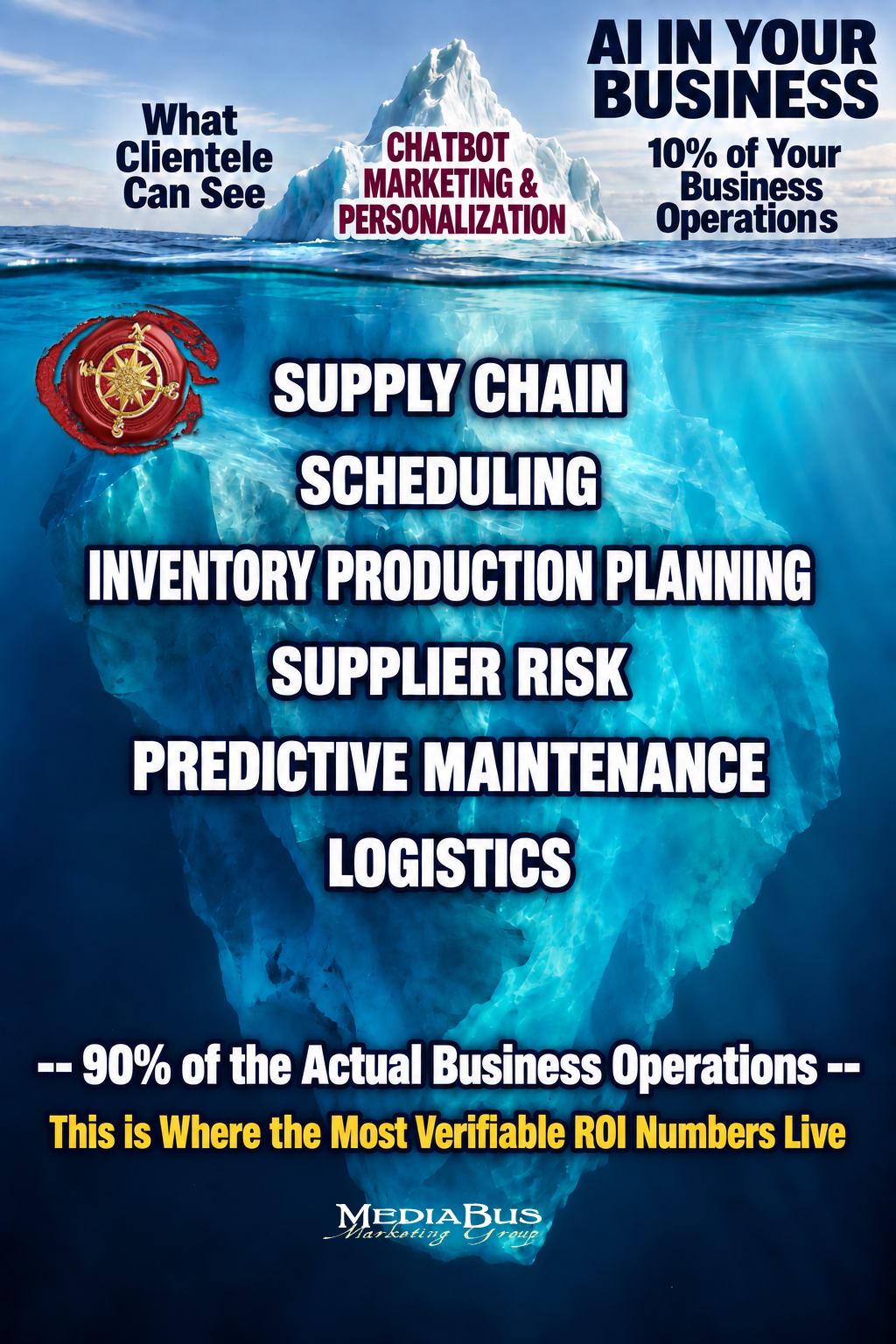
Every AI vendor at every trade show is competing to sell you something for the 10% above the waterline, because that’s the part a demo can show off in ninety seconds. Almost nobody is pitching the 90% below it, not because it’s less valuable – the data says the opposite – but because it doesn’t fit in a ninety-second demo, and ninety-second demos are what get budget approved in a hurry.
What’s Actually in the 90%
Reframed as backup instead of efficiency, “AI operations” stops being an abstract software category and becomes something much more specific: a set of tools that watch how the work actually gets done – the patterns, the reorder timing, the routing logic, the exceptions – and hold that knowledge in a system that doesn’t call in sick, doesn’t go on vacation, and doesn’t walk out the door with two weeks’ notice.
This is the same continuity principle covered in our companion piece on how an AI project manager stops tasks from falling through the cracks – the mechanism is identical, just applied one layer deeper, to the operational knowledge behind the tasks rather than the tasks themselves.
Once you stop looking where the spotlight is, “AI operations” resolves into a short list of specific, unglamorous, highly measurable opportunities: demand forecasting that replaces gut-feel reorder timing with actual sales history, inventory optimization that adjusts stock levels automatically as real demand shifts, and scheduling systems that build a day’s routes or production run against real constraints instead of a rushed morning decision. This is the same territory covered in our companion piece on automating supply chain and scheduling operations in more technical depth – this article is about why that work keeps losing the budget argument to something flashier, not what the work itself involves.
6 Best Practices for Finding Your Highest-ROI AI Opportunity
Little-Known Gems: Where the Money’s Actually Landing vs. Where the Attention Goes
The Perspective Shift
THE REAL POINT: The most impressive AI in your business and the most profitable AI in your business are probably not the same project. The businesses quietly winning in 2026 aren’t the ones with the best demo. They’re the ones who automated the part of the business nobody claps for.
Nobody has ever built a career on a great scheduling algorithm story. That’s precisely why it’s still available, still underpriced, and still sitting exactly where the founder in this article’s story left it for eight months — right below the waterline, doing nothing, waiting for someone to ask the boring question first.
Bottom Line: Find Your Below-the-Waterline Opportunity
Before your next AI dollar goes toward something that would look good in a demo, spend thirty minutes finding out what’s actually costing your business money right now — today, this week, this quarter.
This isn’t an argument against customer-facing AI. It’s an argument for checking the other 90% of the iceberg…
before you decide the 10% is where your next dollar belongs.
MediaBus Marketing Group helps businesses find the highest-verified-ROI AI opportunity in their operations — not just the one that would demo the best.
📞 · Connect with Us Below · ✉
AI for Operations FAQs
Q1: Does this mean customer-facing AI like chatbots is a bad investment?
No – plenty of customer-facing AI genuinely works, and this article isn’t an argument against it. It’s an argument about sequence and measurement. If you’re choosing between two AI projects with unclear priority, the one with a pre-existing, undeniable measurement system is the safer first bet, not the one with the more exciting demo.
Q2: How do we figure out what’s actually costing us the most money right now?
Start with the numbers you already track: overtime costs, stockout frequency, late deliveries, excess inventory carrying costs, or supplier price surprises. Start with the cost, then work backward to the tool, not the other way around.
Q3: Why is operations AI easier to measure than customer-facing AI?
Because operations has been instrumented with hard numbers for decades, long before AI entered the picture. Customer-facing metrics like “engagement” are newer, softer, and more open to interpretation. The ruler existed first in operations; the AI just started using it.
Q4: If backend AI is so valuable, why doesn’t everyone prioritize it first?
Because it’s structurally hard to get excited about, and business decisions are made by humans who respond to excitement. Budget tends to follow attention, and attention tends to follow things that are easy to show off.
Q5: What’s the first step if we want to check our own “waterline” for a missed opportunity?
Spend one week listing every recurring cost, delay, or inefficiency in scheduling, inventory, supply chain, or production. Rank that list by real dollar impact, not by how interesting each item sounds, then compare it against whatever customer-facing AI project is currently funded.
Action Items:
Sources Cited in This Article
Click-Vision 2026 AI Marketing Statistics report · About Chromebooks Enterprise AI Spending Statistics 2026 (Menlo Ventures, McKinsey, Gartner, NVIDIA data) · McKinsey research on AI-enabled supply chain adopters · Noupe chatbot statistics report · SQ Magazine AI in Marketing Statistics 2026.
SHARE THIS STORY ANYWHERE YOU LIKE
SHARE THIS STORY ANYWHERE

Mastering AI Automation for Data Reporting and Decision Support
Mastering AI Automation for Data, Reporting and Decision Support AI will answer any question about your numbers. First, [...]

Mastering AI Automation for Knowledge and Institutional Memory
Mastering AI Automation for Knowledge and Institutional Memory Don’t hoard your knowledge. Don’t dump it in a tool. [...]
Mastering AI Automation for People and Hiring
Mastering AI Automation for People and Hiring Everyone is automating the front door. The money leaves through the [...]