

How AI is Changing Search, and What Small Businesses Should Do About It
Customers now ask whole questions, and an assistant answers from whatever it can verify about you. Make sure it can verify the truth.
Search used to be a list of links. Increasingly, it is a conversation that ends in an answer. This guide shows what actually changed, what Google, OpenAI, and Microsoft say has not, a five-minute test that shows how an assistant describes your company today, and a seven-chair plan that gives every part of your business one job.
What You’ll Find in This Article
- A story about an owner who asked an AI LLM Chatbot to describe her own company, and got three of five facts wrong
- What actually changed in search: longer questions, follow-ups, one question split into many searches, and answers that arrive before the links
- What did not change, according to Google and OpenAI, and what to stop paying for
- The Describe-You Test: a five-minute check of how assistants describe your business, and why small firms may be described less accurately
- The Seven-Chair Plan: what the owner, web, content, sales, operations, reputation, and numbers chairs each do first
- Free tools that show AI activity today, a 30-day plan, six best practices, six little-known gems, a direct next step, and five FAQs
She asked an AI about her own company. It got three facts wrong.
A Home Services Company (illustrative composite, not a single named client)
On a Tuesday night, the owner of a heating and cooling company opened an AI assistant and typed a question she had never thought to ask: “Tell me about my company, and whether I should hire it.” She had spent years on her website and paid for search work most months.
The chosen LLM Chatbot answered fluently and got three of five basic facts wrong. It listed a service she had stopped offering. It gave a phone number from an old directory listing. It described the company in two generic sentences and said nothing about the thing customers actually called her for. It sounded confident the whole way through.
Her website, she realized, said things like “your trusted partner for comfort.” Nothing on it was specific enough to quote. When the LLM went looking for facts, it found the old directory page, and that is the page it believed.
She did not hire an AI specialist. She wrote one page of plain facts, fixed her listings to match, and asked her service manager to write down the five questions customers ask most. The problem had never been that she was invisible. The problem was that she was describable only by accident.
Most conversations about AI and search start with traffic charts. This one starts with a simpler question: when a stranger asks an LLM Chatbot about your business, what does it say? That answer is increasingly the first impression, and it is built from whatever the LLM can find and trust, not from the brochure you wish it had read.
This guide covers how AI is changing search, what has not changed, and what a business of any size can do inside its own walls. It is organized around seven chairs in your company, because this is no longer one person’s marketing task. It is a company-wide habit of being easy to describe correctly.
What Actually Changed in Search for Google
The Question Got Longer, and More Personal
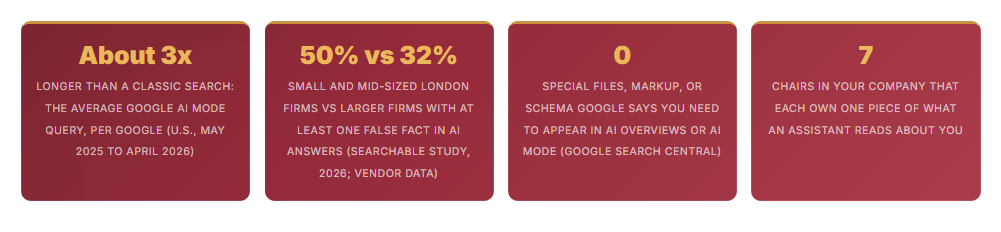
Google published a report on May 19, 2026, titled “How People Are Using AI Mode in the U.S.”, covering May 2025 through April 2026. Its author is Shivani Mohan, Google Search’s vice president of data science and user experience research. According to coverage in Search Engine Journal and PPC Land, the average AI Mode query is about three times as long as a traditional search, and follow-up queries have grown more than 40% a month on average. The most common opening words are ‘what,’ ‘how,’ ‘I,’ ‘is,’ and ‘can,’ and more than one in six U.S. AI Mode searches use voice, image, or video. Google also says AI Mode has passed one billion monthly active users globally. These figures are Google’s own, reported secondhand here, and growth rates in Google Trends data are relative, not absolute.
Now this isn’t just all about Google (it’s AI Mode and back LLM Gemini), although a greater portion of the data we pulled is about their perspective of how AI changed them, because they have lost a good portion of their Search Traffic BEFORE they converted to their AI Mode in the second quarter of 2025. (Approximately down from 95% to near 70% in just the first quarter of 2026 alone). They had been so dominant for so long, it is good to put a post-mortem on that dominance in light of all that has transpired in the last 18 months or so.
The following information does apply to the rest of the LLMs as well.
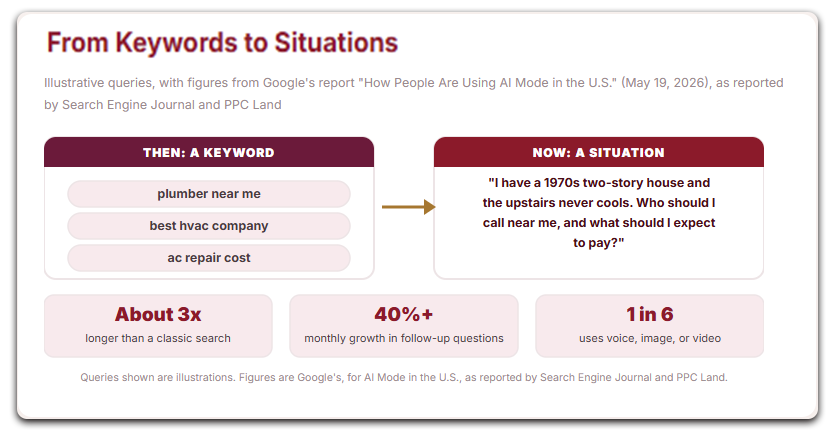
There is a tension worth stating honestly. SparkToro’s 2026 panel data put AI Mode at only 0.34% of U.S. Google searches. Google counts monthly users worldwide, and SparkToro counts the share of searches in one panel, so the two are different measures and can both be true. For planning, the direction matters more than either number: people are learning to describe their whole situation and expect a useful answer. We cover the click data behind this in How to Measure Visibility in a Zero-Click, AI-Answer World.
One Question Becomes Several Searches
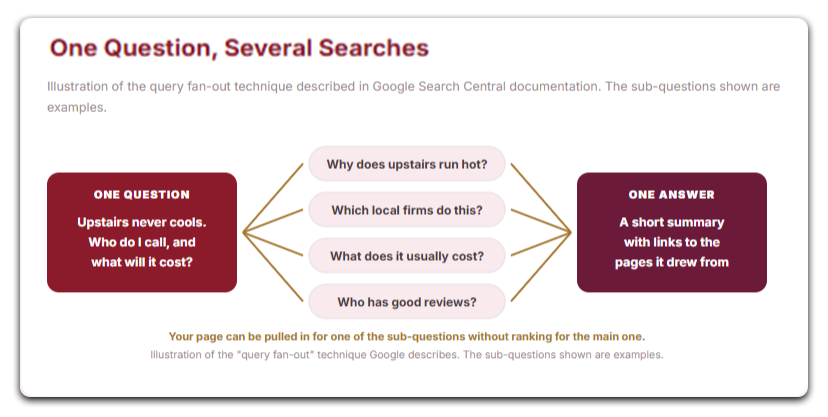
Google’s documentation says AI Overviews and AI Mode may use a technique called query fan-out, which issues multiple related searches across subtopics and data sources to build one response. Google says this lets it display a wider and more diverse set of links. The practical meaning for a small business is that a page can be used for one of the sub-questions without ranking for the main question. A page that clearly answers ‘what does this usually cost’ or ‘who serves my area’ has more than one way to be useful.
The Answer Arrives Before the Links
When an AI summary appears, fewer people click through. Pew Research Center found that users clicked a traditional result in 8% of visits with an AI summary and 15% without one, in March 2025 Google data. Our companion article covers that evidence and how to measure visibility without clicks, so we will not repeat it here. The point for this guide is what it implies: your business may be described to a customer before the customer ever reaches your site.
When Google’s AI Mode describes you, it uses what it can find. The question is whether what it finds is true.
What Did Not Change, and What to Stop Paying For
Google Says There is No Secret
Google’s Search Central page, AI features and your website, says pages must be indexed and eligible to be shown in Google Search with a snippet to be supporting links, and that there are no additional technical requirements. It states that there are no additional requirements to appear in AI Overviews or AI Mode, nor are other special optimizations necessary. It adds that you do not need new machine-readable files, AI text files, or markup, and that there is no special schema.org structured data to add. Google’s recommendations are familiar: keep crawling allowed, make content findable through internal links, provide a good page experience, keep important content available as text, and keep Business Profile and Merchant Center information current. Structured data, where you use it, should match the visible text on the page.
This is Google’s guidance about Google. Other LLM Chatbots have their own crawlers and rules, and some content research suggests particular page features can raise visibility, so treat Google’s statement as the floor, not the whole story. A Princeton-led academic paper on generative engine optimization (Aggarwal et al., KDD 2024) reported visibility gains of up to 40% from some content changes in its tests, varying by domain. It is a reason to keep testing, and not a reason to buy a package of tricks.
This is Google. What About the Others?
So, for the most part, what was in the Google Algorithm before is staying as a requirement for inclusion in their AI answers- all that work, and now traffic will be coming your way. On the others of the Big 5, ChatGPT, Claude, Perplexity and Grok, they too have their main methods on how to determine what is being given as answers to those questions being posted.
The biggest and most profound change is what is being measured, how it is being measured, and wherefrom they are getting their data. For the most part (even for Google’s Gemini as well), it is now a question of how high your Authority Score is, which is being calculated by the LLMs individually. They all calculate it slightly differently, but all of them are looking at how dominant an authority you are for the topics and subject matter; are you a credible source to pull from consistently, and are what you have and do trustworthy in giving the right answers to the questions being posed to the likes of ChatGPT, Claude, Perplexity, and Grok. Remember, the measurement is no longer your Keyword Strength; it is how AUTHORITATIVE, CREDIBLE, and TRUSTWORTHY you and your company are.
The LLMS.TXT Question
LLMS.TXT is a proposed plain-text file meant to guide AI systems. Google’s AI features page says no AI text files are needed to appear in its AI features. Search Engine Journal reports that Google’s Search team has said it is not pursuing the file, and that John Mueller compared it to the old keywords meta tag. It also reports that Chrome’s Lighthouse 13.3 added an experimental audit that checks for the file as part of agent readiness, which is a different goal from search visibility. The sensible reading: it is cheap and unproven, and it should never come before the basics.
This LLM-related txt file is similar to the robots.txt file that was essential for the Google Spiders to index your site’s content. This now LLMS.TXT file is similar in scope to what is being searched for initially. The studies show it doesn’t necessarily help, but it also doesn’t hurt to have it – So I would include it for your Technical SEO readiness.
The Crawler Door That Actually Matters
OpenAI’s publisher FAQ separates two crawlers. It says to make sure you are not blocking OAI-SearchBot if you want your content to appear in ChatGPT search summaries and snippets, and to disallow GPTBot for sites or pages you want excluded from potential training. It also says ChatGPT automatically adds the parameter utm_source=chatgpt.com to referral URLs, so you can track that traffic. Whether to allow training is a business and legal choice for you and your counsel. Whether your site is reachable at all is a technical one, and it is the easiest to get wrong by accident. Our guide to AI crawlers in 2026 lists every bot and what it does.

In the Age of AI
You Gain the Advantage over Those Who Don't Step Up
The Describe-You Test
The Describe-You Test is a five-minute check, and it is MediaBus Marketing Group’s working method, not an industry standard. Ask an LLM the questions a stranger would ask, and write down what is right, what is wrong, and what is missing. Run it in at least three assistants, in fresh sessions, because answers vary from run to run and by account and location.
- What does [your company] do, and who is it for?
- Where is it located, what area does it serve, and what are its hours and phone number?
- How long has it been in business, and how big is it?
- What should I expect to pay for [your most common service] from [your company]?
- How does [your company] compare with [a named competitor], and what do customers say about it?
Score each LLM out of five facts correct, and write down any invented claim. Questions 2 and 3 are the ones most likely to expose stale listings. Question 5 shows which third-party pages the assistant leans on.
Why Small Firms May Be Described Less Accurately
Searchable, a company that works on AI visibility, tested 165 London businesses in 13,365 AI answers across ChatGPT, Perplexity, and Gemini, as reported by IT Brief UK on June 25, 2026. Answers were checked against LinkedIn profiles and Companies House records. It found that small and mid-sized firms received at least one false fact in 50% of cases, against 32% for larger firms, and that fabricated answers ran 5% against 2%. The weakest areas were company size, website, founding year, phone number, and services. Searchable’s co-founder said models underrepresent smaller firms because their web footprint is thinner. That is his view, and the study did not test it, and the report does not give prompt wording or model versions, so treat the numbers as a warning from a vendor, not a benchmark.
Give the LLM Chatbot a Fact Sheet to Find
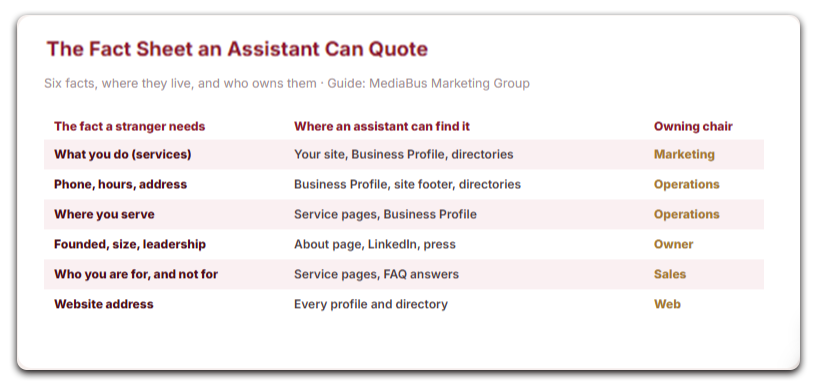
The fix is dull and effective: make the facts easy to find and identical everywhere. The table lists six facts a stranger needs, where an assistant can find each one, and which chair in your company owns it. Google’s own documentation points the same way, since it asks you to keep Business Profile information current and to keep important content available as text.
The Seven-Chair Plan
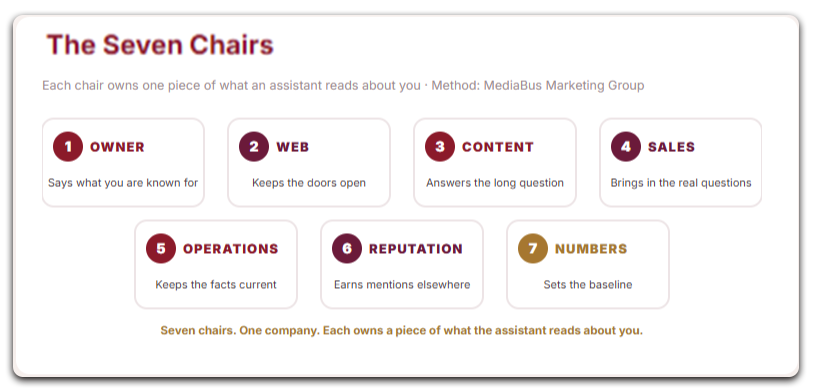
Most AI search advice is handed to one person, usually whoever runs marketing. That fails because the facts an assistant reads about you live in seven places in your company. We call the answer the Seven-Chair Plan. It is MediaBus Marketing Group’s working method: give each chair one first move and one number, and review them together once a month. It builds on the Autonomy Ladder in our pillar article, Mastering AI Automation for LLM Success, so every chair starts at Level 1, where AI assists, and a person decides.
Free Tools That Show AI Activity Today
You can see more than you think without buying anything. In Google Search Console, Google says traffic from sites appearing in AI features is included in the Performance report under the Web search type, and Google has also described generative AI performance reports for AI Overviews and AI Mode, which we cover in our measurement article. Bing is further along on citations. Microsoft introduced an AI Performance report in Bing Webmaster Tools in public preview in February 2026, and in June 2026 announced preview features called Intents, Topics, Citation Share, and Compare. Citation Share divides your site’s citations for a grounding query by all citations shown for that query, and Microsoft calls it an observational metric, not a ranking system or a competitive scoreboard.
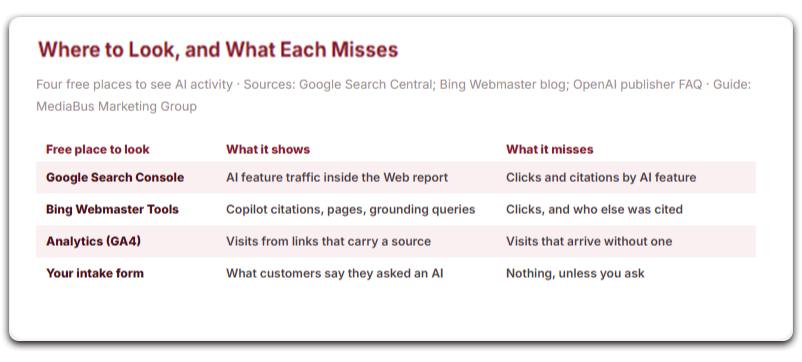
Treat the Bing data as a sample of what is possible. One independent write-up by Search Influence, using its own site from November 2025 to February 2026, counted 19,717 Copilot citations across 86 pages, with one page earning 69% of them, and then a drop of about 97% from December to February with no known cause. The report covers Copilot only and shows no clicks and no competitors. Because of query fan-out, a single conversation can produce several citation events. It is one site and early data, but it shows what to expect: concentrated and volatile.
A Thirty-Day Plan
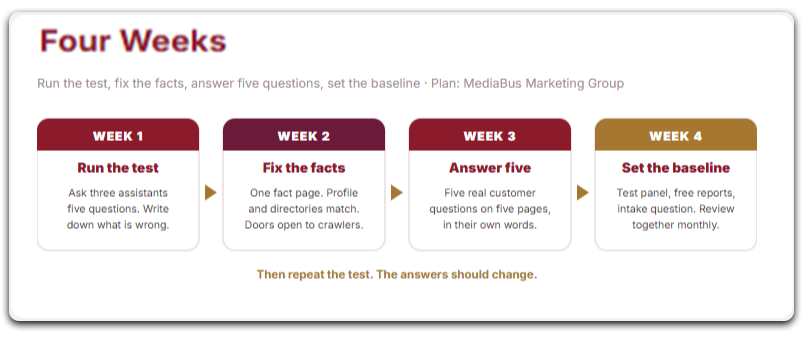
You do not need to fix everything. You need to run the test, fix the facts, answer five questions, and set a baseline. This plan is a starting design from MediaBus Marketing Group, and it fits a business with no marketing department.
If you want help turning the test into a measured plan across all seven chairs, that is what an AI Visibility Audit is for. For the monthly numbers, see How to Measure Visibility in a Zero-Click, AI-Answer World.
6 Best Practices for Small Businesses in AI Search
Little-Known Gems
The Perspective Shift
Being found was the old goal. Being described correctly and included is the new one.
Search used to hand customers a list and let them sort out the truth. Now an LLM Chatbot sorts it out first, and it sorts from whatever it can find. The businesses that do well will not be the ones with the cleverest tricks. They will be the ones whose facts are plain, current, and the same everywhere. Tonight, ask your favorite LLM to describe your company, and write down what is wrong.
Bottom Line:
Google says AI Mode queries run about three times as long as classic searches. Google also says they don’t require any ‘special’ optimization, schema, or AI file needed to appear in its AI features. That is NOT the case for ChatGPT, Claude, Perplexity, or Grok. A study of London businesses found small and mid-sized firms had at least one false fact in 50% of AI answers, against 32% for larger firms, though that study came from a vendor. Put those together, and the pattern is clear: what changes outcomes is not a trick. It is easy to describe correctly.
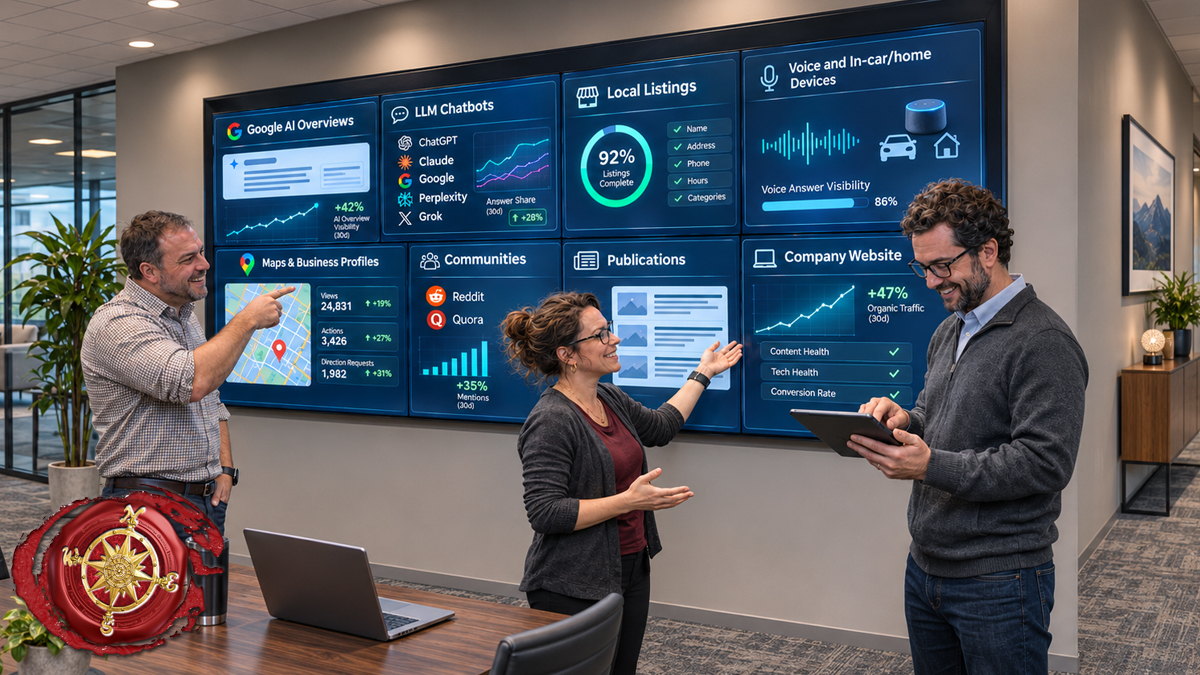
The owner states what you are known for. Web keeps the doors open. Content answers the long question. Sales supplies the real questions. Operations keeps the facts current. Reputation earns mentions elsewhere. Numbers set the baseline.
Seven chairs, one first move each, one number each, reviewed monthly.
MediaBus Marketing Group will run the Describe-You Test with you, show you where assistants get your business wrong, and build the seven-chair plan around your team.
Start with an AI Visibility Audit, and we will show you where you are Seen, Sought After, and what you need to be doing to get there.
📞 · Contact Us Using the Form Below · ✉
AI Search Changes FAQs
Q1. How is AI changing search for small businesses?
Searches are becoming longer, more personal conversations that end in an answer. Google reports that the average AI Mode query is about three times as long as a traditional search and that follow-up queries grow more than 40% a month on average. AI features may also split one question into several related searches, so a page can be used for one sub-question. The practical effect is that your business may be described to a customer before they visit your site, so the facts an assistant can find about you matter more.
Q2. Do I need GEO or AEO instead of SEO?
For Google’s AI features, Google says no special optimization is necessary. Pages need to be indexed and eligible to appear with a snippet, and the usual guidance applies: allow crawling, link internally, keep important content as text, and keep Business Profile information current. Other LLM Chatbots have their own crawlers and behavior, and research suggests certain content changes can raise visibility, so keep testing. So, yes, you need to start incorporating Generative Engine Optimization into your business efforts.
Q3. Should I block AI crawlers on my website?
It depends on what you want. OpenAI says to avoid blocking OAI-SearchBot if you want to appear in ChatGPT search summaries and snippets, and to disallow GPTBot if you want content excluded from potential training. Those are separate bots with separate purposes. Google uses Googlebot for Search and says Google-Extended limits AI training and grounding in other Google systems. Decide deliberately, with legal advice if training use matters to you, and check that nothing is blocked by accident, including at your CDN or host.
Q4. Do I need an llms.txt file or special schema markup?
Not for Google’s AI features. Google says there are no special files, AI text files, or schema.org structured data needed, and that any structured data you use should match the visible text on the page. Chrome’s Lighthouse has an experimental llms.txt audit, but that addresses browser-agent readiness, not search visibility. A file is cheap and unproven. Start with accurate facts, readable pages, and open access. It doesn’t hurt your website, so place it along with the schema markup.
Q5. What should I do first this week?
Run the Describe-You Test. Ask three assistants what your company does, where it is and how to reach it, how long it has operated, what your main service costs, and how you compare with a named competitor. Score the facts, write down every error, and fix the biggest three at the source: your own site, your Business Profile, and the directories the assistant relied on. Repeat monthly.
Action Items:
Sources Cited in This Article
All sources were read in November 2026. SparkToro, 2026 zero-click search study (Similarweb panel, January to April 2026; prior studies 2024 and 2019) · SparkToro and Gumshoe, study of AI recommendation consistency (Fishkin and O’Donnell), as reported by Search Engine Land · Ahrefs, “AI assistants vs. Google: citation overlap” study (August 11, 2025) · Pew Research Center, Google users clicked less when an AI summary appeared (July 22, 2025; March 2025 data) · Bain & Company and Dynata, consumer zero-click survey (n=1,117) · Google Search Central blog, Search generative AI performance reports (June 2026), with details from ppc.land coverage · Google Business Profile Help, “About Business Profile performance” (support.google.com/business/answer/9918094) · G2, B2B buyer survey on AI chatbots (August 2025 survey, reported October 6, 2025) · Martech.org, reporting on AI browser referrers · Peec AI, most-cited domains analysis (March 2026; 30 million cited sources; vendor-published) · Outfunnel, self-reported lead source data (June 17, 2025; vendor-published) · Aggarwal et al., “GEO: Generative Engine Optimization” (arXiv 2311.09735, KDD 2024).
SHARE THIS STORY ANYWHERE YOU LIKE
SHARE THIS STORY ANYWHERE

How AI is Changing Search, and What Small Businesses Should Do About It
How AI is Changing Search, and What Small Businesses Should Do About It Customers now ask whole questions, [...]

What Does Success with AI Look Like for a Growing Business?
What Does Success with AI Look Like for a Growing Business? Success with AI is Not Something You'Feel'. [...]
How to Measure Visibility in a Zero-Click, AI-Answer World
How to Measure Visibility in a Zero-Click, AI-Answer World The click was never the goal. It was the [...]