

How to Measure Visibility in a Zero-Click, AI-Answer World
The click was never the goal. It was the receipt. Here is how to measure the thing the receipt used to prove.
More searches now end with no click, and LLM Chatbots answer questions without sending anyone to a website. Your traffic report cannot see most of that. This guide gives owners and executives a three-link method, Seen, Sought, Sold, a map of ten places where visibility happens, an honest account of what each place lets you measure, and a one-page monthly scorecard.
What You’ll Find in This Article
- A story about an owner whose traffic report fell 22% while her phone kept ringing, and the one question that explained why
- The billboard principle: zero-click is not new, only your dashboard is, and what SparkToro, Pew, and Bain actually measured
- Why a rank report cannot tell you whether an AI assistant names you, and what repeated testing shows instead
- Seen, Sought, Sold: a three-link method for measuring visibility when nobody clicks
- The Echo Problem: one customer, four different credits, and why analytics hides the AI answer
- Ten places visibility can happen, with how to measure each one, what the evidence says, and where we found no good data
- The monthly scorecard, six best practices, six little-known gems, a direct next step, and five FAQs
Traffic Fell 22%… Her Phone Kept Ringing
In October, the owner of an accounting and advisory firm opened her monthly marketing report and found website sessions down 22% from a year earlier. Her marketing manager said what many managers are saying: “SEO is dying.” One board member suggested cutting the budget in half.
She almost agreed. Then her office manager mentioned something small. New callers kept saying odd things: “I asked an AI who handles this kind of work and your name came up.” Nobody had ever recorded it, because the intake form had no place to put it, and the web analytics could not see it.
She did not cut the budget. She added one question to the intake form and the phone script: “How did you first hear about us, and if it was an AI assistant, which one?” Over the next quarter, of 30 new inquiries, nine named an assistant, and several said they had looked up the firm’s name afterward before calling.
The report had not shown her a decline in visibility. It had shown her a decline in clicks. Those are different things, and she had been managing the wrong one.
This is the problem with measuring visibility in a zero-click, AI-answer world: the instruments most owners trust were built to count visits. When a person gets the answer without visiting, the visit never happens, and the instrument reports nothing. Silence on the dashboard is not the same as silence in the market.
This article gives you a way to measure what actually matters, which is whether the right people are seeing you, looking for you, and buying from you, even when no click connects those steps. It also maps the ten places where that can happen, and it is honest about the places where nobody has good measurement yet.
The Billboard Principle, and What the Zero-Click Data Actually Says
Nobody ever asked a billboard for a click
Radio, billboards, the phone book, and a booth at a trade show all worked without a click, and owners judged them by three questions: did the right people see it, did they go looking for us afterward, and did they buy? Zero-click is not a new problem. It is an old one that digital marketing briefly let us forget, because for about twenty years almost every step of the path left a trail of clicks. That trail is getting shorter. The method for measuring a billboard still works. We call it the billboard principle: when you cannot count the click, measure the steps on either side of it.
How many searches end without a click
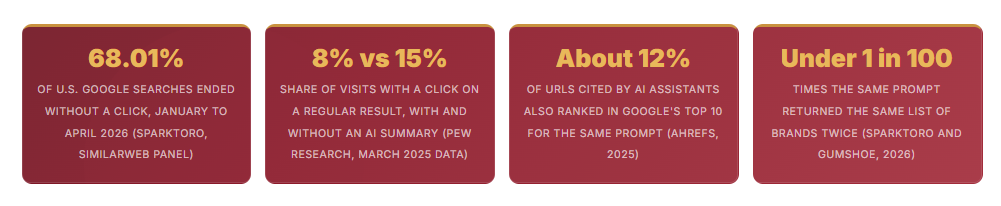
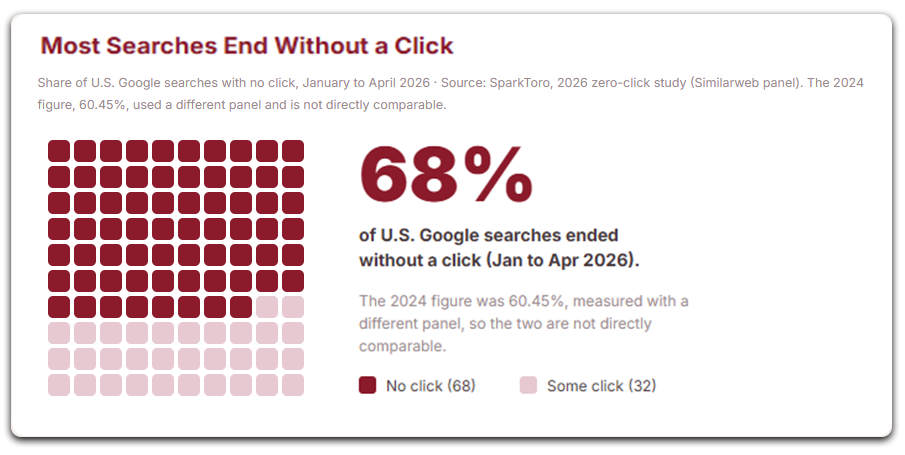
SparkToro reported in 2026 that 68.01% of U.S. Google searches ended without a click, based on Similarweb panel data for January to April 2026. SparkToro’s 2024 study found 60.45%, using a different panel from Datos, and its 2019 study found 49%. The company notes the panels differ, so treat the three numbers as a direction, not a precise trend line. The mobile app is excluded from the panel, and SparkToro expects zero-click to be higher there. The same report estimates AI Overviews appeared on more than 20% of searches, that Google’s AI Mode reached only 0.34% of searches, that AI tools sent out less than 1% of traffic, and that more than 20% of Americans use an AI tool ten or more times a month.
What an AI summary does to the click
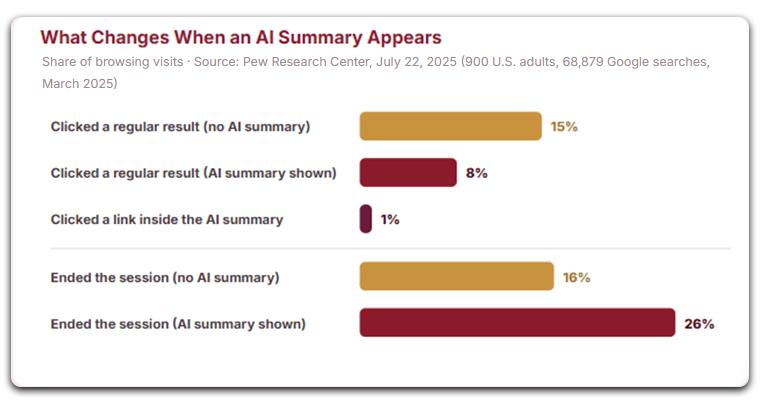
Pew Research Center followed 900 U.S. adults and 68,879 unique Google searches in March 2025 and published the results on July 22, 2025. About 18% of those searches produced an AI summary. When one appeared, users clicked a traditional result in 8% of visits, compared with 15% when none appeared. Only 1% of visits included a click on a link inside the summary. Users ended their browsing session after 26% of visits with a summary, compared with 16% without one. This is Google only, from a single month, so it shows the mechanism and not today’s exact size.
Buyers are changing where they start
Bain & Company, working with Dynata, surveyed 1,117 U.S. consumers and reported that about 80% rely on zero-click results in at least 40% of their searches. Bain estimated that organic web traffic has dropped 15% to 25% as a result, and recommended that companies move from measuring clicks to measuring impressions and what it calls AI reach. On the business side, G2’s August 2025 survey of more than 1,000 B2B software buyers, reported in October 2025, found that about half began their research in an AI chatbot instead of Google, and 87% said chatbots changed how they research. G2 sells reviews, so read that as a vendor-run survey, and note that it covers software buyers, not every B2B category.
When the click disappears, the question does not. People still need to find someone to trust. You just can no longer assume the click will tell you they found you.
Why a Rank Report Cannot Tell You Whether an AI Names You
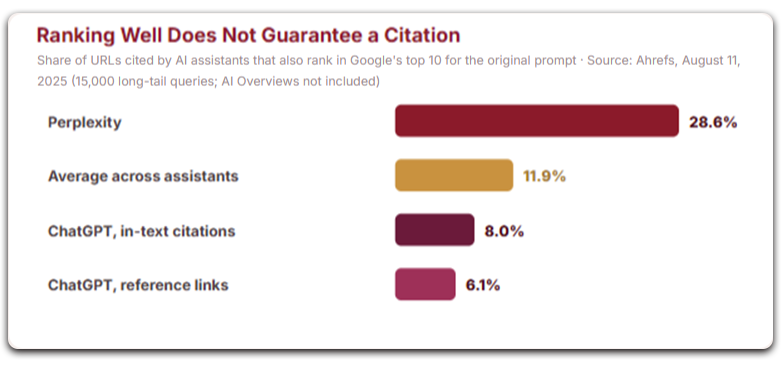
Ahrefs studied 15,000 long-tail queries across ChatGPT, Gemini, Copilot, and Perplexity with data from early July 2025, and reported on August 11, 2025, that only about 12% (11.9%) of the URLs the assistants cited also ranked in Google’s top 10 for the original prompt. Perplexity was highest at 28.6%, and ChatGPT’s in-text citations were 8.0%. The study did not include Google’s AI Overviews, which draw more heavily from pages that already rank, so it does not say rank is worthless. It says rank alone will not tell you whether the assistant outside Google names you.
One answer is a coin flip, so measure presence, not rank
SparkToro and Gumshoe asked 600 volunteers to run 12 prompts across ChatGPT, Claude, and Google’s AI, for nearly 3,000 runs. The same list of brands came back less than once in 100 times, and the same list in the same order about once in 1,000. What did hold up was visibility: some brands appeared in 60% to 90% of responses. Their conclusion was that repeat presence means something and exact rank does not. How many runs are enough remains an open question, and the study does not settle it.
That is why a single screenshot of an AI answer, or a tool that reports your “position” in one, is the wrong instrument. If you want the full mechanics of mention rate, including how a single check misleads, we cover it in Automate the Signals That Get You Recommended by AI, and this article will not repeat it. The point here is where mention rate fits: it is the first of three things to measure, not the whole picture.
Seen, Sought, Sold: Measuring Visibility When Nobody Clicks
When the click goes missing, split the path into three links and measure each one on its own. We call this method Seen, Sought, Sold. It is MediaBus Marketing Group’s working method, not an industry standard, and it is built on the billboard principle: you do not need the click if you can see what happened before and after it.
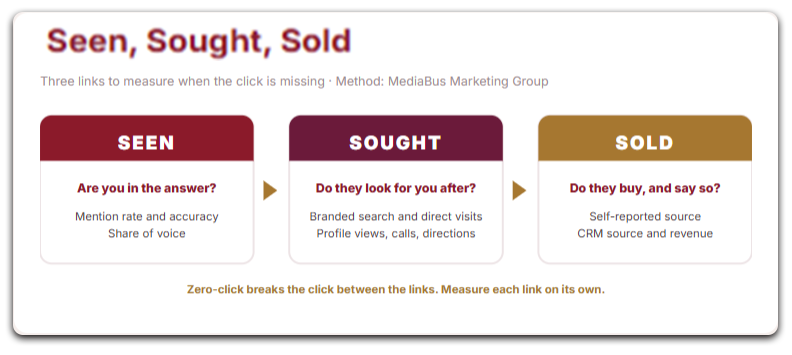
Link 1, Seen: are you in the answer, and is it right?
Write 25 real questions your buyers ask, taken from sales calls and the intake form, not from what you wish they asked. Run each one in the LLM Chatbots your buyers use, several times each, and record three things: whether you were named, whether what was said about you was accurate, and which competitors were named instead. Your mention rate is the share of runs that named you. Repeat the same panel monthly so you can compare like with like. Academic work shows how loosely the field defines this: the Princeton-led GEO paper (Aggarwal et al., KDD 2024) describes a framework for defining visibility metrics and reports visibility gains of up to 40% from some content changes, varying by domain. In other words, even researchers define visibility in more than one way, so pick your definition and keep it fixed.
Link 2, Sought: do people look for you afterward?
If an LLM Chatbot names you and a buyer is interested, the likely next step is to type your name into a search box or call you. That leaves traces: branded search impressions in Google Search Console, direct visits, views, calls, and direction requests on your Google Business Profile, and any sessions that carry a referrer from an assistant. Google’s own Business Profile performance report counts views on Search and Maps, calls, directions, website clicks, messages, and bookings for verified profiles. A branded-search lift is the closest thing a zero-click world has to a billboard’s traffic count. We found no independent study that quantifies how much AI exposure lifts branded search, so treat any such figure you see with caution and measure your own.
Link 3, Sold: do they become customers, and what do they say?
This is the link that analytics cannot supply and a person must ask. Add one required question to every lead path: “How did you first hear about us?” with a free-text box and an option for “an LLM Chatbot,” followed by “which one?” Train whoever answers the phone to ask it and write down the answer in the customer’s words. Self-reported source is imperfect, because people forget and guess, but it is the only place a customer can say the thing your software cannot see. One software vendor, Outfunnel, reported in June 2025 that leads naming AI as their source rose from about 0.8% in the first half of 2024 to about 7.3% in the first half of 2025, while “can’t remember” fell from 8.5% to 4.2%. That is a vendor’s data with an unreported sample size, so use it as a reason to ask the question, not as a benchmark for your business.
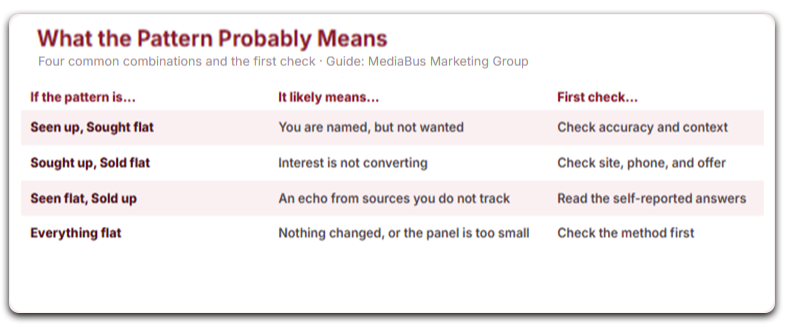
Reading the three links together
Each link on its own can mislead, so the value is in the pattern. This table lists four common patterns, what they probably mean, and what to check first. It is a diagnostic guide from MediaBus Marketing Group, not a statistical test.
In the Age of AI
You Gain the Advantage over Those Who Don't Step Up
The Echo Problem: Why Your Analytics Hides the AI Answer
Follow one customer. An LLM Chatbot names your company. The customer types your name into Google a day later, visits your site from that search, and fills out a form. Your analytics credit that lead to branded organic search. Nothing in the report mentions the LLM, because the LLM Chatbot never sent anyone. We call this the Echo Problem: the answer produces the sale, but the credit lands on whichever step was clickable.
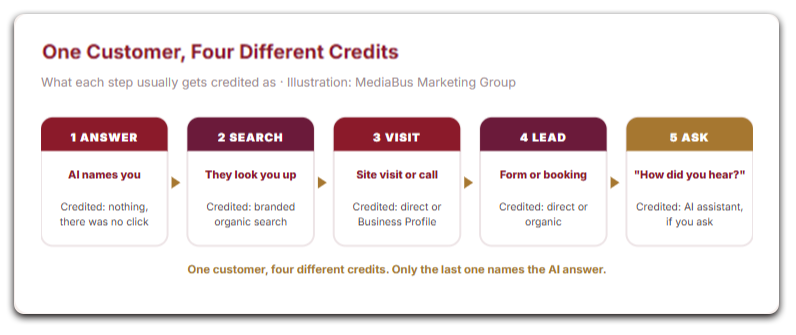
It gets harder to see in two ways. First, Google’s Search Console now has a report for generative AI views. Google’s Search Central announcement in June 2026 describes performance reports for AI Overviews and AI Mode in Search, and for Discover, rolling out in phases. The report covers impressions, pages, countries, dates, and, for Search, devices. As described in coverage of the release, it does not report clicks or citations, so you cannot compute a click-through rate from it. Check whether your property has it before relying on it. Second, referrers can disappear. Martech.org reported that sessions from ChatGPT’s Atlas browser often arrive without a referrer and show up as Direct or (not set), while Perplexity’s Comet browser passes the referrer. That test was small and light on method, so run your own check before you attribute a Direct spike to any LLM.
The remedy for the Echo Problem is not a smarter attribution model. It is the Sold link: ask the customer. When your report says branded search rose and self-reported “AI assistant” answers rose in the same month, that is the echo, finally traced to its source.
Ten Places Visibility Can Happen… Plus One More
Most owners picture visibility as one place, a search results page. In practice, it happens in ten, and they group into three families: where answers are given, where you are found nearby, and where AI learns about you. This map is about the places a customer can meet you. It is different from the map of where automation can run, which we cover in our LLM visibility article.
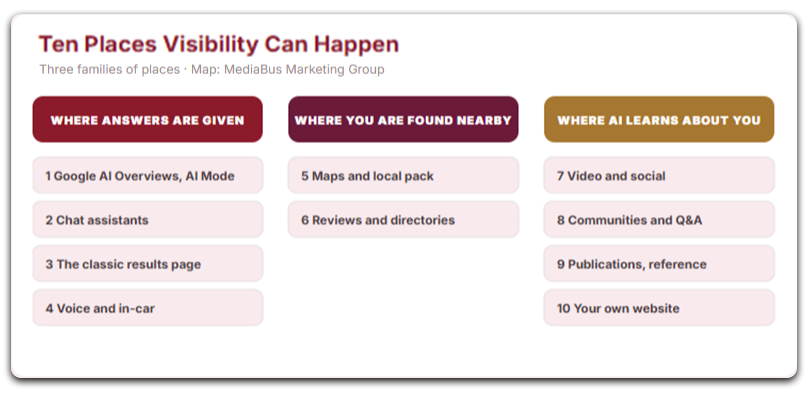
Each card below pairs one place with what the evidence says, how to measure it, and what a person should decide. We cite studies only where we found them and say plainly where we did not. Two cautions apply to the Peec AI figures. Peec sells AI-visibility software, and its list names the most-cited domains without percentages, so it tells you where assistants look, not how much weight each place carries. Industries differ too: in hotels, for example, travel booking sites rise to the top.
The Plus One…
Just in the last week since the date of this posting (which I imagine I will be writing more about in the coming days and weeks), OpenAI has released its own Business Profile Option. Yes, you can go into the likes of ChatGPT and be able to register your business with ChatGPT, which can tell you the direct numbers of mentions, inclusions, citations, recommendations, and how many click-throughs from ChatGPT to your site that you may receive. It is an exciting development and we will have to keep our eyes peeled to see what the real and true numbers may be; however, it is a needed step in the right direction
The One-Page Monthly Scorecard
You do not need ten dashboards. You need nine numbers, reviewed together once a month, with a baseline set before you change anything. This is a starting design from MediaBus Marketing Group, and you should change it to fit your business. The goal is to see Seen, Sought, and Sold side by side so the pattern is visible.
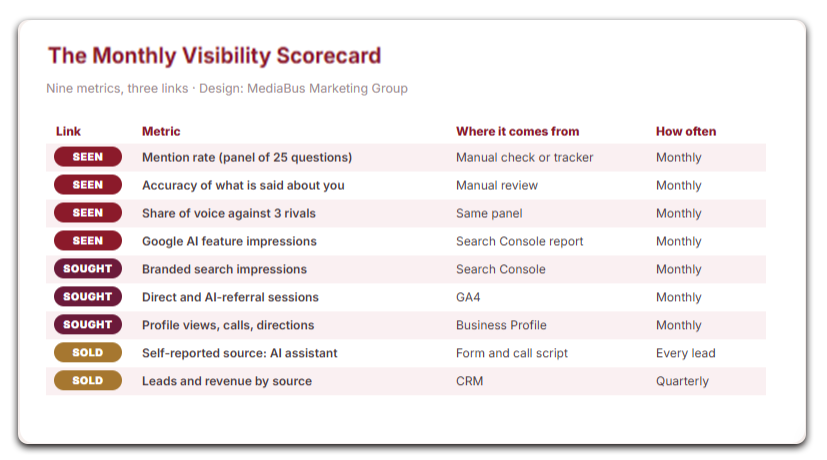
Start with a company baseline so you know what normal looks like, using our company baseline guide, and tie the Sold link back to revenue with the conversion metrics. If your leadership team wants this in a recurring report, our article on AI reporting and decision support explains how to automate it without losing the human check.
6 Best Practices for Measuring Visibility without Clicks
Little-Known Gems
The Perspective Shift
The click was never the point. It was always the receipt.
For twenty-plus years, the click was how we knew a person had been interested. It was never the interest itself. When the receipt disappears, the sensible response is not to panic about the missing paper. It is to measure the thing the receipt used to prove: were the right people able to find you, did they want you, and did they buy? Billboards, radio, and the phone book taught owners to do that long before the first link existed. Today, add one question to your intake form.
Bottom Line:
SparkToro found 68.01% of U.S. Google searches ended without a click in early 2026. Pew found that an AI summary roughly halved the click-through rate on a regular result, from 15% to 8%. Ahrefs found only about 12% of AI citations also ranked in Google’s top 10. The report you have used for years is measuring a smaller and smaller slice of what buyers actually do.
You do not need a new religion. You need a new ruler. Measure whether you are SEEN across a fixed panel of real questions, whether you are SOUGHT through branded search, profile activity, and referrals, and whether you are SOLD by asking customers how they found you.
Check all ten places, be honest about the ones with no data, and review nine numbers a month.
MediaBus Marketing Group will help you build your panel, set your baseline, add the question to your lead paths, and read the three links together each month.,
Start with an AI Visibility Audit, and we will show you where you are Seen, Sought After, and what you need to be doing to get there.
📞 · Contact Us Using the Form Below · ✉
Gap Analysis FAQs
Q1. What does zero-click mean, and how common is it?
Zero-click means a search ends without the user clicking through to any website, because the answer was on the results page. SparkToro estimated that 68.01% of U.S. Google searches ended without a click from January to April 2026, using Similarweb panel data. Its 2024 study found 60.45% with a different panel, so the two are not a clean trend. The mobile app was excluded, and zero-click is likely higher there.
Q2. Can I tell whether ChatGPT or other AI tools send me customers?
Partly. Check your analytics for referral sessions from assistants, but expect undercounting, because some AI browsers strip the referrer and visits can show as Direct. Also watch branded search and Business Profile activity, and ask every new lead how they first heard about you, including which LLM Chatbots, if any. The self-reported answer is the only direct evidence of the Sold link, and it works even when software cannot see the visit.
Q3. How many times should I run a question before I trust the result?
More than once. SparkToro and Gumshoe found the same prompt returned the same list of brands less than once in 100 times, so one run is nearly random, but visibility percentages held up. The right number of runs is an open question. Pick a consistent number, run the same panel monthly in the same assistants, and compare mention rate, not rank.
Q4. Is SEO and rank tracking still worth doing?
Yes, as one input among several. Roughly a third of U.S. Google searches still ended with a click in 2026, and Google’s own AI features draw on search. But Ahrefs found only about 12% of AI-cited URLs ranked in Google’s top 10 for the original prompt, so rank alone will not tell you whether assistants name you. Keep tracking rank and add mention rate, branded search, profile activity, and self-reported source.
Q5. What should I report to leadership each month?
Nine numbers in three groups. Seen: mention rate on a fixed panel, accuracy, share of voice against three rivals, and Google AI feature impressions where available. Sought: branded search impressions, direct and AI-referral sessions, and profile views, calls, and directions. Sold: self-reported source, and leads and revenue by source. Review them together against a baseline set before any change.
Action Items:
Sources Cited in This Article
All sources were read in November 2026. SparkToro, 2026 zero-click search study (Similarweb panel, January to April 2026; prior studies 2024 and 2019) · SparkToro and Gumshoe, study of AI recommendation consistency (Fishkin and O’Donnell), as reported by Search Engine Land · Ahrefs, “AI assistants vs. Google: citation overlap” study (August 11, 2025) · Pew Research Center, Google users clicked less when an AI summary appeared (July 22, 2025; March 2025 data) · Bain & Company and Dynata, consumer zero-click survey (n=1,117) · Google Search Central blog, Search generative AI performance reports (June 2026), with details from ppc.land coverage · Google Business Profile Help, “About Business Profile performance” (support.google.com/business/answer/9918094) · G2, B2B buyer survey on AI chatbots (August 2025 survey, reported October 6, 2025) · Martech.org, reporting on AI browser referrers · Peec AI, most-cited domains analysis (March 2026; 30 million cited sources; vendor-published) · Outfunnel, self-reported lead source data (June 17, 2025; vendor-published) · Aggarwal et al., “GEO: Generative Engine Optimization” (arXiv 2311.09735, KDD 2024).
SHARE THIS STORY ANYWHERE YOU LIKE
SHARE THIS STORY ANYWHERE
How to Measure Visibility in a Zero-Click, AI-Answer World
How to Measure Visibility in a Zero-Click, AI-Answer World The click was never the goal. It was the [...]
The AI Toolkit from MMG for Small Businesses Has Been Updated
The AI Toolkit from MMG for Small Businesses Has Been Updated A Toolkit is a Map. Use Each [...]
Mastering AI Automation for Data Reporting and Decision Support
Mastering AI Automation for Data, Reporting and Decision Support AI will answer any question about your numbers. First, [...]