

What Does Success with AI Look Like for a Growing Business?
Success with AI is Not Something You’Feel’. It is Something You Set Up;One Sentence, Four Roles, a Number and a Date.
Real AI success is quieter than the headlines. It looks like an ordinary Tuesday where something is measurably different, and someone can prove it.
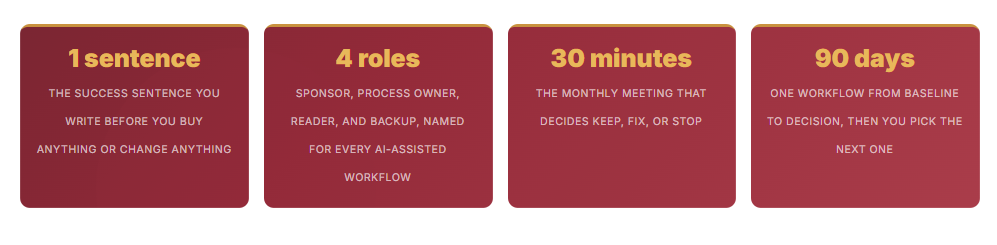 Most advice about AI success tells you what the studies found. This guide tells you what to do on Monday. You will write one success sentence, assign four roles, measure one workflow, set a review rule, and hold a 30-minute monthly meeting. Then you will know, with a number, whether AI is working in your company, and what to do next.
What You’ll Find in This Article
- A story about a board meeting where one question, ‘What is different on an ordinary Tuesday?’, changed what the company did next
- Why the headlines disagree: AI success rates of 5%, 6%, 37%, and 75% all come from different definitions
- Step 1: write the success sentence that every later decision gets checked against
- Step 2: name four roles so the work has an owner, a reader, and a backup
- The Tuesday Test: five signs of real success, and the exact thing you put in place for each one
- Step 3: run the monthly meeting, send the one-slide update, and learn to spot the look-alikes
- The look-alikes: five things that feel like success and are not, including the perception gap
- What to put in place in six parts of your business, the six rules to write down, and a 90-day plan with a note you can send your team
- A three-stage path for a growing business, twelve best practices, six little-known gems, a direct next step, and five FAQs
The Question That Changed What the Company Did Next
At a September board meeting, the CEO of a regional distribution company asked a simple question: “How is AI going?” The operations lead answered with confidence. Licenses had gone to 41 people, three departments had tried tools, and “everybody loves it.”
The chief financial officer, who had been quiet, asked a different question: “What is different on an ordinary Tuesday?” Nobody answered. Not because nothing had happened, but because nobody had written down what Tuesday used to look like.
The CEO did not buy anything that week. She did four things. She picked one process, credit-memo requests, which took about three days to resolve. She named the person who would run it and a second person who would read every draft the AI produced. She had the team time the work for two weeks. And she wrote down, before anything changed, what the saved hours would be used for.
They spent the next month on one process: credit-memo requests, which had been taking about three days to resolve. They mapped the steps, recorded the starting time, named one person to read every draft the AI produced, and agreed in advance what the saved hours would be used for.
By the next board meeting, the answer to “How is AI going?” was one sentence with a number in it. The enthusiasm had not changed. What changed was that someone could now point to something.
Most growing businesses can say how much they spent on AI and how many people have access. Far fewer can say what is different. That gap is where almost all of the disappointment lives, and closing it does not take a new tool. It takes a few decisions that only the owner or the CEO can make.
This guide offers a plain answer: a set of those decisions, in order. Success with AI is not a feeling, a tool count, or a headline. It is a short list of things you can point to on an ordinary Tuesday, and we give you the list, the evidence behind each item, and a way to check your own business this week. Each one comes with a thing to write down, a person to name, or a rule to set. You can do the first one today, in about fifteen minutes.
Step 1: Write the Success Sentence Before You Buy or Change Anything
Every AI project that stalls has the same missing piece: nobody wrote down, in advance, what success would be. So everything gets called a win, and nothing can be called a failure. The fix is one sentence, written by you, before the work starts.
In 90 days, on an ordinary Tuesday, [THE WORKFLOW] will take [AFTER GOAL RESULT] instead of [BEFORE BENCHMARK], [NAME] will read every output, and in the time we save, will go to [THE NEW USE].
We will check on [DATE], and we will keep it, fix it, or stop it.
Notice what the sentence forces. It forces you to pick one workflow instead of ‘AI.’ It forces a before and an after, which means someone has to measure the before. It names a reader, so a person is accountable for quality. It says where the saved time goes, so the hours do not evaporate. And it sets a date, with three possible outcomes. Stopping is one of them.
How to write yours in fifteen minutes
- Pick the workflow. Choose something that repeats weekly, has a clear start and finish, and annoys people. Credit memos, quote follow-up, weekly reporting, and new-hire paperwork are common first picks.
- Write a rough estimate first. A guess is fine for now. You will replace it with a measured number in Step 3.
- Choose how you’ll use the saved time. Be specific: ‘more collection calls,’ ‘quotes out the same day,’ ‘month-end two days earlier.’ ‘More strategic work’ does not count.
- Set the date. Ninety days from now, on the calendar, with the decision meeting already booked.
If you cannot fill in a gold blank, that is the finding. You have just learned what to figure out before spending anything.
Step 2: Name Four Roles for Every AI-Assisted Workflow
AI work fails quietly when everyone is responsible. A tool gets rolled out, a few enthusiasts use it, and nobody owns the result. The fix costs nothing: put four names on the workflow, in writing.
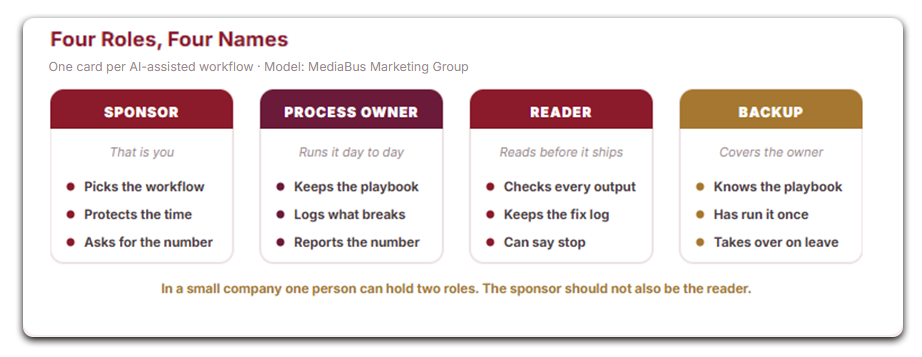
The sponsor is you, or someone who reports to you. The sponsor picks the workflow, protects the time to do it properly, and asks for the number every month. Without a sponsor, the work loses every argument with the daily rush.
The process owner runs it day to day. This person keeps the written steps current, logs what breaks, and reports the measurement. Pick the person who already knows the workflow best, not the person who is most excited about the technology.
The reader is the quality gate. The reader looks at what the AI produced before it reaches a customer, a colleague, a regulator, or the bank. The reader should not be the person who built the workflow, because people are poor judges of their own setup. The reader also needs the authority to say stop.
The backup covers the owner. The backup knows where the playbook lives and has run the workflow at least once. In a company of twenty or forty, one person may hold two roles. The sponsor reading the output is the one combination to avoid.
The Tuesday Test: Five Signs of Real Success, & What to Put in Place for Each
The Tuesday Test is MediaBus Marketing Group’s working method, not an industry standard. Picture an ordinary Tuesday, with nothing special going on, and ask five questions. Below, each sign comes with the one thing an owner puts in place to make it true. Do them in order. By the end, you will have the whole system.
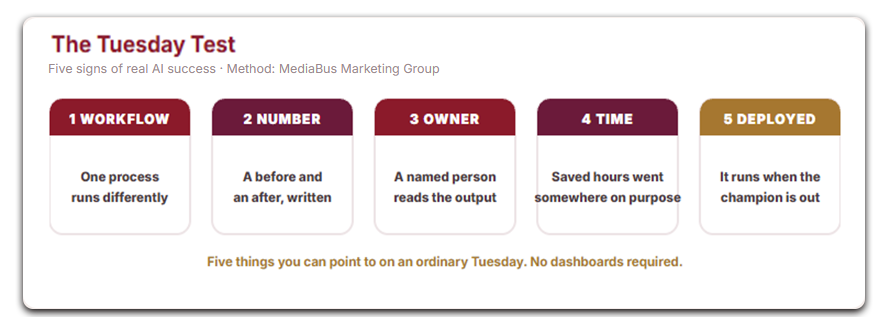
Position 1: One workflow runs differently
What to put in place: a written map of the workflow, before and after. Sit with the process owner for an hour and write down every step, who touches it, and where it waits. Cross out the steps that exist only because of old limits, such as retyping data from one system into another. Then decide, step by step, where AI assists and where a person still decides. Our workflow mapping guide walks through the method.
The goal is a different workflow, not the same workflow with a chatbot attached. If your map after AI looks identical to your map before, nothing has changed except the cost.
Position 2: A number with a before and an after
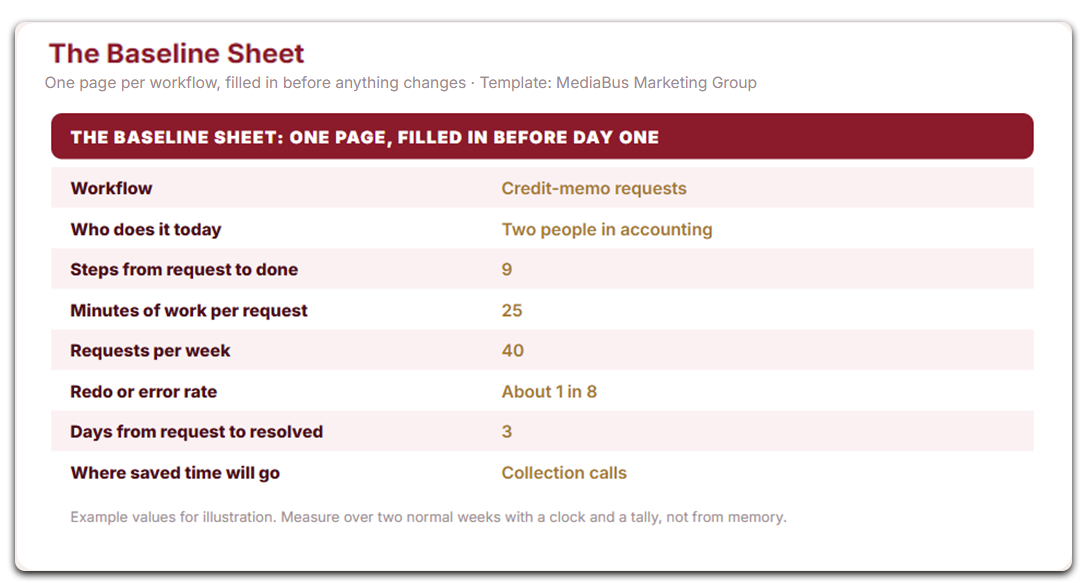
What to put in place: a one-page baseline sheet, filled in before day one. Measure the current workflow for two normal weeks, using a clock and a tally, not memory. Record the minutes per item, the items per week, how often work is redone, and how long the whole thing takes from request to finish. Our company baseline guide covers how to capture it.
 Why bother? Because feelings are unreliable. In a 2025 trial by the research group METR, 16 experienced developers expected AI to speed them up, believed afterward that it had, and were timed at 19% slower on those tasks. That is a small, narrow study of specific tools, and it should not be read as a verdict on AI. The takeaway for an owner is simpler: a team can feel faster and not be faster, and only the clock can tell you which.
Position 3: A named person reads the output
What to put in place: a review ladder. Start with the reader checking everything the AI produces. Keep a short fix log: what was wrong, how often, how serious. Then ease off one rung at a time, and only on evidence.
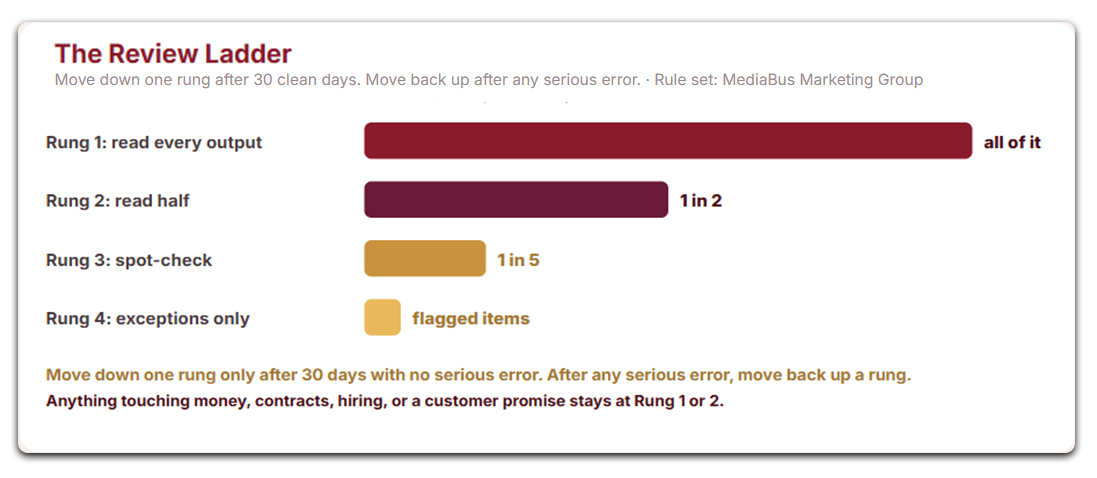
Two rules make the ladder work. First, a serious error sends you back up a rung, no debate. Second, anything that touches money, a contract, a hiring decision, or a promise to a customer never goes below Rung 2. A Stanford and BetterUp survey of 1,150 U.S. desk workers, reported in Harvard Business Review, found that 40% had received polished but empty AI-generated work in the previous month, and respondents said each instance took nearly two hours to sort out. The survey is self-reported, but any manager will recognize the pattern. A reader stops it at the door.
Position 4: The saved time went somewhere on purpose
What to put in place: a reinvestment rule, written before the time is saved. When the workflow gets an hour faster, who gets that hour, and what do they do with it? Write it into the success sentence and into the process owner’s weekly list.
Here is how this fails without a rule. Accounting saves six hours a week on credit memos. Nobody is told what to do with them. The work expands, a few meetings get longer, and by March the hours have disappeared into the day. Compare that with a company that wrote, ‘Two of those hours go to collection calls on invoices over 30 days.’ Now there is a second number to track, and the saving shows up in cash.
The rule can be modest. ‘Same-day quotes.’ ‘Month-end closes two days sooner.’ ‘Every lead gets a call within the hour.’ What matters is that it is specific enough for the owner to check.
Position 5: It runs when the champion is out
What to put in place: a playbook, and then the vacation test. The playbook is a short document with the workflow’s purpose, the steps, the tool and where to log in, the prompts or settings that work, the common failure points, and who to call. It should be written so that the backup can run the workflow without help.
Then run the vacation test. Have the process owner take two weeks off, or simply step away, and let the backup run it from the playbook. If the workflow stops, the playbook is incomplete, and you have found out while it is cheap. Write the playbook in the first 60 days, when the owner is excited and the details are fresh, not on the day they give notice.
If you want help turning tribal knowledge into something a backup can use, our guide on AI and institutional memory covers that.
Step 3: Run the 30-minute Monthly Meeting and Send One Slide
Systems drift unless someone checks them on a schedule. For AI, the check does not need a committee or a dashboard. It needs thirty minutes, once a month, with the sponsor, the process owners, and the readers in the room.
The agenda
- Read the numbers (5 minutes). For each workflow: the before, the now, the date. No commentary yet.
- Read the fix log (5 minutes). What went wrong, how often, how serious. The reader presents it, not the process owner.
- Set the review rung (5 minutes). Move down a rung after 30 clean days. Move up after any serious error. Record the decision.
- Check where the saved time went (5 minutes). Compare it to the rule you wrote. Did it go where you said?
- Decide: keep, fix, or stop (10 minutes). One choice per workflow, and one next workflow to start if there is room.
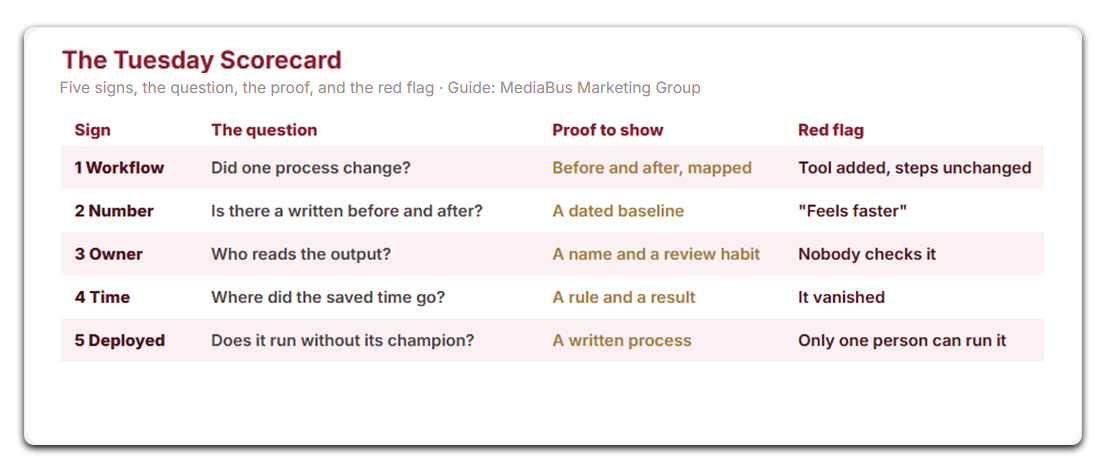
The scorecard below turns the Tuesday Test into a monthly habit. For each sign, ask the question, ask for the proof, and watch for the red flag.
The One-Slide Update for Your Board, Partners, or Leadership Team
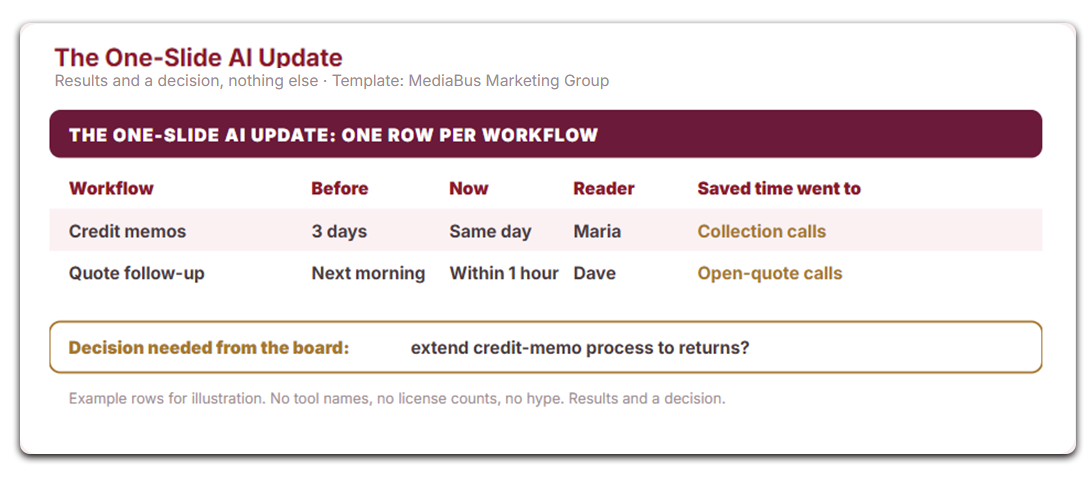
When someone above you or beside you asks, ‘How is AI going?’, hand them the slide, not a tour of the tools. One row per workflow: where it was, where it is, who reads it, and where the saved time went. Add one line for the decision you need.
Know the Look-alikes
Some things feel like success and are not. They are real activity, easy to count, and easy to report, which is why smart teams get fooled. When you see one of them in a status update, ask the question in the right-hand column.
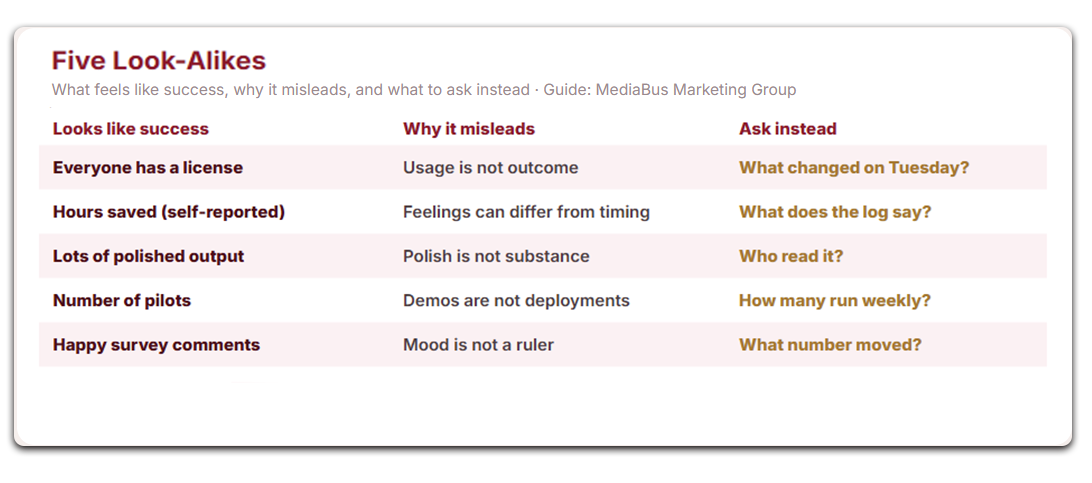
None of these is bad on its own. Licenses, enthusiasm, and pilots are good starting points. They become a problem only when they are reported as the result.
Four Numbers, Four Definitions to Be Aware of
Boston Consulting Group’s September 2025 study of 1,250 senior executives found that only 5% of companies were achieving AI value at scale, and that 60% were not achieving material value at all, with the remaining 35% scaling and seeing some returns. McKinsey’s 2026 State of AI survey, with 1,719 respondents in 97 countries fielded May 4 to June 8, 2026, found that 37% attribute at least some EBIT impact to AI, and that about 6% are what it calls AI high performers: they attribute at least 5% of EBIT to AI and describe its impact as significant. Meanwhile, the 2025 Wharton report, based on about 800 senior leaders at U.S. enterprises with 1,000 or more employees, found that three in four report positive returns.
These numbers are not in conflict. BCG measures value at scale, McKinsey measures a share of earnings, and Wharton measures leaders’ perception of returns, which the report itself describes as perception and not audited financials. A BCG caveat applies too: its data is self-reported, some figures reflect expected rather than achieved results, and its authors are consultants who promote their own framework. The lesson for an owner is practical. If someone quotes you a success rate, ask which definition they used.
Even adoption is measured differently
The same problem shows up with adoption. The U.S. Census Bureau reported that 19.8% of U.S. businesses used AI as of May 3, 2026, in any business function. The U.S. Chamber of Commerce said in August 2025 that 58% of small businesses use generative AI, up from 40% in 2024. The Chamber’s release did not state its sample or method on the page we read, and it is an advocacy organization, so the two figures cannot be compared directly. We cover the Census data in our AI Toolkit update.
Success is possible, and it is specific
None of this says AI does not work. McKinsey found that individuals feel the benefit: 80% say AI has improved their personal productivity. But only 37% of organizations attribute any EBIT impact to it. The distance between those two numbers is the subject of this article. Personal usefulness is common, and business-level results require something more deliberate, which the next section describes.
Individuals feel faster. Businesses get paid only when something about the way work flows has actually changed.
What to Put in Place in Six Parts of Your Business
You do not have to do all six. Pick the one where your team loses the most time or drops the most balls, and start there. Each card says what to put in place, the one ruler to measure it by, and what a person keeps deciding. The autonomy levels come from our pillar guide on mastering AI automation: Level 1 assists a person, Level 2 runs a workflow with a person reviewing, and Level 3 acts on its own within limits. Start at Level 1.
What success looks like in six parts of a growing business
BCG’s report says about 70% of potential AI value is concentrated in core business functions, which is why we frame success by function. Each entry states what success looks like, the warning sign that it is not happening, a first move with its ruler, and what a person should decide. The first-move suggestions are MediaBus Marketing Group’s, not claims from the studies. Every one starts at Level 1 of the Autonomy Ladder in our pillar article, Mastering AI Automation for LLM Success, where AI assists, and a person decides.
Part 1, Leadership: decisions made faster, with the evidence in one place. Success looks like: the weekly numbers meeting starts from one agreed set of figures, and the questions it asks have changed. Warning sign: meetings that still argue about whose numbers are right. First move and ruler: time one recurring decision from question to answer; ruler is hours from question to decision. A person decides: which decisions AI may inform.
Part 2, Sales: faster, steadier follow-up. Success looks like: nobody wonders whether a lead was answered, and time to first response has shrunk and stayed there. Warning sign: follow-up depends on who remembers. First move and ruler: measure time from inquiry to first reply; ruler is hours to first response. A person decides: pricing, promises, and who gets a call. Level 1, Level 2 for reminders.
Part 3, Marketing: more output you would sign your name to. Success looks like: the weekly content job takes less time, and a person has shaped every draft. Warning sign: volume is up, but the writing sounds like everyone else’s, which is workslop for customers. First move and ruler: time one repeating content job against a written voice guide, plus one conversion number. A person decides: brand voice, claims, anything public.
Part 4, Operations: fewer dropped handoffs. Success looks like: tasks stop falling through the cracks, and the same document is no longer rebuilt every week. Warning sign: the tool is in place, but the steps are the same. First move and ruler: map one handoff and count drops per month before and after. A person decides: priorities and any change to a customer commitment.
Part 5, Finance and back office: a calmer month-end. Success looks like: books close sooner, invoices go out on time, exceptions are flagged for a person. Warning sign: faster output with errors discovered by the auditor or the customer. First move and ruler: one recurring task with a person approving every output; ruler is days to close or days sales outstanding. A person decides: payments, prices, anything filed with a regulator. Never automate payments first.
Part 6, People: hiring and onboarding that do not depend on one person. Success looks like: new hires reach their first solo task sooner, and what experienced people know is written down. Warning sign: screening tools nobody has checked for bias, or onboarding that lives in one manager’s head. First move and ruler: one stage, such as the first-week checklist; ruler is days to first solo task. Check screening tools with counsel. A person decides: every hiring, pay, and firing decision.
12 Best Practices to Use This Week
The 90-Day Plan & the Note to Send to Your Team
Everything so far fits into ninety days and one workflow. The plan below puts the pieces in order. Resist the urge to run three workflows at once. A single clean result teaches your company more than three half-finished experiments, and it gives you a method you can repeat.
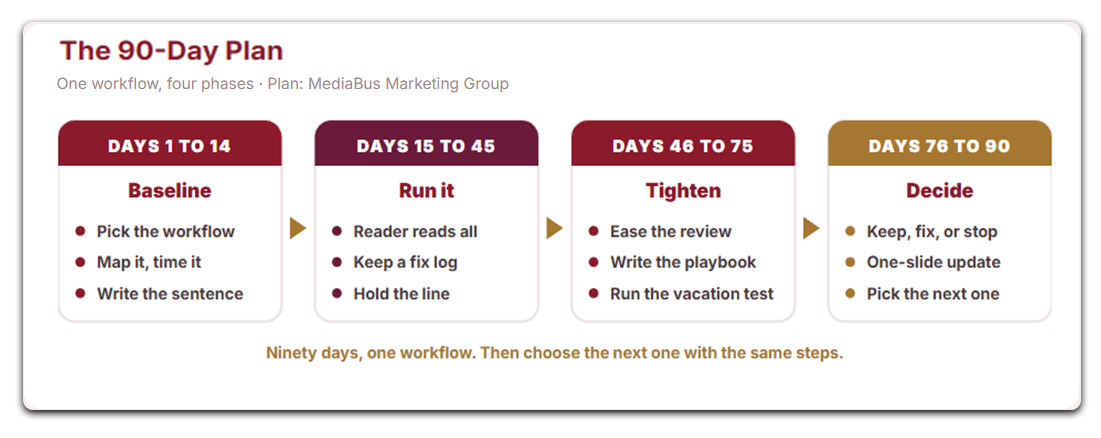
The part owners skip is telling the team. Silence reads as threat. When people hear about AI from rumor, they assume the worst and quietly route around it. A short, plain note from you removes most of that. Here is a version you can adapt and send.
A Note You Can Send Your Team
Team, over the next 90 days, we are going to change how one piece of our work gets done, and we are going to measure whether the change helps.
The workflow is [WORKFLOW]. [NAME] will run it, [NAME] will read what comes out, and [NAME] will back them up. Nobody is being replaced. The goal is to take the slow and repetitive parts off people so they can spend more time on [THE USE].
For the first two weeks, we are only measuring how the work is done today. Please do not change anything yet, and please be honest about how long things take. The numbers are for us to improve the process, not to grade anyone.
If something goes wrong, tell [READER] and write it in the fix log. A caught error is a good day. We will review the results on [DATE] and decide together whether to keep it, fix it, or stop it. Questions come to me directly.
Adapt the wording to your culture. If you have employment-law questions about monitoring or role changes, check with your attorney before sending.
When day 90 arrives, hold the decision meeting. If the number moved and the reader is satisfied, keep it, write the playbook into your standard way of working, and pick the next workflow. If the number moved but quality is shaky, fix it and run another 30 days. If it did not move, stop, and count that as a success: you learned for the cost of a few weeks and not a year of license fees. The incremental testing guide explains why small, reversible steps beat big launches.
Little-Known Gems
The Perspective Shift
Success with AI is a Sentence You Write, a Person You Name, & a Date You Keep.
Most owners wait for the results to tell them whether AI is working. The owners who get results do the opposite. They decide in advance what working means, assign someone to check, and set a day to decide. That is not a technology skill. It is a management habit, and you already have it. You are simply pointing it at something new. Today, fill in the gold blanks.
Bottom Line:
Here is the bottom line. You do not need a bigger budget, a data team, or a better tool to succeed with AI. You need to put six things in place: a success sentence, four named roles, a measured baseline, a review ladder, a rule for where the saved time goes, and a playbook that works when the champion is out. Then you hold a 30-minute meeting every month and decide to keep it, fix it, or stop it.
Start This Week.
Write the sentence. Name the four people. Book the day-90 meeting. The rest follows, one Tuesday at a time.
Do that for one workflow, for ninety days, and you will be able to answer ‘How is AI going?’ with one sentence and a number.
MediaBus Marketing Group will sit down with you & build this with you…
The success sentence, the four roles, the baseline, the review rule, and the 90-day calendar, for the one workflow where your team loses the most time. Tell us where to begin, and we will make the first 90 days simple.
📞 · Contact Us Using the Form Below · ✉
MMG AI SUCCESS FAQs
Q1. What does success with AI look like, and what should I put in place first? Success looks like five things you can point to on an ordinary day: one workflow that runs differently, a written before-and-after number, a named person who reads the output, saved time that went somewhere on purpose, and a process that keeps running when its champion is away. The first thing to put in place is a success sentence: name one workflow, the before and after, the reader, where the saved time goes, and the date you will decide to keep, fix, or stop it.
Q2. Who should own AI in a company with no IT or data team? Give every AI-assisted workflow four named roles: a sponsor, usually the owner or an executive, who picks the workflow and asks for the number; a process owner who runs it day to day; a reader who checks the output before it ships; and a backup who can run it from the written playbook. In a small company, one person can hold two roles. Avoid having the sponsor also be the reader.
Q3. How do I know the time savings are real? Measure before you change anything. Record minutes per item, items per week, redo rate, and days from request to finish over two normal weeks, using a clock and a tally. Measure the same things after 30 and 90 days. Research such as the 2025 METR trial, a narrow study of experienced developers, shows that people can feel faster while being timed slower, so the log should settle the question, not opinion.
Q4. How much should my team be allowed to do with AI on its own? Use a review ladder. Begin with a reader checking every output. After 30 days without a serious error, move to reading half, then spot-checking about one in five, then exceptions only. Any serious error moves the workflow back up a rung. Anything involving money, contracts, hiring decisions, or customer promises should stay at full or half review, and a person should make the final decision.
Q5. How long before I see results, and when should I stop? Plan on 90 days for one workflow: two weeks to baseline, about a month of full-review operation, a few weeks of tightening and writing the playbook, and a decision meeting at the end. That timeline is MMG’s practical guidance, not a study finding. Stop a workflow if the number did not move, if quality problems keep recurring, or if the saved time is not going where you said it would. A clean stop is a useful result. If you want help setting this up, contact MediaBus Marketing Group.
Action Items:
Sources Cited in This Article
The playbook, the Tuesday Test, the success sentence, the four roles, the review ladder, the baseline sheet, and the 90-day plan are MediaBus Marketing Group’s own methods, not findings from the studies below. Boston Consulting Group, “The Widening AI Value Gap” (September 2025; 1,250 executives; about 5% achieving AI value at scale, about 60% not achieving material value) · McKinsey, “The state of AI” survey (2026; 1,719 respondents in 97 nations; 37% report some EBIT impact from AI, about 6% attribute 5% or more) · Wharton and GBK Collective, 2025 AI Adoption Report (October 2025; about 800 leaders at large U.S. firms; three in four report positive returns, a perception measure) · METR, randomized trial of AI tools and experienced open-source developers (July 2025; 16 developers, 246 tasks; developers expected a 24% speedup, believed afterward they were 20% faster, and were measured 19% slower; a narrow snapshot; figures as reported by The Register) · Stanford Social Media Lab and BetterUp Labs, workslop survey (2025; 1,150 U.S. desk workers; 40% had received workslop in the last month; self-reported; as reported by Axios and Harvard Business Review).
SHARE THIS STORY ANYWHERE YOU LIKE
SHARE THIS STORY ANYWHERE

What Does Success with AI Look Like for a Growing Business?
What Does Success with AI Look Like for a Growing Business? Success with AI is Not Something You'Feel'. [...]

How to Measure Visibility in a Zero-Click, AI-Answer World
How to Measure Visibility in a Zero-Click, AI-Answer World The click was never the goal. It was the [...]
The AI Toolkit from MMG for Small Businesses Has Been Updated
The AI Toolkit from MMG for Small Businesses Has Been Updated A Toolkit is a Map. Use Each [...]