

What’s Preventing My Business From Showing Up in AI Inclusions, Citations, and Recommendations
A Complete Guide to GEO, AI Citations & Business Visibility in 2026 – Stop being invisible to the likes of ChatGPT, Perplexity, Gemini, etc.
What You’ll Find in This Article…
- Why AI citations are the new “position zero” – and why your Google ranking doesn’t guarantee you’re in the room
- The 5 root causes that make businesses invisible to ChatGPT, Perplexity, Gemini, and other LLM Overviews
- What Generative Engine Optimization (GEO) is, how it differs from SEO, and why you need both
- The “Consensus Signal” – the little-known mechanism AI uses to decide who to trust and recommend
- Why Bing indexation is a direct ChatGPT visibility action most businesses completely overlook
- The truth about llms.txt: what it actually does (and doesn’t do) for AI citations right now
- The “Island Test” – the single content audit that can dramatically raise your AI citation rate
- Platform-by-platform breakdown: why ChatGPT, Perplexity, and Google AI pull from different source pools
- A concrete action plan – from quick wins to long-game authority building – any size business can deploy
- 5 critical FAQs answered so you understand exactly where to focus your energy first
The Game Has Already Changed – You’re Just Not Playing It Yet
The search landscape as you knew it is gone. It didn’t fade – it was swallowed whole. Over 800 million people now use ChatGPT weekly. Google AI Overviews now appear in roughly 50% of all searches. Perplexity has become the default research tool for analysts, journalists, and technical buyers. When these platforms answer a question – about which software to buy, which contractor to hire, which service to trust – they cite a tight, curated shortlist. If your business isn’t on that shortlist, you don’t exist to that buyer. This is not a future problem. It is the current reality shaping your pipeline right now.
Pages cited in LLM AI Overviews earn 35% more organic clicks than non-cited competitors on the same results page. Visitors arriving from Perplexity convert at roughly 11 times the rate of traditional organic search traffic. And here is what should stop you cold: searches triggering AI Overviews have an 83% zero-click rate, compared to around 60% for traditional queries. Your buyer is getting the answer without ever visiting anyone’s website – and if AI names your competitor, your competitor gets the credit, the trust, and the sale. The question is no longer whether to optimize for AI. The question is how fast you can close the gap.
Most business owners and even most marketers are focused on the wrong battlefield. They are obsessing over Google rankings while the real competition has moved to AI inclusion. An AI Visibility Audit routinely reveals that companies with strong Google presences are completely absent from AI-generated answers in their category — and that smaller competitors who got the structure right are being recommended instead. Rankings and citations are two separate games. You must play both.
Know Your ‘Battlefield’
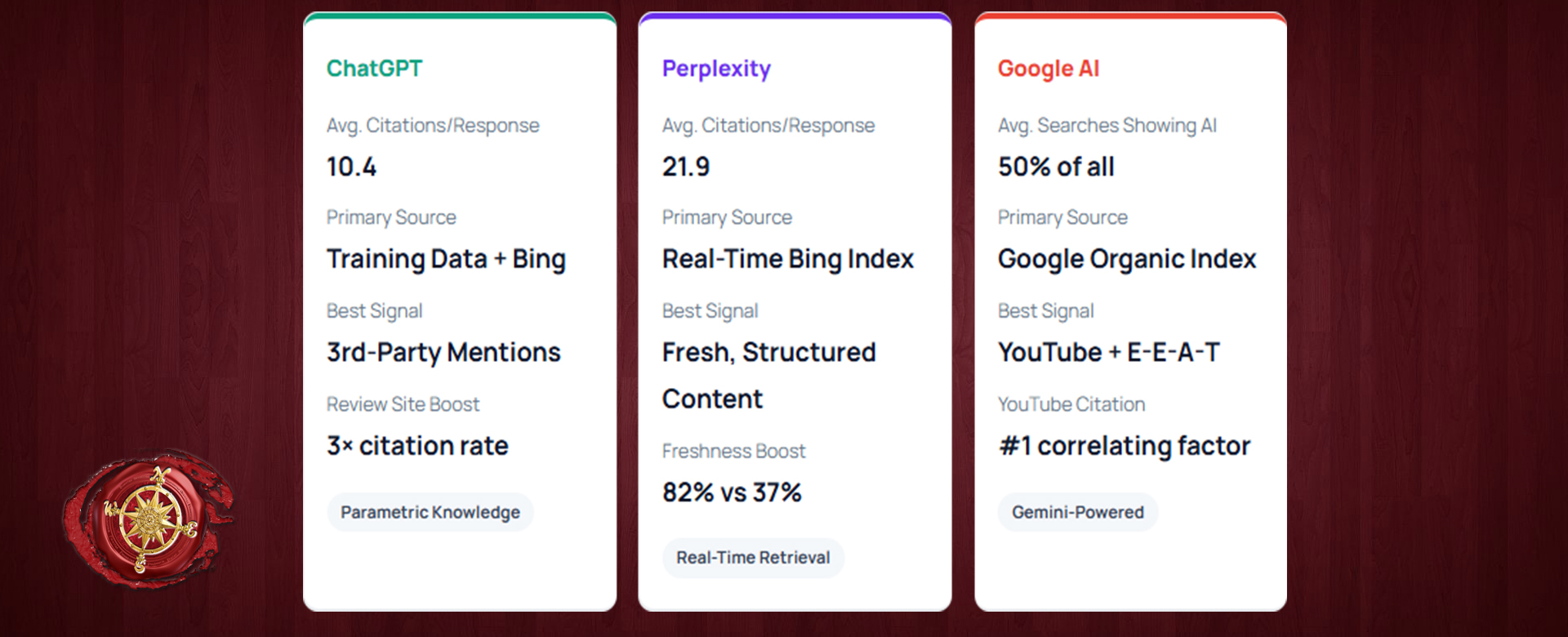
** Only 11% of domains are cited by both ChatGPT and Perplexity. Each platform requires distinct optimization.
The 5 Root Causes That Make Your Business Invisible to AI
Businesses don’t fail to appear in AI recommendations because they are bad businesses. They fail because they have not yet spoken the language AI systems use to identify, verify, and trust a source. Research from Princeton, Georgia Tech, and IIT Delhi found that GEO-optimized content achieves 30–115% higher visibility in AI-generated answers. That range is staggering, and it exists because most brands are starting from near-zero optimization. The opportunity is enormous for those who move now.
- Root Cause #1 – Your Content Is Not Structured for Extraction. AI systems don’t read websites the way humans do. They scan for clear, direct, front-loaded answers. Research confirms that 44.2% of all LLM citations come from the first 30% of page content. If your most important claims are buried under three paragraphs of background context, AI skips them. The fix: answer first, explain second. Every section of your site should open with its conclusion, not build toward it. This is answer-first architecture, and it is the single highest-leverage content change you can make today.
- Root Cause #2 – You Have No Consensus Signal. When ChatGPT, Perplexity, or Gemini needs to recommend a solution, it scans for agreement across multiple independent sources before confidently citing a brand. If your product appears consistently across Reddit discussions, YouTube tutorials, industry publications, review sites like G2, and your own website – all with similar positioning – AI systems gain confidence in recommending you. If you only exist on your own website with minimal external validation, AI systems treat your claims with skepticism. Brand web mentions correlate with AI citation rates at 0.664 – roughly three times stronger than backlinks at 0.218.
- Root Cause #3 – You Are Not in Bing’s Index. This is the most overlooked technical gap in AI visibility strategy. Perplexity and ChatGPT browsing both pull from Bing’s index. If you have not submitted your sitemap to Bing Webmaster Tools, do it today — it takes five minutes and directly affects whether AI search can find you. Check your robots.txt immediately to confirm that OAI-SearchBot, PerplexityBot, and ClaudeBot are not blocked — a blanket “Disallow: /” kills all AI crawler access instantly.
- Root Cause #4 – Your Entity Profile Is Fragmented or Nonexistent. AI systems identify businesses as entities – structured, verifiable facts about who you are, what you do, and where you operate. Align NAP (name, address, phone) across all directories. Claim Google Business Profile and Apple Business Connect. Update Bing Places and industry-specific listings. Brands with clean and consistent entity markup are more likely to be cited in generative responses than those mentioned only in unstructured content. For local businesses especially, consistent entity signals are the difference between being cited and being invisible.
- Root Cause #5 – Your Content Has No Topical Authority. AI systems favor sources that demonstrate deep, consistent expertise on a subject – not generalists who mention many things superficially. Domain-level topical authority matters more than individual page authority for AI retrieval. If your website covers your services across five pages but a competitor has 40 pages of deeply interconnected content on related topics, the competitor wins the citation. Building topical authority means creating pillar content, supporting articles, and linking them with descriptive anchor text.

GEO: Is the New Discipline You Cannot Afford to Ignore
Explore MediaBus’s complete content strategy library to see how GEO integrates into a full marketing system.
Cross-platform monitoring of 20 category prompts across 6 AI platforms found that brands implementing systematic GEO practices achieve an average mention rate of 21.4% on Google Gemini, 20.0% on Microsoft Copilot, 11.4% on Perplexity, and 11.4% on Google AI Mode – compared to near-zero visibility for brands without optimization. Those numbers represent real buyers seeing your name in the exact moment they are researching their next purchase. Zero-optimization brands are invisible in those same moments. The gap is a measurable market share difference that compounds month over month.
Each AI Platform Is a Different Game – Play Each Differently
One of the most dangerous assumptions in AI visibility strategy is that optimizing for one platform covers them all. Analysis of 680 million AI citations found only 11% domain overlap between ChatGPT and Perplexity. A company that dominates Perplexity’s citation pool can be nearly absent from ChatGPT, and vice versa. One-platform thinking leaves 89% of the citation landscape completely unaddressed.
ChatGPT constructs answers more from parametric knowledge baked into training data than from real-time web citations. SE Ranking found that domains with active profiles on G2, Capterra, and Trustpilot have 3× higher ChatGPT citation rates. Domains with significant Reddit and Quora presence have 4× higher rates. Getting your brand mentioned in authoritative third-party publications, review platforms, and community discussions is the lever that moves ChatGPT inclusion – not rewriting your homepage.
Perplexity averages 21.9 citations per response – more than double ChatGPT’s 10.4. Perplexity’s freshness sensitivity is extreme – showing an 82% citation rate for content updated within 30 days, falling to 37% for older content. Optimize for Perplexity by keeping content fresh, front-loaded with direct answers, and submitted to Bing. MediaBus’s AI Visibility Audit benchmarks your brand across all five major platforms simultaneously.
In mid-2025, 76% of AI Overview citations came from top-10 organic results. By early 2026, that figure had dropped to 38% in Ahrefs data and as low as 17% in BrightEdge research. Semantic completeness, structured data, E-E-A-T signals, and multi-modal content now influence Google’s/Gemini’s AI Overview selection independently of ranking position. YouTube has emerged as one of the most-cited sources in AI Overviews, with Ahrefs research on 75,000 brands finding that brand mentions in YouTube video titles and transcripts are the single strongest correlating factor with AI Overview visibility among all signals studied.
Little-Known Gems: What Businesses Miss
Your Action Plan: From Invisible to Cited
The businesses that win AI visibility are not the ones waiting for the perfect strategy. They are the ones executing the fundamentals while their competitors are still arguing about whether AI search is real. Here is the sequence that produces results fastest – ranked by speed of impact.
This Week (Quick Wins):
- Submit your sitemap to Bing Webmaster Tools (5 minutes direct ChatGPT access action).
- Verify that OAI-SearchBot, PerplexityBot, and ClaudeBot are explicitly allowed in your robots.txt.
- Add FAQPage JSON-LD schema to your top three pages with 3–5 direct-answer questions.
- Rewrite the opening paragraph of your most important service page to lead with a direct, quotable answer.
- Test your top pages with JavaScript disabled to identify rendering gaps.
These five actions can be completed in a single day and create immediate improvement in AI crawler accessibility.
This Month (Content & Entity):
- Conduct an AI visibility audit — run your top category questions through ChatGPT, Perplexity, Gemini, Claude, and Grok. Document who is cited and what they have that you don’t.
- Build or update your Organization schema with consistent NAP data and sameAs references.
- Apply the Island Test to your top 10 pages.
- Publish one YouTube explainer video with a transcript on your core topic.
- Identify missing review platform profiles and create them.
A Comprehensive Marketing Plan from MediaBus integrates GEO into your full content calendar so nothing falls through the cracks.
This Quarter (Authority & Consensus Building):
- Publish at minimum four long-form, deeply structured articles on your core topics — each with stacked schema, answer-first structure, internal links, and external citations.
- Pursue mentions in industry publications, local news, and trade directories.
- Establish a 90-day content freshness cycle – update key pages with new statistics and examples, then update the dateModified schema timestamp.
- Monitor which content formats, answer lengths, and entity patterns generate consistent citations versus being ignored by AI systems.
The Long Game (Compounding Authority):
- Early adoption of GEO practices creates authority signals that compound over time, building stronger positions in AI recommendation systems.
- Once an LLM selects a trusted source, it reinforces that choice across related prompts – hard-coding winner-takes-most dynamics into model parameters.
- The businesses building these signals right now are locking in competitive advantages that late-movers will find extremely difficult to dislodge.
AI-enhanced social marketing compounds your visibility by building the multi-platform presence that feeds the consensus signal AI systems use to verify and recommend brands.
The Bottom Line: The Invisible Business Gets Nothing
Every single day that you are not in AI citations, inclusions, and recommendations is a day your competitor gets that mention. That endorsement. That buyer’s trust. That sale. The rules of discovery have been rewritten – not gradually, not tentatively, but completely. The buyer who used to Google your category, scroll through ten blue links, and call three options now asks ChatGPT for a recommendation. Perplexity gives them a synthesized answer with two or three named sources. If you are not one of those sources, you are not in the consideration set. Period.
The good news – the extraordinary, act-on-it-today news – is that most of your competitors are still asleep. They have not submitted to Bing. They have not structured their content for AI extraction. They have not built the multi-platform consensus that AI systems use to verify trustworthiness. A significant gap will emerge between brands that proactively manage AI visibility and those that don’t. Leading brands will consistently appear in AI-generated recommendations, while others will be mentioned less often – losing market share and revenue to competitors they may not even view as threats. The window to establish first-mover authority in your category is open right now. It will not stay open indefinitely.
You did not build your business to be invisible. You built it to serve people, to solve problems, to create value.
The buyers who need exactly what you offer are out there asking AI right now – today – for exactly what you provide.
The only question is whose name comes back. It should be yours. It must be yours. Start with a MediaBus AI Visibility Audit – let us show you exactly where you stand, who is getting cited instead of you, and the precise action plan to change that.
Because being found is not optional. It is everything.
AI Visibility FAQs
Q1: Does my Google ranking automatically mean I’ll appear in AI-generated answers?
No – and this disconnect is widening fast. In mid-2025, about 76% of AI Overview citations came from top-10 organic results. By early 2026, that figure dropped as low as 17% in some research. AI platforms are increasingly selecting sources based on content structure, E-E-A-T signals, entity clarity, and multi-platform authority – independently of where a page ranks in traditional search. You need both SEO and GEO strategies running simultaneously.
Q2: What is the single most impactful thing I can do right now to improve AI citation visibility?
Submit your sitemap to Bing Webmaster Tools if you haven’t – Perplexity and ChatGPT search both draw from Bing’s index, making this a direct citation accessibility action. Then verify that your robots.txt is explicitly allowing OAI-SearchBot, PerplexityBot, and ClaudeBot. These two steps take under an hour and immediately open the door for AI systems to find and cite your content.
Q3: How is GEO (Generative Engine Optimization) different from SEO?
SEO targets search engine rankings and aims for clicks to your website. GEO targets inclusion and citation inside AI-generated answers – often in zero-click environments where the buyer never visits any website. GEO requires answer-first content structure, stacked schema markup, entity consistency across platforms, multi-source consensus signals, and platform-specific optimization for ChatGPT, Perplexity, and Google AI. Both disciplines share a foundation of quality content and authority – but GEO adds an entirely new layer of tactics that SEO alone cannot address.
Q4: Does llms.txt actually help my business get cited by AI platforms?
The honest answer based on 2026 data: not meaningfully for search/answer citation purposes right now. Empirical analysis of over 500 million LLM bot traffic events found that mainstream AI search providers rarely fetch llms.txt during content retrieval. Implement it as low-cost infrastructure for agentic AI interactions – but do not let it substitute for the content structure and authority-building work that actually drives citations.
Q5: How long does it take to start seeing AI citation results after implementing GEO strategies?
Technical quick-wins = Bing submission, robots.txt corrections, and FAQPage schema – can show measurable improvement within days to weeks as AI crawlers re-index your pages. Content restructuring and entity building typically produce noticeable citation improvements within 30–60 days. Building the multi-platform consensus signals that drive consistent ChatGPT inclusion is a 60–90 day compounding effort. The businesses that start immediately and measure consistently establish category authority before competitors wake up to the opportunity.
Action Items:
SHARE THIS STORY ANYWHERE YOU LIKE
SHARE THIS STORY ANYWHERE
Mastering AI Automation for Finance and Back Office
Mastering AI Automation for Finance and Back Office The back office that never forgets. Most back-office losses are [...]
Mastering AI Automation for Project and Task Management
Mastering AI Automation for Project and Task Management Your plan is a prediction. AI's best job is remembering [...]
AI Operations: Automating Supply Chain, Scheduling & More
AI Operations: Automating Supply Chains, Scheduling, & More The Most Profitable AI in Your Business Is Probably the [...]