

How Does AI-Powered Search Change the “Plumber Near Me” Behavior?
The search behavior your customers used yesterday no longer exists. Here’s what replaced it — and the exact moves that put your business at the top of AI’s recommended list, starting today.
What You’ll Find in This Article…
The moment a homeowner types “plumber near me” into ChatGPT, Gemini, or Perplexity – your business either gets recommended or it doesn’t exist for that customer. No second place. No page two. Just a short, confident AI answer that names one or two businesses – and sends callers directly to those phones. This article is your complete guide to understanding what changed, why it changed, and how to be the business AI named first in your market.
- Why AI search has fundamentally rewired how homeowners find local service businesses — and why Google alone is no longer enough to protect your pipeline
- The staggering data: AI search traffic grew 527% in one year, and only 1.2% of local businesses ever get recommended — the opportunity hiding in that gap
- How ChatGPT, Gemini, and Perplexity decide which plumber, HVAC tech, or contractor to name — and the exact trust signals each platform values most
- Why your star rating is now a hard filter, not a ranking factor — and the specific minimum scores each AI platform requires before recommending your business
- The SEO → AEO → GEO framework that ensures your business shows up in traditional search, AI answer boxes, AND AI-generated recommendations — all three
- The 7 concrete actions any local service business can take this week to dramatically improve AI visibility — with zero technical complexity required
- Why businesses that optimize for AI now will be nearly impossible to unseat by competitors who wait — and what that means for your local market
It is 11:47 PM on a Tuesday in late November. A kitchen pipe under the sink has been leaking for three hours and a cabinet full of family photo albums just soaked through. Maria, 38, mother of two, does not open a new tab and type “plumber near me” into Google. She doesn’t scroll through a Local Pack of six listings comparing star counts and website designs. She opens her phone, opens ChatGPT — the same app she used this afternoon to help her daughter with a homework assignment — and she types: “Who’s a reliable emergency plumber in Sandy, Utah that I can call right now?” And ChatGPT answers her. With a name. With a phone number. With a brief, confident explanation of why that business is trustworthy. Maria calls. The plumber shows up. That business gets a 5-star review the next morning. And three other plumbers who would have been perfectly capable of helping her that night — businesses with great Google rankings, years of experience, and genuinely satisfied customers — never received a call. Because they didn’t exist in the answer ChatGPT gave.
That scene is not a future scenario. It is happening in your market right now, every single night. The way local customers find and choose service businesses has been permanently rewritten — not by a Google update, not by a new platform, but by a fundamental shift in how human beings seek information when they need it most.
If you’re a plumber, HVAC technician, electrician, roofer, landscaper, attorney, dentist, or any other local service business — this article is arguably the most important thing you’ll read about marketing in 2026. Not because it’s alarming. Because it’s actionable.
The Search That No Longer Happens
Let’s start with what you knew about local search, because understanding what you knew makes it easier to understand what changed.
For two decades, local search followed a predictable pattern. A homeowner with a problem picked up their phone, opened Google, typed a service plus location, and scanned a map and a list of results. They compared reviews, checked websites, maybe called two or three businesses. Google’s Local 3-Pack was the prize — if you were in those three spots, you were visible.
That model still exists. But it is no longer the whole game. In fact, for a growing and accelerating segment of your most valuable customers, it has already been replaced. What used to require four to six customer actions has compressed into two: ask a question, receive a recommendation, call immediately. The decision is made before your website is ever visited. Before your reviews are ever read. Before you’ve had a single interaction with that customer.
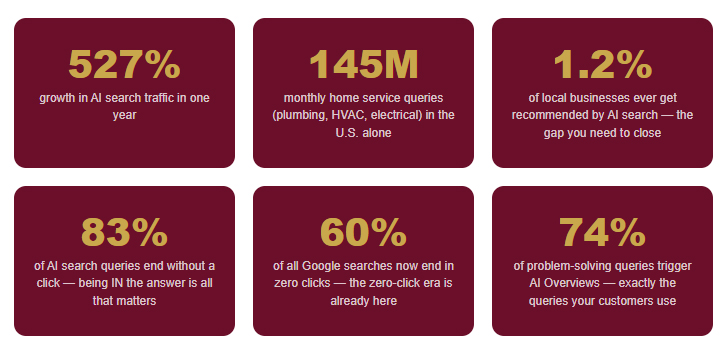
In 2026, AI-powered search engines are no longer a novelty; they’re the primary way millions of people find information, evaluate options, and make decisions. If your brand isn’t being cited in AI-generated answers, you’re losing visibility, credibility, and revenue to competitors who are.
“If your business is not part of that synthesized answer, you do not exist for that customer. The only way to catch this is to actively test – and then optimize.” – DC Jones, Chief Strategist, MMG
How AI Decides Who to Recommend
When a homeowner asks ChatGPT, “Who’s the best plumber in my area?”, how does the AI decide whose name to say? Understanding this is the entire ballgame.
The 7 signals AI uses to decide which local business to recommend:
- Reviews & Star Ratings (strongest signal)
- Google Business Profile completeness
- Schema Markup implementation
- FAQ-style website content
- Website authority and organic rankings
- NAP consistency across directories
- Third-party citations and directory presence

In the Age of AI
You Gain the Advantage over Those Who Don't Step Up
ChatGPT: The Standard-Bearer and What It Needs
ChatGPT still leads with approximately 5.8 billion monthly visits, with over 8 billion inquiries per day, while having fractured its earlier market monopoly as Claude, Gemini, and Perplexity have all grown dramatically. It recommends local businesses only 1.2% of the time across all queries – which means it does recommend businesses to hundreds of millions of users, and only a tiny fraction of businesses have figured out how to be one of them.
ChatGPT recommends only businesses averaging 4.3 stars or higher. Review ratings now function as strict filters – unlike Google Maps, which ranks businesses with 3.5 to 4.0 stars if nearby. ChatGPT responds strongly to website content written in conversational FAQ format because that mirrors the way its own answers are structured. A plumbing company whose website answers “How much does it cost to replace a water heater in Sandy, Utah?” clearly is far more likely to get cited than one whose website says only “We provide expert plumbing services.”
Gemini: Google’s Home Advantage
Gemini has grown rapidly and now commands over 20% of the AI chatbot market, driven by its massive distribution through Google’s existing billions of users. Its critical advantage is Google integration: Gemini pulls directly from Google Business Profiles, Google Maps reviews, and Google’s indexed web content.
Gemini recommends businesses with 3.9 stars or higher and strongly benefits from multimodal content – well-described, geo-tagged photos, video content, and rich media in the Google Business Profile.
Perplexity: The Research Engine for High-Intent Buyers
Perplexity grew 370% year-over-year and has carved out a distinctive niche as an AI-first search engine targeting research and citation-heavy use cases. A homeowner who uses Perplexity to find a plumber is doing deliberate research – making them a higher-value lead. Perplexity requires 4.10 stars and rewards businesses that appear in local news, industry publications, neighborhood platforms like Nextdoor, and third-party review aggregators.
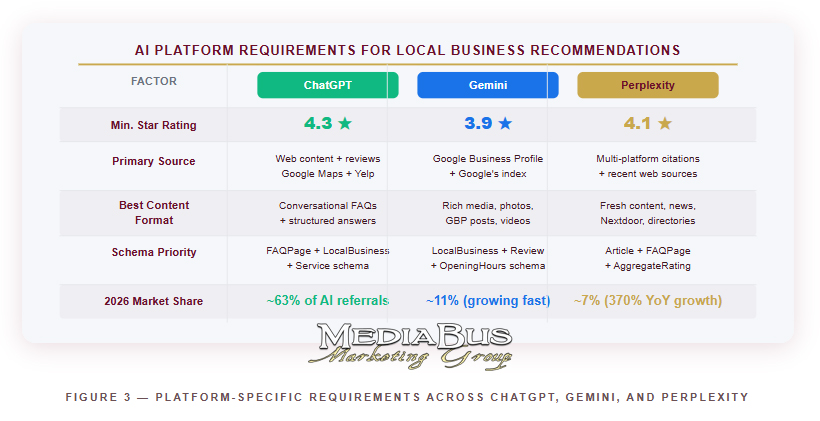
*** The Hard Filter You Can’t Ignore: Unlike Google Maps, which ranks businesses with 3.5–4.0 stars if they’re nearby, AI platforms treat star ratings as a hard filter, not a ranking factor. If your average rating falls below 4.3 stars, ChatGPT will not recommend your business regardless of any other optimization. And here’s the kicker: brands with even a minimal review presence – as few as 1–13 reviews – jump to a 53.5% AI citation rate. That’s a 52 percentage-point swing from brands with no profile at all.
Related Reading from MMG:
- Beyond the Normal — Advanced AI Strategies for Search Everywhere Optimization
- What Kind of Content Works Best for Getting Picked Up by Perplexity?
The SEO → AEO → GEO Framework
If AI search has changed local discovery, local businesses need a new framework for thinking about their digital presence. Not a replacement for what they’ve been doing – an expansion of it.
SEO (Search Engine Optimization) got your website found in Google rankings in the past. AEO (Answer Engine Optimization) now focuses on appearing in direct answers – featured snippets, voice assistants, and AI answer boxes. GEO (Generative Engine Optimization) focuses on being cited within generative AI responses from ChatGPT, Perplexity, and similar platforms. SEO focuses on rankings (central only to things connected to Google/Alphabet), AEO on answer selection, and GEO on AI citation. All three share foundational tactics but differ in target platforms and success metrics.
SEO is your foundation. Traditional search engine optimization – how the Google Algorithm ranked your website, your Google Business Profile, your local citations and reviews – remains essential. Not because Google is going away, but because a portion of the other AI platforms cite sources they already trust, and Google’s index is one of the primary data sources some of those AI platforms draw from for their overall Authority scores. If your SEO is weak, your GEO efforts can suffer. Think of SEO as laying the pipes. Everything else runs through those pipes.
AEO is the bridge. Answer Engine Optimization is the discipline of structuring your content so that AI-powered systems – For instance, Google’s AI Overviews and voice search – can extract your information and present it as a direct answer without requiring the user to click to your website. 74% of problem-solving queries trigger AI Overviews – exactly the queries homeowners use when something breaks. AEO is no longer optional for local service businesses. AEO isn’t only centered around Google products; there are various factors that each of the Big 5 LLMs takes into consideration. This is where SEO goes from Search Engine Optimization to Search Everywhere Optimization.
GEO is the destination. Generative Engine Optimization is the practice of making your business the one that ChatGPT, Gemini, and Perplexity (and Claude and Grok) name when they generate a direct recommendation. GEO is especially powerful for small and local businesses because AI search engines often recommend specific businesses by name when users ask questions like “best [service] in [city]” or “who should I hire for [task].” Small businesses can gain a disproportionate advantage here over larger competitors. This is the most advanced layer — and the one with the biggest competitive opportunity right now.
Related Reading:
- Advanced AI Strategies for Search Everywhere Optimization (SEvO) — MMG
- Get Your AI Visibility Audit — See How You Appear in AI Search Right Now
The 7 Actions That Put You in AI’s Recommendations
These seven actions, taken in this order, will dramatically improve your business’s likelihood of being recommended by AI search platforms. Not in six months. Right now.
01 — Become Un-Ignorable on Reviews
The hard filter that unlocks everything else
Every other optimization effort is built on the foundation of your review profile. AI platforms filter on star ratings before they consider anything else.
The goal is not just average rating – it’s review velocity and recency. AI platforms, especially Perplexity, weight recent reviews far more heavily than a 4.8 rating from reviews that stopped in 2022. A business with 40 reviews at 4.5 stars from the last six months will consistently outrank a business with 200 reviews at 4.7 stars if those 200 are two years old.
Build a review request system into every completed service. Text it. Email it. A QR code on your invoice. One polite ask from a happy customer, automated to fire within 24 hours of job completion, is worth more than any other single marketing investment you can make in 2026.
Immediate Actions:
- Check your current Google, Yelp, HomeAdvisor, and Trustpilot ratings today – know your thresholds
- Set up an automated post-job review request via SMS – target 24 hours after service completion
- Respond to every review (positive and negative) within 48 hours – AI reads your responses as trust signals
- Aim for a minimum of 4 new reviews per month to maintain recency signals
02 — Supercharge Your Google Business Profile
Gemini’s primary data source – don’t leave it half-built
Your Google Business Profile is simultaneously your most important Local SEO asset and Gemini’s primary data source for local recommendations (See number 1 for the importance of reviews). Treating it as a set-it-and-forget-it directory listing is one of the most costly mistakes a local service business can make in 2026.
A complete GBP means: every service listed with a detailed description, every service area defined, every question in the Q&A section answered – because local searches such as “best plumber near me” are increasingly answered directly by AI, and these systems pull data from your Google Business Profile, service pages, reviews, and structured content to form a recommendation. Photos uploaded weekly, geo-tagged, named descriptively. GBP Posts are used as a trust signal factory.
Immediate Actions:
- Complete every section of your GBP – 100% completion matters to both Google and Gemini
- Answer every question in the Q&A section with detailed, specific responses
- Upload 4+ new geo-tagged photos per month – name files descriptively (e.g., “water-heater-installation-sandy-utah.jpg”)
- Post weekly GBP updates highlighting recent jobs, seasonal services, or customer success stories
03 — Write the Content AI Wants to Read – and Cite
FAQ-first content structure is the language AI speaks
Most plumbing and home service websites are invisible to AI systems because they do not answer any specific question. They can’t be cited because they contain no citable fact, no specific answer, no extractable information.
The content AI systems love and cite answers specific questions directly and immediately: “In 2026, the average cost of trenchless sewer line repair in Chicago ranges from $120 to $250 per foot, totaling $3,000 to $8,000 depending on the depth of the municipal tap.” The first sentence answers the query. The evidence block immediately follows with cited authority. This is the structure that gets your business cited as the source of the answer.
Immediate Actions:
- Write 10–15 FAQ answers for the most common questions your customers ask – answer directly in the first sentence
- Create service pages for every specific service in every specific neighborhood you serve
- Include local price ranges, timelines, and permit information – specificity is what AI cites
- Structure headings as actual questions: “How long does a water heater installation take?” not “Our Installation Process.”
Related: What Kind of Content Works Best for Getting Picked Up by Perplexity? | MMG AI Marketing Strategies
04 — Implement Schema Markup – The Language of AI
Structured data is how AI reads your business without guessing
Schema markup tells AI systems exactly what your business is, what it does, where it operates, and what customers think of it – in a format that requires no interpretation. Without schema, AI must guess. With schema, it knows. Research from structured data analysis platforms indicates that pages with FAQ schema are significantly more likely to appear as AI Overview sources – the mechanism is that FAQ schema gives AI systems pre-packaged answer units that require minimal inference.
For a local service contractor, the minimum schema stack: LocalBusiness (or the Plumber subtype) with complete NAP, service area, and hours; FAQPage on every page with Q&A content; Service schema for each service offered; and AggregateRating reflecting your review scores.
Immediate Actions:
- Add LocalBusiness (or Plumber) schema to your homepage and contact page
- Implement FAQPage schema on every FAQ section across your site
- Add Service schema to each individual service page with name, description, and service area
- Test your schema at schema.org/validator and Google’s Rich Results Test tool
05 — Build Your NAP Fortress Across Directories
Consistency is the trust signal AI verifies before recommending you
AI platforms cross-reference your business information across multiple sources before they’ll recommend you. They’re asking: “Is this business consistently who they say they are across the web?” Any inconsistency between platforms creates doubt. And AI doesn’t recommend businesses it has doubts about.
53% of consumers say they are unlikely to visit a business with incorrect or incomplete info on a company’s listings – so this investment protects both your AI visibility and your traditional conversion rates simultaneously.
Immediate Actions:
- Audit your NAP across the top 10 directories – search your business name and verify every listing
- Decide on one exact business name format and enforce it everywhere, down to punctuation
- Claim and complete listings on Yelp, HomeAdvisor, Angi, BBB, Thumbtack, and Nextdoor
- Use Yext, BrightLocal, or Moz Local to monitor consistency across directories automatically
06 — Earn Third-Party Citations Where AI Reads
Perplexity lives on citations – and so does your AI visibility
Being mentioned on your own website means something. Being mentioned in ten credible places the AI already trusts means exponentially more. A prospect asks ChatGPT for a plumber in your city, gets three names, and calls one. You never knew you were even being considered. The only way to catch this is to actively test.
A plumbing company mentioned in a local news article, featured on a Nextdoor page, cited in a home improvement blog, and profiled on the BBB will consistently outrank a plumbing company with a better website but no off-site presence. AI is checking – and what it finds off-site matters enormously.
Immediate Actions:
- Pitch a local news story – seasonal plumbing tips, water safety, or community involvement angles work well
- Get active on Nextdoor and community Facebook groups – answer questions genuinely, no sales pitch
- Submit to relevant local business directories – Chamber of Commerce, local associations, trade publications
- Write a guest post for a local home improvement or real estate blog
- Submit on a regular basis, Press Releases of things that are truly newsworthy, connected to your company
07 — Test Your AI Visibility – Then Measure It Monthly
You can’t optimize what you don’t measure – and most businesses have never even checked
Regularly, there’s no dashboard alert, no ranking drop notification, no visible signal when an AI skips you. A prospect asks ChatGPT for a plumber in your city, gets three names, and calls one. You never knew you were even being considered. The only way to catch this is to actively test
Open ChatGPT, Gemini, and Perplexity right now. Ask each of them: “Who is the best [your service] in [your city]?” Ask it three ways: with your city name, with your neighborhood, and with “near me” plus your location enabled. Document the answers. This 15-minute monthly audit is the most direct competitive intelligence available to any local business in 2026.
Better yet, get connected to us here at MediaBus Marketing Group and get started on your very own AI Visibility Pack. Which includes the ability to write the press releases (when you connect your choice of PR Newswire Network Service), Alerts for community conversations that you can participate in on Reddit and in Quora on the subjects that matter to your business, as well as have a monthly report of where you stand with closing the gaps you have now to where each LLM wants you to be to earn the higher Authority Scores from each of them.
Immediate Actions:
- Do your first AI visibility audit today – get all five major platforms for your service in your city
- Document who IS named – those are your priority competitors to study and outperform
- Set a calendar reminder for the same audit on the first Monday of every month
- Track your AI mention rate over time – it’s the clearest leading indicator of your future pipeline
📖 Related:
- Get Your Free AI Visibility Audit from MediaBus Marketing Group
- How to Build an AI Strategy That Scales — The MMG Framework
- MMG Lead Generation Systems for Local Service Businesses
The Compounding Advantage – Why Now Matters
Og Mandino captured it in the simplest possible language: I will act now. I will act now. I will act now. Not because urgency for its own sake is a virtue. But because the value of the right action taken at the right moment is categorically different from the value of the same action taken later.
THIS IS ONE OF THOSE MOMENTS
The plumbing companies, and quite frankly, all the trades services businesses that adapt to LLM optimization, unstructured entity trust, and advanced schema markup today will build an insurmountable digital moat. Because LLMs train on historical data and established trust, the companies that become the AI’s preferred recommendation in 2026 will be nearly impossible to unseat by competitors who wait until 2028 to adapt.
The idea that the difference between extraordinary and ordinary outcomes is not dramatic, revolutionary action, but consistently taking the right small actions slightly ahead of the field. In local AI search, the slight edge is available right now to any business willing to claim it.
Your 90-Day AI Visibility Roadmap:
Find Out If AI Is Recommending Your Business Right Now
MediaBus Marketing Group offers a comprehensive AI Visibility Audit that shows you exactly how ChatGPT, Gemini, and Perplexity see your business today — and the specific steps that will move you into their recommended results. For local service businesses in Sandy, Utah, and beyond, this is the most valuable marketing conversation you can have in 2026.
👉 Get Your Free AI Visibility Audit → Or Fill Out the Form Below to Get Started
No obligation • We’ll test your business against all three AI platforms and show you exactly where you stand (801) 893.1398 • info@mediabusmarketing.com
AI-Powered Search FAQs
Q1: Does AI search replace Google for local businesses, or do I still need both?
Both – and this is the most important nuance to understand. AI search does not replace Google for local businesses; it adds a new layer of discovery that runs in parallel. Google remains dominant, processing roughly 89.6% of global search queries. Google Business Profile is still non-negotiable. Your local SEO fundamentals still matter enormously – not just because Google sends traffic directly, but because AI platforms like ChatGPT and Perplexity partially rely on Google’s indexed content when forming their recommendations. Strong SEO is the prerequisite for AI visibility, not an alternative to it. The businesses that win in 2026 and beyond master SEO as the foundation, AEO as the bridge, and GEO as the destination. Abandoning any layer of that stack is a mistake. Adding the GEO layer to existing strong SEO is the competitive play that most local businesses haven’t made yet — and that’s where your opportunity lives.
Q2: How long does it take to start appearing in AI recommendations after optimizing?
The timeline varies by platform. Google Business Profile updates propagate into Gemini relatively quickly – often within 2–4 weeks of significant updates. Schema markup changes are typically crawled and indexed within 2–6 weeks. Review velocity improvements typically start showing up in AI recommendation frequency within 60–90 days. Content changes (new FAQ pages, service pages) take the longest, often 60–90+ days. The important frame: this is an ongoing discipline, not a one-time optimization. The businesses that sustain these practices over 6–12 months build compounding citation authority that becomes very difficult for competitors to overcome quickly.
Q3: My Google rating is strong, but I’ve never appeared in a ChatGPT recommendation. What’s missing?
A strong Google rating is the ticket to the game, not a guarantee of playing. Several factors commonly prevent businesses with good Google reviews from appearing in AI recommendations. First, check whether your reviews appear across multiple platforms – Google alone isn’t enough for all five AI platforms. Second, check your website content: does it include FAQ-style, question-and-answer structured content that AI can directly cite? Generic service descriptions are invisible to AI. Third, check your schema markup – without LocalBusiness and FAQPage schema, AI systems must guess at your information. Fourth, verify your NAP consistency across directories. Any inconsistency creates doubt that reduces AI confidence in recommending you. The MMG AI Visibility Audit will identify exactly which of these factors is limiting your AI presence.
Q4: Is there any risk that AI search changes again and makes these optimizations obsolete?
The specific tactics will evolve, but the underlying principles are durable. Every AI recommendation system, regardless of how it changes technically, will always reward the same foundational qualities: trust (expressed through reviews, consistency, and citations), authority (expressed through structured, specific, verifiable content), and relevance (expressed through clear service and location signals). These are not algorithm quirks that get patched – they are the criteria by which any intelligent system evaluates whether to stake its reputation on a recommendation. Investing in a strong review profile, quality content, and clean directory presence is a bet on the enduring value of being a trustworthy, well-documented local business. That bet hasn’t been wrong in 25 years of digital marketing evolution.
Q5: How is what you’re describing different from regular local SEO? Can’t my current SEO agency handle this?
It overlaps with local SEO, but it’s not the same discipline – and many traditional SEO agencies have not yet adapted their practice to include it. Traditional local SEO focuses on ranking in Google’s map pack and organic results. GEO and AEO focus on being cited in AI-generated answers, which requires different skills: content architecture for AI citation, schema markup for machine-readability, multi-platform citation building for AI trust verification, and platform-specific optimization for ChatGPT, Gemini, Claude, Grok and Perplexity’s different data sources. The right question to ask your current agency is: “Are you actively testing our AI visibility on all three major platforms, and do you have a strategy for improving it?” If the answer is uncertain, that’s important information. MediaBus Marketing Group offers AI-specific visibility audits and optimization strategies built specifically for the 2026 local search environment.
Action Items:
SHARE THIS STORY ANYWHERE YOU LIKE
SHARE THIS STORY ANYWHERE
Mastering AI Automation for Finance and Back Office
Mastering AI Automation for Finance and Back Office The back office that never forgets. Most back-office losses are [...]
Mastering AI Automation for Project and Task Management
Mastering AI Automation for Project and Task Management Your plan is a prediction. AI's best job is remembering [...]
AI Operations: Automating Supply Chain, Scheduling & More
AI Operations: Automating Supply Chains, Scheduling, & More The Most Profitable AI in Your Business Is Probably the [...]