

The AI Toolkit from MMG for Small Businesses Has Been Updated
A Toolkit is a Map. Use Each Chapter as Your Company Needs, When Your Business Needs It.
MMG’s AI Toolkit for small businesses runs eleven chapters, from strategy to marketing to finance to HR. Almost nobody needs all eleven chapters every single month. This guide shows what is inside, which three chapters to read first and which eight to use when you ned to use them, and a five-step rule for turning one chapter into one result in 30 days.
What You’ll Find in This Article
- What’s inside the Toolkit: eleven chapters, three to read and eight to use, and what MCP actually stands for
- The name half-life: four product names that changed owners or closed, and the Four Tool Checks to run before you sign up for anything
- The One-Chapter Rule: one pain, one chapter, one tool, one ruler, 30 days
- The eight chapters you use, each with when to open it, the first move, the ruler, and where to go deeper
- The unglamorous chapter that carries 70% of the weight
- Six best practices, six little-known gems, a direct next step, and five FAQs
Most Small Businesses Are Still at the Starting Line
The U.S. Census Bureau’s Business Trends and Outlook Survey found that overall business AI use stayed between 17% and 20% from December 14, 2025, to May 3, 2026, ending at 19.8%. Use climbed with firm size: 37% of firms with 250 or more employees, and 32% of firms with 100 to 249 employees. Among firms with fewer than 20 employees, the Census reported no significant change over the period, and fewer than 20% of firms with four or fewer employees reported using AI.
That fact for the Small Businesses unrealized harnessing of the power of what AI can do for their company, and the lack of doing that MUST CHANGE. In fact, it is those who are a one-man band to a few trusted employees who can benefit the most from the Adoption, Planning, Integration, Testing, Implementation, and Scaling of AI and the Agentic methods of doing business! That is, MediaBus Marketing Group’s entire focus is to be able to have what AI can do best, do the best for those that need it the most.
If you have not started, you are unfortunately in the majority. Not quite behind the competition, but generational technologically far behind. The risk is not that you are late; you are. It’s the never taking the steps to incorporate what can be most beneficial to your profits, your bottom line, and most importantly, your time!
Starting is Not the Same as Getting Value
Boston Consulting Group surveyed 1,000 senior executives across more than 20 sectors in 59 countries for its 2024 report on AI value. It found that 74% of companies had yet to show tangible value from AI, and only 26% had built the capabilities to move beyond proofs of concept and generate it. Now, this study in terms of AI and its adoption is a bit older, but the real-time stats on use are not that far off. These are mostly larger companies, so treat the percentage as a direction, not a forecast for a 14-person firm. The direction is clear: buying or trying tools is common, and results are not.
Narrow is normal
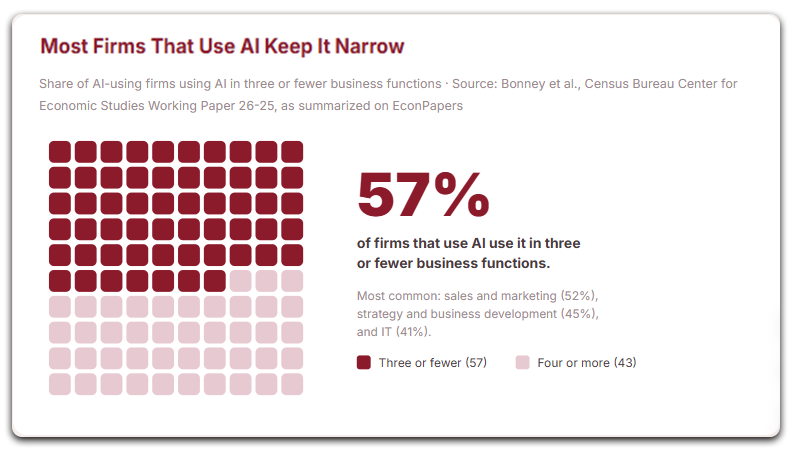
A Census Bureau working paper using the 2026 AI supplement to the same survey, as summarized on EconPapers, found that 57% of firms using AI use it in three or fewer business functions. The most common were sales and marketing (52%), strategy and business development (45%), and IT (41%). The same paper found that firm commercial performance correlates positively with the breadth of AI integration. That is an association, not proof that breadth causes performance, and it describes larger firms more than small ones. It does suggest a sequence: start narrow, prove a result, then widen.
What’s Inside the Toolkit?
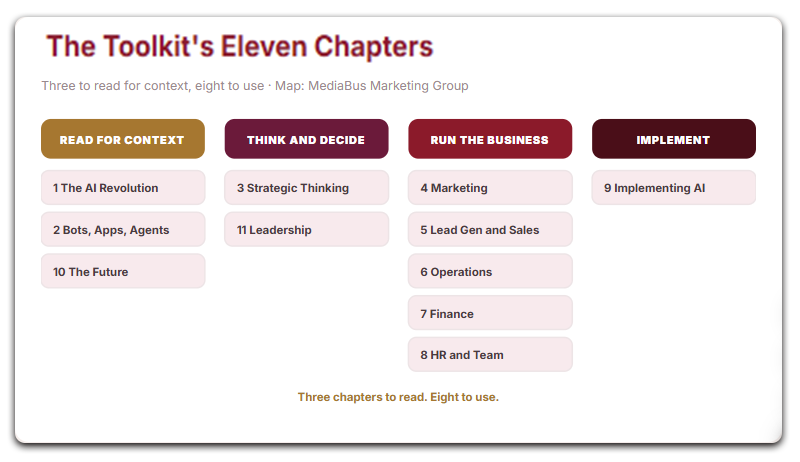
The AI Toolkit from MediaBus Marketing Group is written for small business owners, founders, operations managers, marketers, and executives. It has eleven chapters, and readers request the electronic PDF through the form on the original announcement page. The chapters fall into four groups.
Three chapters to read once
Chapter 1, The AI Revolution for Small Business, makes the case for why AI matters now and how small teams can compete. Chapter 2 explains bots, apps, agents, co-pilots, and MCPs. MCP stands for Model Context Protocol, an open standard that Anthropic introduced on November 25, 2024, for connecting AI assistants to the places where a business keeps its data and tools. Chapter 10 looks at where AI and small business are heading. Read these three in an hour, so that the vocabulary and the stakes are clear, and then stop.
Eight chapters to use when the pain arrives
The other eight each correspond to a part of the business: strategic thinking and decisions (3), marketing (4), lead generation and sales (5), operations and productivity (6), financial management and forecasting (7), HR, recruiting and team collaboration (8), implementing AI (9), and AI-powered leadership (11). You do not read these in order. You open the one that matches the pain you have today, which is the next section’s job
Within each one, there is a mention or two about the tools that can be used (so your company doesn’t have to spend the precious time and resources on creating their own) that may have a shelf life that lasts less than the latest Anthropic Model Update. However, it gives you a starting point to launch from when you are considering getting your business working smoothly with the programming that works for it.
What Has Been Updated from the First Version?
Very good question! As we will detail, there are chapters within the Toolkit that are evergreen. They are standing the test of time, even when things are moving at Quantum speeds. Chapters 1 and 2 are those in the Toolkit, although how you can strategically think and move with AI in Chapter 3 has changed since the beginning of 2026.
If we were to use a giant swathe of a proverbial paintbrush, which in essence we are, I would say the largest leap forward has gone from having a tool that has been produced by a company, offered on a monthly subscription basis, that was doing one or two singular things, which are now no longer needed. The capabilities of the likes of ChatGPT, Claude, Perplexity, Gemini, and even Grok (with their Grokbots) have gone to a more agentic emphasis. Less tool utilization, more LLM configuration to your specific needs.
The largest updates we saw were in the Marketing and Sales Chapters. However, the capabilities that are in the Back Office and Human Resources chapters had the most movement in what can now be done to assist the Small Business Owner the most. Taking back their time from those duties that are needed but can, with a little bit of effort, be automated.
The Four Tool Checks
Before you create an account for any AI tool, run four checks. They take ten minutes. We call them the Four Tool Checks, and they are MediaBus Marketing Group’s working method, not an industry standard.
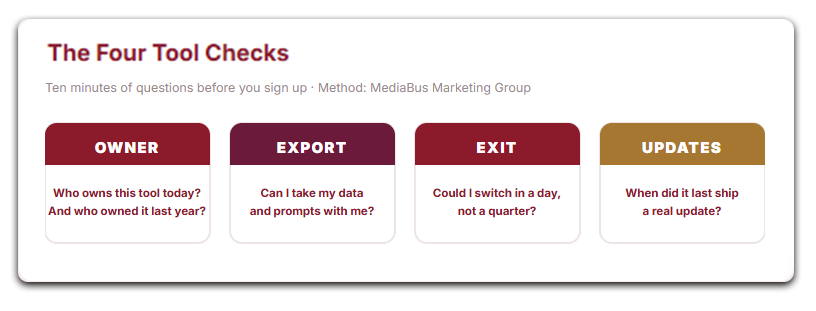
- Owner: find out who owns the tool today and whether that has changed in the last year, because a change of owner often precedes a change in pricing or direction.
- Export: confirm you can take your data, prompts, and settings with you in a usable form.
- Exit: estimate whether you could switch in a day or whether the tool would be woven into so many steps that leaving takes a quarter.
- Updates: look for a recent, real product update, not just a blog post. A tool that fails two of the four is a bad first pilot, however good the demo.
There is a method for all this AI Madness!
The One-Chapter Rule
The antidote to the Getting No Traction Mistake is a rule small enough to follow on a busy Tuesday. The One-Chapter Rule has five steps: one pain, one chapter, one tool, one ruler, and a decision on day 30. It is MediaBus Marketing Group’s working method, and it builds on the Pain, Ruler, Risk scoring in our pillar article, Mastering AI Automation for LLM Success.
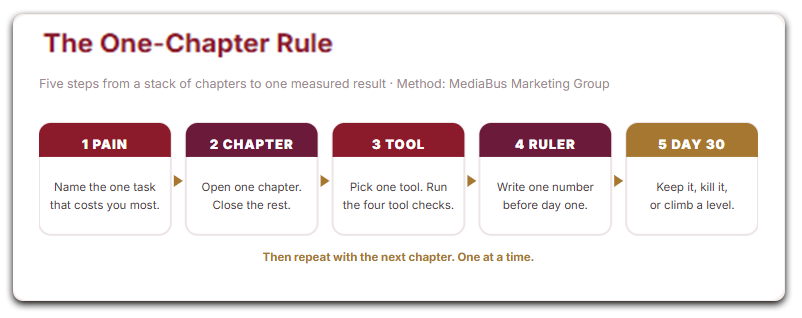
1. Name one pain. Finish the sentence, ‘The task that costs us the most time or money every week is…’ Choose one. If you can’t, ask the person who does the work, not the person who manages it.
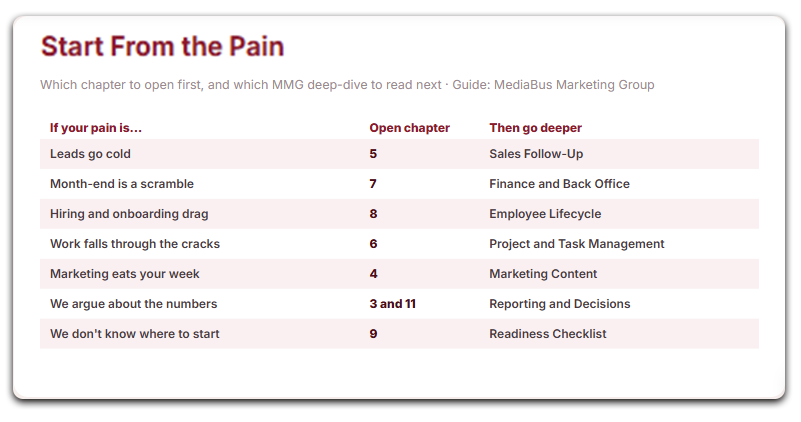
2. Open one chapter. Match your pain to one chapter and close the other ten. The pain table in the next section does the matching for seven common cases. Map the task as it is done today before you change it, using a workflow mapping, so you automate the real process and not the one in your head.
3. Pick one tool. Choose a single tool of the type the chapter describes, and run the Four Tool Checks. If nothing off the shelf fits the task, that is the moment to look at custom AI software, not the moment to sign up for a sixth trial.
4. Set one ruler. Write down a single number before day one, such as hours from request to quote, minutes per report, or days to fill a role, and record today’s value. A company baseline gives you that starting point, and our conversion metrics cover the conversion side.
5. Decide on day 30. Run the pilot for 30 days at Level 1 of the Autonomy Ladder, where the AI drafts and a person decides. Then choose one of three: keep it, kill it, or climb one level. Then open the next chapter and repeat the five steps.
The Eight Chapters You Can Use
Where to start each place
Each card below pairs one Toolkit chapter with the pain that tells you to open it, a small first move with its ruler, and where a person keeps the decision. The first-move suggestions are MediaBus Marketing Group’s, not claims about what the chapters say. Every one starts at Level 1 of our Autonomy Ladder, where AI assists and a person decides, because the first 30 days should teach you how the tool behaves before it acts on its own.
Which Chapter is First?
If you only remember one thing from this section, remember to start from the pain, not the chapter. This table matches seven common pains to the chapter to open and the MMG article to read next.
The Unglamorous Chapter that Carries 70% of the Weight
Chapter 9 sounds like the one to skip. It covers readiness, choosing tools, SOPs, training, culture, building agents, and ethics. It is also where the evidence says most of the work sits. In its 2024 report, Boston Consulting Group describes a 70-20-10 principle: around 70% of AI implementation challenges are people- and process-related, 20% are technology problems, and 10% involve the AI algorithms themselves. Leaders, BCG says, put 10% of their resources into algorithms, 20% into technology and data, and 70% into people and processes.
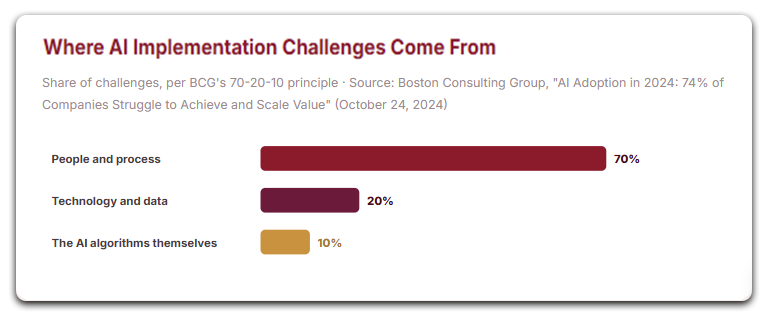
That is a finding about larger companies, and a 14-person firm has fewer moving parts. The shape still transfers. When a pilot stalls, the cause is rarely the tool. It is more often that nobody wrote down how the task is done, nobody was trained, or nobody decided what the AI is allowed to do. If you want a faster way to test your own readiness, our AI readiness checklist article in the MMG article library covers it.
The MIT NANDA report, The GenAI Divide, points the same way. As summarized by Fortune in August 2025, it found that about 5% of AI pilots reach rapid revenue acceleration, and attributed the gap to flawed integration rather than model quality. It drew on 150 leader interviews, a survey of 350 employees, and analysis of 300 public AI deployments; companies were often reluctant to share failure rates, so read the 95% as a warning, not a law.
Simply put, the tech is all well and good, but if you or your team fails to utilize it the way you should, or the way you can, failure will be the result of your efforts with adopting and incorporating AI into your busines practices.
6 Best Practices for Using this MMG AI Toolkit
Little-Known Gems
The Perspective Shift
The tools will change their names. The question you ask before choosing one won’t.
What is this costing me, and how will I know it is fixed? That question was useful before AI; it is useful now, and it will still be useful after every product in every toolkit has been renamed, acquired, or retired. A toolkit’s job is not to be finished. Its job is to get one page dog-eared, one number moved, and one habit changed, and then to be opened again. Today, open one chapter.
Bottom Line:
The Census Bureau had AI use at 19.8% of businesses as of May 3, 2026, with no significant change among firms under 20 employees. BCG found 74% of companies had yet to show tangible value. Most firms that do use AI keep it to three or fewer functions. The winners are not the people who read the most. They are the people who pick one pain and measure one result.
That is what the updated AI Toolkit is for.
The first three chapters give you the vocabulary and the stakes. Eight give you a starting point for the parts of the business that cost you the most. Chapter 9 keeps you honest.
This is a decision before it is a project. This week, finish one sentence: the task that costs us the most time or money every week is… Then open one chapter, pick one tool, write down one number, and give it 30 days. Start small. Measure first. Then climb.
MediaBus Marketing Group will help you find the one chapter, the one task, and the one rule to start with…
Choose which of the company’s pain points to automate first, and set up the AI-use rules that protect what makes the business hard to copy. Tell us where your know-how lives today, and we’ll show you where to start.
📞 · Contact Us Using the Form Below · ✉
MMG AI TOOLKIT FAQs
Q1. What is in the AI Toolkit from MMG for small businesses? Eleven chapters: The AI Revolution for Small Business; Understanding AI Bots, Apps, and Agents; Strategic Thinking with AI; Marketing; Lead Generation and Sales; Operations and Productivity; Financial Management and Forecasting; HR, Recruiting and Team Collaboration; Implementing AI in Your Business; The Future of AI and Small Business; and AI-Powered Leadership and Decision-Making. It’s written for owners, founders, operations managers, marketers, and executives, and readers request the PDF through the form on the announcement page.
Q2. Do I need to read the whole Toolkit before I start? No. Read chapters 1, 2,3, and 10 once for context, then use the One-Chapter Rule: one pain, one chapter, one tool, one number, and a review at 30 days. Read chapter 9 before you start, because readiness, SOPs, and training are where pilots tend to succeed or stall.
Q3. Do I have to buy all the tools the Toolkit mentions? No. Product names change owners and sometimes close: x.ai (Bizzabo, 2021; standalone service ended that October), pymetrics (Harver, 2022), Reclaim.ai (Dropbox, 2024), Paradox (Workday, 2025). Treat each as an example of a category, pick one tool, and run the Four Tool Checks first.
Q4. Is AI worth it for a business with fewer than 20 employees? It most certainly can be, if you start narrow and measure. Overall business AI use was 19.8% as of May 3, 2026, with no significant change under 20 employees. A Census working paper found 57% of AI-using firms use it in three or fewer functions, and BCG found 74% of companies had yet to show tangible value. A 30-day pilot on one task, with one measured result and a person reviewing output, limits the cost of finding out.
Q5. How do I know if an AI pilot is working? Choose one number before you start and record today’s value (hours from request to quote, minutes per report, days to fill a role). Run it for 30 days with a person reviewing every output. On day 30, compare, then keep it, kill it, or give it more autonomy. Without a starting number, you can’t tell, which is why the baseline comes first.
Action Items:
Sources Cited in This Article
All sources were read in November 2026. MediaBus Marketing Group, “Announcing the AI Toolkit from MMG for Small Businesses” (mediabusmarketing.com) · U.S. Census Bureau, Business Trends and Outlook Survey, “Large Firms With at Least 20 Employees Biggest AI Users” (census.gov, May 2026) · Bonney, Breaux, Dinlersoz, Foster, Haltiwanger, and Pande, “The Microstructure of AI Diffusion: Evidence from Firms, Business Functions, and Worker Tasks,” Census Bureau Center for Economic Studies Working Paper 26-25, as summarized on EconPapers · Boston Consulting Group, “AI Adoption in 2024: 74% of Companies Struggle to Achieve and Scale Value” (October 24, 2024) · MIT NANDA, “The GenAI Divide: State of AI in Business 2025,” as summarized by Fortune (August 18, 2025) · Anthropic, “Introducing the Model Context Protocol” (November 25, 2024) · CB Insights, x.ai profile (acquired by Bizzabo, June 3, 2021) and an archived x.ai service notice (September 2021) · Harver, “Harver Acquires pymetrics” (August 11, 2022) · TechCrunch, “Dropbox has acquired AI-powered scheduling startup Reclaim” (August 22, 2024) · Workday, “Workday Completes Acquisition of Paradox” (October 1, 2025) · The Finish-the-Book Mistake, the One-Chapter Rule, the Four Tool Checks, and the Autonomy Ladder are MediaBus Marketing Group’s own methods. Nothing here is legal, financial, or accounting advice.
SHARE THIS STORY ANYWHERE YOU LIKE
SHARE THIS STORY ANYWHERE

How to Measure Visibility in a Zero-Click, AI-Answer World
How to Measure Visibility in a Zero-Click, AI-Answer World The click was never the goal. It was the [...]
The AI Toolkit from MMG for Small Businesses Has Been Updated
The AI Toolkit from MMG for Small Businesses Has Been Updated A Toolkit is a Map. Use Each [...]

Mastering AI Automation for Data Reporting and Decision Support
Mastering AI Automation for Data, Reporting and Decision Support AI will answer any question about your numbers. First, [...]