

THE LLM AUTHORITY SCORE — DOMAIN SCORE IMPROVEMENT GUIDE
What AI Systems Actually Use to Evaluate Your Credibility, Why Traditional Domain Authority Is Nearly Irrelevant, and the Exact Program to Build the Score That Gets You Cited
WHAT YOU’LL FIND IN THIS ARTICLE
Every small business owner who has invested in SEO in the past should have an idea of what their domain authority score may be. It is the number that SEO tools(SEMRush, Ahrefs, etc.) use to summarize your website’s credibility – and for twenty-plus years, it has been the shorthand metric for how much trust search engines place in your content.
Here is what almost nobody has told you: when researchers recently analyzed 21,767 domains, they found that traditional Domain Authority correlates at approximately zero, yes, nulla, nada, nothing to LLM visibility. ChatGPT, Claude, Grok, Perplexity, and Gemini are operating on an entirely different credibility model – one that rewards specific, verifiable signals that most small businesses have never deliberately built. This article gives you the complete picture: what the LLM Authority Score actually is, the six dimensions that compose it, why each one matters more than your DA number, and the specific improvement program that systematically raises every dimension. Here is what is inside:
- The study that changes everything — the correlation data that proves traditional DA does not predict AI citations
- The Two-Gate System — how LLMs evaluate authority in sequence before they ever cite you
- The six dimensions of LLM authority — semantic completeness, entity strength, structural clarity, external corroboration, freshness, and multi-platform presence
- The five pages LLMs expect every business to have — and what happens if any one is missing
- The Entity Physics model — why LLMs evaluate authority like gravitational mass, not link juice
- The scoring framework — the 0-100 readiness scale and what each tier means for citation probability
- The improvement program — specific actions for every dimension, in priority order
- Internal links to related MMG resources throughout
THE DATA THAT SHOULD CHANGE HOW YOU THINK ABOUT AUTHORITY
Before you start any optimization program, the research findings make clear where the entire investment case stands.
A study analyzing 21,767 domains measured how authority scores align with citation frequency and visibility in LLM-generated responses. The results: Domain Rating (DR) correlation with OpenAI visibility: r ≈ 0.00. Perplexity correlation: r = –0.17. Gemini correlation: r = –0.14. High-DR domains vary widely across the visibility spectrum, showing no consistent advantage in generative outputs.
Zero correlation. In some cases, negative.
[Within Gemini, this percentage can be raised when you take into consideration that they are still using the traditional domain authority measurement with their local listings, or the Google Business Profile (the modern-day yellow pages) offering.]
Contextual precision and topical relevance outweigh historical ranking strength, confirming that LLMs evaluate authority differently from traditional search engines. In other words, how well you ranked on Google’s Algorithm in the past has NO BEARING on how you show up now with each of the LLMs.
This does not mean your domain authority is worthless. It means the metric you have been optimizing to improve your Google rankings has almost no predictive relationship with whether AI systems cite you. The two systems are running on different scoreboards.
The businesses that understand this – and invest in the signals that actually predict LLM citation – are building an AI authority advantage that their DA-focused competitors are not building. Because their competitors are still chasing the wrong number.
As documented in our MMG article on whether GEO is just SEO rebranded, there is a specific 20% divergence between what Google rewards and what AI rewards. This article is a detailed guide to that divergence – specifically, the authority dimension of it.
Think of it this way, the merchant who has spent years polishing their bronze scale – the one all the other merchants use to measure their standing – discovers one day that the new market inspects goods differently. Not by weight. By origin, by consistency, by what the other trusted merchants say. The bronze scale still matters in the old market. In the new market, it is nearly irrelevant.
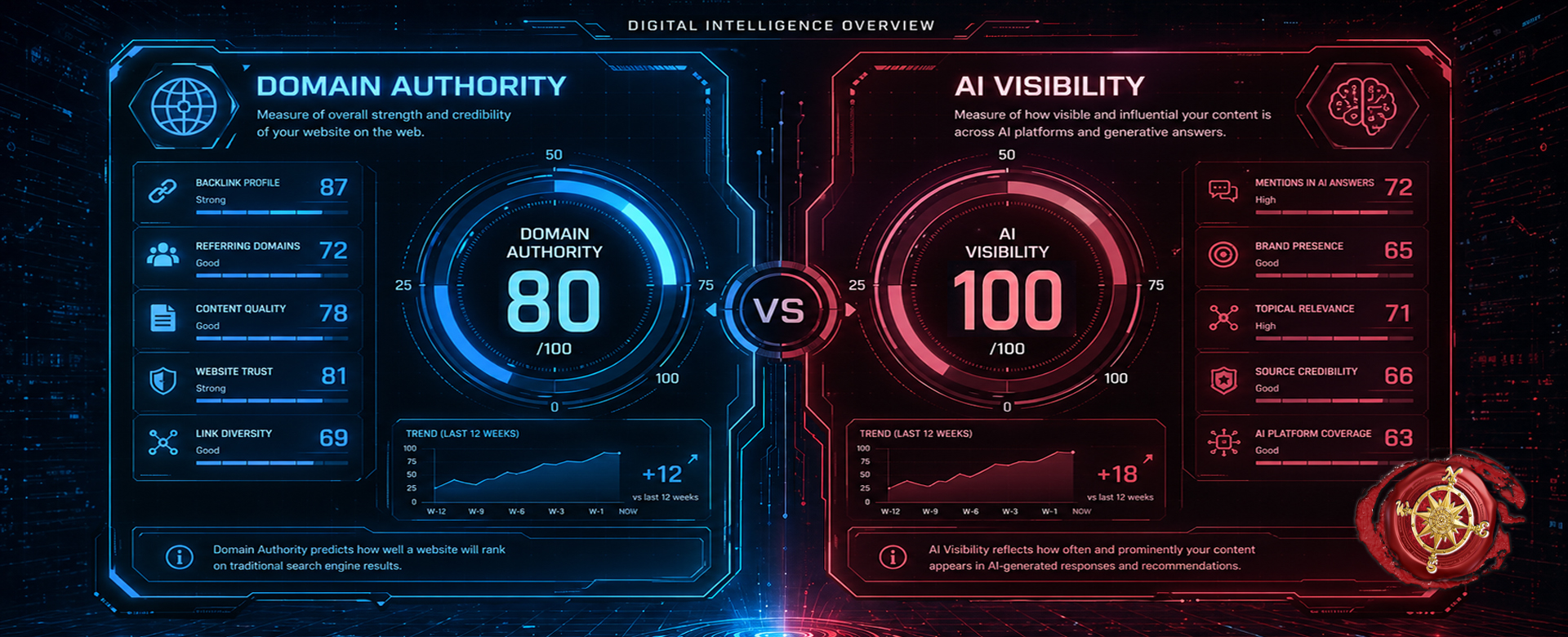
In the Age of AI
You Gain the Advantage over Those Who Don't Step Up
THE TWO GATE SYSTEM
Before a single word of your content is considered for AI citation, your domain must pass through two sequential gates. Most businesses are stopped at Gate 1 and never know it.
LLMs evaluate holistic signals, including semantic relationships, topical depth, and backlinks. Think of it as a two-stage filter. Gate 1: Inclusion. Domain Authority still matters as a prerequisite. If your domain authority is too low, your content may never enter the AI retrieval layer. Gate 2: Citation. Once included, structure and verifiability become the deciding factors. Well-structured, transparent content is far more likely to be cited than poorly formatted, higher-DA content.
THE SIX DIMENSIONS OF LLM AUTHORITY
THE LLM AUTHORITY SCORE: THE COMPLETE PICTURE
Combining the six dimensions produces the composite LLM Authority Score — the holistic evaluation that determines whether AI systems cite you confidently, cite you hesitantly, or do not cite you at all.
Score 0-40 — Not Citable: AI agents cannot physically parse your content. You face a high risk of LLM hallucinations, where ChatGPT invents facts because it cannot extract your source code.
Typically indicates: site blocked to AI crawlers, JavaScript-rendered content AI cannot read, no schema markup, entity not recognized across platforms.
Score 41-75 — Included But Not Selected: AI bots can crawl your site, but you lack the semantic authority signals to be cited. You exist in the training data, but you are not the definitive answer.
Typically indicates: good technical foundation, adequate content, but insufficient semantic completeness, external corroboration, or entity strength to be selected over better-scoring competitors.
Score 76-100 — Verified, Citable Entity: You are a verified entity. Your HTML is clean, your schema is complete, and AI engines prioritize your semantic payload for direct citations.
This is the target. Every action in the improvement program below is designed to move your score from wherever it is into this tier.
THE IMPROVEMENT PROGRAM — BY PRIORITY
Sequence matters. Higher-leverage actions first.
PRIORITY 1 — Gate Clearing (Week 1): If you are stuck at Gate 1 (domain authority below 20-30), link building from relevant authoritative sources is the prerequisite. Nothing above Gate 1 matters if your domain is excluded from the retrieval pool entirely.
If you have cleared Gate 1, verify it: check your robots.txt and Cloudflare settings to confirm AI crawlers are not blocked. This is the single fastest improvement available — taking a domain from Not Citable to Included in days.
PRIORITY 2 — Entity Establishment (Week 1-2): Entity strength improvements are foundational and affect every other dimension. Complete the entity audit: identical name/address/description everywhere, Wikidata record claimed, Organization schema on homepage, Google Business Profile updated with current information. Each completion raises entity strength immediately.
PRIORITY 3 — Structural Clarity (Week 2-4): Audit against the five foundational page types. Create or complete any missing pages. For every existing service page that is a grouped list, create individual service pages. Implement the Triple Schema Stack on every key page. These are predominantly one-time improvements that permanently raise the structural clarity dimension.
PRIORITY 4 — Semantic Completeness (Month 1-2): Run the semantic gap audit on your five highest-traffic articles. For each gap identified, add a section or a supporting article that closes it. Apply the GEO content architecture standard to every piece: answer-first, question-format headings, Island Test for every paragraph.
PRIORITY 5 — External Corroboration (Ongoing from Month 1): Launch the systematic review generation program. Distribute your first press release through a recognized newswire. Submit the first trade publication pitch. These actions compound — each one strengthens every subsequent one. The full earned media program documented in this series is the systematic implementation.
PRIORITY 6 — Freshness Protocol (Ongoing): Set the quarterly content review calendar. Apply version blocks and “Last Updated” timestamps immediately to your top twenty pages. Schedule the first quarterly review session.
PRIORITY 7 — Multi-Platform Presence (Month 2-3): Complete the platform audit against the ten source portals. Establish a minimum viable presence on any platform where you are absent. Begin systematic LinkedIn thought leadership content if you are a B2B business. Explore YouTube if demonstrated expertise is a core differentiator in your category.
THE MEASUREMENT SYSTEM FOR LLM AUTHORITY SCORE IMPROVEMENT
Improvement without measurement is investment without accountability.
THE BOTTOM LINE
The businesses that are being cited most frequently by AI systems are not the businesses with the highest domain authority scores from Google.
High-DR domains vary widely across the visibility spectrum, showing no consistent advantage in generative outputs. Contextual precision and topical relevance outweigh historical ranking strength.
They are the businesses that built semantic completeness in their content clusters. That established verifiable entity strength across the cross-web ecosystem. That implemented the structural clarity AI systems expect. That earned the external corroboration from third-party sources that transforms self-attestation into verified credibility. That maintained freshness signals demonstrating active editorial stewardship. That built a multi-platform presence that gives AI systems multiple independent angles from which to recognize and recommend them.
These are not the signals that built your Google rankings. They are the signals that determine your AI recommendations. And as documented in the AI visibility ROI article, AI-referred visitors convert at rates between 4.4x and 15x organic search visitors, in a channel growing at over 500% annually.
The LLM Authority Score you build this year is the competitive foundation your business stands on for the next five years. Build it deliberately. Build it in sequence. Build it now, while the competitive window — the period before most businesses in your category have started — is still open.
This is a first-mover advantage moment.
Most businesses will not adapt for another 12-18 months. By then, early adopters will have already captured significant market share.
The authority a merchant builds is not a number on a tool. It is the accumulated weight of every credible source that has spoken of them honestly, every record that confirms their identity, every corner of the market where their name has been spoken with precision and respect. That weight does not accumulate overnight. It compounds — one corroboration at a time, one publication at a time, one satisfied customer’s honest account at a time. And when it reaches its threshold, the advisors of the new age do not hesitate when asked who to recommend.
At MediaBus Marketing Group, we build the complete LLM Authority Score improvement program — from entity establishment and structural clarity through semantic completeness, external corroboration, and multi-platform presence — connected to the measurement system that tracks every dimension’s improvement over time.
Because your success is exactly how we measure ours.
Let us run your complete LLM Visibility Audit
Identify exactly which of the six dimensions is limiting your AI citation frequency, what the improvement program looks like for your specific business and category, and how we will build it starting this week.
AI VISIBILITY SCORE FAQs
FAQ 1 — What is the LLM Authority Score, and how is it different from traditional Domain Authority?
The LLM Authority Score is the composite measure of how credible, recognizable, and citable an AI system considers a business entity to be — based on the specific signals that large language models use when deciding which sources to cite in their responses. It differs fundamentally from traditional Domain Authority in both composition and predictive value.
Traditional Domain Authority (Moz) and Domain Rating (Ahrefs) are primarily backlink-based metrics. They quantify the quantity and quality of external links pointing to a domain as a proxy for credibility in Google’s ranking algorithm. A study analyzing 21,767 domains found that Domain Rating correlates at approximately zero with LLM visibility — meaning high DR does not predict AI citation frequency, and in some cases shows a slight negative correlation across Perplexity and Gemini.
The LLM Authority Score is composed of six dimensions that actually predict AI citation frequency: semantic completeness (correlation 0.87 — the strongest predictor), entity strength (how consistently and widely your business is recognized across the web), structural clarity (how easily AI systems can parse and extract your content), external corroboration (third-party independent sources that verify your expertise and identity), freshness (recency of content updates and new third-party signals), and multi-platform presence (the breadth of authoritative platforms where your entity is established). Improving these six dimensions is the path to increasing AI citation frequency — regardless of whether your traditional domain authority number changes at all.
FAQ 2 — Why does traditional Domain Authority have near-zero correlation with LLM visibility, and what does that mean for my SEO investment?
The near-zero correlation between Domain Authority and LLM visibility reflects a fundamental architectural difference between how Google evaluates pages and how AI systems evaluate sources.
Google’s algorithm treats backlinks as votes – external pages linking to yours signal that your content is trusted and authoritative. Domain Authority quantifies the accumulated weight of those votes. This works for a system designed to rank pages in a list, where authority is primarily determined by the judgment of other webmasters.
AI systems evaluate sources differently. They compute confidence scores based on how many independent sources corroborate a claim, how consistently those sources describe entity relationships, and how easily they can extract and verify information. A high-authority domain that produces content with poor structural clarity, low semantic completeness, and minimal third-party entity corroboration will be passed over for citation in favor of a lower-authority domain that provides better-structured, more comprehensively sourced, and more clearly extractable content.
For your SEO investment: traditional SEO work is not wasted – domain authority still serves as a Gate 1 prerequisite, and the overlap between good SEO practice and LLM authority building is approximately 80%. The investment implication is that focusing exclusively on domain authority building (link acquisition campaigns, domain authority growth) without also building the Gate 2 signals (semantic completeness, entity strength, structural clarity, external corroboration) will produce Google ranking improvements while leaving AI citation frequency unchanged. Build both.
FAQ 3 — What are the five pages every small business website needs for LLMs to take it seriously, and what happens if any are missing?
LLMs evaluate websites against an expected structural completeness — a set of page types that indicate a legitimate, credible business entity. Research confirms that if even one of these foundational page types is missing or poorly executed, AI systems reduce their authority rating for that business’s entire category.
The five foundational pages are: a Homepage that provides a clear entity definition (who you are, what you do, who you serve, where you operate) — this is the first question LLMs ask when encountering a business: “Is this a real business?”; an About/Team page with named, credentialed principals whose expertise is explicitly verified — self-attestation of credentials carries minimal weight; credentials confirmed by external sources carry substantial weight; individual Service pages for each distinct service category — a single “Services” page listing fifteen services is structurally weaker than fifteen individual service pages; a Location/Contact page with NAP (Name, Address, Phone) matching every external directory exactly — inconsistency here triggers entity confusion; and a Social Proof/Results page featuring specific case studies, testimonials with documented outcomes, and client results with verifiable metrics.
The practical implication: a local contractor with five specific service pages, a complete about page with named licensed professionals, fifty recent reviews, and complete schema markup will be cited by AI systems more frequently than a competitor with a single combined services page, a generic about section, two hundred blog posts, and no schema markup. Structural completeness outperforms content volume for LLM authority.
FAQ 4 — How does original research and proprietary data specifically improve LLM authority score?
Original research and proprietary data represent the highest-leverage single content investment for LLM authority building – because they create citation necessity rather than citation competition.
When a piece of content provides a statistic or data point that exists only in that content- your own survey data, your own client outcome analysis, your own industry measurement – AI systems that want to include that specific data point in their response must cite you specifically. There is no alternative source. You have not just produced citable content. You have produced content with mandatory citation value for any AI response that incorporates that specific fact.
This contrasts with content that presents general knowledge about a topic, where dozens of other sources provide the same information and the AI can cite any of them. In a citation competition between multiple sources, the AI selects based on structural clarity, semantic completeness, and freshness. In a citation necessity situation, your business is the only option.
The practical program: publish at least one piece of original research per year — a client outcome study, an industry survey, a proprietary methodology with documented results. Frame it as a named methodology or framework (the MMG AI Visibility Framework, not “our approach to AI visibility”). Named methodologies create entity associations — AI systems learn to associate your brand name with the methodology name, which produces co-citation benefits across every related query. The investment is a one-time research project. The citation benefit compounds for as long as the data remains the authoritative source for that specific measurement.
FAQ 5 — What is the minimum viable program for improving LLM Authority Score for a small business with limited resources?
The minimum viable LLM Authority Score improvement program prioritizes the actions with the highest impact-to-effort ratio — actions that produce meaningful LLM authority improvements without requiring significant ongoing budget.
The single highest-leverage action: verify that your robots.txt file allows all AI search crawlers (OAI-SearchBot, PerplexityBot, Claude-SearchBot, ChatGPT-User, Claude-User) and that Cloudflare is not blocking them by default. This takes ten minutes and may immediately move a business from Not Citable to Included — the most significant single-action LLM authority improvement available.
The second action: complete the entity consistency audit. Identical business name, address, and description across Google Business Profile, Bing Business, Yelp, LinkedIn, every relevant industry directory, and your own website. Claim and complete your Wikidata record. Implement the Organization schema on your homepage. These are one-time tasks that permanently strengthen the entity strength dimension.
The third action: create or complete the five foundational pages. If individual service pages don’t exist, create them. If the about page lacks named, credentialed professionals, add them. If no social proof page exists, build one with specific client outcomes. This structural completeness work has a permanent positive effect on structural clarity scoring.
The fourth action: implement the Triple Schema Stack on all key pages — Article, FAQPage, and ItemList schema in one JSON-LD block. Research shows this produces a 13% higher citation likelihood. One technical implementation session: permanent benefit.
The fifth action: launch systematic review generation. Ask every satisfied client for a review on Google and the most relevant industry platform. Each review is a corroboration event that strengthens the external authority dimension. No budget required — just the discipline to ask consistently.
These five actions together constitute the minimum viable LLM Authority Score improvement program. They can be executed in one to two weeks for most small businesses. The businesses that execute all five and then track their Brand Visibility Score monthly will see measurable improvement within sixty to ninety days.
Action Items:
SHARE THIS STORY ANYWHERE YOU LIKE
SHARE THIS STORY ANYWHERE
Mastering AI Automation for Finance and Back Office
Mastering AI Automation for Finance and Back Office The back office that never forgets. Most back-office losses are [...]
Mastering AI Automation for Project and Task Management
Mastering AI Automation for Project and Task Management Your plan is a prediction. AI's best job is remembering [...]
AI Operations: Automating Supply Chain, Scheduling & More
AI Operations: Automating Supply Chains, Scheduling, & More The Most Profitable AI in Your Business Is Probably the [...]