

What You’ll Find in This Article…
This is not a technical guide to keywords and algorithms. It is a clear-eyed look at the single most important shift in how professional service and product companies get found, evaluated, and chosen by the clients worth having, and why the businesses that understand it now will compound an advantage over the next five years that their competitors will struggle to close, regardless of budget.
You will find:
- The precise answer to whether GEO is just SEO rebranded or something genuinely new
- The specific mechanisms that make AI visibility different at its core
- The four mindset shifts that separate consultants building durable authority from those chasing tactics
- The complete visual framework for understanding where your practice sits in the new discovery landscape
- A 90-day roadmap you can begin executing this week without a technical team.
Is It Something Completely Different? —
If you have suspected the Ground Has Shifted and want to know Exactly How Far, keep on reading!
THE MOMENT IT LANDED FOR ME
Let me tell you about a conversation I had with a consultant — call him Michael. Twelve years in business advisory. Solid regional practice. Clients who genuinely referred him. A website that ranked reasonably well for its primary service terms. By every traditional measure of a healthy consulting practice, he was doing fine.
Then, a prospect he had been pursuing for eight months called him.
Not to hire him. To tell him they had found someone else, someone they had “come across” while researching options. Someone they had never heard of six months ago, who had apparently been highly recommended by multiple sources. When Michael asked how they found this person, the answer was simple.
“We asked ChatGPT.“
Michael had never heard of ChatGPT recommending his competitor. He had never thought to check. He had spent a decade building a practice on the assumption that if the work was good and the website was optimized, the clients would find their way to him.
That assumption was accurate for a long time. It is no longer accurate without qualification.
Here is the qualification: the work still matters. The expertise still matters. The reputation still matters. But the infrastructure that carries that reputation to the buyers who are looking for it — that infrastructure has changed, and most heads of companies have not updated their mental model of how it works.
So… This is that update.
THE THING MOST PEOPLE GET WRONG ABOUT THIS QUESTION
When people ask whether AI has changed business discovery, most of the conversation goes in one of two directions.
Direction one: “SEO is dead. Everything has changed. You need to throw out your entire strategy and start over.” This is wrong, often expensive, and usually said by someone selling a new service.
Direction two: “AI is just a new layer on top of SEO. Do good SEO, and the AI stuff will take care of itself.“ This is 80% correct — and 100% dangerous if you stop there, because the 20% that is genuinely new is the 20% that determines whether you get named or ignored when a prospect asks an AI for a recommendation in your space.
The honest answer – the one that should govern how you invest your time and your practice’s resources – sits precisely between those two positions.
GEO (Generative Engine Optimization) is 80% excellent SEO applied with precision, plus 20% that is structurally, architecturally, and strategically new. The 80% builds the foundation. The 20% is where the AI says your name.
For any business, getting that 20% right is not a marketing detail. It is a business survival imperative.
THE DISCOVERY SHIFT NOBODY PUT IN A SLIDE DECK
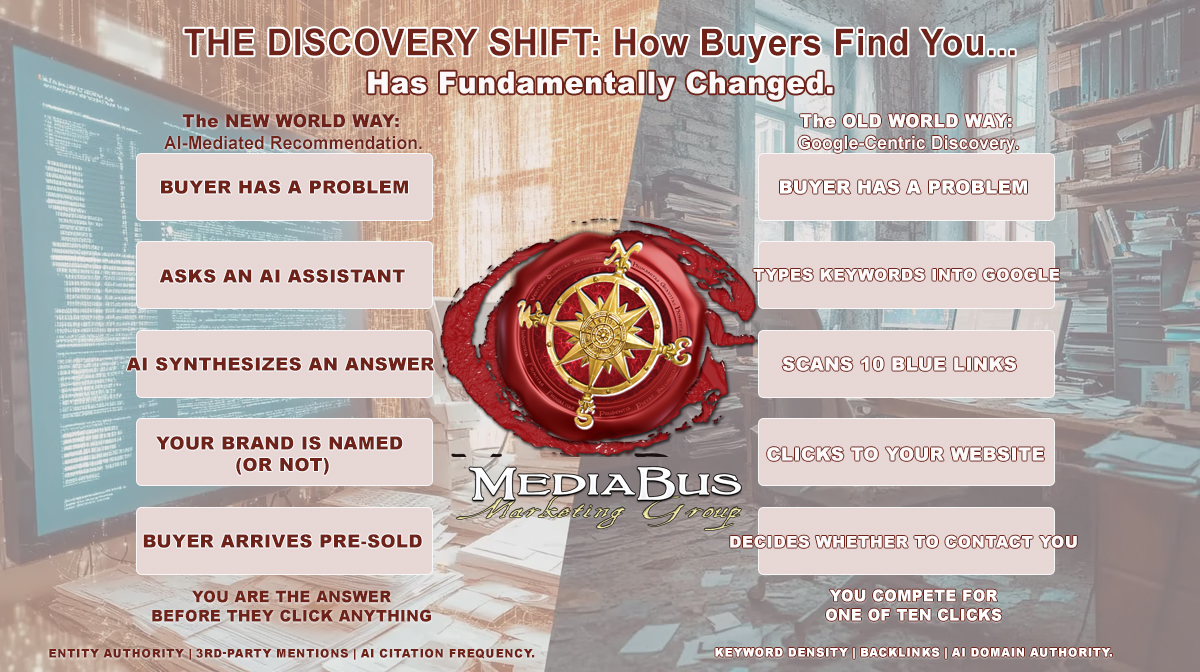
Here is the change that matters most: Traditional SEO was a competition for position in a list. When a prospect searched for “business advisor [your city]” on Google, they saw ten results and chose one to click. Your job was to be in the top three positions. Success was measured in rankings and clicks.
AI search is not a list. It is a recommendation.
When that same prospect opens Perplexity, Gemini, ChatGPT, Grok, or Claude and types “who should I hire for operational consulting in [your region]” — the AI does not give them a list of ten options and let them decide. It synthesizes everything it knows about your category and gives them a direct, confident answer. Two names. Maybe three. Often one.
You are either in that answer, or you are not.
What the Numbers are Saying to Us
The overlap between top Google rankings and AI-cited sources has dropped from 70% to below 20%. ChatGPT now accounts for 87.4% of all AI referral traffic to websites. AI-referred visitors convert at 4.4 times the rate of organic search visitors. Traditional search volume is projected to decline 25% by the end of 2026 as buyers shift to AI-assisted research, and the searches they are shifting away from are not the casual browsing searches. They are the high-intent, comparison-phase, “who should I hire” searches that matter most to anyone in business right now.
This is not a future trend. For the buyers who are making consequential purchasing decisions — your buyers- are already doing this — it is already the present.

FOUR MINDSET SHIFTS that separate the BUILDING AUTHORITY & those who are not
I want to go deeper than tactics here, because the tactical implementation is only as valuable as the mental model underneath it. If you change what you do without changing how you think about what you are doing, you end up with a new set of actions built on the same outdated assumptions.
Here are the four assumptions that need to be updated.
SHIFT 1: From “I need to rank” to “I need to be recognized.”
SEO was fundamentally about position. You optimized a page to rank for a keyword. Success was a number — position 1, 2, 3 on Google’s results page according to their nebulous Algorithm.
GEO is fundamentally about recognition. The AI is not assigning you a position. It is deciding whether it knows you well enough, from enough trusted sources, in enough authoritative contexts, to include your name in a recommendation it is delivering to a buyer who asked for its best answer.
The mental model shift: stop thinking about your website as a document to be ranked. Start thinking about your business as an entity to be recognized. What does the AI know about you? Where has it encountered your name? In what contexts? With what associations? With what third-party corroboration?
Recognition is built differently from just ranking. It is built through the accumulation of authoritative, consistent, multi-source signals that teach AI systems who you are, what you do, and why you belong in the recommendation when someone asks about your category.
SHIFT 2: From “My website is my digital presence” to “My digital footprint is my presence.”
Here is a finding that should restructure how you think about content investment: 85% of brand mentions in AI responses come from third-party pages, not owned domains. 89% of AI citations come from earned media.
Your website is 23% of the AI’s picture of your business. The other 77% is built by what the rest of the web says about you — in publications, directories, reviews, press releases, community forums, and industry platforms.
Most businesses invest almost exclusively in their own website and their own content. That investment is not wrong. But if it is the only investment — if there is no systematic program for earning third-party mentions, press coverage, review volume, and industry citation — it is a house built on a foundation that supports only a fraction of the structure that AI visibility actually requires.
SHIFT 3: From “traffic is the goal” to “recommendation is the goal.”
Here is the subtler mindset shift, and in some ways the most important one.
Traditional SEO creates traffic. Visitors arrive at your website. You measure sessions, bounce rates, and time on page. Success is quantified in the analytics dashboard.
AI search does something different. When Perplexity recommends your practice to a prospect, that prospect may never visit your website immediately. They may call directly. They may search your name. They may ask their colleague who already uses you. The recommendation has been made — and it has done its work — before a session is ever recorded.
This is why measuring AI visibility with traditional SEO metrics consistently undervalues it. The conversion happens upstream of the click. The influence is exercised before any tracking pixel fires.
The implication: success in GEO requires new metrics. Share of Model – the percentage of relevant AI queries where your name appears. Brand Visibility Score – how often you show up when buyers ask for recommendations in your category. These are the leading indicators. GA4 AI traffic channel data is the lagging confirmation.
SHIFT 4: From “content as a traffic machine” to “content as the proof of expertise.”
The age of AI has made authentic expertise more valuable, not less.
Here is why. AI content tools have flooded every industry with generic, well-structured, SEO-plausible content that sounds like expertise without being grounded in it. The internet is now extraordinarily full of content that meets every technical SEO requirement and contains no original thought.
AI citation systems are getting better at distinguishing between them. Original data, original research, named expert attribution, specific documented outcomes, proprietary frameworks built from real experience — these are the citation triggers that generic content cannot produce.
For any business who have had any time in business, making payroll, equipment payments, and following through on contracts, with documented client outcomes, with a perspective on industry problems that comes from having sat across the table from the people experiencing them — that is the content raw material that AI systems weigh most heavily and most durably.
The shift: stop producing content to satisfy an algorithm. Start producing content that captures what you actually know and proves it with specificity. The algorithm, at this point, is sophisticated enough to tell the difference.
THE ARCHITECTURE OF AI VISIBILITY — WHY THIS IS NOT JUST SEO
Now, let us get specific about the mechanics. Because understanding the why makes the what obvious.
Traditional SEO works at the page level. Google evaluates your page for a keyword query, assigns it a ranking signal based on relevance, authority, and technical factors, and positions it in a list.
GEO works at the passage level. When an AI system receives a query, it executes a process called Retrieval-Augmented Generation (RAG). The AI breaks the query into sub-queries, searches its index for relevant content, extracts passages of 200-500 words from retrieved pages, converts each passage into a mathematical representation (a vector), compares those vectors to the query’s intent, and synthesizes the best-matching passages into a composed answer.
What this means for your content: the AI does not retrieve your page. It retrieves your best paragraph. Every section of every piece of content you produce must function as a self-contained, standalone, extractable knowledge block. A paragraph that requires reading the surrounding content to make sense produces an ambiguous vector. An ambiguous vector does not get retrieved. A paragraph that is complete, precise, directly answers a specific question, and embeds your brand name in proximity to your category — that produces a precise vector that gets matched and cited.
This is why the technical structure of content — direct answer architecture, question-formatted headings, FAQ schema, Triple Schema Stack — is not cosmetic. It is the extraction architecture that determines whether a piece of content can be cited at all.
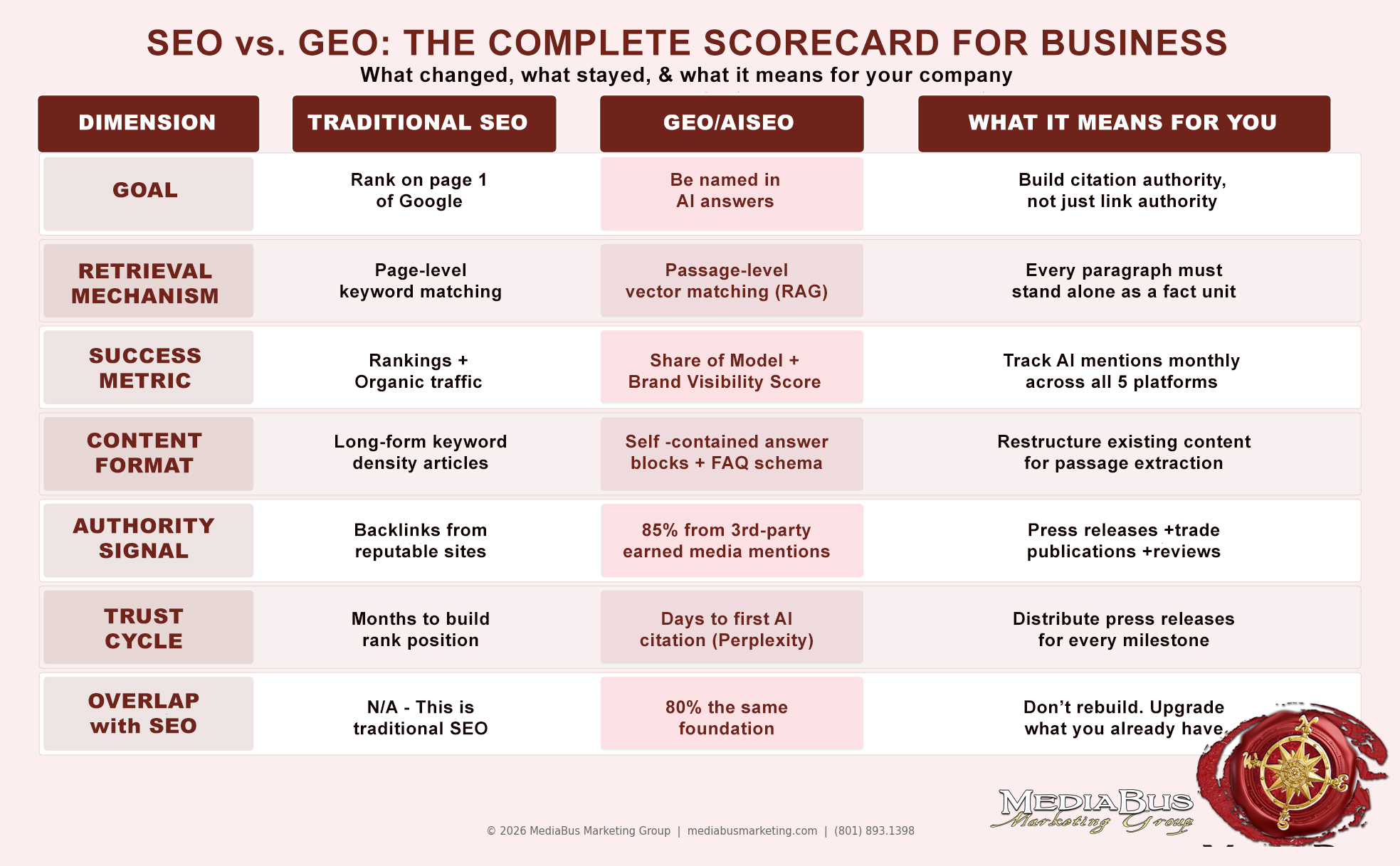
Seven dimensions of comparison: goal, retrieval mechanism, success metric, content format, authority signal, trust cycle, and overlap. The scorecard shows precisely what changed, what stayed, and what it means for your consulting practice specifically.
THE CONSULTING AUTHORITY FLYWHEEL
Here is the model that ties everything together — and the reason this matters as a long-term compounding investment rather than a one-time tactical campaign.
In the old model, most everyone has been trained on for the last 20+ years, from Google’s Algorithm, authority was built through relationships, referrals, and rankings. Each was valuable. None of which are compounded automatically.
In the new model, when you build AI visibility correctly, you are building a flywheel.
- Original insight content earns AI citations.
- AI citations generate buyers who discover you through AI recommendations.
- Those buyers arrive pre-sold — they have already received an endorsement from a system they trust.
- Pre-sold buyers convert faster and refer more readily.
- Client wins become case studies.
- Case studies become press coverage.
- Press coverage becomes third-party earned media.
- Third-party earned media is exactly the source category AI systems cite most heavily.
- Which feeds the next cycle of AI citations.
Each rotation of the flywheel compounds on the previous one. The AI visibility you build in month one makes month six easier. The third-party mentions you earn in quarter one make quarter three’s citations more frequent and more confident.
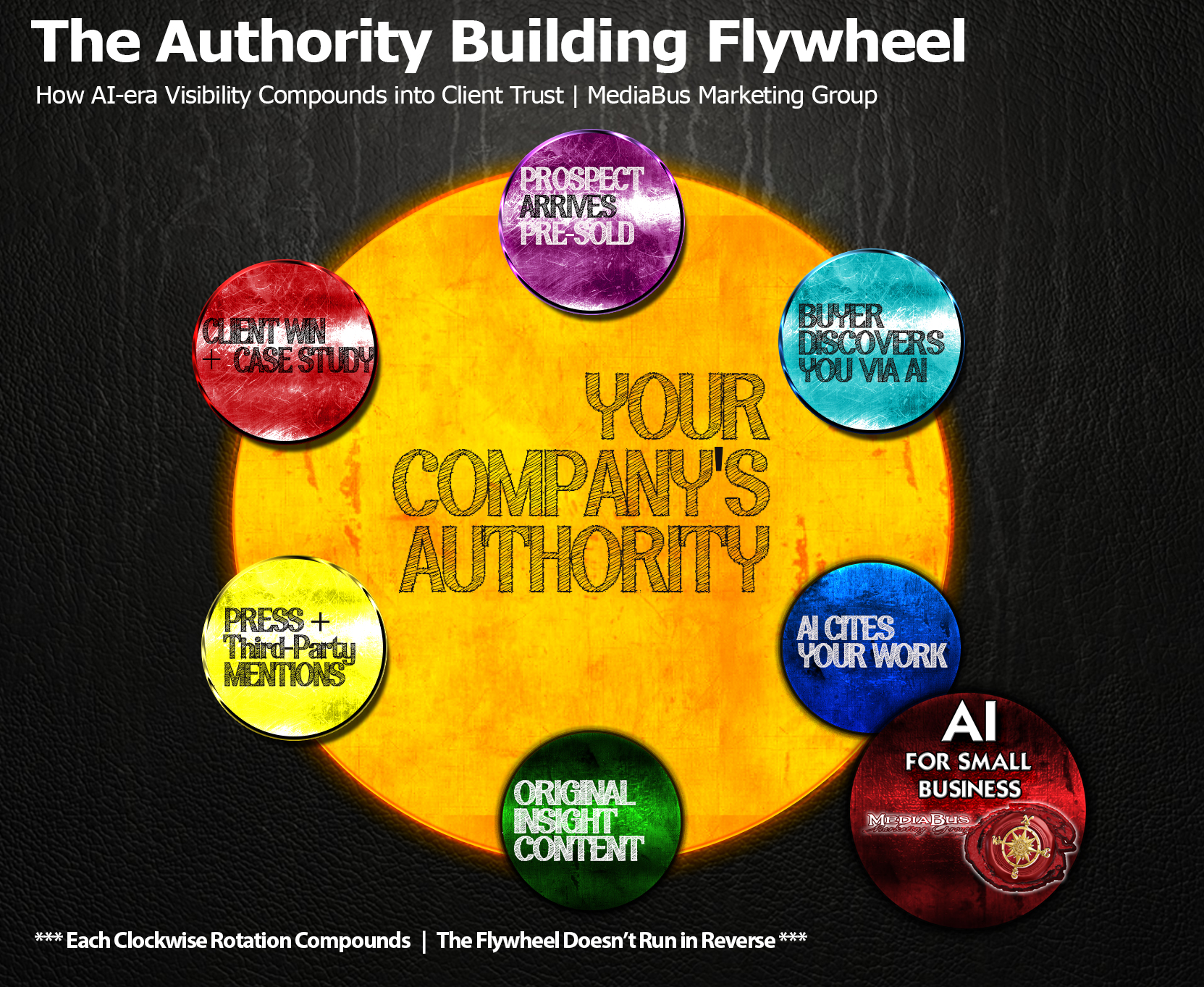
The six-node flywheel: original insight content → AI cites your work → buyer discovers you via AI → prospect arrives pre-sold → client win + case study → press + third-party mentions → back to AI citation. Each rotation strengthens every subsequent one.
The businesses that start building this flywheel now are not just twelve months ahead of those who start later. They are building an asset whose compounding curve makes the gap exponentially harder to close over time. AI recognition, like domain authority before it, becomes a structural advantage that budget alone cannot quickly replicate.
THE SPECIFIC THINGS MOST GET WRONG
Let me be direct about the most common failure patterns, because knowing what not to do is as important as knowing what to do.
They optimize their website and nothing else. The website is 23% of the equation. The other 77% – reviews, press releases, trade publication features, industry directory listings, community forum presence, LinkedIn thought leadership – does not receive a fraction of the investment it deserves. The company that publishes excellent website content but distributes zero press releases, holds zero third-party mentions, and has not claimed their professional directory presence has built a beautifully optimized foundation on top of which there is almost nothing for AI systems to corroborate.
They write for search engines instead of for AI extraction. The content looks right. It has the keywords. It has the structure. But every paragraph depends on the surrounding context to make sense. Every section requires sequential reading to deliver its meaning. None of it is modular. None of it passes what the research community calls the Island Test – the question of whether an extracted paragraph can stand alone as a complete, accurate, attributable statement. Content that fails the Island Test is content that AI systems cannot reliably cite.
They use promotional language that gets filtered. “Industry-leading expertise.” “Unparalleled client outcomes.” “Best-in-class advisory services.” These phrases are filtered by AI advertising detection systems regardless of the surrounding content quality. The business owner who replaces “industry-leading” with “clients report average efficiency improvements of 23% in year one, documented across 47 completed engagements” has transformed a promotional claim into a citation-worthy fact.
They never measure AI visibility at all. If you do not run the monthly visibility audit – which consists, in part, of three prompts across five AI platforms, documented, compared month to month – you are operating blind in the channel that is already driving the highest-converting discovery traffic available. The businesses that track this data make better decisions about where to invest. The consultants who do not track it make guesses.
WHAT THE NEXT NINETY DAYS LOOK LIKE
This is not a three-year transformation project by any stretch of the imagination! It is a structured ninety-day upgrade to an existing practice that already has the expertise, the track record, and the client relationships to build significant AI visibility quickly.
An AI Visibility Roadmap that we give you once you are able to see the full picture of where your company is and what your business needs to do to cover the gaps that you have when it comes to LLM Inclusion and Recommendations.
CLICK HERE TO GET STARTED AND RECEIVE YOUR CUSTOMIZED AI VISIBILITY ROADMAP
The sequence matters. Foundation before authority. Authority before measurement. Measurement before optimization. The business leaders who skip these tactics without building the foundation produce inconsistent results. The consultants who follow the sequence produce compounding ones.
THE THING I WANT YOU TO ACTUALLY TAKE AWAY FROM THIS
I have written a lot of words here. Let me compress them for you.
The question is not whether AI has changed how business works. It has. The question is whether the change demands that you abandon everything you know and start over, or whether it demands something more nuanced – a specific upgrade to a specific 20% of your practice’s visibility infrastructure, built on a foundation that your decade of expertise has already largely constructed.
The answer is the nuanced one.
You have the expertise. You have the track record. You have the client relationships that, if properly documented and distributed through the right channels, would make AI systems cite you with the confidence they currently reserve for the competitors who understood this earlier than you did.
The gap between where you are and where you need to be is not a chasm. It is a structured AI Visibility Audit and Program – ninety days of focused execution – that builds the AI visibility infrastructure your expertise deserves.
Most people will read this and not act. They will return to the workflow that has always worked, adjusting for the discomfort that something might be changing by telling themselves they will address it later.
Later is when the flywheel has already built a momentum advantage for someone in your market that takes years to close.
Those who act on this now will spend the next five years being the businesses that AI recommends with confidence. The ones who do not will spend those same five years wondering why referrals have slowed and where the good prospects went.
You have been building something real for a long time. Do not let the discovery infrastructure that carries it to the people who need it become the reason it does not reach them.
A FINAL THOUGHT
There is a version of this conversation that ends with a list of tactics and a call to action. That version is fine. Useful, even.
But I want to leave you with something more honest.
The reason this shift is hard is not that the tactics are complex. The reason it is hard is because it requires you to update a mental model about how your practice gets found that has been accurate for most of your career. Updating mental models is uncomfortable. It requires admitting that something you were confident about is no longer fully true. That takes a specific kind of intellectual courage that most people defer indefinitely.
Those entrepreneurs I most respect – the ones who have built practices that compound rather than plateau – share one characteristic above all others. When the evidence tells them something has changed, they update. They do not rationalize the evidence away. They do not wait for perfect certainty. They look at the data, acknowledge the shift, and ask: given this, what is the most intelligent next move?
You are reading this because some part of you already knows the shift is real. The only question left is what you do with that knowledge.
At MediaBus Marketing Group, we have spent twenty-five years in regional markets building lead gen systems that are exactly the kind of integrated visibility programs this article describes — and we have spent the last few years integrating every element of GEO, AI citation building, and entity authority development into the strategic foundation we build for businesses like yours.
We understand local and regional markets. We understand the service space. We understand what it means to build authority with mid-sized clients who make decisions based on trust rather than brand recognition.
DM us CONSULTANT or call (801) 893.1398. We will run your AI Visibility Audit — show you exactly how the Big 5 LLMs currently describe your practice, map every gap in your AI visibility infrastructure, and give you the specific 90-day program that closes it.
This is not a generic marketing engagement. It is the infrastructure upgrade your decade of expertise has already earned the right to support.
SEO vs GEO FAQs
FAQ 1 — Is GEO (Generative Engine Optimization) actually different from SEO, or is it just a new name for the same discipline?
GEO is 80% excellent SEO applied with precision, plus 20% that is genuinely new and architecturally different. Understanding exactly which 20% is different — and why — is the strategic intelligence that matters.
The 80% overlap: high-quality content, technical website accessibility, domain authority signals, E-E-A-T (Experience, Expertise, Authoritativeness, Trustworthiness), topical depth, and backlink quality all feed both traditional search rankings and AI citation frequency. Strong SEO remains the foundation that GEO requires. Businesses that abandon SEO to chase GEO tactics are building on sand.
The 20% that is genuinely new: the retrieval mechanism is architecturally different. Traditional SEO optimizes at the page level. AI retrieval systems use a process called Retrieval-Augmented Generation (RAG), which retrieves content at the passage level — extracting specific 200-500 word chunks that best answer the sub-queries behind a user’s question. Every section of content must function as a self-contained, standalone knowledge block that can be extracted and cited independently. Content that requires surrounding context to make sense produces ambiguous vectors that do not get retrieved. The value exchange is also different: traditional search is primarily a traffic channel, while AI search is a branding and recommendation channel where the influence is exercised before any click is recorded. And the source ecosystem is wider: 85% of brand mentions in AI responses come from third-party pages, not owned domains — requiring a multi-source presence program that goes well beyond website optimization.
FAQ 2 — As a professional in my marketplace, why does AI visibility matter specifically for what we do – and what is the ROI case?
Most companies that have their doors open are among the highest-beneficiaries of AI visibility investment for a specific structural reason: the buying decision is entirely trust-based, and AI recommendations carry trust transfer at a scale no other discovery channel matches.
When a buyer asks an AI system for a business recommendation and receives your name, they arrive with a pre-formed confidence in your credibility. The AI has implicitly endorsed you. Research from Adobe documents that AI-referred visitors are 12% more engaged and 5% more likely to convert than visitors from any other source. Semrush data shows AI-referred visitors convert at 4.4 times the rate of organic search visitors. For a practice where a single client engagement may be worth tens of thousands of dollars, the financial arithmetic of AI visibility investment resolves quickly.
The competitive dimension is equally important. The overlap between top Google rankings and AI-cited sources has dropped from 70% to below 20%. The consultants appearing in AI recommendations are not necessarily the ones with the best Google rankings — they are the ones with the strongest entity recognition, the deepest third-party mention record, and the most GEO-structured content. That means AI visibility is currently an open competitive window, particularly in regional consulting markets where most practitioners have not begun building their AI presence. The businesses that build AI visibility now will be compounding a structural advantage by the time their competitors recognize the opportunity.
FAQ 3 — How does a professional services company build the third-party mentions and earned media that AI systems weigh most heavily?
The research finding is specific: 89% of AI citations come from earned media, and 85% of brand mentions in AI responses come from third-party pages rather than owned domains. This makes earned media the highest-priority investment in any AI visibility program for consultants.
The most accessible and highest-return earned media building mechanisms for consulting practices are: press releases distributed through recognized newswires (PR Newswire, Business Wire, GlobeNewswire) for every significant business milestone — new service offerings, geographic expansions, client wins with documented outcomes, awards and certifications, strategic partnerships; trade publication features and expert commentary placements in industry publications your ideal clients read; professional directory presence on platforms AI systems actively draw from — LinkedIn with complete company page, Clutch, G2, industry-specific professional associations; review volume and recency on Google Business Profile, Yelp, and any industry-specific review platforms relevant to your consulting category; and community forum presence where practitioners in your industry discuss problems and solutions.
For More Information on how MediaBus Marketing can assist you in this, click here to read more about our AI VISIBILITY PACK
Organizations with active press release strategies see 67% more AI citations than competitors who do not maintain press release programs. A consulting practice that distributes six to eight releases per year — one for each significant milestone — is building a compounding earned media record that feeds AI citation frequency consistently.
FAQ 4 — How do I measure whether my AI visibility efforts are working, and what metrics should I be tracking?
AI visibility requires its own measurement framework, separate from traditional SEO metrics. The businesses that measure only rankings and organic traffic are consistently undervaluing their AI visibility and making under-informed investment decisions.
The three-part measurement system for consulting practices: the monthly prompt audit, the Brand Visibility Score, and the GA4 AI Traffic Channel.
Please refer to our AI VISIBILITY PACK for more details, but it consists of the following
Monthly Prompt Audit: run three prompts across all five major AI platforms (ChatGPT, Perplexity, Gemini, Grok, Claude) at the same time each month. The Category Discovery prompt asks the AI for the best consultants in your category and market. The Direct Brand Query asks the AI what it knows about your specific practice. The Competitive Comparison asks the AI to compare you to your primary competitor. Document every response, track which language the AI uses to describe you, and note which competitor appears when you do not. Run these with identical prompts every month so changes reflect your program’s performance rather than prompt variation.
Brand Visibility Score: the percentage of tested prompts in which your brand appears. If you test 20 prompts and appear in 8, your BVS is 40%. A 10% or more quarter-over-quarter improvement confirms your program is compounding.
GA4 AI Traffic Channel: create a custom channel grouping capturing referral sessions from chatgpt.com, perplexity.ai, gemini.google.com, claude.ai, and grok.com. Track sessions, engaged sessions, and conversion rates from this channel separately from traditional organic traffic. These visitors arrive with higher purchase intent — having already received a recommendation — and their conversion behavior provides the clearest available measurement of what your AI visibility program is worth in revenue terms.
FAQ 5 — What is the single most important thing a consultant can do this week to begin building AI visibility?
The single most important thing is the AI Visibility Audit – running the prompt test across all five major AI platforms to establish your current position before implementing anything else. You cannot manage what you have not measured, and the consultants most surprised by their AI visibility gap are almost always the ones who assumed their traditional digital presence translated into AI mentions. It often does not.
Get a head start! The preliminary audit takes thirty minutes. Use these three prompts for each of the five platforms: “What are the best [your service category] consultants in [your region]? Give me your top recommendations,” “Tell me about [your business name] — what do they do, who do they serve, and are they worth considering for [your primary service]?” and “Compare [your business] to [your primary competitor] for [your primary service] — which would you recommend?”
Document every response. What position do you appear in, if at all? What language does the AI use to describe your practice? What does it say about your competitor? Which third-party sources does it draw from when it mentions either of you?
That documentation is your strategic roadmap. It tells you exactly which of the seven pillars in the AI-mentioned authority framework — entity establishment, third-party mentions, brand-embedded content, community presence, review sentiment, technical accessibility, and monitoring — needs the most urgent investment. Starting from data rather than assumptions is the difference between a visibility program that compounds and one that produces inconsistent results you cannot attribute to specific inputs.
Action Items:
SHARE THIS STORY ANYWHERE YOU LIKE
SHARE THIS STORY ANYWHERE
Mastering AI Automation for Finance and Back Office
Mastering AI Automation for Finance and Back Office The back office that never forgets. Most back-office losses are [...]
Mastering AI Automation for Project and Task Management
Mastering AI Automation for Project and Task Management Your plan is a prediction. AI's best job is remembering [...]
AI Operations: Automating Supply Chain, Scheduling & More
AI Operations: Automating Supply Chains, Scheduling, & More The Most Profitable AI in Your Business Is Probably the [...]