

How I Build an AI Strategy That Scales
… an AI Strategy That Scales as My Business Grows?
The practical, no-fluff blueprint for founders, executives, and growth-minded leaders who refuse to be left behind in the greatest business transformation of our lifetime.
Key Stats at a Glance:
- 95% of AI pilots never scale
- 70% of AI investment belongs in people & process
- 300% avg ROI within 24 months (for those who do it right)
- 90 days to initial proof of value
What You’ll Find in This Article…
This isn’t another vague thought-piece about “AI disruption.” This is your practical, no-fluff blueprint to build an AI strategy that survives first contact with reality – and scales as your business does.
- Why 95% of AI pilots fail — and the one mindset shift that changes everything
- The 5-Stage AI Maturity Ladder — know exactly where you stand today
- The 70-20-10 Principle — how to allocate resources for maximum return
- The Data Foundation Secret — the asset most companies already own but ignore
- Governance and Trust Architecture — how to govern AI without killing innovation
- The AI Center of Excellence — your secret weapon for scaling without chaos
- Quick-Win Use Cases by Company Size — from solopreneur to enterprise
- ROI Measurement Frameworks — how to prove value in the boardroom
- The 90-Day Launch Sequence — your action plan starting tomorrow
- 5 FAQs — answered with brutal honesty
The Moment Everything Changes
Right now – in this precise window of history – you are standing at the edge of the most profound business transformation since the invention of the internet. This is not an exaggeration or hyperbolic in any way. But unlike the dot-com era, where you needed millions of dollars and a team of engineers to compete, AI has thrown the doors wide open and truly leveled the playing field for all those who are industrious enough. The small bakery on the corner can now deploy the same caliber of intelligence that was, two years ago, exclusive to billion-dollar corporations. The question is no longer, “Should we use AI?” The question – the only question that matters – is: “How do we build it in a way that doesn’t just work today, but compounds, multiplies, and scales tomorrow?”
Most businesses are getting this wrong. Not because they lack intelligence. Not because they lack resources. They’re getting it wrong because they’re treating AI like a software purchase when it is, in fact, an organizational transformation. They’re buying tools when they should be building systems. They’re hiring prompt engineers when they should be engineering a culture. And they’re chasing pilots when they should be architecting platforms.
“In 2025, the organizations pulling ahead are those that treat AI not as a siloed initiative but as a catalyst for reinvention.” — IMD AI Maturity Index 2025–2026
This article will show you precisely how to do it right. We are going to break down every dimension of a scalable AI strategy — with the kind of clarity that lights a fire under you and the kind of precision that lets you act tomorrow morning.

In the Age of AI
You Gain the Advantage over Those Who Don't Step Up
Section 1: Why Most AI Initiatives Fail to Scale — And Why Yours Won’t
Section 2: The 5-Stage AI Maturity Ladder — Where Are You Right Now?
Before you can chart a path forward with AI, you must be ruthlessly honest about where you stand. Most companies grossly overestimate their AI maturity. Here is the framework that cuts through the self-deception:
Stage 1 — The Casual: You’ve tried ChatGPT. Someone on your team uses AI tools occasionally. There is no central policy, no defined use cases, no measurement. This is not a strategy — it is curiosity. Most small businesses live here longer than they should.
Stage 2 — The Prompt User: You’ve launched one or two structured AI pilots. You are measuring something — though not always the right things. Results are promising in isolation but have not changed how the business operates. The danger zone: staying in Stage 2 feels safe, but it creates false confidence.
Stage 3 — The Workflow User: Integration of AI is embedded in specific workflows. Employees use it daily. You have basic governance policies. You are measuring productivity gains. This is where real ROI begins to appear — and where most mid-market companies aspire to be.
Stage 4 — The Builder: AI operates across multiple business functions with coordinated governance. In this ‘Orchestration,’ you have an AI Center of Excellence (CoE). Data pipelines are robust and automated. You are measuring both hard ROI and strategic impact. Enterprise companies at this stage are creating moats.
Stage 5 — The System Thinker: It is a Transformer, AI that is not a tool in your business — AI IS the business model. You are building proprietary AI capabilities that competitors cannot easily replicate. Your data is your most valuable asset. You are generating new revenue streams that did not exist before.
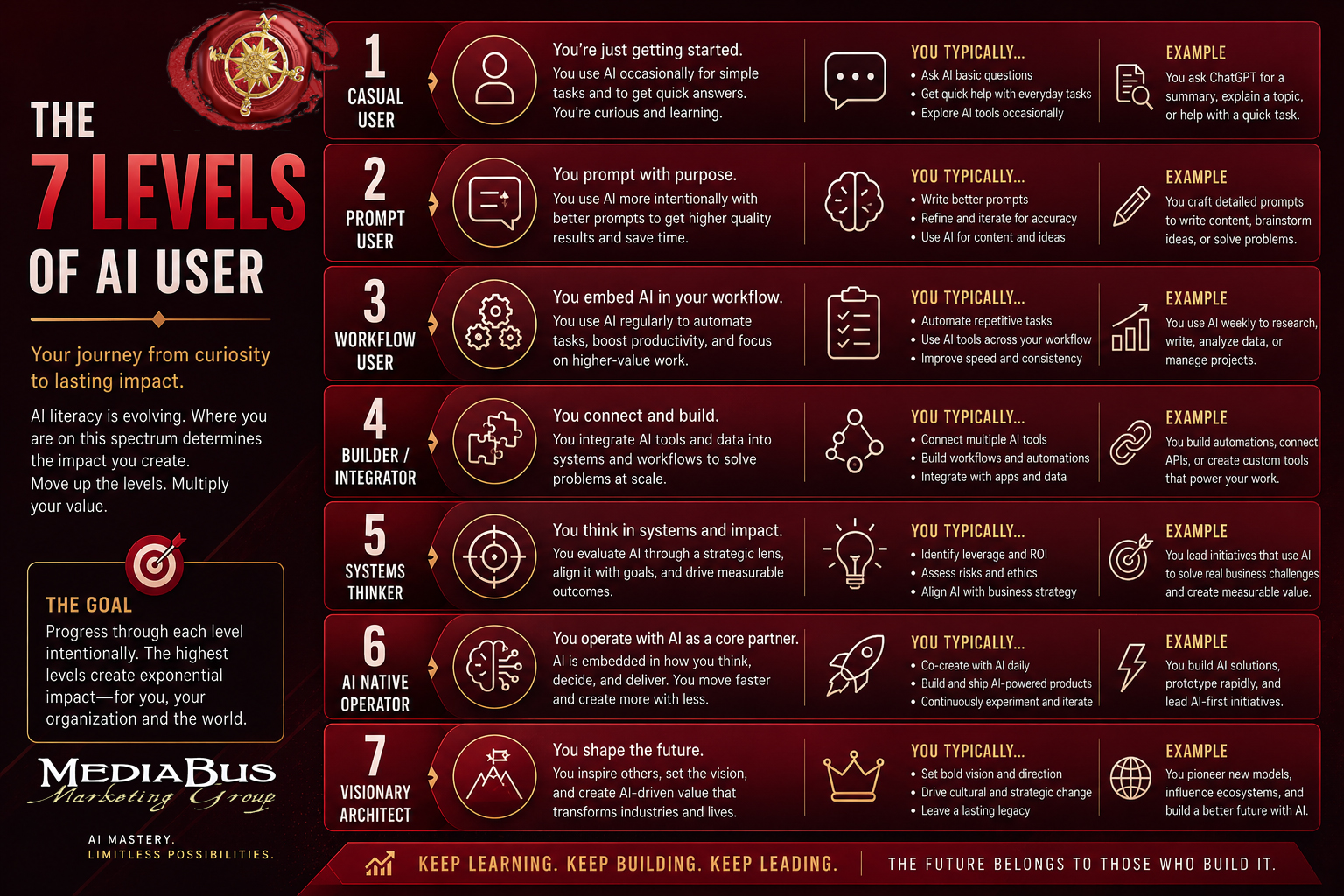
Stage6 — The AI Native Operator: This is where true partnership with the AI manifests itself. You are able to succinctly, precisely, and quickly create the ongoing solutions that can be captured and harnessed with the assistance of the AI within your business’s operations and turn them into a revenue-generating proposition.
Stage 7 — The Visionary Architect: You can move at the Speed of AI. As the advancements of each model come along, you are nimble and have ample bandwidth to stay at the “tip of the proverbial AI Sword”.
Your Homework Right Now: Honestly assess which stage you occupy. Not where you aspire to be — where you ARE. Write it down. The gap between your current stage and Stage 5 is your AI strategy roadmap.
Section 3: The Architecture of a Scalable AI Strategy — 5 Non-Negotiable Pillars
A scalable AI strategy is not a list of tools. It is a living system with five interlocking components. Remove any one of them and the whole structure collapses.
Pillar 1 — A Clear Business-First Vision
Every successful AI strategy begins not with technology but with business objectives. What specific outcomes do you need to achieve? Revenue growth? Cost reduction? Customer retention? Speed of delivery? AI is not a goal – it is an accelerant. It will accelerate the broken SOPs as well as the tried and true ones.
Define the destination first. Then determine how AI gets you there faster.
Companies that pursue AI for its own sake – chasing the hype – consistently underperform. Companies that say “We need to reduce customer churn by 18% in 12 months, and here is how AI can help us do that” consistently outperform. Be the second company.
Pillar 2 — The Data Foundation
This is the little-known gem that will separate you from 80% of your competitors: data quality, not AI sophistication, is the primary determinant of AI success. According to research, data quality issues are the most cited limiter of AI deployment – reported by 49% of firms and rising to 52% for companies above $10B in revenue.
Your competitors are spending millions on frontier AI models while sitting on garbage data. You can outmaneuver them by investing first in data infrastructure: clean it, tag it, centralize it, and make it liquid – flowing freely to wherever your AI systems need it. Your proprietary data is your competitive moat. No competitor can copy it.
*** The Gem Most Businesses Miss: Your email archives, customer service transcripts, sales call recordings, inventory history, and support tickets contain intelligence that no AI vendor can sell you. That proprietary dataset – cleaned, labeled, and fed into the right models – becomes a competitive advantage that compounds over time and is nearly impossible to replicate.
Pillar 3 — Governance and Trust Architecture
Here is where the company’s ambition meets responsibility – and quite frankly where most scaling efforts stall. As your AI footprint expands, so does your exposure: bias risks, privacy vulnerabilities, regulatory obligations, and brand reputation. The EU AI Act’s provisions are now in effect, and similar frameworks are emerging globally. Governance is not optional — it is existential.
Imagine the worst data breach your company could experience, where proprietary information that gives you the competitive edge, the cherished client list you have curated for years, and yes, even vital financial data is leaked online. You are already in danger of such things before AI usage… Don’t be the very cause of such devastation by using AI without Silos, Boundaries, Established Protocols, or Internal Safeguards in place!
But here is the crucial insight: governance done right is not a brake on innovation. It is an accelerant. Companies with robust AI governance frameworks build faster, deploy more confidently, and face fewer costly rollbacks. The goal is not bureaucracy — it is a trusted architecture that empowers your teams to move fast without breaking things that matter.
Pillar 4 — Talent and Culture Transformation
BCG research reveals a staggering principle: 70% of your AI investment should go to people and processes. Only 20% towards technology and data. Only 10% to algorithms. Read that again, because it flies in the face of everything the AI software vendors are selling you.
The companies winning with AI are not the ones with the best tools. They are the ones where every employee – from the receptionist to the CFO – has AI fluency. Where teams are not afraid of AI taking their jobs, because leaders have created a culture where AI makes jobs bigger, not smaller. Where there are internal champions, trainers, and a feedback loop that continuously improves how AI is used.
Pillar 5 — Measurement and Feedback Loops
What gets measured gets scaled. Build an AI ROI dashboard from Day One. Track hard ROI: time saved, costs reduced, revenue generated, errors eliminated. Track soft ROI: employee experience, innovation velocity, customer satisfaction scores. Embed feedback loops into every AI system so models improve with use. The compounding effect of continuous improvement is where AI strategies truly begin to generate exponential returns.
Section 4: The AI Center of Excellence — Your Scaling Engine
If there is one structural investment that separates companies that scale AI from those that stagnate, it is the AI Center of Excellence (CoE). And here is the great news: you do not need to be an enterprise company to build one. Even a 20-person team can establish a lightweight CoE that delivers outsized results.
An AI CoE is not a department of PhD researchers. It is a cross-functional team – ideally three to seven people – that owns AI strategy, establishes standards, evaluates tools, shares best practices, and serves as the connective tissue between AI initiatives across the organization. Think of it as the air traffic control tower for your AI ecosystem.
The CoE prevents “AI sprawl” – the phenomenon where individual departments independently adopt incompatible tools, creating duplicated costs, data silos, and governance nightmares. It creates a reference architecture: standardized patterns for how AI is integrated, how it is monitored, how it is updated, and how it is governed. This repeatability is the engine of scale.
*** CoE for Small Businesses: If you are a small business, your CoE might be one person wearing multiple hats: your most AI-curious team member empowered with authority, budget, and executive support. The title matters less than the mandate: own the strategy, establish the standards, champion the culture.
Key CoE responsibilities include: establishing AI use case prioritization frameworks, defining build vs. buy decision criteria, piloting use cases for scalability before broad rollout, embedding responsible AI practices, and building AI literacy across the organization. Companies that establish a CoE early see dramatically faster time-to-value and significantly lower costs as they scale.
Section 5: Quick-Win AI Use Cases by Business Size
Theory is certainly seductive. And you definitely get a lot of ‘theory’ when swimming in the waters of AI! Results, however, are transformative. Here are the highest-ROI AI use cases, organized by business scale, that you can begin implementing within the next 90 days.
For Solopreneurs and Micro-Businesses (1–10 employees)
- AI-powered content creation and marketing copy — eliminate 10–15 hours per week
- Automated customer email responses and FAQ handling — respond 24/7 without hiring
- AI bookkeeping and expense categorization — reduce accounting costs by 60%
- Proposal and contract generation — close deals 3x faster
- Social media scheduling and optimization — maintain presence without the grind
For Small Businesses (10–100 employees)
- AI-powered customer service with human escalation protocols
- Sales pipeline intelligence: predict which leads will close and when
- Inventory demand forecasting: reduce overstock and stockouts by up to 40%
- Employee onboarding automation: cut time-to-productivity in half
- Document processing and intelligent data extraction
For Mid-Market Companies (100–1,000 employees)
- Predictive maintenance for equipment and infrastructure
- AI-assisted workforce planning and scheduling optimization
- Customer churn prediction and proactive retention programs
- Intelligent document management and contract analysis
- Real-time competitive intelligence monitoring
For Enterprise (1,000+ employees)
- Enterprise-wide AI orchestration across all business functions
- Custom large language models trained on proprietary data
- AI-driven product personalization at scale
- Autonomous AI agents managing complex multi-step workflows
- Predictive analytics for strategic decision-making and scenario planning
Section 6: The 90-Day AI Strategy Launch Sequence
Every great journey requires a first step that is both bold and specific. Here is your 90-day launch sequence – a phased approach that research shows delivers up to 2.8 times higher ROI than ad hoc adoption.
Days 1–30: Foundation and Diagnosis
- Conduct an honest AI maturity assessment (use the 7-Stage Ladder above)
- Audit your data assets: what do you have, where is it, how clean is it?
- Identify your top three business challenges most amenable to AI solutions
- Establish your lightweight AI CoE or designate your AI Champion
- Begin AI literacy training for the leadership team
Days 31–60: Pilot Selection and Launch
- Select ONE high-impact, low-complexity use case to pilot first
- Define success metrics before you begin – not after
- Establish your governance framework: data privacy, access controls, ethics guidelines
- Choose tools based on scalability, not just current capability
- Launch the pilot with a cross-functional team, not just the tech department
Days 61–90: Measure, Refine, Scale
- Measure against your pre-defined success metrics relentlessly
- Document what worked, what did not, and why
- Capture institutional knowledge: how is AI changing workflows?
- Build the case for scaling: quantify hard and soft ROI
- Define your Year One roadmap based on pilot learnings
Remember: firms that begin with high-impact, low-complexity pilots see up to 2.8 times higher ROI than those that attempt broad, simultaneous deployment. Start focused. Win decisively. Scale confidently.
Section 7: The Crucial But Little-Known Gems
The Bottom Line: Your AI Strategy Starts Today
Here is what I want you to understand in the very fiber of your being: the gap between those who build scalable AI strategies now and those who wait is widening every single day. Not gradually — exponentially. The organizations pulling ahead in 2025 and 2026 are not the ones with the biggest budgets. They are the ones with the clearest vision, the most committed leadership, and the courage to act before they feel fully ready.
You now have the framework. The 5-Stage Maturity Ladder. The 70-20-10 Principle. The Data Foundation. The Center of Excellence. The 90-Day Launch Sequence. The Gems most of your competitors will never discover. You know more right now, having read this article, than most executives who have been “exploring AI” for two years.
“The future belongs to the AI mature — those who trust it, govern it, scale it, and unlock its full potential.” — IMD AI Maturity Index 2025
Knowledge without action is entertainment. So here is your call to action, and it is not theoretical: Before you close this article, identify ONE thing. One business challenge. One data asset you already own. One process that is consuming hours of human talent of which could be automated. Write it down. Assign it an owner. Give it a 90-day deadline. Make it someone’s job – even if that someone is you – to move it from idea to pilot in the next 30 days.
Because the businesses that will dominate the next decade are not the ones that understood AI best.
They are the ones who acted on that understanding first. The playing field is leveled. The tools are accessible. The frameworks are proven. The only variable left is you.
The question is not whether AI will transform your industry. It already is. The question is whether you will lead that transformation — or be forced to catch up. The time for waiting is over. The time for building is now. Fill Out the Form Below to Get Started Today!
This is your moment. Build something that scales. Build something that lasts.
Build something that, ten years from now, you look back on as the decision that changed everything.
AI Scaling FAQs
FAQ 1: Where should a small business with a limited budget start with AI?
Start where the pain is greatest, and the data already exists. Identify the single most time-consuming, repetitive task in your business – the one that costs you the most hours per week. That is your pilot. Use an existing AI SaaS tool (not a custom build) to address it. Budget 70% of your AI investment for training your team and redesigning the workflow – not for the technology itself. Set a 90-day ROI target. Measure everything. The companies with the tightest budgets that win with AI are the ones that go deep on one use case rather than shallow on many.
FAQ 2: How do I get my team to actually adopt AI tools?
Adoption is a cultural problem, not a technology problem. Three things drive genuine adoption: First, involve employees in selecting the tools – people support what they help create. Second, connect AI adoption directly to employee benefits – show how it makes their job bigger, not smaller, and eliminates the work they hate most. Third, create visible wins early and celebrate them loudly. When Sarah in customer service saves 12 hours a week because of an AI tool and gets recognized for what she does with those 12 hours, the rest of the team wants in. Top-down mandates create compliance. Bottom-up enthusiasm creates transformation.
FAQ 3: How do I measure the ROI of an AI initiative?
Measure both hard and soft ROI from Day One. Hard ROI includes: hours saved multiplied by fully-loaded hourly cost, error rates before vs. after, revenue influenced, costs reduced, and cycle time improvements. Soft ROI includes: employee satisfaction scores, customer experience metrics, innovation velocity (how quickly can you test and launch new ideas?), and strategic optionality (what new business opportunities does this enable?). Build an AI ROI dashboard before you launch any initiative. Companies with pre-defined measurement frameworks are dramatically better positioned to defend and grow their AI investments. Remember: only 29% of companies can currently measure AI ROI confidently. Being in that 29% is itself a competitive advantage.
FAQ 4: How do I ensure our AI strategy stays ethical and compliant?
Bake governance in from the beginning – not as a retrofit. Establish a clear AI ethics policy that covers data privacy, bias testing, human oversight requirements, and transparency standards. Assign accountability: someone must own responsible AI, not as a side task but as a core responsibility. Stay current on regulatory frameworks: the EU AI Act is now in force, and similar regulations are emerging globally. Most practically: build a “human in the loop” requirement for any AI decision that materially affects customers, employees, or business outcomes. The rule of thumb for responsible AI is simple: if you would not be comfortable explaining this decision to your best customer or a journalist, it needs human review before it goes live.
FAQ 5: How long does it realistically take to see results from an AI strategy?
The honest answer is: 90 days for initial proof of value, 12 months for meaningful operational transformation, 24–36 months for sustainable competitive advantage. Research indicates that organizations that close the experimentation-to-implementation gap can expect a 3.7% ROI for every dollar invested in AI initiatives, but that requires patience and discipline. The trap most organizations fall into is expecting enterprise-level transformation from a 30-day pilot. Resist it. Follow the phased approach: prove value in 90 days, build momentum in the first year, and invest in scale in years two and three. The companies that achieved average returns of 150–300% within 24 months all shared one characteristic: they committed fully to the process and resisted the temptation to abandon the strategy when early results were modest. Commit to the process. Trust the framework. The compounding begins.
Action Items:
SHARE THIS STORY ANYWHERE YOU LIKE
SHARE THIS STORY ANYWHERE

Mastering AI Automation for Finance and Back Office
Mastering AI Automation for Finance and Back Office The back office that never forgets. Most back-office losses are [...]

Mastering AI Automation for Project and Task Management
Mastering AI Automation for Project and Task Management Your plan is a prediction. AI's best job is remembering [...]

AI Operations: Automating Supply Chain, Scheduling & More
AI Operations: Automating Supply Chains, Scheduling, & More The Most Profitable AI in Your Business Is Probably the [...]