

WHAT YOU’LL FIND IN THIS ARTICLE…
The Honest Answer That Resolves the Confusion, Preserves What You Have Built, and Adds the Layer That Makes AI Recommend You
Every small business owner who has spent years building their Google presence is asking the same question right now: Do I need to throw out everything I know and start over for AI? The answer is both more reassuring and more specific than most people expect. This article gives you the complete, practical comparison of what optimization for Google and optimization for ChatGPT share, where they diverge, why the divergence matters more than most people acknowledge, and the exact dual-track program that makes your business visible across both systems simultaneously. Here is what is inside:
- The fundamental question resolved — same discipline or different discipline?
- The three-tier framework — SEO, AEO, and AIO, and what each one does for your business
- The overlap map — the exact tactics that serve both Google and ChatGPT simultaneously
- The seven divergences — where optimization for AI requires genuinely different approaches
- The small business advantage — why AI search levels the playing field in ways Google never did
- The unified optimization checklist — every action required, sequenced by impact
- The measurement difference — why ranking reports no longer tell the full story
- Suggested internal links to related MMG resources throughout
THE QUESTION BEHIND THE QUESTION
When a small business owner asks, “Can I optimize for ChatGPT the way I did for Google?” — they are really asking three things.
A) Is the work I have already done worth anything in the AI world? (Yes — more than most people realize.)
B) Do I need completely new skills or a completely new strategy to be visible in AI search? (No — but you need a specific upgrade layer.)
C) Which of the two systems should I prioritize if I have limited time and budget? (Both — and they share more infrastructure than the marketing headlines suggest.)
Besides the quick answers above, we will dive deep into all of this in this article, answering all three.
Both Google and ChatGPT reward clear, helpful, trustworthy, and well-structured content. If your content ranks well in Google, there’s a good chance it’s also being used or at least referenced by AI tools.
But the overlap is not complete. And the parts that do not overlap are precisely the parts that determine whether AI systems recommend you confidently or mention you with the hedged, qualified language that sends buyers elsewhere.
Understanding the difference — and building both simultaneously — is the program this article delivers.
THE THREE DISCIPLINES YOU NEED TO KNOW
Before comparing tactics, let’s clarify the vocabulary. Three related but distinct disciplines are operating in parallel in 2026 — and confusing them produces unfocused strategy.
SEO — Search Engine Optimization:
The original discipline. Optimizing your website so that Google’s algorithm ranks your pages in its results list for relevant keyword queries. Success is measured in rankings and organic traffic. SEO gets you discovered. It is still essential. Anyone telling you SEO is dead is trying to sell you something.
As documented in our MMG article on whether GEO has taken over from traditional SEO, Google still accounts for over 93% of all organic search traffic (that is, including the AI Answers within Gemini and the Ranked ‘Blue Links’ along with the ever-popular Local Listings that regional and local companies are optimizing for), which means abandoning SEO to chase AI optimization is not a strategy. It is a revenue destruction plan.
AEO — Answer Engine Optimization:
The newer discipline. AEO (Also known as GEO or Generative Engine Optimization) is the practice of optimizing your content so that search platforms can directly provide answers to user queries, rather than just listing links. It focuses on making your content the answer that engines deliver to users — whether through featured snippets, voice assistant responses, or AI-powered chat results.
AEO/GEO gets you selected. Where SEO earned a position in a list, AEO earns inclusion in the answer itself. AEO’s goal is to increase visibility in AI answers, measured by mentions and citations. As a result, you build brand awareness and consideration — even without a click.
AIO — Artificial Intelligence Optimization:
The technical layer. AIO is the practice of structuring digital content so it can be efficiently crawled, interpreted, and referenced by AI models such as ChatGPT, Gemini, Claude, Grok, and Perplexity.
AIO gets you cited. This is the infrastructure work — robots.txt configuration, schema markup, JavaScript rendering, entity consistency — documented in detail in the MMG guide on AI crawlers and technical AI visibility.
The strategic insight: you need all three. They operate in sequence. AIO makes you accessible. AEO makes you citable. SEO makes you discoverable. Omitting any one of the three leaves a gap that undermines the other two.
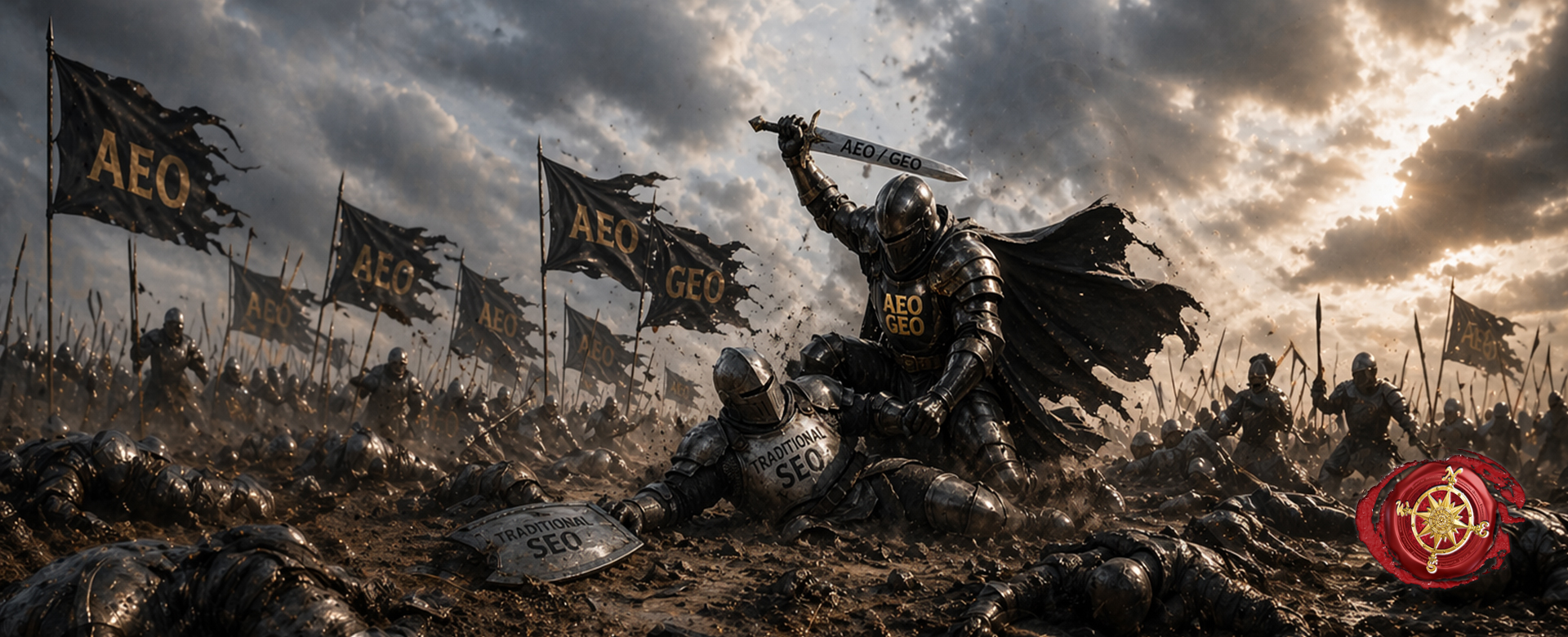
In the Age of AI
You Gain the Advantage over Those Who Don't Step Up
What Google & ChatGPT Actually Share
Start with the reassuring part — because it is substantial.
AEO/GEO and traditional SEO share foundational principles but differ in how they measure success, what they optimize for, and how content needs to be structured. Both reward high-quality, well-structured content. Both value E-E-A-T signals. Both benefit from topic cluster architecture.
The overlap is not cosmetic. It is structural. Here is what serves both systems simultaneously.
Shared Signal 1 — Content Quality and E-E-A-T:
Google developed the E-E-A-T framework (Experience, Expertise, Authoritativeness, Trustworthiness) to identify content that demonstrates genuine expertise from real practitioners. AI systems use the same evaluative criteria — because they were trained on content that Google had already identified as authoritative.
Small businesses do not need to start from scratch if they already have a robust SEO strategy. AEO/GEO success is all about making small, targeted changes to maintain rankings and increase mentions in AI search.
The content you have already produced that demonstrates genuine expertise – with named authors, specific credentials, documented outcomes – is exactly the content that both Google and AI systems weigh most heavily.
Shared Signal 2 — Topical Authority:
Google rewards websites that cover a subject comprehensively and consistently. AI systems draw from the same topical depth when deciding which sources to cite for category-level questions. Building topical authority is essential for both AI and traditional search performance.
The Content Carousel strategy documented in this series — producing pillar content and cluster articles that comprehensively cover your specialty — builds topical authority that compounds for both Google and AI simultaneously.
Shared Signal 3 — Technical Health:
Your pages must be crawlable, indexable, fast enough, mobile-usable, internally linked, and rendered in a way that leaves important content visible in text. Answer systems do not bypass bad infrastructure. They inherit it. Search Engine Land
Every technical SEO investment — page speed, mobile optimization, clean site architecture, proper indexation — directly benefits AI visibility. Google and AI crawlers share infrastructure requirements. A technically broken website fails both systems.
Shared Signal 4 — Schema Markup:
Both engines reward well-structured data. But while Google uses schema to enhance listings, ChatGPT uses it to understand and cite your business. Schemas like LocalBusiness, Service, and nested FAQ is non-negotiable for ChatGPT Ootimization.
The Triple Schema Stack (Article + FAQPage + ItemList) documented throughout this series serves both Google’s featured snippets and AI citation extraction simultaneously.
Shared Signal 5 — Backlinks and Third-Party Authority:
Google leans heavily on backlinks and technical SEO. ChatGPT focuses more on how clearly your expertise is communicated and how often your business is mentioned in credible places online.
The shared principle: authoritative third-party sources matter to both systems. The press release strategy and the earned media program in this series build both backlink authority for Google and third-party mention authority for AI simultaneously.
The bottom line on overlap: When you optimize content for AI tools, you also optimize it for Google discoverability. The unified optimization program is not twice the work. It is the same work, executed more precisely, with AI-specific additions that apply to the top layer.
THE SEVEN DIVERGENCES: Where Optimization for the likes of ChatGPT is Genuinely Different
The overlap is substantial. But the divergences are critical — and they are exactly where most businesses that think they have covered AI optimization have actually left the most important gaps.
THE SMALL BUSINESS ADVANTAGE IN AI SEARCH
Here is the reframe that should make this entire program feel like an opportunity rather than a burden.
Small businesses can take advantage of changes that have happened with the widespread adoption of AI search. Changes to the search landscape can seem overwhelming for small businesses, but they actually provide a unique opportunity.
Google’s search landscape, after twenty-five years of refinement, heavily favors established domains with large backlink profiles and significant content libraries. A new small business competing against a national chain for Google rankings is competing against years of compounded domain authority that takes years to match.
AI search operates differently. The LLMs are primarily only caring about your Authority and Sentiment score that produces organic recommendations. There is no shortcut via PPC, only genuine digital presence and structured mentions.
The regional HVAC business with ten years of documented client outcomes, a complete entity record, a systematic press release program, and a structured FAQ library built around the specific questions its buyers ask — that business can compete with national chains in AI search in a way it never could in Google paid search.
The expertise is the asset. The documentation and distribution of that expertise is the program.
A B2B SaaS provider noticed a 20% drop in overall blog traffic over six months. Initially, they panicked. However, upon closer inspection of their CRM, they found that their lead quality had actually doubled. Why? Because AI searchers who are looking for specific solutions are often further along in the buyer’s journey. By the time they clicked the link in a ChatGPT response, they were already pre-qualified by the AI.
This is the AI search quality advantage for small businesses. The buyers who arrive from AI recommendations have already been through a research and evaluation process inside the AI conversation. They arrive knowing who you are, why you were recommended, and what they want from you. The conversion rate data documented throughout this series – AI-referred visitors converting at rates between 4.4x and 15x organic search rates – flows directly from this pre-qualification mechanism.
THE PROGRAM IN PRACTICE — WHERE MOST BUSINESSES SHOULD START
Given everything above — the overlap, the divergences, the program — where does a small business with limited time and budget begin?
If you have existing Google SEO momentum:
Your Layer 1 foundation is mostly built. The priority is Layer 2 (entity and technical AI infrastructure) and Layer 3 (content architecture upgrade). Both of these are primarily one-time investments on existing content rather than net-new production.
Week 1: robots.txt configuration + Cloudflare check + Bing Webmaster Tools submission. This is the highest-leverage thirty minutes of AI optimization available at any stage.
Week 2-3: Retrofit your five highest-traffic articles to AEO standard — answer-first sections, question-format headings, FAQ addition, schema markup.
Month 2: Launch the FAQ library. Twenty entries minimum, FAQPage schema, covering every question your buyers ask at every stage of their research.
Month 2-3: First press release through a recognized newswire. One milestone. One distribution. Immediately begins building the third-party mention record that AI systems weigh most heavily.
If you are starting from zero:
Follow the five-layer sequence documented in the complete AI Visibility Strategy Framework: SEO foundation first, entity and technical infrastructure second, content architecture third, authority ecosystem fourth, measurement fifth. Do not skip layers.
The businesses that skip directly to AEO tactics without the SEO foundation — fast site, clean architecture, basic domain authority — produce inconsistent results because the AI systems they are trying to reach use Google performance as a credibility proxy.
The universal starting point:
Run our AI VISIBILITY AUDIT, the AI Baseline Audit documented throughout this series. Three prompts across all five major platforms. Right now. Before investing another hour in any optimization work.
What you find there — whether you appear, how you are described, what the AI says about your competitors — tells you specifically which layers need the most urgent investment. The businesses that start from data rather than assumptions make decisions that compound. The businesses that start from guesswork make decisions that overlap and conflict.

THE BOTTOM LINE
The answer to the question that opened this article:
Can you optimize for ChatGPT the way you did for Google?
Yes — about 80% of the principles are the same. Content quality, E-E-A-T signals, topical authority, technical accessibility, structured data, and authoritative third-party references. The SEO work you have already done has built the foundation that AI visibility requires.
No — the remaining 20% is genuinely, fundamentally, and architecturally different. Passage-level extraction versus page-level ranking. Entity-based authority versus link-based authority. Bing’s index versus Google’s index for ChatGPT. Multi-source ecosystem presence versus website-centric optimization. Brand Visibility Score versus rankings. Zero advertising access versus PPC.
In practical terms, SEO helps you earn discoverability. AEO/GEO helps you earn inclusion in answers. Search Engine Land
You need both. They share more infrastructure than the marketing headlines suggest. And the businesses that build both simultaneously, on the same foundation, with the same content production effort, with AI-specific additions applied to the top layer, are the businesses that capture visibility across every channel their ideal buyers use.
The new LLM Visibility program is not a replacement. It is an upgrade.
The upgrade is specific. The upgrade is documented. And the competitive window for building the AI visibility advantage that compounds over the next five years — while most of your competitors are still debating whether to start — is open right now.
By adjusting content strategies, maintaining a strong technical foundation, building topical authority, and being willing to monitor success and pivot accordingly, small and medium-sized businesses can stay competitive and build brand recognition.
And the businesses that do this first in their market will not just stay competitive. They will build the recommendation authority that the AI systems trusted by their buyers will reinforce — confidently, consistently, and at scale — with every question those buyers ask.
At MediaBus Marketing Group, we build the complete unified program — SEO foundation through AEO/GEO and AIO upgrade layers — for small businesses that want to capture visibility across every channel their ideal buyers use. Twenty-five years of regional market expertise applied to the discipline that is redefining how businesses get found, evaluated, and chosen.
Because your success is exactly how we measure ours.
Fill out the Form Below and add ‘OPTIMIZE’ to begin the benchmark audit of your current SEO/AEO/GEO and AI visibility simultaneously — map every gap in the technical, content, and authority layers — and build the unified program that makes your business discoverable by Google and recommendable by AI starting this week.
ChatGPT Inclusion FAQs
FAQ 1 — Can I optimize for ChatGPT the same way I optimized for Google, or do I need a completely different strategy?
You can use approximately 80% of the same principles — and that shared foundation is the reason you do not need to start over. Both Google and ChatGPT reward high-quality content that demonstrates genuine expertise, correct technical accessibility, E-E-A-T signals (Experience, Expertise, Authoritativeness, Trustworthiness), topical authority developed through comprehensive content coverage, and authoritative third-party references. If your website ranks well on Google, there is a meaningful probability that AI systems are already drawing from it — because both systems reward the same underlying content quality.
The remaining 20% that requires genuinely different approaches covers seven specific divergences. The objective changes from earning a ranked position in a list to earning inclusion in a synthesized answer. The retrieval mechanism changes from page-level keyword matching to passage-level semantic extraction via RAG. ChatGPT draws from Bing’s index rather than Google’s — meaning Bing Webmaster Tools submission is a direct ChatGPT visibility action. There is no paid advertising access in AI search — only organic authority. Content structure must produce self-contained extractable passages rather than just keyword-dense pages. Success measurement requires Brand Visibility Score and Share of Model rather than just rankings and traffic. Authority is built from multi-source entity presence across the full web ecosystem rather than primarily from backlink accumulation.
The strategic recommendation: maintain your SEO program as the foundation, add the AI-specific technical layer (robots.txt, schema, Bing submission, entity consistency), upgrade content structure to AEO standard (answer-first, question-format headings, FAQ library), and build the authority ecosystem (press releases, earned media, review generation). This is an upgrade to an existing system — not a replacement of it.
FAQ 2 — What is the most important technical difference between optimizing for Google and optimizing for ChatGPT?
The most important technical difference is the index source. ChatGPT’s web search capability draws from Bing’s index, not Google’s. This means a business that has invested exclusively in Google SEO — submitting its sitemap only to Google Search Console, building its technical foundation only for Googlebot — may rank on page one of Google while being nearly invisible to ChatGPT’s search retrieval system.
The practical actions that close this gap are: submitting your sitemap to Bing Webmaster Tools (free, takes five minutes, directly feeds ChatGPT search indexing), implementing the IndexNow protocol to notify Bing automatically when content is published (triggers ChatGPT search indexing within hours rather than days), and explicitly allowing OAI-SearchBot and ChatGPT-User in your robots.txt file (separate from GPTBot, which is the training crawler — these are different bots with different functions).
The second most important technical difference is the rendering requirement. Google runs a sophisticated JavaScript engine and can see content rendered by React, Vue, and other JS frameworks. Most AI crawlers cannot execute JavaScript. Content that renders only via JavaScript is invisible to AI retrieval systems, even if it ranks well on Google. Testing this is simple: disable JavaScript in your browser and reload your key pages. Whatever content disappears is invisible to AI crawlers. Fix with server-side rendering or pre-rendering.
FAQ 3 — Does Google SEO still matter if AI search is growing — and how should I allocate time between the two?
Google SEO still matters substantially in 2026, and abandoning it to focus exclusively on AI optimization would be a costly mistake. AI referral traffic is growing faster than any other channel — over 500% year-over-year —, but it currently represents approximately 1% of total website sessions for most businesses. Optimizing exclusively for the 1% while neglecting the 93% is not a growth strategy.
The unified approach is the correct allocation for most small businesses. The good news is that the unified approach requires less additional effort than the question implies, because the two disciplines share the same foundation. Approximately 80% of the work serves both systems simultaneously. The AI-specific additions — robots.txt configuration, Bing Webmaster Tools submission, IndexNow implementation, FAQ schema library, entity consistency audit, press release program — are layered on top of the existing SEO foundation rather than competing with it.
Practical time allocation guidance: if you are currently spending ten hours per month on SEO-related activities, adding two to three hours of AI-specific optimization (content restructuring, schema implementation, monthly prompt audit) captures the majority of the available AI visibility benefit without reducing your Google SEO investment. The businesses that treat these as competing priorities make both worse. The businesses that treat them as complementary layers — SEO foundation with AEO and AIO upgrade — make both better simultaneously.
FAQ 4 — Why does ChatGPT favor small businesses in ways Google never did – and how can a small business take advantage?
ChatGPT and other AI search systems create a structural competitive advantage for small businesses relative to Google that is rooted in a single fundamental difference: AI search has no paid advertising access.
In Google search, large companies can purchase visibility through Google Ads and dominate the first several results for high-intent commercial queries — regardless of organic authority. A national chain with a significant advertising budget can appear above a better-reviewed, more experienced regional business simply by outspending them. For small businesses with limited marketing budgets, competing in paid search against well-funded national or regional competitors is often prohibitively expensive.
AI search platforms like ChatGPT, Perplexity, and Gemini provide only organic recommendations — no advertising, no paid placement, no premium visibility for purchase. The recommendation is generated purely from the AI’s assessment of which business has the strongest expertise signal, the deepest third-party corroboration, and the most accurately structured content for the specific query.
This means the regional business consultant with twelve years of documented client outcomes, a systematic press release program, a comprehensive FAQ library, and a complete entity record across every AI source portal can be recommended by ChatGPT as confidently as — or more confidently than — a national competitor with a ten-times-larger marketing budget. The expertise is the asset. The documentation and distribution of that expertise is the program. And no amount of advertising spend can shortcut the genuine credibility that AI systems evaluate.
FAQ 5 — What is AEO, and how does it differ from both traditional SEO and GEO?
AEO stands for Answer Engine Optimization — the practice of structuring content so that AI-powered answer systems select it as a cited source when generating responses. It is one of three related but distinct disciplines operating in the current search landscape.
Traditional SEO optimizes your website so that Google’s algorithm ranks your pages in its results list for relevant keyword queries. Success is measured in rankings and organic traffic. SEO gets you discovered.
GEO (Generative Engine Optimization) is a broader discipline that encompasses the complete strategy for building visibility across AI-powered search systems — including technical infrastructure, entity presence, content architecture, third-party authority building, and measurement. GEO is the strategic framework.
AEO is the content-specific layer within GEO. Where traditional SEO optimizes content for keyword relevance and page-level authority, AEO optimizes content for passage-level extractability and direct answer inclusion. AEO requires every section to answer its question in the first 40-60 words, every heading to be formatted as a question in natural buyer language, every paragraph to pass the Island Test (extractable as a standalone citation without surrounding context), every FAQ entry to be schema-marked-up and directly answerable, and every factual claim to be supported by a specific statistic with inline source attribution.
The practical application: AEO is not a replacement for SEO. It is an additional layer applied to the same content production process. A piece of content produced to traditional SEO standards needs approximately 20-30 minutes of AEO retrofit — answer-first restructuring, question-format heading conversion, FAQ addition, schema implementation — to serve both systems simultaneously. The businesses that build AEO into their standard content production process, rather than treating it as a separate discipline, produce content that compounds across both channels with every piece published.
Action Items:
SHARE THIS STORY ANYWHERE YOU LIKE
SHARE THIS STORY ANYWHERE
Mastering AI Automation for Finance and Back Office
Mastering AI Automation for Finance and Back Office The back office that never forgets. Most back-office losses are [...]
Mastering AI Automation for Project and Task Management
Mastering AI Automation for Project and Task Management Your plan is a prediction. AI's best job is remembering [...]
AI Operations: Automating Supply Chain, Scheduling & More
AI Operations: Automating Supply Chains, Scheduling, & More The Most Profitable AI in Your Business Is Probably the [...]