

Can AI Help Me Predict Customer Behavior – Churn, Upsell, Lifetime Value – and How Accurate Are Those Predictions?
The definitive playbook for business owners who are done guessing and ready to know — before the customer even decides.
What You’ll Find in This Article…
- The $3.8 Trillion Wake-Up Call: Why ignoring customer behavior prediction is the most expensive mistake a business can make right now.
- The Three Pillars of AI Prediction: How churn prediction, upsell intelligence, and customer lifetime value (CLV) work — and why they work best together.
- Real Accuracy Numbers: What modern AI models actually achieve (80–95% accuracy on churn, 20–40% marketing ROI lift) and what drives those results.
- The Little-Known Secrets: The “Buyer’s High Window,” the 4–8x intervention advantage, and why predicting CLV decline matters more than predicting churn itself.
- Best Practices for Any Size Business: Step-by-step implementation guidance from no-code to enterprise.
- The Accuracy Killers: The data sins that destroy prediction quality — and the simple fixes that restore them.
- Tools & Platforms: What works for small businesses today without a data science team.
- 5 Frequently Asked Questions with direct, usable answers.
THE PROBLEM
The $3.8 Trillion Blind Spot Sitting in Your Customer Data Right Now
Right now, somewhere in your customer database, a profitable client is 72 hours from leaving you… And you don’t know it. Another is ready to spend three times more with you this month – and you’re about to send them the same generic email as everyone else. This isn’t a theory. If you have been in business for any amount of time, you have already experienced this! This is the operating reality of every business that hasn’t yet applied AI to customer behavior prediction.
And the price tag on that blind spot? Globally, poor customer experiences driven by reactive (rather than predictive) relationship management put an estimated $3.8 trillion in revenue at risk each year on average – and that number’s only growing.
Here’s the truth that the old playbook didn’t prepare you for: in this age of AI, the most dangerous thing you can do is wait for customers to show you they’re unhappy. By then, you’ve already lost. The game has fundamentally changed. The businesses that are winning – quietly, systematically, and with the kind of margins that seem almost unfair – aren’t working harder. They’ve simply flipped the script. They are predicting behavior, not reacting to it.
This article is your complete guide to understanding, implementing, and profiting from AI-powered customer behavior prediction. Whether you run a local service business, a SaaS platform, or a retail operation with 10,000 SKUs, the principles here apply. The tools are accessible. The results are real. And the window of competitive advantage, while it exists, is closing fast.
KEY STATS AT A GLANCE
- 95% — Max accuracy for AI churn prediction on comprehensive CX data (Harvard Business / MIT Technology Review)
- 40% — Marketing ROI improvement when companies shift to CLV-based customer acquisition strategies
- 4–8× — Higher success rate for early AI-triggered intervention vs. win-back campaigns after churn
- 2.9× — Revenue increase for businesses using AI-powered predictive analytics vs. reactive retention strategies
THE FRAMEWORK
The Three Pillars of AI Customer Prediction — and Why They Only Work Together
Most business owners hear “AI customer prediction” and think it’s one thing. It isn’t. It’s three interlocking systems — and the companies seeing extraordinary results are the ones who’ve understood how these pillars reinforce each other. Think of it like a three-legged stool. Remove any leg, and the whole thing crashes.
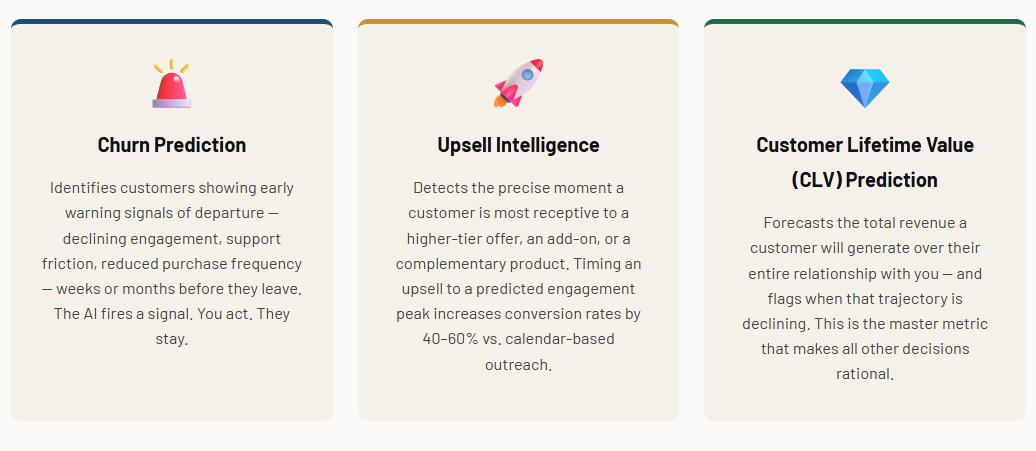
Here’s the insight that changes everything: churn prediction without CLV context is noise. When you combine a churn risk score with a customer’s predicted lifetime value, you now know not just who might leave – but who’s worth fighting to keep. A low-CLV, high-churn-risk customer may not warrant a discount offer. A high-CLV, moderate-churn-risk customer deserves your best retention specialist on the phone today.
This is AI doing what the human brain cannot do at scale: holding thousands of variables simultaneously, updating in real time, and serving you a prioritized action list every morning. It is not magic. It is mathematics — and the math has never been more accessible to businesses of any size.
📎 Related Reading from MediaBus Marketing Group
- AI-Powered Customer Engagement Predictions — How AI fundamentally reshapes the way you engage with your customer base
- Customer Retention Strategies — Proven frameworks for keeping the customers AI identifies as at-risk
- Ideal Buyer Personas – The Hidden Engine Behind Every Business Win — The foundation that makes your prediction models far more accurate
- Behavioral Segmentation Matters — Why behavior-based grouping outperforms demographic grouping in the AI era
Now, the above are only the tip of the iceberg of what you can measure, monitor, and gauge. We can show you how to put these three into place for you.
The Numbers
How Accurate Are These Predictions — Really?
Let’s have the honest conversation that most tech vendors avoid. AI prediction models are powerful — but they are not magic. Accuracy ranges dramatically based on the quality of your data, the maturity of your model, and how you define what you’re predicting. Here’s what the research actually shows, model by model:
| Prediction Type | Typical Accuracy | Best-Case (Enterprise) | Data Requirements | Confidence |
|---|---|---|---|---|
| Short-Term Churn (30 days) | 80–88% | 92–95% | Usage logs, support tickets, and login frequency | HIGH |
| Long-Term Churn (90–365 days) | 68–80% | 85–90% | Full transaction history, engagement depth, NPS data | MODERATE |
| Upsell Propensity | 65–78% | 80–85% | Purchase history, product usage, browsing behavior | MODERATE |
| CLV (12-Month) | R² > 0.60 | R² > 0.80 | RFM data + onboarding patterns + engagement signals | HIGH |
| CLV (5-Year) | R² 0.40–0.55 | R² 0.65–0.70 | Multi-year transaction history + macro trend modeling | LOWER |
| Next Best Action / Offer | 55–72% | 78–84% | Real-time behavioral signals + contextual data | MODERATE |
The critical insight buried in this table: shorter prediction windows are dramatically more accurate than longer ones. A model predicting 30-day churn outperforms a 12-month churn model by a significant margin. This is why best-in-class implementations run rolling short-horizon models continuously, rather than producing one annual “churn report” and hoping for the best.
AI-powered sentiment analysis now achieves 85–90% accuracy in detecting customer emotions across text interactions – frustration, satisfaction, confusion – in real time. This emotional layer, fed into your churn and upsell models, is the competitive moat that most businesses haven’t yet discovered.
“The question isn’t whether AI can predict customer behavior with enough accuracy to be useful. It already can. The question is whether your business is set up to act on what it knows.”
THE LITTLE-KNOWN GEMS
The Crucial, Little-Known Insights That Change the Game Entirely
1. The “Buyer’s High” Window – and Why Missing It Costs You a Fortune
After a first purchase, there’s roughly a 27% probability that a customer returns. After a second purchase, that probability explodes to 54%. AI identifies the precise moment after a first purchase – a window researchers call the “Buyer’s High” period – when the customer’s emotional connection to your brand is at its peak. Automated, personalized post-purchase communications triggered during this window reduce 90-day churn by 14% and drive 45% higher second-purchase rates. Most businesses send the same email blast to first-time buyers as to five-year loyalists. That’s not just inefficient – it’s burning money.
2. Predicting CLV Decline Is More Valuable Than Predicting Churn
Here’s the insight that the best data scientists know and most business owners don’t: by the time a customer shows “churn signals,” their lifetime value trajectory has often been declining for weeks. The leading indicators – reduced product breadth, declining engagement velocity, increasing support friction – appear in your relational data well before the customer consciously decides to leave. Early intervention at the CLV-decline stage has a 4–8x higher success rate than win-back campaigns after the customer has already churned. You’re not fighting to get someone back. You’re preventing the departure before they even make the decision. That’s an entirely different conversation – and a far easier one to win.
3. The 80/20 Rule Has a Dangerous Hidden Layer
Every business owner knows that 20% of customers generate 80% of revenue. But AI reveals something more unsettling: within that top 20%, there’s often another 80/20 split. Your top 4% may be generating 64% of your revenue. And if any segment of that 4% shows churn signals, you have a business-critical emergency – whether or not a human has noticed it yet. AI doesn’t just surface this: it gives you a prioritized intervention list, calibrated by both churn risk and CLV, so your retention team wakes up every day knowing exactly who to call first. This alone is worth the entire investment in predictive analytics.
4. Acquisition Economics Flip When You Know CLV in Advance
Consider this: a $200 lead that converts into a $50,000 customer is vastly more cost-effective than a $20 lead that converts into a $500 customer. Without CLV prediction, your acquisition strategy optimizes for cost-per-lead – a metric that has almost nothing to do with actual profitability. With CLV prediction integrated into your marketing campaigns, you optimize for predicted CLV per acquisition dollar. Companies that make this shift report a 20–40% improvement in marketing ROI. You’re not just spending less – you’re spending the same amount and getting dramatically better customers in return.
5. Model Freshness Is a Hidden Profit Lever
A churn model trained in Q1 on last year’s data and never updated will quietly degrade in accuracy through the year. Customer behavior shifts with seasons, macroeconomic trends, competitive moves, and product updates. The wellness brand Hydrant built a custom churn model in just two weeks using modern no-code AI platforms – and the system continuously learns from new data, keeping predictions current. For most small businesses, the biggest accuracy killer isn’t the model – it’s the staleness of the model. Fresh data in, fresh predictions out. Stale data in, expensive mistakes out.
Here Are More Deeper Dives from MediaBus Marketing Group
- Data Integration Checklist for AI Marketing Success — The exact data audit your business needs before building prediction models
- What Are the Steps to Prepare My Business for AI Adoption? — The sequential roadmap to AI-readiness for any size company
- The Lean AI Stack for Small Businesses — Which tools deliver maximum ROI at minimum cost
- Crawl Inside the Mind of Your Customer — Understanding the behavioral patterns AI models are trained to detect
The Engine Room
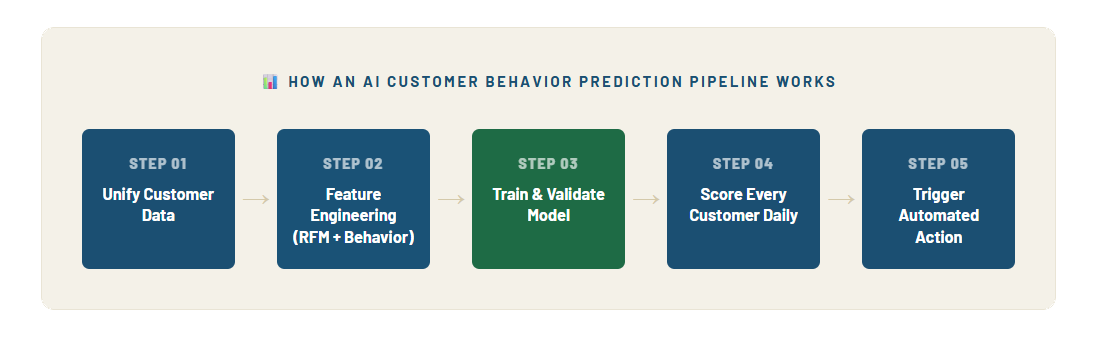
What Data Does AI Actually Need — and What’s the Minimum Viable Dataset?
One of the great myths about AI prediction is that you need terabytes of data and a team of PhD data scientists to get started. You don’t. Here’s what actually matters, organized by model sophistication:
Tier 1 — The Minimum Viable Dataset (Any Small Business Can Start Here): You need RFM data – Recency (when did they last buy?), Frequency (how often do they buy?), and Monetary Value (how much do they spend?). This is the foundation. Probabilistic models built on clean RFM data can produce actionable churn risk scores and CLV estimates without any advanced data science. If your CRM has 12 months of transaction history and a customer ID, you have enough to start. Platforms like Pecan AI allow business analysts to build these models through a conversational interface — no code required.
Tier 2 — Enhanced Prediction (Mid-Market Businesses): Add behavioral signals: product usage frequency, feature adoption rates, support ticket volume and sentiment, email open and click rates, login frequency. Each additional data stream meaningfully improves model accuracy. The rule of thumb: every relevant behavioral signal you add to a Tier 1 model typically improves predictive power by 3–8 percentage points.
Tier 3 — Enterprise-Grade Prediction: Layer in real-time contextual data – browsing patterns, in-app behavior, sentiment from customer conversations, competitive intelligence signals, and macro trend overlays. At this tier, models predicting short-term churn can reach 92–95% accuracy. Most businesses don’t need this level – and shouldn’t invest in it until Tiers 1 and 2 are producing consistent ROI.
THE BUSINESS IMPACT OF AI CUSTOMER BEHAVIOR PREDICTION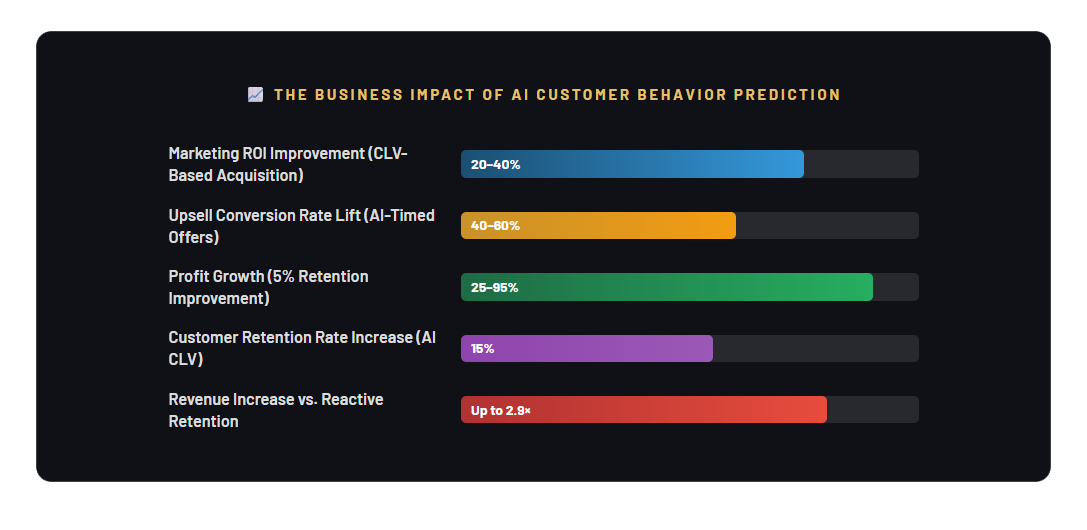
DEEPER DIVES INTO THIS SUBJECT
- Data Integration Checklist for AI Marketing Success — The exact data audit your business needs before building prediction models
- What Are the Steps to Prepare My Business for AI Adoption? — The sequential roadmap to AI-readiness for any size company
- The Lean AI Stack for Small Businesses — Which tools deliver maximum ROI at minimum cost
- Crawl Inside the Mind of Your Customer — Understanding the behavioral patterns AI models are trained to detect
THE PITFALLS
The Accuracy Killers — What Destroys Prediction Quality and How to Fix It
The majority of AI prediction failures aren’t model failures — they’re data failures. Here are the five most common accuracy killers and the fixes:
Accuracy Killer #1 — Siloed Data. Your purchase data lives in your CRM. Your support data lives in Zendesk. Your email engagement data lives in Mailchimp. None of them talk to each other. Result: your model can only see one dimension of your customer’s relationship with you. Fix: unify customer data into a central hub — a single customer ID connecting every touchpoint. This alone can improve model accuracy by 15–25%.
Accuracy Killer #2 — Stale Models. A model trained once and never updated will degrade in accuracy as customer behavior shifts. Fix: implement continuous learning — schedule monthly or quarterly model retraining as a standard business process, not a special project.
Accuracy Killer #3 — Wrong Time Horizon. Asking a model to predict 12-month churn with six months of data is like asking someone who’s known you for six months to predict your behavior next year. Fix: match your prediction horizon to your data depth. Start with 30-day windows. Expand as your data history grows.
Accuracy Killer #4 — Predictions Not Visible to Teams. Churn prediction that identifies a customer as “at risk” is a starting point, not an action plan. Fix: predictions must be visible, contextualized, and actionable — not buried in a data science dashboard. They must live inside the tools your team already uses.
Accuracy Killer #5 — No Action Workflow. Predicting churn is only valuable if something happens next. The most successful deployments automate the intervention: a personalized email triggers, a success manager gets an alert, and a targeted offer deploys. Prediction without action is just expensive knowing.
*** Critical Risk Management Reading
- What Are Common Pitfalls & Risks of Applying AI in My Business? — Comprehensive guide to avoiding the most expensive AI mistakes
- How Does AI Affect Data, Security, Privacy & Compliance for SMBs? — Protecting your customer data while extracting maximum insight from it
- 15 AI Business Myths Debunked — Clearing the confusion that causes businesses to under-invest or mis-invest in AI
THE PLAYBOOK
Best Practices: A Step-by-Step Implementation Guide for Any Size Business
The following checklist represents the distilled best practices from the highest-performing AI prediction implementations across industries in 2025–2026. Follow this sequence. Don’t skip steps. Each one builds on the last.
Your AI Prediction Implementation Checklist:
✓ Audit Your Data Foundation First. Before touching a single AI tool, inventory your customer data. What do you have? Where does it live? How clean is it? Garbage in, garbage out — this is not a cliché; it’s the most important truth in machine learning.
✓ Unify Your Customer Identity. Create a single customer ID that links transactions, support history, email engagement, and behavioral data. A customer data platform (CDP) or even a well-structured CRM integration can accomplish this without enterprise-level investment.
✓ Start With Churn, Win Fast. Churn prediction has the clearest ROI of the three prediction types and requires the least data complexity to get started. Build this model first, prove the value, then expand to upsell intelligence and CLV.
✓ Choose the Right Tool for Your Stage. No-code platforms (Pecan AI, Churnly) for businesses starting. Mid-market platforms (GoHighLevel) for subscription businesses with 500+ customers. Enterprise solutions (Salesforce Einstein, custom ML pipelines) when you’re scaling beyond that.
✓ Embed Predictions Into Existing Workflows. Churn scores and CLV estimates must live inside the tools your team already uses – your CRM, your helpdesk, your marketing automation platform. An insight nobody sees is worth exactly nothing.
✓ Define Your Intervention Playbook Before You Launch. For every prediction trigger (high churn risk, CLV decline signal, upsell propensity), define the action: who gets notified, what message is sent, what offer is extended, what the success metric is. Build this before you turn the model on.
✓ Monitor, Measure, Retrain. Track model accuracy monthly. Compare predicted vs. actual outcomes. Retrain on fresh data quarterly at minimum. This is a living system, not a set-it-and-forget-it installation.
✓ Combine Risk Score + CLV for Prioritization. Never act on churn risk alone. Always overlay CLV to prioritize interventions. High CLV + high churn risk = immediate, high-touch response. Low CLV + high churn risk = automated, low-cost intervention.
THE TOOLKIT – to do all this
Tools That Actually Work — Platform Recommendations for 2026
The platform landscape for AI customer behavior prediction has matured dramatically. Here’s an honest assessment of what works at each business tier:
For Small Businesses (Under 1,000 Active Customers): Start with your CRM’s native AI features. HubSpot’s predictive lead scoring and Salesforce Einstein both offer accessible entry points. For standalone churn prediction, Pecan AI offers a conversational, no-code interface that lets non-technical marketers build custom churn models. Hydrant built a production-grade model in two weeks. Churnly offers a focused, affordable subscription churn solution for businesses just getting started.
For Mid-Market Businesses (1,000–50,000 Customers): GoHighLevel is the gold standard for subscription businesses. You can embed churn scoring directly into customer success workflows. For e-commerce, Klaviyo’s predictive analytics now includes CLV prediction and churn risk scoring built on your purchase and email engagement data — with no data science required.
For Enterprise (50,000+ Customers): Custom ML pipelines built on your own data warehouse (Snowflake, BigQuery) fed into platforms like Kumo.ai deliver the highest accuracy at scale. Kumo’s graph neural network approach processes relational database data directly, delivering CLV and churn predictions in under one second. Verint and Qualtrics XM offer enterprise-grade sentiment analysis integrated with predictive scoring across every customer channel.
With whichever Customer Information Aggregator or Customer Relations Management package you bring on, make sure you do your homework on whether it will actually do what you want and need it to do for your business. Nothing worse than having to retool a CRM from another, and yet to another!
*** Tools & Technology Resources from MediaBus
- The AI Toolkit from MMG for Small Businesses — Curated tool stack designed specifically for SMBs entering AI
- Essential Marketing AI Automation Tools — The automation layer that turns predictions into actions
- Custom AI Model vs. Off-the-Shelf LLMs — When to build vs. buy your prediction capability
- How Quickly Can Small Businesses See Results from AI Integration? — Realistic timelines and early ROI milestones
THE OPPORTUNITY
The Window Is Open — But Not Forever
Here is the reality most business consultants won’t tell you because they’re still catching up themselves: we are in the last 24-to-36 months of a genuine competitive advantage window in AI-powered customer prediction. Right now, the majority of small and mid-market businesses are still operating on gut instinct, lagging indicators, and quarterly review cycles. The businesses that move in the next 12 months will build prediction capabilities, generate ROI data, retrain their models, and create operational habits that will be extremely difficult for late movers to replicate.

The economics here are not subtle. A 5% improvement in customer retention can increase profits by 25 to 95% — that’s a Bain & Company finding validated repeatedly across industries. For a business doing $2 million in annual revenue with a 70% gross margin, improving retention by just 5 percentage points on your highest-value customer segment could translate to an additional $70,000 to $133,000 in annual profit — from a technology investment that, for a small business, might cost $300 to $1,500 per month. The math is embarrassingly compelling.
But it requires a shift in mindset that some leaders struggle to make: from reactive to predictive. From reporting what happened to forecasting what will happen. From managing relationships based on what customers tell you to managing them based on what the data knows before they say it. This shift is not complicated. It’s a decision — a commitment to run your business on intelligence rather than hope.
THE BOTTOM LINE
The Customers You’re About to Lose Are Already Telling You. Are You Listening?
Every customer departure, every missed upsell, every underperforming segment – these are not mysteries. They are patterns. And patterns, by definition, can be predicted. The technology to see what’s coming exists right now, it is accessible at every budget level, it produces ROI that dwarfs its cost, and the majority of your competitors haven’t deployed it yet. That is not an obstacle. That is an invitation.
The question you have to answer isn’t whether AI can help you predict customer behavior. The research is detailed: it can, with 80–95% accuracy for churn, 40–60% conversion lift on AI-timed upsells, and 20–40% marketing ROI improvement on CLV-based acquisition. The question is whether you’ll let another year pass running your customer relationships on intuition while your competitors run theirs on intelligence.
You have the map. You have the math. The next move is yours.
→ Visit mediabusmarketing.com/contact-us to schedule your First Call Today OR Fill Out the Form Below.
AI Customer Predictability FAQs
Q1: I’m a small business with limited data. Can I still use AI to predict customer behavior, or do I need thousands of customers first?
You don’t need thousands of customers to start. Modern probabilistic models like RFM-based CLV analysis can produce actionable insights with as few as 200–300 customers and 12 months of transaction history. No-code platforms like Pecan AI and Klaviyo’s built-in predictive tools were specifically designed for businesses at this scale. The key is data quality, not quantity. Clean, unified transaction data with a consistent customer ID is far more valuable than a large but fragmented dataset. Start with what you have. Build the model. Learn from it. The accuracy improves as your data grows — but the business insights begin immediately.
Q2: What’s the difference between AI predicting churn and just setting up a re-engagement email after 90 days of inactivity?
The 90-day rule is a blunt instrument. AI prediction is a surgical scalpel. The traditional rule applies the same intervention to every inactive customer regardless of their value, their reason for inactivity, or their likelihood of response. AI models consider dozens of behavioral signals simultaneously – purchase frequency trends, support sentiment, engagement velocity, product usage patterns, and seasonal factors. The result: you know which customers are genuinely at risk versus just seasonal, why they’re at risk, and which intervention is most likely to work for each specific customer. More importantly, AI catches at-risk signals 30–90 days before the inactivity trigger fires — intervening while retention is still easy, not after the customer has already mentally moved on.
Q3: How do I measure whether my AI prediction model is actually working and worth the investment?
Track five metrics: (1) Model Accuracy – compare predicted vs. actual outcomes monthly; target R² above 0.60 for CLV models and 80%+ classification accuracy for churn models. (2) Retention Rate Change – measure the churn rate of customers who received AI-triggered interventions vs. those who didn’t; A/B test this rigorously. (3) Intervention Conversion Rate – what percentage of at-risk customers who received outreach were retained? (4) Revenue Per Retained Customer – did the intervention maintain or grow their CLV? (5) Marketing ROI – Are you spending your acquisition budget more efficiently on higher-CLV prospects? Expect to see meaningful signals within 90 days of deployment and clear ROI within 6 months. Most implementations targeting the right customer segments see the technology pay for itself in the first retained high-value account.
Q4: Are there privacy and compliance concerns with using AI to analyze customer behavior data?
Yes – and they’re manageable with the right practices. The core requirements: obtain proper consent for behavioral data collection in your terms of service and privacy policy, ensure your data handling complies with applicable regulations (GDPR in Europe, CCPA in California, and industry-specific rules like HIPAA in healthcare), use data minimization principles (collect only what’s needed for the prediction), and ensure your AI platform vendor has appropriate data security certifications (SOC 2 Type II at minimum). The good news: most major AI prediction platforms – GoHighLevel, Klaviyo, Salesforce Einstein – are built with compliance frameworks baked in. The data you already legally collect for marketing and operations is almost always sufficient to build powerful prediction models — no invasive data collection required. For a comprehensive guide, see MediaBus Marketing Group’s article on AI Data, Security, Privacy & Compliance for SMBs.
Q5: How long does it take to build and deploy an AI customer prediction model, and what internal resources do I need?
The timeline depends heavily on your data readiness and tool choice. With a no-code platform and clean CRM data, a functional churn prediction model can be running in 2–4 weeks — the wellness brand Hydrant built a production model in two weeks using Pecan AI. A mid-market implementation using a purpose-built platform like GoHighLevel typically takes 4–8 weeks, including data integration and team training. Custom enterprise ML pipelines can take 3–6 months. Resource requirements follow the same curve: no-code tools require only a marketing or operations manager with basic analytical skills; mid-market platforms need a CRM administrator and a customer success lead; enterprise deployments need a data engineering team. The critical internal resource at every level is executive commitment – the willingness to act on predictions, not just review them. The technology is the easy part. Building an action-first culture around the insights is where most businesses either win or leave the value on the table.
Action Items:
SHARE THIS STORY ANYWHERE YOU LIKE
SHARE THIS STORY ANYWHERE

How Can AI Help Us Capture More Business and Handle More Work Without Immediately Hiring More People?
How Can AI Help Us Capture More Business and Handle More Work Without Immediately Hiring More People? The [...]

Setting Realistic Goals for AI Implementation
Setting Realistic Goals for AI Implementation The SMART Framework, the Achievability Trap, and Two Verified Real-World Examples of [...]
What KPIs Should I Actually Track?
What AI KPIs Should I Actually Track? The 6-Metric Framework That Separates Proof from Guesswork What You'll Find [...]