

Marketing Automation Benefits:
The Machine That Never Sleeps, Never Forgets, and Never Loses a Lead
What You’ll Find in This Article
- The defining shift – why marketing automation is a force multiplier, not just a tool
- 7 core benefits backed by verified 2024–2026 research data and real ROI figures
- The ROI math most consultants never show you – calculated per dollar and per scenario
- Behavioral trigger campaigns – the advanced strategy separating 7-figure from 6-figure operations
- AI-powered automation in 2025–2026 – predictive sequences, dynamic content, agentic AI
- The full customer journey view – automation mapped from stranger to loyal advocate
- The costly mistakes that kill automation ROI before it compounds
- Little-Known Gems – five non-obvious strategies most marketers have never tried
- A bottom-line CTA that will make you question why you waited this long
The Merchant Who Never Slept
There is an old parable about a merchant who wanted to serve every customer who knocked at his door – day or night, weekday or holiday, in sickness and in health. He was a good man. A tireless man. But he was also one man.
His competitor across the road had a different philosophy. He built systems. He trained apprentices who followed precise instructions. He created messages that appeared at the exact moment a customer needed them – answers that arrived before the question was fully asked, offers that materialized precisely when desire was strongest.
Within three years, the tireless merchant was exhausted, understaffed, and losing business to a competitor he could not outwork. Because you cannot outwork a system. You can only outbuild one.
Marketing automation is that system. And the businesses that build it right are writing a very different story than the ones still answering every knock by hand. The machine is not a threat to great marketing – it is the amplifier that makes great marketing unstoppable.

In the Age of AI
You Gain the Advantage over Those Who Don't Step Up
What Marketing Automation Actually Is – And What It Isn’t
The Seven Core Benefits of Marketing Automation
These are not feature lists from a vendor brochure. These are the seven mechanisms – backed by verified research – through which marketing automation converts raw technology spend into compounding revenue growth.
1. Lead Nurturing That Actually Converts
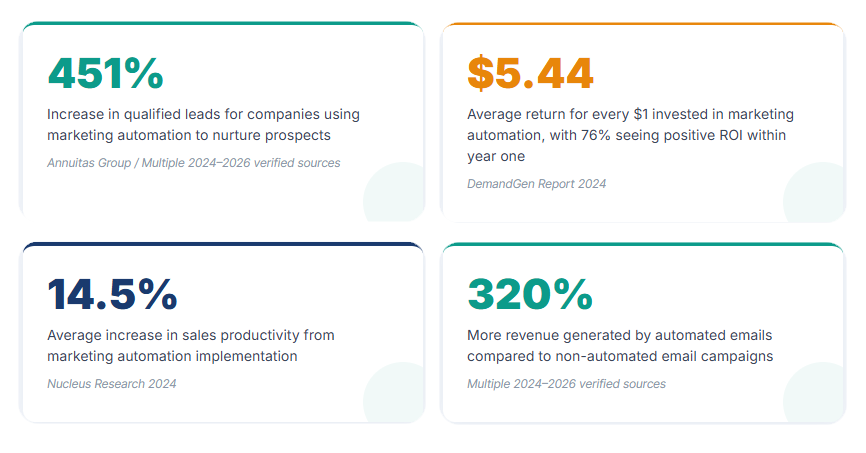
Most leads don’t buy on first contact. Businesses using marketing automation to nurture prospects experience a 451% increase in qualified leads. Four hundred and fifty-one percent. That is not a rounding error – that is the difference between a pipeline and a profit machine.
Automated nurture sequences guide prospects through educational content, social proof, objection handling, and value demonstration – on their schedule, at their pace, and triggered by their behavior. A prospect who downloads a whitepaper at 11 pm on a Tuesday triggers a sequence that would take a human sales team days to replicate. Personalized email campaigns through marketing automation can improve click-through rates by 14% and conversion rates by 10%.
2. Radical Time and Cost Efficiency
The math is unambiguous. Companies implementing AI-powered marketing automation see 14.5% increases in sales productivity and 12.2% reductions in marketing costs. For a $2 million marketing operation, that’s $244,000 per year in recovered capacity – not from cutting staff, but from eliminating manual, repetitive work that buries talented marketers in execution instead of strategy.
Every email sequence you build once gets deployed a thousand times. Every lead scoring rule you configure works every hour of every day. Your online content becomes a living, breathing sales asset – not a static page that waits passively to be found.
3. Personalization at Inhuman Scale
Personalization is the currency of modern marketing. Research shows 71% of consumers expect personalized interactions – and 76% get frustrated when they don’t receive them. But personalization across thousands of leads, dozens of segments, and multiple channels is physically impossible to do manually.
Marketing automation solves this with dynamic content rules: the email your awareness-stage prospect receives is fundamentally different from what your decision-stage prospect receives, even from the same master campaign. 82% of consumers are more likely to engage with personalized content generated by automation.
4. Lead Scoring That Removes Human Bias
Without a system, salespeople chase leads based on gut feeling, recency bias, or whoever sent the friendliest email. With marketing automation’s lead scoring, every prospect earns a quantified score based on behaviors and profile attributes. Marketing automation can improve conversion rates by 53% – and companies using automated lead scoring are the ones capturing that lift, while their competitors work the wrong leads.
5. Multi-Channel Orchestration
A prospect who visits your pricing page, abandons without converting, sees a retargeted LinkedIn ad, clicks through to a case study, and then receives a timely SMS with a consultation offer – that is multi-channel orchestration. No human coordinates this in real time. The system does it because you told it to, once, in a workflow. MMG’s social marketing capabilities integrate directly with automation platforms to create closed-loop sequences that follow the prospect wherever they go.
6. Closed-Loop Measurement and Attribution
Marketing automation doesn’t just execute – it records. Every email opened, link clicked, form submitted, and page visited after a campaign feeds back into a data layer that tells you exactly what’s working. 78% of enterprise marketing teams report improved revenue attribution accuracy after implementing marketing automation with CRM systems (Forrester 2024). When you know Sequence B generates 3x the pipeline of Sequence A, you can double down with confidence. Data becomes strategy.
7. Revenue Velocity and Scalable Growth
Companies that automate lead management see a 10% or more bump in revenue in 6–9 months. And the compounding nature of automation means this isn’t a one-time bump – it’s a baseline acceleration. Businesses generate an average ROI of $5.44 for every $1 spent on marketing automation, with 76% seeing positive returns within one year. For businesses pursuing scale, marketing automation removes the ceiling imposed by headcount. You don’t need a fifth SDR to reach 5x more leads. You need a better-engineered automation architecture.
The ROI Math Nobody Shows You
Let’s run the real numbers. Here’s a scenario for a mid-sized B2B service company generating $5M in annual revenue.
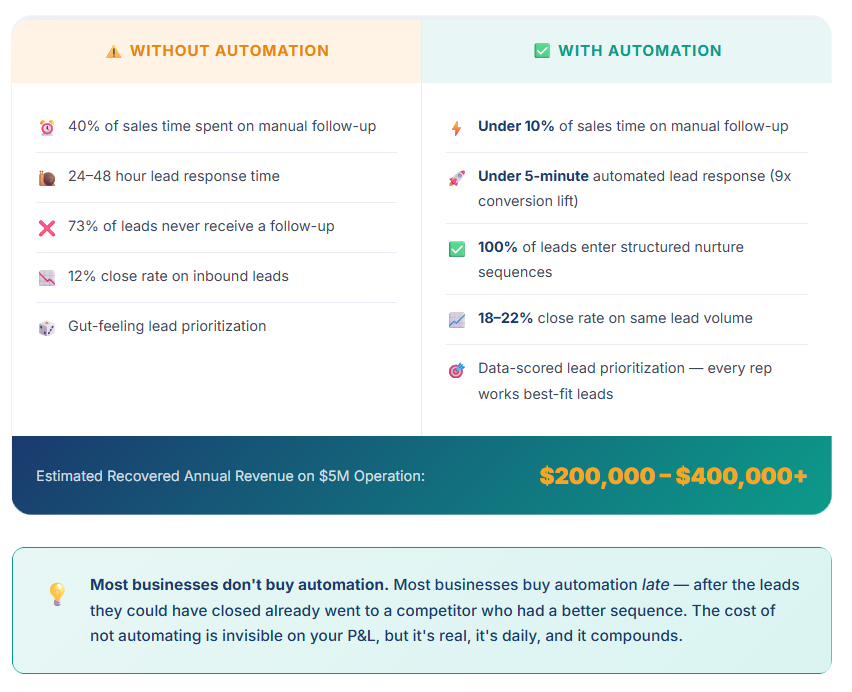
On $5M in revenue, recovering just 20% more pipeline through faster response and systematic follow-up represents $200,000–$400,000 in recovered annual revenue. That’s the automation ROI on a single metric – before you factor in personalization, lead scoring, and multi-channel orchestration.
Most businesses don’t buy automation. Most businesses buy automation late – after the leads they could have closed already went to a competitor who had a better sequence. The cost of not automating is invisible on your P&L, but it’s real, it’s daily, and it compounds.
Behavioral Triggers: The Secret Weapon Most Businesses Never Deploy
Here is where sophisticated operators separate themselves from the pack. Basic marketing automation sends scheduled emails to segmented lists. Advanced marketing automation fires precise messages based on specific behavioral events – in real time, at the exact moment of maximum relevance.
A behavioral trigger campaign watches what your prospects do and responds accordingly:
- Page visit trigger: Prospect views pricing page 3× in 72 hours without converting → triggers a personal-feeling check-in email from a named sales rep with full behavioral context already loaded
- Inactivity trigger: No email opens in 30 days → automatically shifts prospect to re-engagement sequence with a different value proposition before going permanently cold
- High-intent signal trigger: Downloads a product comparison guide → immediately escalates lead score and adds them to a hot-lead daily digest for the sales team
- Post-purchase trigger: Customer completes first transaction → initiates onboarding sequence that drives product adoption, satisfaction, and upsell readiness
The power of behavioral triggers is psychological precision. You are not guessing when to reach out. You are responding to stated intent, and personalized emails triggered by automation drive a 10x higher conversion rate than mass emails. The difference is not the technology – it’s the timing and relevance that only behavioral data can unlock
Marketing Automation Across the Full Customer Journey
Marketing automation is not a top-of-funnel tool. It is a full-lifecycle infrastructure. Here is how world-class operators deploy it at every stage – from first contact to loyal advocate.
AWARENESS STAGE: Automated social posting and content distribution ensure your online content reaches the right audiences consistently. Paid social audience sync automatically updates lookalike audiences based on your highest-value customers.
CONSIDERATION STAGE: Lead magnets trigger automated email sequences delivering educational content matched to the prospect’s specific interest. Behavioral retargeting keeps your brand visible across channels without manual ad management.
DECISION STAGE: High-intent behavioral triggers escalate leads to sales with full context – what they read, what they watched, what they downloaded. Sales reps receive enriched lead profiles, not cold names.
RETENTION STAGE: Post-purchase automation drives onboarding, product adoption, NPS measurement, and upsell identification. The lifetime value of a customer doubles when onboarding is systematized.
ADVOCACY STAGE: Automated referral programs, review request sequences, and loyalty campaigns convert satisfied customers into active promoters — without requiring your team to manually identify and reach each one.
Your web development foundation matters here too – every automation sequence eventually lands a prospect somewhere on your website, and the experience they find there either amplifies or destroys the momentum the automation built.
The Mistakes That Kill Your Automation ROI
Speed of implementation is not the same as quality of implementation. These are the most common – and most costly – errors:
Mistake 1: Automating a Broken Strategy. Automation amplifies whatever you feed it. If your messaging is weak, automation delivers weak messaging faster and at greater scale. Fix the strategy first. Then automate.
Mistake 2: Ignoring List Hygiene. A database with 40% invalid or disengaged contacts doesn’t just hurt deliverability – it poisons your analytics. Regular suppression of inactive contacts and validation of new entries are core infrastructure, not optional maintenance.
Mistake 3: Over-Sequencing Without Value. Prospects don’t unsubscribe because you emailed them. They unsubscribe because you bore them. Every touchpoint in a sequence must earn its place by delivering something useful. Volume is not a strategy.
Mistake 4: No Lead Score Decay Rules. A lead who was hot six months ago and has gone dark is no longer a hot lead. Without decay rules that reduce scores for inactive contacts, your “hot lead” list fills with people who peaked months ago. Decay rules keep pipeline prioritization honest.
Mistake 5: Building in Silos. Email automation disconnected from your CRM, disconnected from paid social, disconnected from web analytics, is not a marketing automation system – it’s a collection of tools having separate conversations with the same prospect. Integration is not optional. It’s the entire point.

Bottom Line: The Machine Is Running. Is It Yours?
Every day, your competitors’ automation sequences are waking up before your sales team does. They are following up with leads you haven’t touched in 45 days. They are scoring prospects you haven’t prioritized. They are sending the perfectly timed SMS at the exact moment of peak intent – while your team is still in their morning standup.
Marketing automation is not the future. It is the present infrastructure of every serious growth operation. The question is not whether to build it. The question is whether you build it now – intentionally, strategically, with proper architecture – or whether you build it later, reactively, after you’ve felt the cost of not having it.
The ROI math is inescapable.
$5.44 back for every $1 invested. 451% more qualified leads. 53% higher conversion rates. 320% more revenue from automated emails.
These aren’t promises – they are the measured, documented, peer-reviewed results of businesses that committed to the machine.
Here is what we know about you: You are reading this because you are serious about growth. You are not interested in marginal improvements. You want the system that compounds – the machine that never sleeps, never forgets, and never lets a hot prospect go cold for want of a well-timed message.
MediaBus Marketing Group has spent over 25 years building, optimizing, and scaling marketing systems for businesses that refuse to be ordinary. We are ready to build yours.
Your automation architecture starts with a single conversation – and that conversation is worth more than every manual follow-up email you’ve ever sent. The machine is waiting. Build it.
Marketing Automation FAQs
Q1: What is marketing automation, and how does it differ from email marketing?
Email marketing is one channel; marketing automation is the entire orchestration infrastructure that manages multiple channels simultaneously based on behavioral triggers and data-driven logic. Email marketing sends messages to lists. Marketing automation watches what each individual prospect does – across email, your website, social media, SMS, and ads – and responds with precisely timed, targeted messages that adapt to their behavior. Marketing automation includes email as one of its many tools, but also CRM integration, lead scoring, multi-channel coordination, A/B testing, attribution reporting, and AI-powered personalization. The difference is the difference between sending a broadcast and conducting a symphony.
Q2: How long does it take to see ROI from marketing automation?
Most well-implemented marketing automation systems begin showing measurable ROI within 90 days of launch. Research shows B2B companies see a 10% revenue lift within 6–9 months. However, the architecture of your initial setup matters enormously. A poorly configured system with weak messaging and no lead scoring will underperform for months before you diagnose the problem. The businesses that see the fastest returns invest 2–4 weeks in strategy and architecture before building a single sequence – and that upfront investment pays back in the quality of every workflow deployed afterward. 76% of companies achieve positive ROI within their first year.
Q3: What size business benefits from marketing automation?
Marketing automation delivers value across every business size. Solo operators and small businesses benefit from automation that extends their personal reach – allowing one person to maintain consistent communication with hundreds of prospects simultaneously. Mid-sized businesses use automation to systematize handoffs between marketing and sales, reduce lead leakage, and build scalable acquisition engines. Enterprise organizations leverage automation for complex multi-touch, multi-segment, multi-channel orchestration across global customer bases. The entry point is remarkably accessible: our Automation Platform is relatively inexpensive on the overall scope of doing business, removing any excuse for delay regardless of company size.
Q4: What are the most important integrations for a marketing automation system?
The four integrations that deliver the highest compounding value are: (1) CRM integration – ensures marketing data informs sales activity and vice versa, eliminating the wall between lead generation and deal closing; (2) Website analytics integration – enables behavioral triggers based on page visits, allowing you to respond to high-intent signals in real time; (3) Paid advertising integration – syncing with Google Ads and Meta creates closed-loop attribution, smarter audience targeting, and the ability to suppress existing customers from cold-acquisition campaigns; (4) SMS platform integration – unlocks the highest-open-rate channel in digital marketing for precision delivery of time-sensitive messages; and (5) Content Creation & Management – The production, dissemination, and governance of the content you put out to your target audiences.
Q5: How do I avoid my automated emails feeling impersonal or robotic?
The three disciplines that make automation feel personal: (1) Behavioral relevance – messages triggered by what the prospect actually did create relevance that feels like attention even when automated; (2) Context personalization – referencing what they downloaded, what problem they indicated they have, or what industry they work in makes every message feel written specifically for them; and (3) Authentic voice throughout – automation written in the natural, direct voice of a real human being consistently outperforms polished corporate copy on every metric. The goal is not to hide that you use automation. The goal is to make the automation so valuable and well-timed that the prospect is grateful for it.
Action Items:
SHARE THIS STORY ANYWHERE YOU LIKE
SHARE THIS STORY ANYWHERE

Mastering AI Automation for Finance and Back Office
Mastering AI Automation for Finance and Back Office The back office that never forgets. Most back-office losses are [...]
Mastering AI Automation for Project and Task Management
Mastering AI Automation for Project and Task Management Your plan is a prediction. AI's best job is remembering [...]
AI Operations: Automating Supply Chain, Scheduling & More
AI Operations: Automating Supply Chains, Scheduling, & More The Most Profitable AI in Your Business Is Probably the [...]