

What You’ll Find in This Article
When it comes to getting it right, you need to know how the E-E-A-T fits in to all this
- How E-E-A-T has evolved from traditional SEO into a core driver of AI visibility
- Why LLMs (ChatGPT, Gemini, Perplexity) evaluate authority differently than search engines
- The real meaning of Experience, Expertise, Authority, and Trust in the AI era
- How freshness, structure, and semantic depth influence AI citations
- The role of brand mentions, entity recognition, and cross-platform consistency
- Practical strategies to build “citation-grade” content that AI systems trust and reference
- How MediaBus Marketing Group’s approach aligns with the future of AI-driven discoverability
Understanding E-E-A-T in the AI Era
You may have noticed that the way you search on Google has changed. The old model rewarded pages that won rankings, collected backlinks, and captured clicks. The new model still values those things, but AI systems now decide visibility in a different way than people have become accustomed to in the past. When ChatGPT, Google’s AI-powered search features, Gemini, Perplexity, and similar tools assemble answers, they are not simply reproducing the classic “10 blue links” experience. They are selecting, synthesizing, and citing information they judge to be useful, trustworthy, and extractable. That shift moves E-E-A-T – Experience, Expertise, Authoritativeness, and Trust – from a supporting SEO concept to a central visibility framework for the AI era. Google says its systems use a mix of signals to identify content that demonstrates aspects of E-E-A-T, especially on sensitive topics, and its quality rater guidance states plainly that trust is the most important member of the E-E-A-T family.
At MediaBus Marketing Group, that shift fits the company’s operating philosophy. MediaBus’s work is as blending 20+ years of marketing expertise with AI-driven insights to create data-backed strategies that engage, convert, and grow brands. Its own positioning around AI-powered content, strategic visibility, and reliable AI deliverability aligns with the same core reality now shaping LLM citations: content has to be credible, useful, structured, and dependable enough for both humans and machines to trust.
Why E-E-A-T matters more in AI search than in traditional search
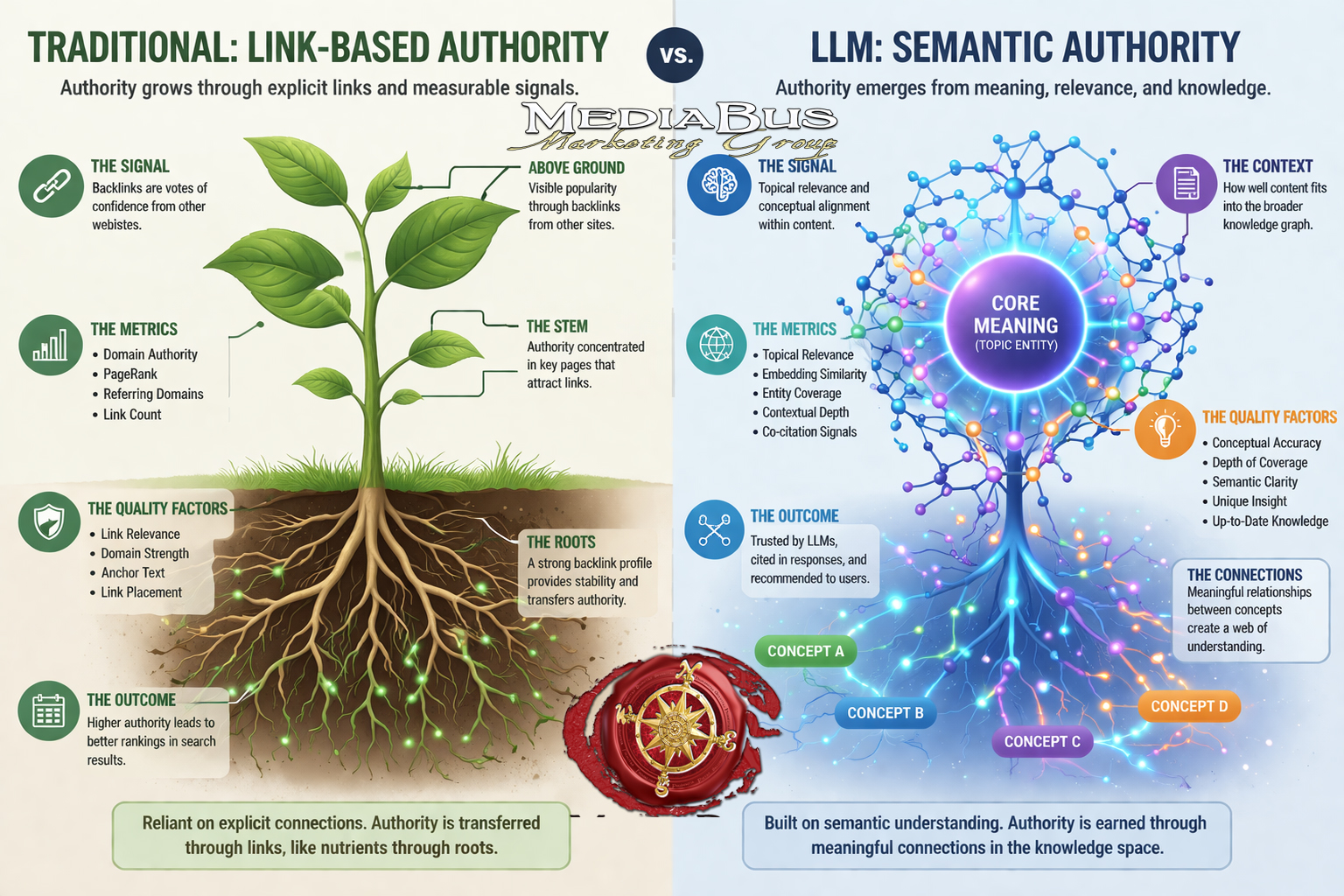
In classic SEO, authority was often interpreted through structural signals such as backlinks, domain strength, and ranking performance. Those signals still matter (especially if you are gearing towards Google in any way – it’s Local Listings, or Inclusion on Gemini), but they are no longer the whole story. AI systems increasingly surface sources that are semantically rich, current, clearly authored, and easy to extract answers from. Google’s documentation emphasizes that readers should be able to tell who created the content, how it was created, and why it exists, because those cues help people and systems understand quality and credibility.
That is why “above the normal” now means going beyond generic optimization. It means publishing content that proves real-world experience, demonstrates subject fluency, earns recognition, and removes doubt. In MediaBus terms, it means creating content with a mission — content that informs with purpose, guides with clarity, and converts with confidence.
The Four Pillars of E-E-A-T in the age of LLM Citations
How LLMs Evaluate Content Differently from Traditional Search
Large language models do not behave exactly like legacy ranking systems. They retrieve, interpret, and assemble answers. That creates a different standard for citation-worthiness.
Before we start, you need to be speaking/writing in the natural language, no hype, no industry only abbreviations, speak to those who you are targeting. If you want to learn more about how to do that, CLICK HERE
Here it is, in what the LLMs prioritize content that:
- Covers a topic comprehensively
- Addresses related questions
- Builds contextual understanding
This is why content clusters and topic depth outperform isolated posts.
Let’s begin! First, extractability matters. Content that is easy to parse tends to be easier to cite. We at MediaBus stress structured, AI-legible, brand-anchored, modular content as part of the post-search reality. That aligns with the overall LLM advice to make authorship and content-creation details clear, and with the broader shift toward machine-readable context.
Content must be:
- Structured
- Scannable
- Clearly organized
If AI cannot easily extract answers, it won’t cite your content.
Second, freshness matters more than many brands realize. Ahrefs’ analysis of nearly 17 million citations across seven AI and search platforms found that AI assistants cite fresher content than traditional organic search results. On average, AI-cited URLs were 25.7% fresher than URLs in organic SERPs, and ChatGPT showed the strongest tendency to cite newer pages. Separate Search Atlas research on 90,000 search-enabled citations found a strong recency bias across OpenAI, Gemini, and Perplexity, with Gemini showing the strongest preference for recent material.
AI systems strongly prefer recent content.
The studies show:
- AI-cited content is significantly fresher than traditional search results
- Most citations come from content published or updated within the last year
Freshness signals relevance and reliability.
Third, brand signals and mentions increasingly outweigh brute-force publishing. Ahrefs found that branded web mentions and YouTube mentions correlated more strongly with AI visibility than classic authority metrics like domain rating or backlink counts in some AI systems. In other words, the market talking about you may matter more than the number of pages you publish.
AI systems recognize:
- Repeated mentions
- Cross-platform visibility
- Consistent positioning
If your brand appears across multiple trusted sources, your likelihood of citation increases.
What It Takes to Win LLM Citations
To be cited by any AI LLM, your content has to do more than rank. It has to be the kind of source a model can trust and use. That means:
Your article should answer a specific question early, clearly, and directly. It should reveal who wrote it and why they are qualified. It should include evidence, examples, and terminology that show real familiarity with the subject. It should be updated when facts or market conditions change. It should be structured so machines can understand the page hierarchy and key takeaways without confusion. Google explicitly recommends clear bylines and background information about authors, because that helps readers understand E-E-A-T.
Look for these key operating principles for LLM Citations, Inclusions, and, hopefully, recommendations: purposeful messaging, AI-powered storytelling, structured content, topic clustering, authority signals, brand-driven search behavior, and the shift from ranking obsession to relevance in an AI-powered world.

What It Takes to Win LLM Citations
To become “AI-citable,” your content must meet a higher standard:
- Answer questions clearly and directly
- Demonstrate real expertise and experience
- Be structured for easy extraction
- Be updated regularly
- Include clear authorship and credibility signals
- Be consistent across platforms
MediaBus’s approach—focused on precision messaging, structured content, and authority positioning—aligns directly with these requirements.
Above the normal: the new standard for AI visibility
“Above the normal” means moving past ordinary content production and into citation-grade publishing.
It means not writing one generic blog post about a topic, but building a complete topical environment around it. It means not hiding the author, but proving the author. It means not sounding smart, but being verifiably informed. It means not publishing and forgetting, but refreshing and expanding. It means not treating AI visibility as accidental, but engineering it through structure, consistency, brand presence, and trust.
Few are building authority.
Even fewer are building trust.
- You don’t publish content—you build assets
- You don’t chase traffic—you earn credibility
- You don’t sound informed—you prove it
- You don’t publish once—you continuously refine
Because in AI-driven search, visibility is no longer given.
It is earned repeatedly.
That is also why MediaBus’s philosophy is relevant here. Position your company consistently, emphasizing getting the right message, of the right product or service, to the right people, at the right time; building trust through transparent, purposeful content; and using AI as a system for precision rather than guesswork. In the LLM era, that is no longer just a marketing mindset. It is an inclusion/citation strategy.
Final takeaway
E-E-A-T does not affect LLM citations because AI systems follow one single public “score.” It affects citations because the signals behind E-E-A-T map directly to what AI systems need when selecting supporting sources: clear authorship, real experience, deep expertise, recognizable authority, and dependable trust. Google’s own documentation and quality guidance support that framework, while newer AI visibility research shows that freshness, mentions, and extractable structure are increasingly important in real citation behavior.
The MediaBus Approach to AI Visibility
Our methodology aligns with how AI systems evaluate content today:
- AI-Powered Content Strategy → Precision messaging built for human + machine understanding
- Structured Content Architecture → Designed for extractability and citation
- Topical Authority Clustering → Depth over volume
- Brand Signal Amplification → Presence across platforms
- Reliable AI Deliverability → Consistency, accuracy, and trust at scale
This is not SEO 2.0.
This is post-search positioning.
The brands that win AI visibility will not be the ones that merely publish more. They will be the ones that become more believable, more useful, more recognizable, and more consistently trustworthy across the entire digital ecosystem. And when that happens…
They won’t just appear in results.
They’ll become the source.
Begin Today by filling out the form below to schedule a Discovery Call with MediaBus
Action Items:
SHARE THIS STORY ANYWHERE YOU LIKE
SHARE THIS STORY ANYWHERE

How Can AI Help Us Capture More Business and Handle More Work Without Immediately Hiring More People?
How Can AI Help Us Capture More Business and Handle More Work Without Immediately Hiring More People? The [...]

Setting Realistic Goals for AI Implementation
Setting Realistic Goals for AI Implementation The SMART Framework, the Achievability Trap, and Two Verified Real-World Examples of [...]

What KPIs Should I Actually Track?
What AI KPIs Should I Actually Track? The 6-Metric Framework That Separates Proof from Guesswork What You'll Find [...]