

Here’s What Does an AI Chief of Staff Actually Do for a Small Business Owner
The $200,000–$350,000 Executive Role Every Small Business Needs – Now Accessible for Less Than You May Think
What You’ll Find in This Article
- Why 72% of your week is being consumed by work that will never grow your business – and how to stop it today
- What a traditional Chief of Staff actually does – the $200K–$350K role small businesses have always needed but could never afford
- The 8 core functions an AI Chief of Staff performs around the clock, without salary, benefits, or sick days
- The “Second Brain” architecture – how to build an AI that learns your business and gets smarter every week
- The economics that rewrite everything – A full C-suite operating infrastructure for less than $5000/month
- The First 30 Days Blueprint – exactly how to deploy your AI Chief of Staff and what to give it first
- Little-Known Gems – five capabilities most business owners have never considered
The Owner Who Owned Nothing
Every business owner has wondered how much time they spend on the tasks of an administrative nature that could be saved, if properly delegated… Wonder no more….

That virtual steward is now available to every small business owner in the world. It runs without sleep. It never takes a day off. It costs less than a new laptop. It is called an AI Chief of Staff – and the lesson of reclaimed time is precisely why you need one.
The $250,000 Role You Are Doing Yourself – for Free
Let’s start with the number that should stop you cold: the average executive spends 72% of their working time on coordination, communication, and administrative tasks. Only 28% goes to actual strategic thinking and high-leverage decisions. For small business owners, the data is even more sobering.
Our research has shown that thousands of business owners found that 68.1% of entrepreneurs’ time is spent working “in” the business – tackling day-to-day tasks, putting out fires – versus only 31.9% working “on” the business through long-term goals and strategic planning. The business tool Slack’s study has found small business owners are losing an average of 96 minutes of productivity daily – three full weeks of lost time per year – to wasted communication overhead alone.
A human AI Chief of Staff at a mid-to-large company earns a $200,000–$350,000 base salary at Series B+ companies and large enterprises as of June 2026 – a senior cross-functional role responsible for internal AI adoption, workflow automation, and translating AI capabilities into operational leverage. Their job: flip that ratio. Get the executive’s time flowing toward the 28% that matters. Every fast-growing company has one. Almost no small business can afford one. Until now.
THE ECONOMIC ASYMMETRY: An AI Chief of Staff capability now costs less per month than a single day of a human Chief of Staff’s salary, making executive-level operations support accessible to every business size. This is not a marginal efficiency improvement. It is a structural reordering of what small businesses can access

In the Age of AI
You Gain the Advantage over Those Who Don't Step Up
What a Traditional Chief of Staff Actually Does
The Benchmark
A human Chief of Staff is not an executive assistant. The distinction matters. An executive assistant handles logistics you assign: schedule this, book this, send this. A Chief of Staff manages your operating system – ensuring the right information reaches the right person at the right time, decisions are made with full context, projects stay on track without your constant attention, and the leadership team moves in the same direction.
Chief of Staff: Human vs. AI – The Role Comparison
The companies that hire Chiefs of Staff gain a force multiplier at the top of the organization. The executive makes better decisions faster, with less preparation time and less cognitive load. This is what every small business owner needs – and what almost none of them have ever been able to afford.
The 8 Core Functions of an AI Chief of Staff
Function 1: Communication Filter and Inbox Intelligence
The average small business owner receives 121 emails per day. An AI Chief of Staff triage system categorizes incoming communications by urgency and importance, drafts responses to routine inquiries in your voice, flags the 10% that actually require your personal attention, and handles the 90% that don’t. Executives using approval-first AI assistants report saving an hour or more per day on triage and coordination. Over a 250-day work year, that is 250+ hours recovered – more than six full workweeks given back to you without a single new hire. 1+ Hour Saved per Day
Function 2: Calendar and Meeting Optimization
Your calendar is not a neutral document. It is a statement of priorities, and for most small business owners, it is a statement that says “everyone else’s priorities come before mine.” An AI Chief of Staff applies scheduling rules you set once: protecting morning focus hours, batching meetings into designated windows, auto-scheduling recurring reviews, and building preparation time before important calls. Tools like Reclaim.ai, Motion, and Calendar AI automatically protect your highest-leverage hours from the relentless invasion of other people’s schedules. Focus Hours Protected
Function 3: Pre-Meeting Intelligence Packages
Two-thirds of executives identify meetings as the number-one thing they spend too much time on (Korn Ferry / Fortune). The problem is not usually the meeting itself – it is arriving unprepared and leaving without clear action items. An AI Chief of Staff automatically generates a pre-meeting brief for every scheduled call: who you’re meeting, their background, your last conversation, relevant company news, and the three most important things to know before you walk in. It captures meeting notes in real time and generates a structured action-item summary before the meeting recording has stopped uploading. Zero Prep Time Needed
Function 4: Research and Competitive Intelligence
A traditional Chief of Staff is often the person who does the research you don’t have time for. An AI Chief of Staff now handles this continuously, automatically, and comprehensively. Competitor pricing changes, new market entries, industry news relevant to your clients, regulatory updates in your sector – all monitored, synthesized, and delivered as a daily or weekly briefing without a single search query from you. An AI Chief of Staff helps organizations maintain operational visibility around the clock. For small businesses that have never had a research function, this is the equivalent of adding a full-time intelligence analyst who works 24/7 at zero marginal cost.
This same function feeds your online content strategy and social marketing presence – because content and campaigns informed by real-time intelligence are exponentially more relevant than those built on guesswork. 24/7 Market and Platform Monitoring
Function 5: Decision Support and Strategic Briefing
Great decisions are made on great information. Most small business owners make decisions on incomplete information, because synthesizing the right data would take time they don’t have. An AI Chief of Staff provides on-demand decision support: given your context and options, it synthesizes the relevant data, presents the pros and cons, and offers a structured recommendation based on your stated priorities. Your judgment is not replaced – it is amplified. The same decision made with better information, in less time, with more consistency produces materially better business outcomes over time. Better Decisions, Faster
Function 6: Document Generation and Institutional Knowledge
Proposals, SOPs, team communications, client reports, performance reviews, onboarding documentation – the document generation burden on a small business owner is relentless. An AI Chief of Staff drafts these in your voice, using templates learned from your previous outputs, updated with current information from your systems. More importantly, it maintains what no small business has ever had: a true institutional memory. Every decision, every process, every policy – written down, searchable, and preserved. Not lost when a key employee leaves. Every Document, In Your Branded Voice
Function 7: KPI Monitoring and Performance Alerts
You cannot manage what you do not monitor. Most small business owners check their key metrics reactively (when something feels wrong) rather than proactively. An AI Chief of Staff connects to your sales data, marketing analytics, financial reports, and operational systems, and alerts you when metrics move outside acceptable ranges. It doesn’t wait for you to think to look. It tells you when you need to know. This is the difference between managing your business and having your business manage you. Proactive not Reactive
Function 8: The Second Brain – Context, Continuity and Institutional Memory
Every decision, meeting, customer interaction, and operational workflow strengthens the AI’s understanding of the business — creating an organization that continues to learn, coordinate, and execute around the clock. A human Chief of Staff eventually leaves and takes everything they learned with them. An AI Chief of Staff accumulates this context permanently. It learns your decision-making patterns, communication preferences, strategic priorities, and operational standards. It can onboard a new team member with a briefing that would have taken a human CoS weeks to prepare. And it improves every week you use it. Permanent Institutional Memory
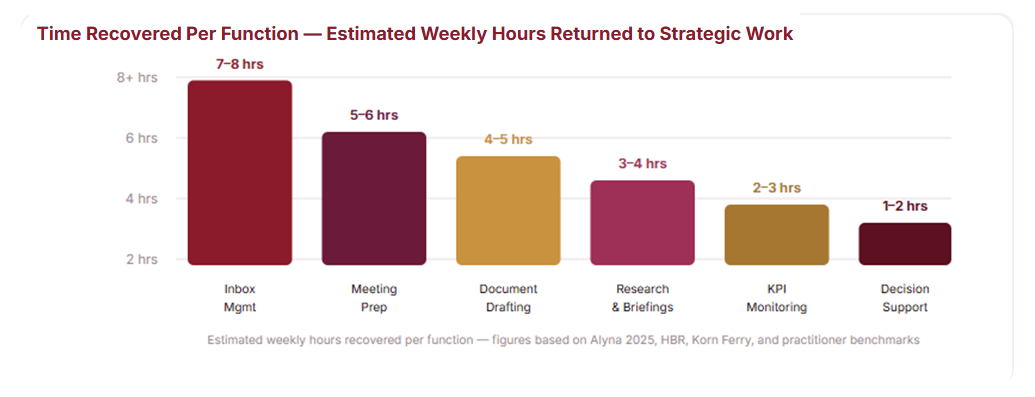
An AI Chief of Staff would cost less per month than a single week of a human Chief of Staff’s salary – making executive-level operations support accessible to every business size. For the cost of a single business trip per month, a small business owner now has access to the operating infrastructure that Fortune 500 companies build entire executive teams to provide. The only question is whether you build it.
AI Chief of Staff Deployment: 1st 30 Days
The businesses that get the most from an AI Chief of Staff are not the ones with the most sophisticated technology. They are the ones with the clearest implementation plan.
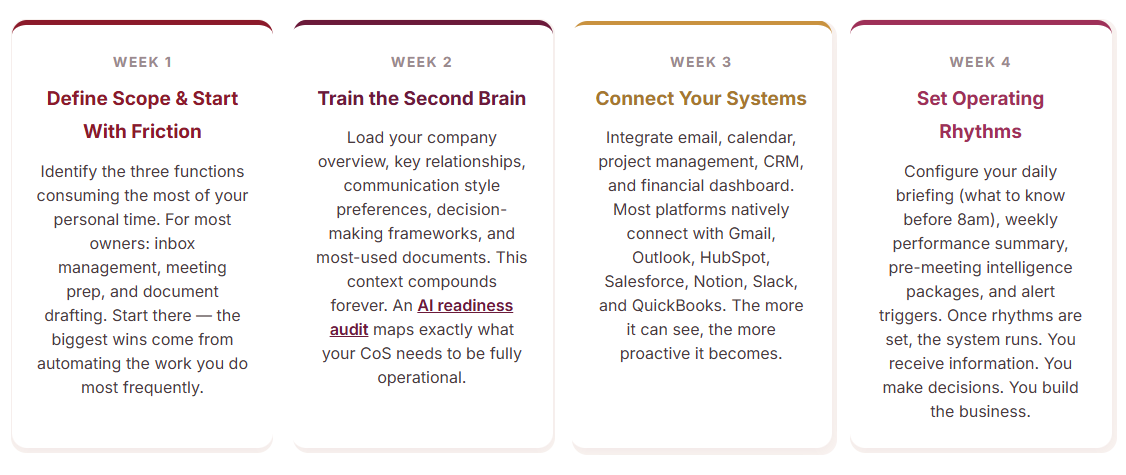
Week 1 – Define Scope and Start With Friction: Identify the three functions consuming the most of your personal time right now. For most small business owners: inbox management, meeting preparation, and document drafting. Start there. The biggest early wins come from automating the work you do most frequently, not the work that sounds most impressive.
Week 2 – Train the Second Brain: Feed the system your company overview, key customers and relationships, communication style preferences, decision-making frameworks, and most commonly used documents and responses. This is the foundation of your institutional memory – and the investment you make here compounds indefinitely. An AI readiness audit can map exactly what context your AI CoS needs to operate at full capability for your specific business.
Week 3 – Connect Your Systems: Connect email, calendar, project management, CRM, and financial reporting dashboard. Most AI CoS platforms support native integrations with Gmail, Outlook, Google Calendar, HubSpot, Salesforce, Notion, Slack, and QuickBooks. The more systems it can see, the more proactive and useful it becomes.
Week 4 – Set Your Operating Rhythms: Configure your daily briefing (what do you need to know before 8am?), weekly performance summary, pre-meeting intelligence package, and alert triggers. Once these rhythms are set, the system runs. You receive information. You make decisions. You build the business.
THE PRIORITIZATION RULE: If you perform any function more than once per week in a repeatable way, it belongs in your AI Chief of Staff’s scope. If it requires your personal judgment on every instance, it stays with you. The boundary between these two territories is exactly where you get your time back.
The Four Deployment Mistakes That Kill AI CoS Value
Mistake 1: Deploying Without Defining Your Voice. An AI CoS drafts communications in your name. If you never define your voice – your tone, phrasing preferences, formality levels by relationship type – it produces generic outputs that require heavy editing and cost more time than they save. Invest two hours defining your communication voice with examples. This investment pays back every single day it operates.
Mistake 2: Over-Automating Too Quickly. The temptation is to hand everything over immediately. The businesses that sustain AI CoS value take a phased approach: automate one function, measure output quality, refine the training, then expand. Over-automation without quality review creates situations where your AI CoS sends emails you didn’t intend or misclassifies urgent communications as routine.
Mistake 3: Failing to Maintain the Context Layer. Your AI CoS’s effectiveness is a direct function of the context it has. New customer relationships, new strategic priorities, new team members – all need to be loaded into the system as they emerge. Schedule a monthly “context refresh”: 30 minutes to update your AI CoS on what has changed. Without it, the system operates on stale information within six months.
Mistake 4: Collecting Tools Instead of Building a System. The conversation has moved beyond experimenting with chatbots and AI assistants. Leading organizations are embedding AI into executive workflows to improve decision quality, accelerate execution, and increase leadership capacity. An AI Chief of Staff is not a collection of individual apps – it is a coordinated system where each element feeds the others. Without integration, you have apps. With integration, you have a system – and systems compound where apps don’t.
Little-Known Gems
The AI CoS Capabilities Most Owners Never Discover
Bottom Line: The Craftsman Returned to His Workbench
You started your business because you are excellent at something. You have a craft, a service, a product, an insight that the world will pay for. And somewhere in the daily administration of running a business, that excellence is getting buried under 121 emails, reactive meetings, and decisions made without the information you should have.
The AI Chief of Staff does not replace your judgment.
It protects the conditions your judgment requires: focus, preparation, information, and time.
The 68.1% of your week you’re spending working “in” your business rather than “on” it does not have to stay that way. The ratio can be flipped. Not someday. Not after you hire the right person. Now.
The companies building AI Chief of Staff capabilities today are not simply adopting another technology. They are increasing the capacity of their leadership teams, reducing decision latency, and creating organizations that continue to learn, coordinate, and execute around the clock. The future advantage will not belong to the owner who works the longest. It will belong to the owner who builds the best system.
MediaBus Marketing Group has spent over 25 years building operating systems for businesses that refuse to stay small because their owner ran out of hours. AI strategy – including the architecture of AI Chief of Staff systems – is now at the center of what we build. We don’t sell tools. We build the system that runs behind your business so you can run ahead of it.
📞 · Contact Us at MMG Right Now · 🌐
Your AI Chief of Staff starts with a single conversation – and that conversation is worth more than the next 10 emails you’re about to answer yourself. Tell us what your mornings look like right now. Let us show you what they could look like instead.
AI Chief of Staff FAQs
Q1: What exactly is an AI Chief of Staff and how is it different from a virtual assistant?
An AI Chief of Staff is a coordinated system of AI tools, intelligent agents, and automated workflows that manages your operating environment – not just your logistics. A virtual assistant handles tasks you assign: schedule this, book this, send this. An AI Chief of Staff proactively manages your operating environment: it filters what reaches you, prepares you for every interaction, monitors your business for anomalies, synthesizes information into decision-ready briefings, and maintains the institutional context of how your business operates. The VA is reactive and task-driven. The CoS is proactive and systems-driven. For small business owners currently doing both roles themselves, the distinction is the difference between recovering scattered hours and recovering entire strategic days.
Q2: What tools actually make up an AI Chief of Staff system for a small business?
A practical AI Chief of Staff system is built from five categories:
- Communication intelligence – AI replaces inbox triage tools like Alfred, Superhuman AI, or Alyna that categorize, draft, and prioritize
- Calendar optimization – Replaces Reclaim.ai or Motion for intelligent scheduling
- Meeting intelligence – Replaces Otter.ai, Fireflies.ai, or Fellow.ai for pre-meeting briefs, real-time transcription, and action item extraction
- Research and briefing – Incorporates Claude, Perplexity, or custom AI agents for competitive monitoring and daily briefings
- Knowledge management – Utilizes the likes of Notion AI, Mem.ai, or custom systems for institutional memory and document drafting.
The power is not in any single tool – it is in the integration layer that allows them to share context and coordinate outputs. Without integration, you have apps. With integration, you have a Chief of Staff.
Q3: How long does it take to set up and see real results?
A minimal viable AI Chief of Staff – covering email triage, meeting notes, and basic briefings – can be operational in 7-14 days. Businesses that invest 2–3 weeks in structured setup – defining communication voice, loading business context, completing integrations, and establishing operating rhythms – see the fastest results.
At the 30-day mark, most business owners report recovering 45–90 minutes per day. At the 90-day mark, when the system has accumulated enough context to operate proactively, the reported recovery typically reaches 1.5–2+ hours per day. Beyond that, the system compounds. The AI Chief of Staff you build today will be meaningfully more capable in six months – because it will have learned six months of business-specific lessons that no new hire can replicate from a standing start.
Q4: What should I absolutely not delegate to an AI Chief of Staff?
Three categories should remain with you, at least initially:
- Relationship-critical communications with your most strategic customers, partners, or investors – these relationships deserve your authentic voice
- Hiring decisions – while an AI CoS can screen resumes, synthesize profiles, and prepare interview briefs, the final hiring judgment requires human pattern-matching that current AI does not reliably replicate
- The strategic narrative of your company – the story of why your business exists, where it’s going, and why it matters must come from you, in your authentic voice. Everything else is a legitimate candidate for delegation. The boundary between these two territories is exactly where you reclaim your most valuable working hours.
Q5: Will an AI Chief of Staff ever know my business well enough to be genuinely useful – or is it always generic?
This is the question that separates businesses that build AI CoS systems from those that only experiment with AI tools. An AI Chief of Staff improves in two ways: through system-level learning (as AI models improve, the underlying capabilities of the system improve automatically), and through context accumulation (as you add more business context, communication examples, decision records, and operational documentation, outputs become increasingly precise). Most business owners find the threshold of “genuinely useful” appears within 2–4 weeks for basic functions and within 60–90 days for proactive, business-specific intelligence. Beyond that point, the system compounds rather than plateaus. The AI Chief of Staff you build today will be dramatically more capable in two years – because it will have accumulated institutional knowledge of your business that no competitor can replicate from a standing start.
Action Items:
SHARE THIS STORY ANYWHERE YOU LIKE
SHARE THIS STORY ANYWHERE

Will AI Replace Employees or Help Them Accomplish More?
Will AI Replace Employees or Help Them Accomplish More? Two Companies, Same Year, Opposite Bets — and the [...]

Can Our AI Project Manager Stop Tasks from Falling Through the Cracks?
Can Our AI Project Manager Stop Tasks from Falling Through the Cracks? Two Verified Case Studies, the Real [...]

How Can AI Help Us Capture More Business and Handle More Work Without Immediately Hiring More People?
How Can AI Help Us Capture More Business and Handle More Work Without Immediately Hiring More People? The [...]