

DOMAIN AUTHORITY in the AGE of AI
WHAT YOU’LL FIND IN THIS ARTICLE…
Most small businesses are optimizing for one scorecard and ignoring the other – and the one they are ignoring is the one that is growing fastest. Domain authority has governed digital visibility for twenty + years, and it still matters when you are sourcing Google Properties. But in 2026, a completely parallel scoring system has emerged — one that determines whether AI systems like ChatGPT, Perplexity, and Gemini name your business in their recommendations.
These two systems share significant infrastructure, but they diverge in ways that most businesses have never been told about. As mentioned in the Guide Article that this supplemental is connected to, a study of 21,767 domains found that traditional Domain Rating correlates at nearly zero with AI citation frequency. This article gives you both programs — the Google authority program that has always worked and the LLM authority program most competitors have not started — and the integration logic that makes each one strengthen the other. Here is what is inside:
- What domain authority actually measures — and what it does not, including the critical distinction between a proxy metric and a ranking factor
- The logarithmic scale reality — why each point becomes exponentially harder to earn and what that means for your timeline
- The three pillars of domain authority improvement — backlink building, E-E-A-T content, and technical SEO foundations with specific actions for each
- The backlink audit — how to identify and remove the toxic links actively eroding the authority you have built
- The benchmark framework — how to evaluate your score relative to competitors rather than an abstract ideal
- The near-zero correlation finding — the research that proves traditional DA does not predict AI citation frequency
- The six dimensions of LLM Authority — the parallel scorecard AI systems actually use to decide whether to recommend you
- The integration program — the specific actions that build both scores simultaneously with the same investment
- The unified measurement system — what to track, how often, and what the numbers actually mean
THE NUMBER MOST BUSINESSES ARE OPTIMIZING FOR — AND THE ONE THEY ARE IGNORING
You should know your domain authority score. You have been watching it for years. You know roughly what it means – how many quality sites link to you, how much trust the SEO tools assign your domain, how you stack up against your competitors in Google’s invisible ranking calculus.
Here is what almost nobody has told you.
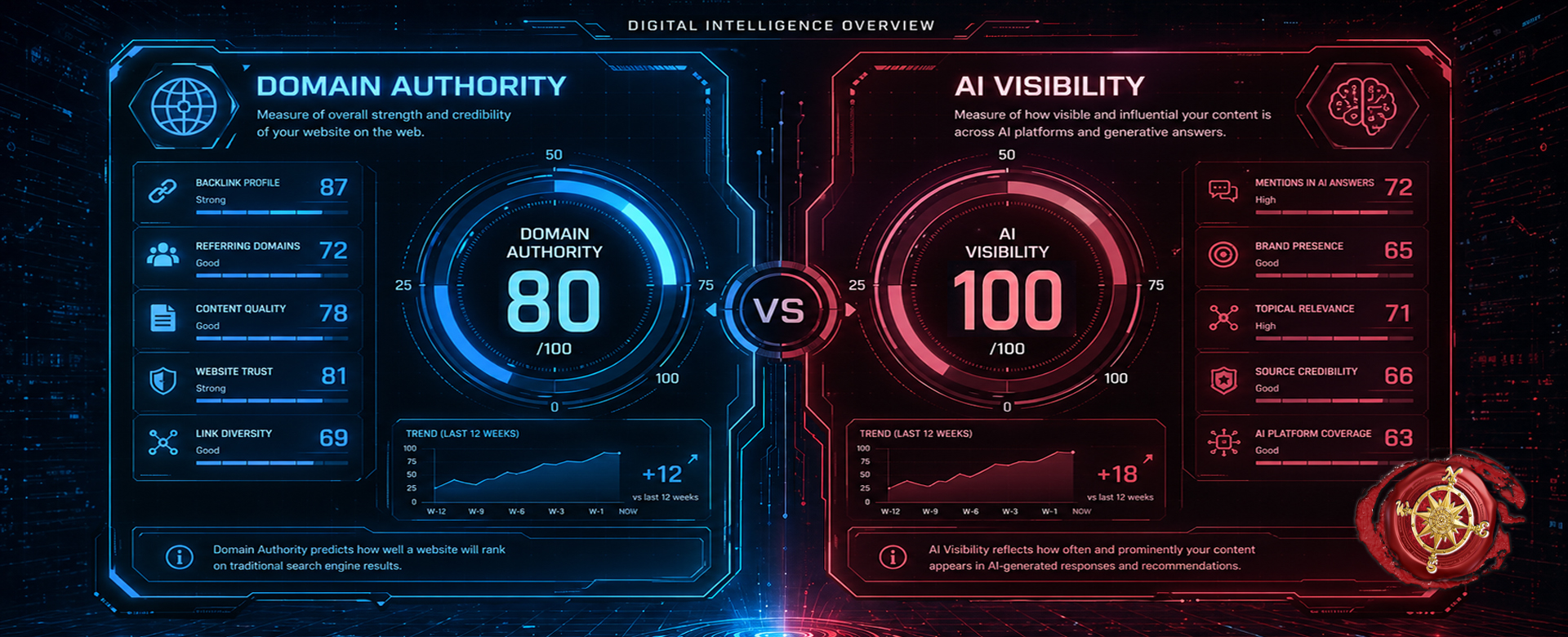
A study analyzing 21,767 domains measured the correlation between Domain Rating and LLM visibility — how often those domains get cited by ChatGPT, Perplexity, and Gemini. The result: Domain Rating correlation with OpenAI visibility: r ≈ 0.00. With Perplexity: r = –0.17. With Gemini: r = –0.14.
Zero correlation. Slightly negative in some cases.
The number you have spent years building has almost no predictive relationship with whether AI systems recommend you.
This does not mean domain authority is irrelevant. It means there are now two scorecards – the one that determines your Google rankings, and the one that determines whether AI systems name your business when your ideal buyers ask for a recommendation. Building only for one while ignoring the other is the most common and most expensive strategic gap in small business digital marketing in 2026.
This article gives you both programs. The Google authority program has always worked. The AI authority program that most businesses have not yet started. And the integration logic that makes them reinforce each other rather than compete.
PART ONE — DOMAIN AUTHORITY: WHAT IT IS, WHY IT STILL MATTERS, AND HOW TO BUILD IT
UNDERSTANDING THE SCORE
Domain authority – called Domain Authority by Moz, Domain Rating by Ahrefs, Authority Score by Semrush – is a third-party metric estimating how likely your website is to rank in search engine results. It runs on a logarithmic scale from 0 to 100. That logarithmic scale matters more than most people realize: moving from DA 20 to DA 30 is achievable with consistent effort over months. Moving from DA 70 to DA 80 requires a fundamentally different level of strategy, resources, and time. Each point becomes progressively harder to earn.
What it measures: primarily the quality and quantity of external websites linking to yours – with additional weighting for the authority of those linking domains, the relevance of the links to your subject matter, and various technical health signals.
What it does not measure: Google does not use any third-party authority score in its ranking algorithm. Google has confirmed this repeatedly. Domain authority is a proxy – a useful approximation of the signals Google does care about, not a direct input into its calculations.
Why it still matters despite not being a Google factor: the signals that produce high domain authority – quality backlinks from reputable sites, excellent content, solid technical foundations – are precisely the signals Google does value. A rising DA score is a reliable leading indicator that you are building the right foundations. A stagnant or declining DA score is an early warning that something in those foundations needs attention.
What is a good score?
There is no universal answer. Score relativity is everything. Your score is best evaluated against your direct competitors and your industry average.
DA 20-30 is typical for new or small sites establishing their presence. DA 40-60 indicates a growing brand-building category leadership. DA 60+ is territory held by major publications, established enterprises, and dominant category authorities. A DA of 30 might be excellent for a regional service business. The same score would be uncompetitive for a national e-commerce platform. Benchmark against your actual competitors. Their scores are your targets – not an abstract ideal.
Faces of Business Culture
Your Company Culture Can Be on Display for Others to Connect with.
THE THREE PILLARS OF DOMAIN AUTHORITY IMPROVEMENT
Pillar 1 — Build a High-Quality Backlink Profile
Backlinks are the primary currency of domain authority. Each one is a vote of confidence from another website — a signal to Google that your content is valuable enough for someone else to reference. Quality beats quantity every time. One backlink from a DA 70 trade publication in your category is worth more than fifty links from unknown directories.
The specific actions that build the strongest backlink profiles:
Create linkable assets. Original research, proprietary data, comprehensive guides, documented case studies with specific outcome metrics — these are the content types that earn natural backlinks because they provide unique value that other writers want to reference. When you publish a piece of content that contains a statistic or methodology that exists nowhere else, you become a citation-necessary source. Other publishers must link to you to substantiate that specific claim. The investment is in one research project. The citation benefit compounds for years.
Guest posting. Writing expert articles for reputable publications in your industry builds authority, earns links, and extends your brand presence into communities where your ideal buyers spend time. Focus on publications with high DA and genuine audience relevance. The backlink matters. The audience relationship matters more.
Digital PR and earned media. This is where domain authority building and AI visibility building converge most powerfully. When you pitch your original data or expert commentary to journalists and earn coverage in industry publications, you are simultaneously building backlinks for Google authority and third-party earned media citations for AI authority. One distribution event. Two compounding benefits. The press release strategy documented in the MMG AI Visibility Series is the systematic implementation of this dual-benefit program.
Broken link building. Find broken links on authoritative sites in your category and offer your relevant content as a replacement. The webmaster fixes a problem on their site. You earn a relevant, editorial backlink. Both parties benefit.
Unlinked brand mentions. Use Google Alerts and mention monitoring tools to find references to your business that do not include a link. Reach out and ask for the link conversion. You are already being referenced as authoritative — capturing the link credit is a straightforward ask.
Pillar 2 — Authoritative Content That Demonstrates E-E-A-T
Content is the foundation on which all backlink authority rests. Without content worth linking to, link building is an uphill battle against irrelevance.
Google’s E-E-A-T framework — Experience, Expertise, Authoritativeness, Trustworthiness — is not just a quality checklist. It is the evaluative lens through which both Google’s algorithms and AI systems assess whether your content deserves to be cited.
Experience means your content demonstrates first-hand knowledge of the subject. Not summarized theory — documented practice. Case studies from your actual work. Outcomes from your specific implementations. Data from your particular market. This is the signal that separates genuine practitioners from content farms, and it is the signal that AI systems are increasingly sophisticated at detecting.
Expertise means the content is created by or attributed to a named professional with verifiable credentials. The author bio matters. The credentials listed matter. The consistency of that author’s presence across platforms matters. As documented in the LLM Authority Score guide in this series, self-attestation carries minimal weight with AI systems. External corroboration of credentials carries substantial weight.
Authoritativeness is earned through backlinks from other authoritative sources, through brand mentions in trusted publications, and through community recognition in your field. It is not claimed through your own website’s assertions.
Trustworthiness is built through accuracy, transparency, consistent business information, and a track record of reliable content. Every factual error, every inconsistency across platforms, every piece of promotional language dressed as objective analysis — all of these erode the trust signal that determines both Google ranking and AI citation confidence.
Pillar 3 — Technical SEO Foundations
LLMs weigh authority signals and domain credibility when synthesizing answers. E-E-A-T are not just SEO considerations — they are AI inclusion criteria.
The technical health of your website affects both Google rankings and AI citation potential. The requirements are broadly the same across both systems.
Page speed under two seconds on mobile. Slow websites frustrate users, elevate bounce rates, and signal poor quality to both Google’s algorithm and AI crawlers that skip slow-loading pages. Test with Google PageSpeed Insights. Fix the largest contributors first.
Mobile-first design. Google uses mobile-first indexing. Over 50% of all web traffic is mobile. Your mobile experience is your primary experience. Test on actual devices, not just emulators.
HTTPS security. Non-negotiable. Every page. Every subdomain.
Clean site architecture. Every important page is reachable within three to four clicks from the homepage. A logical hierarchy that makes topic relationships explicit for both users and crawlers. Strong internal linking that distributes authority from high-authority pages to supporting content.
Core Web Vitals compliance. Largest Contentful Paint, First Input Delay, Cumulative Layout Shift — Google’s official page experience signals. These directly affect ranking. They also affect whether AI crawlers successfully extract your content, since slow rendering produces incomplete content access.
THE BACKLINK AUDIT — PROTECTING WHAT YOU HAVE BUILT
PART TWO — THE LLM AUTHORITY SCORE: THE PARALLEL SCORECARD THAT DETERMINES AI VISIBILITY
Domain authority governs Google. What governs ChatGPT, Perplexity, Gemini, Claude, and Grok is a different, overlapping but distinct set of signals – the LLM Authority Score.
The six dimensions of LLM authority — and their correlation with AI citation frequency:
Semantic completeness (correlation 0.87): Content that comprehensively addresses a topic from multiple angles. Pages scoring 8.5/10 or higher on semantic completeness demonstrate 340% higher AI citation inclusion rates. Not word count. Coverage depth.
Entity strength: How consistently and widely your business is recognized across the web as a distinct, verifiable entity. The AI’s question: “Is this a real business I have encountered consistently across multiple trusted sources?” As documented in the Become Recommendable by the Big 5 LLMs article in this series — identical name, address, and description across every platform is the foundational entity strength investment.
Structural clarity (correlation 0.68): How easily AI systems can parse and extract your content. Clean HTML structure, schema markup, answer-first architecture, self-contained paragraphs that pass the Island Test — extractable as standalone citation units without surrounding context.
External corroboration: The third-party earned media record that establishes your authority through sources independent of your own website. The 89% of AI citations come from earned media, not owned content. Every press release, every trade publication feature, every expert commentary placement — each one a corroboration event.
Freshness: Recency of content updates and new third-party signals. Content more than fourteen days old without updates shows a 23% decline in AI citation frequency.
Multi-platform presence: The breadth of authoritative platforms where your entity is established. Written expertise, video demonstrations, professional network presence, community platform participation — the more independent angles from which AI systems can recognize you, the more confidently they recommend you.
THE INTEGRATION PROGRAM — BUILDING BOTH SIMULTANEOUSLY
The good news: the two programs share significant infrastructure. The work is additive, not duplicative.
Actions that serve both Google DA and LLM Authority simultaneously:
Every press release through a recognized newswire builds backlinks for Google and third-party corroboration for AI. Every piece of E-E-A-T content with named expert authors builds Google ranking potential and AI citation credibility simultaneously. Every trade publication feature builds domain authority backlinks and earned media AI citations from the same placement. Every review earned on Google Business Profile builds local SEO signals and AI sentiment data from the same source.
Actions specific to LLM Authority that do not move DA:
robots.txt configuration allowing AI search crawlers — zero Google effect, critical for AI citation access. Bing Webmaster Tools sitemap submission — minimal Google effect, direct ChatGPT search indexing. Triple Schema Stack implementation — incremental Google featured snippet benefit, 13% higher AI citation probability. Entity consistency across all directories — minor Google local benefit, foundational AI entity recognition. Monthly three-prompt AI sentiment audit — no Google effect whatsoever, essential AI visibility management.
The unified weekly practice:
One piece of content published weekly, structured to both Google SEO and GEO standards simultaneously — question-format headings, answer-first architecture, FAQ section with schema, named expert attribution, statistics with inline citations, brand name embedded alongside category in the body. The Search Everywhere Friendly content standard from this series is the production checklist.
One milestone press release per significant business event. One trade publication pitch per month. One review generation follows up after every completed client engagement. One monthly prompt audit across five AI platforms.
This is not two programs running in parallel. It is one program producing compounding results across both visibility systems simultaneously.
THE BOTTOM LINE
Domain authority still matters. The businesses with strong DA scores have built genuine online credibility — quality content, quality backlinks, quality technical foundations — that Google rewards with rankings and that AI systems use as a Gate 1 credibility prerequisite.
But it is no longer sufficient on its own.
The buyers who are going to find your business in the next five years are increasingly arriving through AI systems. And AI systems have their own scorecard. One that correlates at near-zero with your DA number. One that rewards semantic completeness, entity strength, structural clarity, external corroboration, content freshness, and multi-platform presence. One that most of your competitors have not started building.
The businesses that build both — that maintain the Google authority program that drives today’s organic traffic while systematically building the LLM authority score that drives tomorrow’s AI recommendations — are the businesses compounding visibility across every channel their ideal buyers use.
The two-scorecard reality is not an inconvenience. It is a competitive window. Most businesses know one scorecard. The businesses that master both will own the visibility landscape for the next decade.
At MediaBus Marketing Group, We Build a complete Integrated Program for Your Company
Domain Authority Foundation and LLM Authority Score Improvement Simultaneously
Because your success is exactly how we measure ours.
Let us audit both your domain authority position and your LLM Authority Score. Begin today by filling out the form below – We show you exactly where the gaps are in each, how the two programs reinforce each other, and build the integrated strategy that makes your business stronger on every scorecard that matters.
LLM Authority Supplemental FAQs
FAQ 1 — What is domain authority, and does it directly affect my Google rankings?
Domain authority — called Domain Authority by Moz, Domain Rating by Ahrefs, and Authority Score by Semrush — is a third-party metric estimating how likely a website is to rank in search engine results. It is calculated primarily from the quality and quantity of external backlinks pointing to your domain, weighted by the authority of those linking domains and the relevance of those links to your subject matter.
Google has repeatedly confirmed that it does not use any third-party authority score as a direct ranking factor. Domain authority is a proxy — a useful approximation of the signals Google does evaluate, not a direct input into its algorithm. The reason it still matters despite not being a Google factor: the elements that produce high domain authority (quality backlinks from reputable sites, excellent E-E-A-T content, strong technical foundations) are precisely the signals Google does use to determine ranking. A rising domain authority score is therefore a reliable leading indicator that your broader SEO program is building the right foundations. A stagnant or declining score is an early warning that something in those foundations needs attention.
The authority scale is logarithmic — meaning movement from DA 20 to DA 30 is substantially easier than movement from DA 70 to DA 80. Each additional point at higher score levels requires significantly more effort, higher quality link acquisition, and greater content investment than the same incremental gain at lower levels. This is not a discouragement. It is a moat — the businesses that build genuine domain authority earn a structural advantage that late entrants cannot quickly replicate, regardless of budget.
FAQ 2 — What is the single most important action for improving domain authority?
The single most important factor is the quality of your backlink profile — specifically the number of unique, high-authority, topically relevant websites that link to your domain. A single editorial backlink from a DA 70 trade publication in your specific industry is worth more for domain authority improvement than fifty directory listings or low-quality blog placements.
The most efficient mechanism for earning high-quality backlinks is creating what practitioners call linkable assets — pieces of content so genuinely valuable that other publishers naturally want to reference them. Original research, proprietary data, documented case studies with specific outcome metrics, and comprehensive industry guides are the content types that attract editorial links from authoritative sources. When your content contains a statistic or methodology that exists nowhere else, other publishers must cite you specifically to include that data in their own work. You become a citation-necessary source rather than a citation-optional one.
Digital PR — actively pitching your original data and expert commentary to journalists and industry publications — is the systematic version of linkable asset promotion. When earned media placements result, you simultaneously gain backlinks for domain authority, third-party citations for AI visibility, and brand presence with audiences you did not previously reach. This convergence of benefits from a single activity makes digital PR the highest-ROI link-building investment available to most small businesses, particularly when coordinated with a systematic press release program distributed through recognized newswire services.
FAQ 3 — How is LLM Authority different from domain authority, and why does my DA score not predict whether ChatGPT recommends me?
Domain authority measures the strength of your backlink profile as a proxy for Google ranking potential. LLM authority measures the composite credibility, recognizability, and structural accessibility of your business entity as a proxy for AI citation probability. They are related but distinct — sharing a foundational overlap while diverging significantly in their specific determinants.
The divergence is empirically confirmed. A study analyzing 21,767 domains measured the correlation between Domain Rating and LLM visibility across major AI platforms. The results: correlation with OpenAI visibility at approximately zero, with Perplexity at –0.17, and with Gemini at –0.14. High Domain Rating domains varied widely across the AI visibility spectrum, with no consistent advantage in generative outputs. The research conclusion: contextual precision and topical relevance outweigh historical ranking strength in determining AI citation frequency.
LLM authority is composed of six dimensions that actually predict citation frequency: semantic completeness (how comprehensively your content addresses the full topic — the strongest predictor at a correlation coefficient of 0.87), entity strength (how consistently and widely your business is recognized as a verified entity across the web), structural clarity (how easily AI systems can parse and extract your content at the passage level), external corroboration (third-party earned media citations from sources independent of your own website), content freshness (recency of updates and new external signals), and multi-platform presence (the breadth of authoritative platforms where your entity is established). Building these six dimensions is the LLM authority improvement program — and it runs largely parallel to, rather than competing with, the domain authority program.
FAQ 4 — How do I identify and remove toxic backlinks that are harming my domain authority?
Toxic backlinks — links from penalized sites, private blog networks, link farms, irrelevant mass-directory submissions, or paid link schemes that violate Google’s guidelines — send negative quality signals that can trigger manual penalties and depress your domain authority score regardless of the quality of your legitimate link profile.
The identification process uses a backlink analysis tool (Ahrefs, Moz, or Semrush) to surface links with high spam scores, links from domains with near-zero authority or no topical relevance to your business, and link patterns that appear manipulative rather than editorial. Warning signs include: large volumes of links arriving in a short period from diverse unrelated domains, links from sites with no organic traffic and no legitimate content, and links using exact-match anchor text across multiple low-quality sources.
The removal protocol follows a specific sequence. First, attempt direct removal: contact the webmaster of the linking site and request that the link be removed. Document every outreach attempt with date, contact information, and response. Many webmasters will comply, particularly if the link was added without their knowledge as part of a spam campaign. Second, for links that cannot be removed through outreach, use Google’s Disavow Tool to instruct Google to ignore those specific links when evaluating your site. This tool requires precision — disavowing legitimate links is harmful, and the tool should only be used when the toxic link volume is substantial and verified. Conduct a link audit at a minimum, quarterly. The backlink profile you build through sustained effort deserves the same ongoing maintenance as the content that earns it.
FAQ 5 — What is the realistic timeline for improving domain authority, and how do I benchmark my progress?
The honest timeline for domain authority improvement depends on three variables: your starting score, your industry’s competitive landscape, and the consistency and quality of your investment in the three core pillars (backlink building, E-E-A-T content, and technical foundations).
For a new or low-authority site (DA 10-20), consistent investment over six to twelve months of disciplined link acquisition and content production typically produces meaningful movement to the DA 25-35 range. For an established site in the DA 30-50 range, reaching DA 50-60 typically requires twelve to twenty-four months of sustained effort at increasing quality thresholds. For high-authority domains above DA 60, each additional point requires progressively more significant investment — this is the logarithmic reality of the scale, and it is a feature rather than a flaw, since it creates the structural moat that makes early authority building compound into durable competitive advantage.
The most useful benchmarking practice is competitor-relative rather than absolute. Check your domain authority score monthly and simultaneously check the scores of your three to five primary competitors. Your target is not an abstract ideal number — it is to match and then exceed the scores of the businesses competing for the same buyers you are. If your DA is 32 and your primary competitors sit at 38, 41, and 45, you have a clear target and a measurable gap to close. A consistent upward trend in your score, combined with consistent growth in linking root domains (unique websites linking to you) is confirmation that your program is working. Plateau or decline signals a need to either increase link quality, audit for toxic links, or address technical issues that are suppressing the authority signals you are building.
Action Items:
SHARE THIS STORY ANYWHERE YOU LIKE
SHARE THIS STORY ANYWHERE

Mastering AI Automation for Finance and Back Office
Mastering AI Automation for Finance and Back Office The back office that never forgets. Most back-office losses are [...]
Mastering AI Automation for Project and Task Management
Mastering AI Automation for Project and Task Management Your plan is a prediction. AI's best job is remembering [...]
AI Operations: Automating Supply Chain, Scheduling & More
AI Operations: Automating Supply Chains, Scheduling, & More The Most Profitable AI in Your Business Is Probably the [...]