

Social Media Algorithms: The Deep Dive
The rules changed. Again. Here’s exactly what’s powering every major platform in 2026 – the ranking signals, the hidden mechanics, and the specific actions that put your content in front of the right people.
What You’ll Find in This Article…
Most businesses are operating with a 2023 understanding of algorithms that have been completely reengineered. The platforms haven’t just tweaked a few signals – they’ve rebuilt their recommendation systems from the ground up around AI, predictive modeling, and a new metric that matters more than likes, followers, or posting frequency. This article decodes all of it, platform by platform, with the specific signals, the tested tactics, and the strategic framework to make the 2026 algorithm your most productive unpaid employee.
- Why followers no longer guarantee reach on any major platform – and the “interest graph” shift that changed everything
- The universal ranking truth all 2026 algorithms share: dwell time and completion rate now outweigh every other signal
- Instagram’s three-tier system decoded – why DM shares are now worth more than 100 likes and how carousels generate 55% more reach than single images
- TikTok’s predictive AI and 60-minute stress test – the exact window that determines whether your content travels or dies
- LinkedIn’s 360Brew system and the “authority score” – why personal pages are dominating company pages 65% to 5%
- YouTube’s “satisfaction” model and Facebook’s Andromeda AI – the signals behind the two platforms most businesses misuse
- The cross-platform content multiplier framework that turns one piece of original content into five platform-optimized assets without extra work
In the 1960s, if you wanted to reach a million people, you bought a television commercial – a 30-second slot, a fixed message, a take-it-or-leave-it broadcast. The audience was captive. There was no algorithm deciding whether they’d see you. There was no engagement rate, no watch time, no “completion signal.” You paid, they watched, and that was the transaction. Fast-forward to 2026, and the landscape is unrecognizable. There are no captive audiences anymore. The platform has become the broadcaster, the producer, and the gatekeeper – simultaneously. And the algorithm running each platform is not a passive machine. It is an active intelligence that makes tens of thousands of decisions per second about your content: who sees it, when, for how long, and whether it earns the right to be seen by anyone else. The businesses that understand this intelligence – that treat the algorithm as a relationship to develop rather than a barrier to overcome — are seeing compounding organic growth that their competitors simply cannot explain.
The businesses that don’t understand it are doing something far more common and far more expensive: creating content that never gets seen by audiences that never had the chance to care, for campaigns that looked great in the brief and delivered nothing in the metrics.
This article ends that. Not with generic advice about “posting consistently” or “engaging with your audience.” With the actual mechanics – platform by platform, signal by signal – of how the 2026 algorithms work, what they reward, and the specific strategic moves that turn algorithmic understanding into organic reach, lead generation, and measurable business growth.
The Seismic Shift Every Business Missed
Here is the most important thing to understand before we go deep on any single platform: every major social media platform in 2026 has made the same fundamental architectural change. Every one of them. And most businesses are still operating as if this change never happened.
They have all moved from the follow graph to the interest graph.
The follow graph was the old model: the algorithm showed you content from people and pages you follow. Your followers were your guaranteed audience. If you had 10,000 followers, you had a reasonable expectation that a meaningful percentage would see what you posted.
That model is dead. Every major 2026 platform has moved from follow-graph to interest-graph recommendation — followers no longer guarantee reach; content itself has to earn distribution through watch-time, engagement velocity, and content-signal matching. Massmetric
This change has one enormous practical implication: every piece of content you create now competes on its own merits. Your account history helps. Your follower count helps slightly. But neither protects you from the algorithm’s most fundamental judgment: does this content earn the attention of the people who see it?
“Followers no longer guarantee reach. The content itself has to earn distribution through watch time, engagement velocity, and content-signal matching.” — DigitalApplied, How Social Media Algorithms Work in 2026
The Universal Truth All 2026 Algorithms Share
Before we go platform-specific, three signals that all 2026 algorithms share – regardless of whether you’re on Instagram, TikTok, YouTube, Facebook, or LinkedIn.
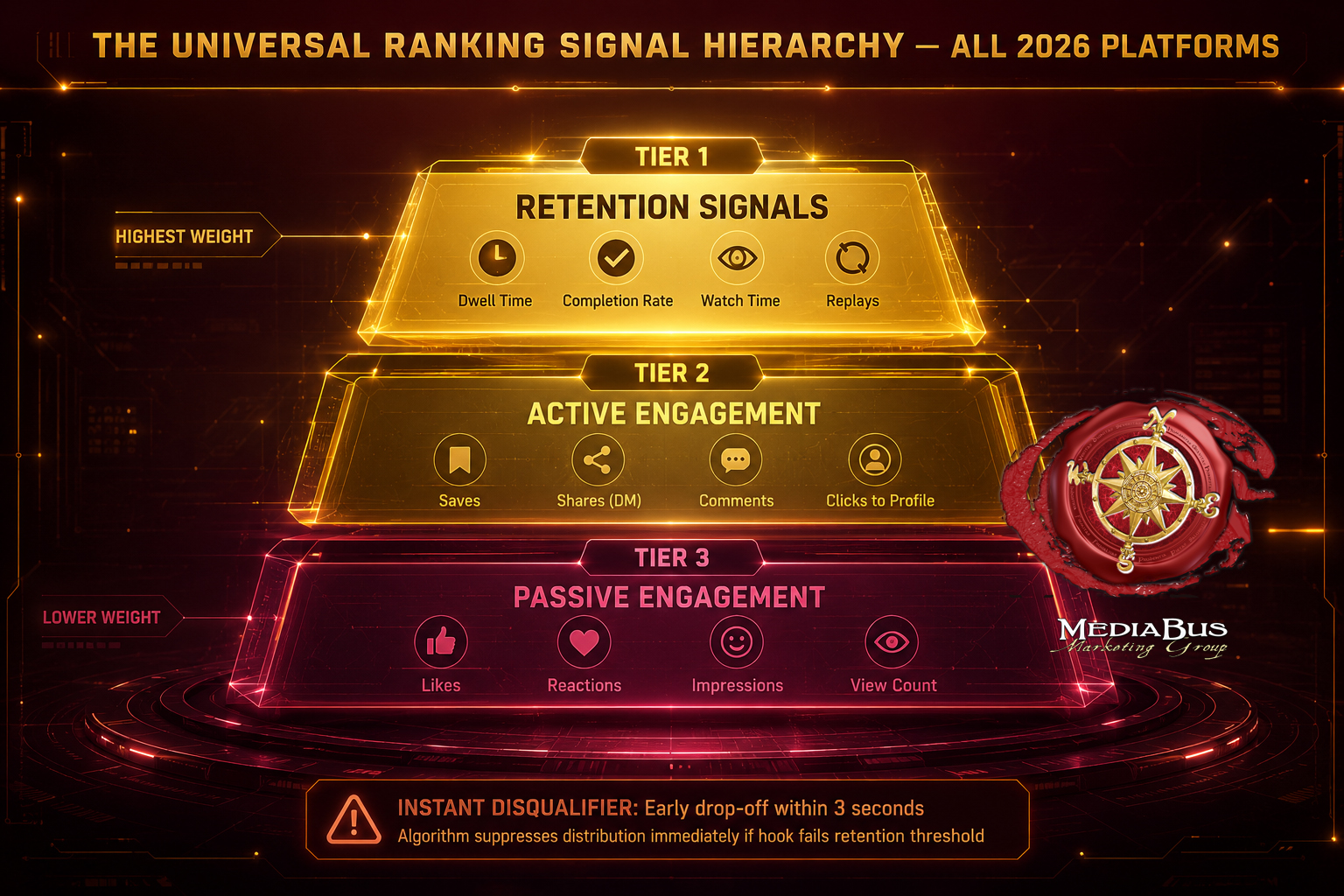
The Universal Ranking Signal Hierarchy – Tier 1 (Highest Weight): Retention Signals – Dwell Time, Completion Rate, Watch Time, Replays. Tier 2: Active Engagement – Saves, DM Shares, Comments, Profile Clicks. Tier 3 (Lower Weight): Passive Engagement – Likes, Reactions, Impressions. Instant Disqualifier: Early drop-off within 3 seconds – the algorithm suppresses distribution immediately if the hook fails the retention threshold.
Signal 1: Retention is king. Every platform’s most heavily weighted ranking signal in 2026 is some version of “how long did people stay?” Dwell time and completion rate are the two most under-reported ranking signals – both now carry more weight than likes on Instagram, TikTok, YouTube, and LinkedIn. A video watched by 1,000 people who complete it will outrank a video seen by 10,000 people who leave at the three-second mark – every time, on every platform. The hook isn’t a nice-to-have. It’s the entire game.
Signal 2: Saves and DM shares outperform likes. Across Instagram, YouTube, and LinkedIn, saves are now the most powerful engagement signal for algorithmic ranking. Algorithms in 2026 prioritize engagement quality over engagement volume. Design content to be saved (reference guides, frameworks, checklists) and shared (“someone needs to see this” moments).
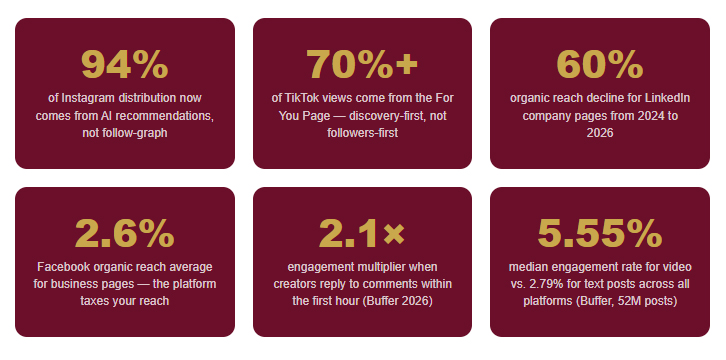
Signal 3: The first 60 minutes are diagnostic. Buffer’s analysis of 52 million posts confirmed that on every platform studied, creators who reply to comments perform better than those who do not. Early comment responses within the first hour trigger a 2.1× engagement multiplier, as algorithms interpret creator participation as a signal of content quality and community value.
Related MMG Resources:
- MMG Social Marketing Strategy — Full-Service Social Media Management
- Campaign Planning — Build a Social Strategy That Works With the Algorithm
- Marketing with AI — How We Use AI to Maximize Organic Reach
Platform by Platform — The Algorithms Decoded
Instagram — The Interest Machine
94% AI recommendations • Views as primary metric • DM shares are king
Instagram has officially transitioned to “Views” as the primary metric across all formats (Reels, Stories, Photos, Carousels), unifying how performance is calculated. 94% of Instagram distribution now comes from AI recommendations. Where Instagram was once about likes and followers, it is now about whether people watch, save, and share.
For Reels specifically, the average watch completion rate has become the primary ranking metric. A Reel watched by 10,000 people who all stop at 3 seconds performs worse than a Reel watched by 1,000 people who watch all the way through and replay it. Instagram’s algorithm considers sends via DM the strongest signal for reaching new audiences. According to Metricool data, 694,000 Instagram Reels are sent via DM every minute.
A Socialinsider analysis of 150,000 posts found that carousels generate 55% more reach and 70% more saves than single images. Carousels with 7 to 10 slides outperform those with 3 to 4 because the extended dwell time sends stronger positive signals to the algorithm.
Top Ranking Signals: Watch completion rate/video view duration · DM shares · Saves · Comments (within first 1–2 hours) · Keywords in captions and alt text
Highest-Leverage Tactics:
- Lead every Reel with a pattern-interrupt hook in the first 1.5 seconds – text overlay, visual shock, or direct statement – then deliver the promise immediately
- Build carousels specifically to be saved: checklists, reference guides, step-by-step frameworks earn saves at 3–5× the rate of opinion content
- Use Trial Reels to test content with non-followers before pushing to your audience – gather engagement data risk-free
- Replace hashtag-stuffing with 3–5 natural keyword phrases integrated into your caption naturally
- Reply to every comment within the first hour – the 2.1× engagement multiplier is real and documented
TikTok — The Predictive Engine
60-minute stress test • Search-first discovery • 70%+ views from For You Page
TikTok’s algorithm is becoming predictive. Using behavioral AI, TikTok now surfaces videos that anticipate what users will like before they’ve even searched for them. Nearly half of U.S. consumers now use TikTok as a search engine (Adobe 2026).
Every video undergoes a high-pressure stress test during its first 60 minutes. Strong early engagement can push content from hundreds of views to millions in hours. Creator communities report that completion rate requirements for algorithmic amplification have risen significantly. Reports indicate TikTok is increasingly showing new videos to a segment of your existing followers before distributing them to the broader For You Page. If your followers don’t engage, the content doesn’t travel.
The TikTok algorithm is boosting longer videos, typically 1 to 3 minutes, to encourage deeper storytelling instead of quick clips. This changes how reach and distribution work, especially for educational or narrative content.
Top Ranking Signals: Completion rate and average watch time · Re-watches/replays · Shares to other platforms · Trending audio · Caption keywords and hashtags
Highest-Leverage Tactics:
- Open every video with an unresolved tension: “Here’s what nobody’s telling you about…” – create the need to stay
- Include your primary keyword phrase in the caption naturally – TikTok’s search discovery matches keywords before users finish typing
- Design for re-watch value: end your video with a reveal or twist that makes a viewer want to see it again from the beginning
- Use TikTok’s native shopping features where applicable – the algorithm gives algorithmic priority to in-platform commerce content
- Post when your niche is active – TikTok’s initial test pool is drawn from your followers, so their active windows matter most
Related:
- MMG Online Advertising — Amplify Your Organic Strategy with Paid Media
- Advanced AI Strategies for Search Everywhere Optimization
LinkedIn — The Professional Authority Engine
360Brew AI system • Personal profiles dominate • First 60 minutes decide reach
Organic reach dropped 60% on company pages between 2024 and 2026. Company pages now represent just 5% of user feeds, while personal profiles dominate 65% of content consumption. If your LinkedIn strategy is built primarily around your company page, you are publishing into a void.
LinkedIn’s new “360Brew” system analyzes post context instead of relying on hashtags. Posts that clearly signal intent and value perform better without keyword stuffing. The 2026 algorithm changes tightened the reach penalty for posts containing external links in the post body – a 60% suppression signal. Direct link-clicking decreased 60% while relationship-building pathways increased in strategic importance.
Creators who post 3+ times per week for 8+ consecutive weeks build an ‘authority score’ that raises their baseline reach per post. A new creator with one viral post will not sustain high reach without the underlying consistency signal. The biggest 2026 LinkedIn algorithm change: short-form vertical video now gets an extra distribution boost – this is the highest-leverage new opportunity for organic reach.
Top Ranking Signals: Dwell time · Meaningful comments (especially from 1st-degree connections) · Consistency score/authority score · Short-form vertical video · Multi-image carousels (6.6% engagement vs. 4.85% for single images)
Highest-Leverage Tactics:
- Shift your primary content investment to personal profiles, not company pages – build founder or team member authority
- Never put links in the body of a post – use the first comment instead; this eliminates the 60% reach penalty
- Write posts with the hook in the first two lines – LinkedIn truncates after the second line; users must click “see more” to continue
- Build a “document carousel” using native PDF upload – these consistently achieve the highest dwell time of any LinkedIn content format
- Publish, then immediately spend 30 minutes engaging in the comments of relevant posts – trigger the notification effect
YouTube — The Satisfaction Engine
Watch time + satisfaction • Searchable structure • Shorts cross-pollinate
YouTube has evolved from a pure watch-time model to a satisfaction model. The question YouTube’s AI asks is not only “how long did they watch?” but “did they feel satisfied?” Measured through post-watch behavior: did the viewer search for more from this creator? Did they subscribe after watching?
YouTube continues to favor structured, searchable content. YouTube continues to favor structured, searchable content – think of it as SEO within the platform. Clear titles, chapters, and answers win visibility. Your content strategy needs to serve both search (answer a clear question) and recommendations (satisfy curiosity). Google itself announced updates that elevate the visibility of social content, with Google results pages now including posts from YouTube Shorts.
Top Ranking Signals: Click-through rate (CTR) · Watch time percentage and average view duration · Viewer satisfaction (post-watch behavior) · Comments · Title/description keyword alignment
Highest-Leverage Tactics:
- Title format that works: [Specific Result] + [Specific Audience] + [Specific Timeframe]
- Add timestamps (chapters) for every video over 8 minutes – YouTube uses these for structured data that improves search ranking
- Create a “content loop”: end every video by teasing the next one in a way that creates urgency to subscribe
- Use Shorts as a discovery tool – extract the most compelling 60-second moment from each long video and publish it as a Short
- Put your primary keyword in the title, first 100 words of the description, and one chapter heading
Facebook – The Andromeda AI and the Community Era
Groups dominate reach • Andromeda behavioral AI • 2.6% average organic reach for pages
Facebook’s 2026 algorithm is powered by “Andromeda,” Meta’s most advanced behavioral AI. Unlike the algorithms of the past that relied on simple “likes,” Andromeda looks at Dwell Time, Sentiment Analysis (the emotional tone of your comments), and Intent Signals (whether you search for a brand after seeing their post).
Facebook’s 2026 algorithm update is all about community, connection, and behavioral prediction. Posts inside active Groups get a major reach advantage. That’s a big shift from 2025, when most algorithm changes were still centered on raw engagement.
The algorithm is a creature of habit. If a user spends 80% of their time watching Facebook Reels, their feed will become 80% video. Replying fast and often is a high-stakes ranking factor.
Top Ranking Signals: Relationship strength (DMs, tags, repeat comments) · Dwell time and sentiment of comments · Group membership and engagement · Video completion rate · Early engagement velocity
Highest-Leverage Tactics:
- Create or join a Facebook Group as the primary community hub – Groups consistently outperform Pages for organic reach by 5–10×
- Reels first: every key piece of content should start as a Facebook Reel
- Respond to every comment within the first hour of posting – speed of response is a documented ranking signal
- Avoid external links in your post body – use them in comments or as the destination of a CTA at the end of the post
- Use conversational captions that prompt genuine responses – questions outperform announcements for distribution
The Cross-Platform Content Multiplier
The businesses generating the most organic reach in 2026 are not producing five times the content – they’re producing one piece of original, high-quality content and multiplying it systematically across platforms. This is the Content Multiplier Framework – grounded in how the algorithms actually read content. Content is embedded, not tagged – transformer-based recommendation models infer topic from the content itself, which makes niche consistency matter more than hashtags. One long-form piece (podcast or YouTube video) feeds 5–8 native short-form outputs per platform, each edited to the platform’s hook pattern and aspect ratio.
The Content Multiplier – From One Core Piece to Five Platform Assets:
- Source Content: One long-form piece (YouTube video, podcast episode, or long LinkedIn article) – the authoritative foundation, keyword-optimized for search
- Instagram Reel: Extract the single most compelling 60-second moment, add a text overlay hook, optimize the caption with 3–5 niche keywords, and design for DM share
- TikTok: Same source moment, retrimmed to end on a re-watch trigger, trending audio underneath, caption written as a searchable question
- LinkedIn Post: Pull the most counterintuitive insight as a text-first post with a two-line hook; link goes in the first comment; build engagement in the first 60 minutes
- Facebook Reel + Group Post: Native video upload (not YouTube link) for Reels reach; key insight as a question-led Group post to drive discussion
- YouTube Short: 60-second teaser that prompts “watch the full version” with a specific promise – this drives long-form view duration, which YouTube rewards
Related:
- MMG Online Content Strategy — Keyword-Rich Content That Earns Visibility
- MMG Visual Graphics & Video — Platform-Optimized Creative
- What Kind of Content Works Best for AI Search?
The Universal Playbook – What Works on Every Platform in 2026
The idea is that when you get the core offer right, distribution becomes dramatically easier because the product does the work. The same principle applies to content. When you get the content architecture right – the hook, the structure, the retention mechanics, the call to action – the algorithm becomes your distribution partner instead of your gatekeeper.
The 7 Algorithm-Proof Content Principles for 2026:
Hook in the first 1.5 seconds / first 2 lines. Every platform cuts distribution to content that loses people immediately. Your opening must create an unresolved tension, a surprising claim, or a direct challenge to the viewer’s assumption. Not a setup – a hook.
Design for saves, not likes. Reference guides, frameworks, templates, checklists, and step-by-step how-tos earn saves at 3–5× the rate of opinion content. A saved post is an algorithm signal that your content has lasting value.
Create DM-share moments. Ask yourself: “What would make someone send this to a specific friend?” Content that creates a “this is literally you” or “you need to see this” moment drives DM shares – the highest algorithmic signal across Instagram and TikTok.
Respond within the first hour. Buffer’s analysis confirms a 2.1× engagement multiplier for creators who reply to early comments. This is not about being polite – it’s about triggering the algorithmic cascade that extends distribution.
Niche consistency beats volume. Creators who post 1–2 times daily and maintain consistent content embedding see compound distribution. Creators who post erratically – 3 videos, then a 10-day gap — see the model “forget” their audience cluster and reset baseline reach. Choose your niche, stay in it, and let consistency compound.
Keep AI off the surface, in the engine. Platforms increasingly detect low-effort AI voiceovers, stock-footage slideshows, and generated thumbnails. Use AI for scale; keep a strong human-signal layer on top.
Never put links in the body (except YouTube). On LinkedIn, Facebook, Instagram, and TikTok, external links in the post body actively suppress reach. Move links to comments, bio, or a CTA that directs elsewhere. Keep the algorithm on your side by keeping the audience on the platform.
The Truth About Organic Reach – And the Honest Conversation
Here is the truth that no algorithm guide should leave out: organic reach is declining on every platform. Not because your content is bad. Not because you’re doing something wrong. Because the platforms are businesses, and their business model involves selling advertising. Median organic reach for business Pages sits below 2% of followers on Facebook. LinkedIn’s algorithm is unique but company pages face declining reach.
This doesn’t mean organic strategy is dead. It means organic strategy needs to be paired with paid amplification, an understanding of which content earns algorithmic distribution vs. which content needs a paid boost, and a realistic expectation about what “winning organically” actually looks like in 2026. The brands winning on social media today use organic content to identify what resonates, then amplify the winners with paid – creating a compounding return on both investments simultaneously.
If you’re building a social strategy on organic reach alone, you’re building on a foundation the platforms are actively narrowing. The winning move is an integrated approach: organic for testing and authority, paid for scale, and AI-driven automation – like the systems we build through MMG’s AI Agents service — for the consistency and personalization that no manual team can sustain at the volume modern algorithms reward.
*** Facebook Tip – Getting connected to as many people as you can with your individual business-oriented profile is a solid move, but one that is gaining the most traction right now is inclusion in Facebook Groups and participation within those that contain more readily your target audience, who will be susceptible to your messaging and potential offers. Find where your Ideal Buyers are in which group and become active and give top-of-the-mind engaging interactions as much as possible.
Ready to Make the Algorithm Work for You?
MediaBus Marketing Group builds integrated social media strategies for small- and mid-sized businesses in Sandy, Utah, and beyond — combining platform-specific algorithm expertise with AI-powered content systems that maintain the consistency, quality, and niche focus needed to earn organic reach in 2026.
👉 Get Your Social Media Strategy Session → mediabusmarketing.com/contact-us/
Free consultation • We’ll audit your current social presence against 2026 algorithm requirements (801) 893.1398 • info@mediabusmarketing.com
Social Media Algorithms FAQs –
Action Items:
SHARE THIS STORY ANYWHERE YOU LIKE
SHARE THIS STORY ANYWHERE

Will AI Replace Employees or Help Them Accomplish More?
Will AI Replace Employees or Help Them Accomplish More? Two Companies, Same Year, Opposite Bets — and the [...]

Can Our AI Project Manager Stop Tasks from Falling Through the Cracks?
Can Our AI Project Manager Stop Tasks from Falling Through the Cracks? Two Verified Case Studies, the Real [...]

How Can AI Help Us Capture More Business and Handle More Work Without Immediately Hiring More People?
How Can AI Help Us Capture More Business and Handle More Work Without Immediately Hiring More People? The [...]