

Here’s Where AI Can Make the Biggest Difference in My Company
The 8 High-Impact Zones, Prioritization Framework, and Compounding Advantage Map

What You’ll Find in This Article
- Why the question “Where should I start with AI?” is the most strategically valuable in business right now – and why most companies are answering it wrong
- The 4-Filter AI Prioritization Framework – how to identify your highest-ROI implementation zone before spending a single dollar
- The 8 highest-impact AI zones with verified payback periods, ROI benchmarks, and what each one actually transforms
- Customer Service AI: 4.1-month payback, $3.50 per $1 invested – the function AI has already proven at scale
- Sales & Revenue: 50% more leads, 60% lower acquisition cost – and how AI recovers the 75% of selling time lost to admin
- The Internal Knowledge Gap – why your company’s institutional knowledge base is the most overlooked AI asset in existence
- The AI Flywheel Effect – why early movers are building a permanent advantage latecomers can never fully close
- Little-Known Gems – five counterintuitive AI deployment truths most consultants aren’t telling you
- The four implementation mistakes that destroy AI ROI – and the framework for avoiding every one
- A Bottom Line that will make you rethink what your business is leaving on the table today
The Goldsmith and the Apprentice
Here’s an allegory that may help elaborate the point we are making in this article:
There was once a master goldsmith who had worked his craft for forty years. His apprentice came to him one morning, eyes wide with news. “Master,” he said, “I have heard of a new tool. A furnace that burns three times hotter than any we have used. It can melt any metal in half the time. Where should we put it?”
The old man set down his work. He looked at his apprentice for a long moment. “What a strange question,” he said at last. “Where is the work taking the longest? Where is the quality falling short? Where is the customer waiting? Where is your best craftsman spending his time on something that doesn’t need his judgment?”
The apprentice thought carefully. “The crucible work,” he said slowly. “That is where every order waits the most.”
“Then that,” said the master, “is where the furnace belongs. A tool that can do everything should be placed where it changes everything. The greatest mistake is putting a powerful tool where it only makes easy things slightly easier. The wisdom is not in the tool — it is in knowing exactly where the tool meets the highest need.”
You now hold a furnace that burns hotter than anything business has ever seen. It is called artificial intelligence. And the question is not whether to use it – it is where to place it so that everything changes. This article answers that question. Specifically. With data. With a framework. And with the kind of clarity that turns hesitation into momentum.
The Question Every Leader Is Actually Asking
When business owners and executives ask “Where can AI make the biggest difference in my company?” they are not asking a technology question. They are asking a strategy question. They want to know where their time, money, and organizational energy should go — and how to know before everyone else figures it out and the competitive window closes.
78% of enterprises have adopted AI in at least one business function, up from 55% in 2023 – the fastest adoption curve for any enterprise technology in the past two decades. Generative AI adoption reached 65% of enterprises in 2025, up from 33% in 2023 – the fastest technology adoption rate McKinsey has ever measured. However, only 28% of enterprises have deployed AI in production at scale across multiple business functions with measurable impact. The gap between experimenting with AI and extracting compounding value from it is the defining business opportunity of 2026.

79% of organizations reported measurable ROI from at least one AI initiative – most notably in automation, forecasting, and customer operations. The ones not seeing ROI deployed AI where it was easiest – not where it would make the most difference. The goldsmith’s lesson, played out at enterprise scale.
YOUR STARTING MAP: BCG’s data shows that support functions like customer service currently generate 38% of AI’s total business value. Operations generate 23%. Marketing and sales generate 20%. R&D generates 13%. This is the landscape. But the right answer for your company depends on where your highest-frequency, highest-friction, highest-value bottlenecks actually live – and that requires a diagnostic, not a vendor pitch.

In the Age of AI
You Gain the Advantage over Those Who Don't Step Up
The AI Prioritization Framework:
Find Your Highest-ROI Zone First
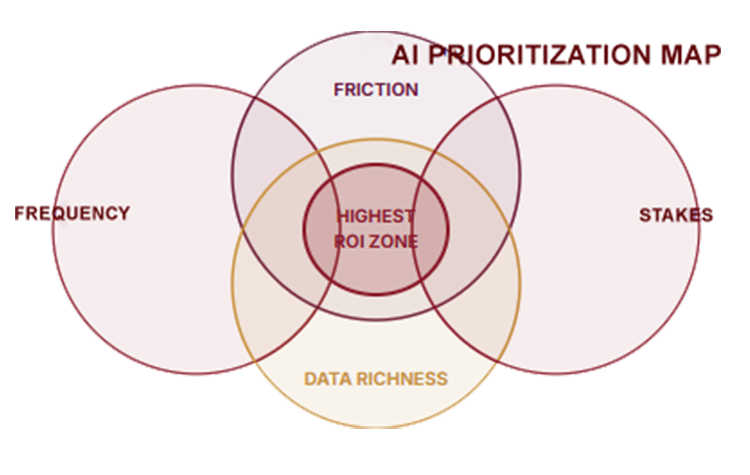
Before you deploy a single AI tool, run your operations through four filters. These four lenses identify the zones where AI will create immediate, measurable, defensible returns – and where it will simply accelerate whatever you already have, good or broken.
THe AI Prioritization Matrix – Where the Filters Converge
The 8 Highest-Impact AI Zones – Ranked, Mapped, and Measured
Based on verified 2025–2026 research from McKinsey, Bain, Gartner, BCG, PwC, Deloitte, and Salesforce, here are the eight business functions where AI creates documented, measurable, compounding impact, with payback periods and ROI benchmarks you can take to a CFO.
Little-Known Gems: What the Best Operators Know That Others Don’t
Gem 1: Your Internal Knowledge Base Is Your Most Overlooked AI Asset. Most businesses deploy AI to face customers before ever pointing it inward. But your company has accumulated years – sometimes decades – of institutional knowledge locked inside documents, email threads, SharePoint folders, and the heads of employees who might leave tomorrow. An AI knowledge retrieval system (built on RAG – Retrieval-Augmented Generation architecture) turns this buried knowledge into an always-available, instantly searchable intelligence layer. New employees onboard in days instead of weeks. Senior people stop answering the same questions forty times a year. The company’s brain never retires – and never calls in sick.
Gem 2: The AI Flywheel Gives Early Movers a Permanent Advantage. AI systems improve as they accumulate data about your specific business context. Every customer interaction processed, every document analyzed, every decision informed by AI makes the next response more accurate, more relevant, and more valuable. This creates a compounding advantage that latecomers cannot simply buy their way into – the value comes from accumulated, context-specific learning, not the platform itself. A business that started its AI program in 2024 and ran it consistently through 2026 doesn’t just have a two-year head start. It has an AI that has learned two years of business-specific lessons that competitors’ AI will spend years catching up on. The flywheel is spinning. Get on it or watch it leave you behind.
Gem 3: The “Process Before AI” Rule – The Most Expensive Mistake in the Game. Small businesses burned an average of $12,000 in 2025 by blindly automating low-value administrative tasks without strategic evaluation. The most common error was implementing AI for routine email sorting or basic data entry without measuring actual time savings – these low-complexity tasks often required more human oversight than expected, negating potential productivity gains. The rule is simple and non-negotiable: AI does not fix broken processes. It accelerates them. A flawed workflow automated by AI is a flawed workflow that fails faster and more consistently. Map your highest-friction processes first. Diagnose before you prescribe.
Gem 4: AI Competitive Intelligence Is Almost Completely Unclaimed Territory. The vast majority of companies do competitive analysis manually, quarterly, and incompletely. In 2026, AI can monitor competitor pricing changes in real time, track their content publication strategy as it evolves, analyze sentiment across thousands of customer reviews to identify emerging market gaps, and synthesize industry trend data from hundreds of sources simultaneously – continuously, automatically, at near-zero marginal cost. Understanding which AI crawlers index your content in 2026 and monitoring your competitors’ AI visibility is the starting point. Most of your competitors haven’t discovered this yet. The window for asymmetric advantage is still open.
Gem 5: AI-Ready Content Earns Double – From Humans and From AI Search Engines. The content your company creates for marketing and sales enablement now serves two fundamentally different audiences simultaneously: human readers who make purchase decisions, and AI systems (ChatGPT, Perplexity, Google AI Overviews) that are increasingly the first stop for business buyers. Structured, authoritative, entity-rich content that serves both channels is no longer optional – it is the infrastructure for visibility in both traditional search and AI-generated answers. An AI visibility audit tells you exactly where you stand in that ecosystem today. Your social marketing presence feeds these signals too – consistent brand mentions across platforms are among the strongest predictors of AI citation frequency in 2026.
The Implementation Mistakes That Destroy AI ROI
Mistake 1: Starting With Technology, Not Problems. In 2026, senior leadership picks the spots for focused AI investments, looking for a few key workflows or business processes where payoffs can be big – then applies the right talent, technical resources, and change management. The #1 failure pattern is reversing this sequence: choosing a tool first, then looking for problems. AI is a capability. The businesses achieving sustainable ROI started with an honest audit of where their operations hurt most – not a vendor demo.
Mistake 2: Piloting Without Measurement Infrastructure. 51% of businesses that implement AI cannot measure its ROI (Jasper, 2025). Unmeasured ROI is, structurally, no ROI at all – it cannot be defended in budget cycles, scaled, or optimized. The organizations capturing the 10–20%+ sales ROI gains are not just better at AI; they are better at measurement, and they designed their AI programs around measurable outcomes from the start.
Mistake 3: Treating AI as a One-Time Deployment. 41% of agent rollouts cross positive ROI within 12 months, and 19% never reach payback – almost entirely due to evaluation drift, governance gaps, and unmeasured rework, not agent capability limitations. AI is not software you implement and forget. It is a live operational system that requires ongoing calibration, measurement, governance, and evolution to sustain the returns it initially delivers.
Mistake 4: Skipping the Change Management Layer. The AI skills gap is seen as the biggest barrier to integration, and education – not role or workflow redesign – was the #1 way companies adjusted their talent strategies due to AI (Deloitte 2026). Deploying AI without investing in team education and process redesign produces the most common failure mode: buying a capability that nobody uses because nobody was trained to trust it. The businesses doubling AI ROI in 2026 redesigned workflows around AI’s capabilities – they didn’t bolt AI onto existing processes and hope for the best.
Bottom Line: The Furnace Is Ready – Where Is Your Work Taking the Longest?
Every day your competitors are deciding where to place the furnace. Some are placing it where it was easiest to justify. Some are placing it where their technology vendors told them to. And a small group – the businesses that will define their categories in the next five years – are placing it where the work takes the longest, where the customer waits the most, where the quality falls shortest, where the best people are buried in work that doesn’t deserve their judgment.
The organizations closing the AI execution gap in 2026 are not the ones with the biggest budgets or most sophisticated technical teams.
They are the ones with the clearest diagnosis of where AI belongs, the most disciplined implementation framework, and the measurement infrastructure to know when it’s working – and to double down without hesitation when it is.
The math is inescapable:
- 6.4 hours per knowledge worker per week recovered.
- 4.1-month payback in customer service.
- 50% more leads in sales.
- 22% efficiency gains in marketing.
- 70% of finance teams reporting revenue increases.
These are not projections – they are the measured, documented, audited results of businesses that made the right placement decision and built the right system around it.
MediaBus Marketing Group has spent over 25 years building systems that transform how businesses grow.
AI strategy is now at the center of everything we build – because it is at the center of everything that matters. We start with your operations, your bottlenecks, your best competitive opportunities – and we build AI strategy around what your specific business needs, not what a vendor wants to sell you.
Your AI implementation starts with a conversation — and that conversation is the most valuable 45 minutes you’ll spend this quarter. The furnace is ready. Tell us where the work takes longest.
AI Difference FAQs
Q1: How do I know which AI application to start with for my company?
Apply the four-filter prioritization framework: Frequency (where do your people repeat the most tasks?), Friction (where does work slow down and customers wait?), Data Richness (where is your data cleanest and most historical?), and Stakes (where is human error most costly?). Where these four filters converge is your highest-ROI starting zone. For most businesses, this convergence appears first in customer service, marketing content production, or sales follow-up automation – not because those are the best AI applications in the abstract, but because they typically score highest on all four filters simultaneously. An AI readiness audit can map this convergence for your specific operations in days, not months of internal analysis.
Q2: What size company benefits most from AI – enterprise or small business?
AI delivers measurable ROI across every company size, but the implementation looks different. For small businesses (10–25 employees), Gartner projects AI efficiency gains of 18–32% across customer service, administrative, and operational workflows – translating to $124,000–$312,000 in annual labor-equivalent savings. For mid-market and enterprise companies, the opportunity expands to include predictive analytics, supply chain optimization, and multi-function automation that compounds across departments. The entry point is now lower than ever: platforms like HubSpot AI, Jasper, and Salesforce Agentforce offer enterprise-grade capabilities at SMB price points. The businesses getting the most value are not the largest – they are the most intentional about where they deploy.
Q3: What is a realistic timeline for seeing ROI from AI implementation?
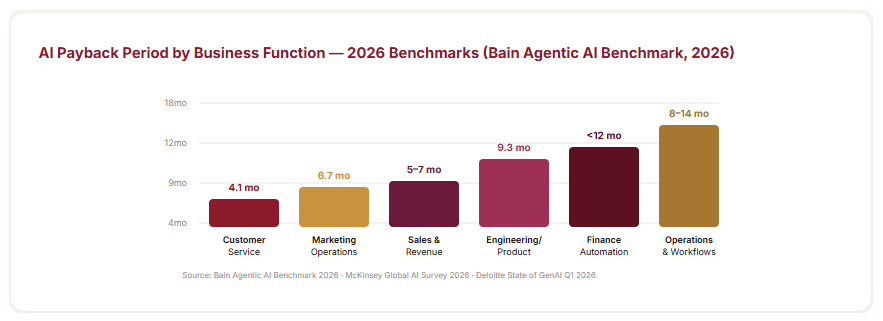
Payback periods vary significantly by function: customer service AI delivers the fastest payback at 4.1 months median (Bain, 2026). Marketing operations average 6.7 months. Engineering and product development average 9.3 months. Finance automation typically achieves payback within 12 months. For vendor-deployed agents, time-to-first-value averages 38 days compared to 94 days for custom-built systems. The critical qualifier: 41% of AI deployments that fail to hit ROI within 12 months fail because of measurement gaps, governance issues, and evaluation drift – not AI capability failures. ROI is as much a measurement discipline as it is a technology question.
Q4: What are the biggest mistakes companies make when implementing AI?
Four patterns appear consistently in failed implementations: (1) Starting with technology before diagnosing the problem – choosing a tool and then looking for applications; (2) Piloting without measurement infrastructure — 51% of AI adopters cannot measure their AI ROI, making optimization impossible; (3) Automating broken processes – AI accelerates whatever it touches, including dysfunctional workflows; and (4) Skipping change management – the AI skills gap, not technology cost, is the #1 barrier to AI integration per Deloitte 2026. The businesses avoiding these four patterns consistently outperform their sectors on AI ROI metrics, often by factors of 3–5× on the same technology investments.
Q5: How does AI affect my marketing specifically – and where do I start?
AI in marketing creates value at five distinct levels: (1) Content production – 1,500-word articles now take under 2 hours vs. 8–10 hours previously; (2) Personalization – AI delivers different messaging to different segments based on behavioral data; (3) Campaign optimization – AI continuously adjusts ad spend, audience targeting, and creative based on real-time performance data; (4) Social media – AI scheduling, copy generation, and audience analysis make consistent, high-quality social presence achievable without proportional staff growth; (5) AI search visibility – structured, authoritative content now earns citations in AI-generated search results alongside traditional rankings. A comprehensive marketing plan that integrates AI at all five levels is now the competitive baseline for 2026. An AI visibility audit is the first step in knowing exactly where you stand.
Email Marketing Strategies for Local Businesses
Building a Local Subscriber List
Email marketing is still one of the most effective ways to reach customers. By building a local subscriber list, businesses can keep their audience informed about upcoming promotions, events, or changes in store hours.
Personalizing Offers
One of the best things about email marketing is the ability to personalize offers based on customer behavior or preferences. Sending tailored promotions or reminders about services is a great way to keep your local customer base engaged.
Mobile Marketing and its Role in Local Business Growth
SMS Marketing
Many local businesses are turning to SMS marketing as a direct way to reach their audience. With open rates far exceeding those of email, SMS is an excellent tool for promoting flash sales or sending appointment reminders.
Location-Based Mobile Ads
Using location-based mobile ads allows businesses to target potential customers when they are in proximity to the business. This is especially effective for retail stores and service-based businesses looking to drive foot traffic.
Pay-Per-Click (PPC) Advertising for Local Businesses
Geo-targeting in PPC Ads
One of the standout features of PPC advertising is the ability to geo-target. Local businesses can ensure their ads only appear to users in specific locations, maximizing the relevance of the traffic they drive to their websites.
Budgeting for Local Ads
PPC ads allow businesses to set their own budgets, making it a highly flexible marketing tool. Local businesses with limited resources can start small and gradually scale as they begin to see returns on their investment.
Measuring Success in Local Digital Marketing
To ensure that digital marketing efforts are effective, local businesses must measure their success. Tracking key performance indicators (KPIs), such as website traffic, conversion rates, and customer engagement, helps businesses optimize their strategies.
Action Items:
SHARE THIS STORY ANYWHERE YOU LIKE
SHARE THIS STORY ANYWHERE

How Can AI Help Us Capture More Business and Handle More Work Without Immediately Hiring More People?
How Can AI Help Us Capture More Business and Handle More Work Without Immediately Hiring More People? The [...]

Setting Realistic Goals for AI Implementation
Setting Realistic Goals for AI Implementation The SMART Framework, the Achievability Trap, and Two Verified Real-World Examples of [...]
What KPIs Should I Actually Track?
What AI KPIs Should I Actually Track? The 6-Metric Framework That Separates Proof from Guesswork What You'll Find [...]