

How an AI Chief of Staff Can Give Business Owners Back Control of Their Company
The 8-Layer Control Stack: The System That Transforms Reactive Owners Into Strategic Leaders
What You’ll Find in This Article
- Why 54% of business owners have hit the wall of lost control – and why more effort makes it worse, not better
- The Founder’s Trap: the specific mechanics by which growth steals control from the person who built the business
- The 8-layer Control Stack: the precise domains where an AI Chief of Staff restores owner authority
- The measurable cost of lost control: burnout statistics, decision quality degradation, and the revenue impact
- What the Clarity Moment feels like – and the specific transformation at the 90-day mark
- How to build your Control Stack in 30 days – the sequenced deployment that maximizes speed of recovery
- Little-Known Gems – five control-restoration insights most AI consultants never discuss
- The boundary conditions: what an AI CoS controls, what it supports, and what it will never replace
The Founder’s Trap: How Growth Steals Control
The paradox at the center of every successful small business is this: the growth you worked for is the mechanism that takes your control away. When the business was small, you had complete visibility. You knew every customer, every project, every dollar, every problem. Control was easy because scale was small.
Then the business grew. New team members joined, each becoming the keeper of their own domain of knowledge. New clients arrived, each with their own context and history. New projects launched, each with their own dependencies. New systems were added (a CRM, a project management tool, a communication platform, a financial dashboard), each holding a piece of the operational picture that no single view synthesized.
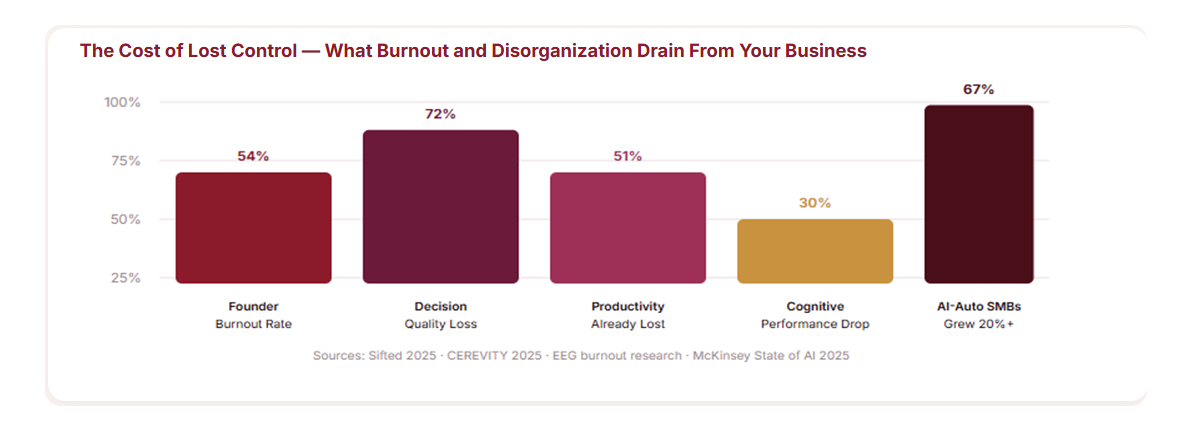
54% of founders experienced burnout in the past 12 months (Sifted, 2025). 65% of startup failures are attributed to founder burnout or internal conflict, not market conditions. These are not weak founders or poor business models. These are founders who hit the Founder’s Trap: the structural condition where operational demands exceed the owner’s cognitive and temporal capacity, where the business has grown faster than the systems available to manage it.
The average small business owner loses 1 hour 36 minutes each day to tasks they consider unproductive – over three full work weeks annually (Salesforce/Slack, 2024). Small business leaders lose nearly a full workday per week to multitasking and context switching. 72% of founders say stress directly impairs their decision-making quality. 51% say burnout has already reduced their productivity. These are not personal failings. They are the symptoms of a control architecture that has not kept pace with a growing organization.

THE BRUTAL TRUTH: 84% of business owners work more than 40 hours per week. 25% work 60+. And the tragedy is that more hours invested in a broken control architecture does not restore control – it accelerates the collapse. Working harder in the Founder’s Trap makes the trap tighter, not looser. The answer is not more effort. It is better infrastructure.
What Lost Control Actually Costs
Before we build the solution, we have to be precise about the problem – because “feeling out of control” sounds like a leadership complaint, not a financial emergency. It is, in fact, a financial emergency.
30% – reduction in cognitive performance from founder burnout (EEG studies). Burned-out leaders make worse decisions across every domain.
$37 billion – wasted annually in unnecessary meetings alone. The primary symptom of a business running on conversation instead of systems.
51% – of founders report burnout has already reduced their productivity. Not might. Already.
45% – of routine administrative tasks that AI can fully manage. The same tasks currently consuming the owner’s highest-value hours.
Lost control does not just feel bad. It produces measurably worse decisions at the exact moments when decision quality matters most. It creates a team that waits for the owner’s approval on decisions the owner should never have to touch. It creates the reactive culture – where the business manages the owner instead of the owner managing the business.
67% of small businesses using AI automation saw revenue growth of 20%+ last year (McKinsey 2025). The gap between these businesses and those still running on broken control architectures is not a technology gap. It is a systems gap – and the AI Chief of Staff is the system that closes it.
The Control Stack:
8 Layers of AI-Powered Command
An AI Chief of Staff does not restore owner control through a single intervention. It restores it through a layered architecture, which we call the Control Stack. Each layer addresses a specific domain where control has been lost, and each layer compounds the effectiveness of every layer above it. Here are the 8 layers, in order of deployment:
FOUNDATION LAYER
Layer 1: Information Control – Knowing Before Being Told. The first thing an owner loses when control slips is information integrity. Not because information doesn’t exist (it exists in abundance) but because nobody has designed a system for surfacing the right information to the right person at the right time. The default is reactive: you find out about problems when they become urgent enough that someone escalates them. Information Control inverts this. Your AI Chief of Staff monitors every data source your business touches – sales metrics, project status, customer health signals, financial performance, team activity – and delivers a structured daily briefing before you begin your workday. You know how your ship is before you step onto the deck. This single layer, implemented correctly, removes the need for 80% of the status update conversations that currently consume your day.
TIME LAYER
Layer 2: Time Control – Owning Your Calendar and Your Focus. The calendar is the most accurate reflection of who is actually in control of a business. If your calendar is filled with other people’s priorities – reactive meetings, status calls, requests scheduled before you could evaluate their importance – then your time is not your own. Time Control uses your AI Chief of Staff to apply your stated priorities as scheduling rules:
- Protecting morning focus blocks
- Batching meetings into designated windows
- Inserting preparation time before important calls
- Declining or rescheduling lower-priority requests automatically.
The owner stops being the person who arrives to discover what today will be – and starts being the person who designed what today will be before the first message arrived.
FILTER LAYER
Layer 3: Communication Control – Reaching You Only When You Must Be Reached. Eight out of ten employees experience information overload on a daily basis. The average office worker now receives roughly 121 emails per day, each one representing a micro-decision about whether to read, respond, delegate, or delete. For a business owner, this overload is magnified because every email potentially carries something that matters. Communication Control is the AI CoS’s triage function:
- Categorizing incoming communications by urgency and genuine importance
- Drafting responses to routine inquiries in the owner’s voice
- Routing non-urgent items to the appropriate team members
- Surfacing the 10–15% that actually requires the owner’s personal decision or relationship management.
The owner stops being an information clearinghouse and starts being an information destination.
QUALITY LAYER
Layer 4: Decision Control – Better Information, Faster Decisions, Fewer Regrets. Lost control produces the decision quality problem that most owners feel but cannot name: they are making important decisions with incomplete information, under time pressure, in the middle of operational chaos, while managing eight other demands simultaneously. Decision fatigue reduces not just decision speed but decision quality. Cognitive performance drops by up to 30% from burnout (EEG research). Decision Control is the AI CoS’s briefing and synthesis function:
- For every significant decision the owner faces
- The system gathers the relevant data
- Presents the options with their tradeoffs
- Provides a structured recommendation based on the owner’s stated priorities.
The owner still decides. But they decide with better information, in less time, with fewer regrets.
LEADERSHIP LAYER
Layer 5: Strategic Control – Operating Above the Operational Fray. The distinction between working in a business and working on a business is not a motivational poster concept – it is a structural distinction that determines whether a company grows or stagnates. Most owners who have lost control are fully deployed in the operation:
- They are the bottleneck
- The escalation point
- The institutional knowledge repository
- The primary decision-maker for everything from major strategy to minor logistics.
Strategic Control creates the structural conditions for the owner to operate above the day-to-day. When information is flowing automatically, when time is protected, when communication is filtered, when decisions are pre-briefed, the owner gains the hours, the cognitive bandwidth, and the visibility required to actually lead the company. AI automation helps handle 3–5× more operational volume without proportional owner involvement – and that multiplication is what strategic control looks like in practice. Pair this with a comprehensive marketing plan built on this foundation.
TRUST LAYER
Layer 6: Delegation Control – Trusting Your Team Because the System Confirms. Most owners who are bottlenecks do not want to be bottlenecks. They are not control freaks; rather, they are visibility addicts. They cannot delegate because the system doesn’t show them what’s happening after they delegate. Without visibility into downstream execution, delegation feels like abandonment. Delegation Control is the AI CoS’s monitoring and alert function:
- It tracks the progress of delegated work
- Flags delays before they become failures
- Surfaces quality issues before they reach the client
- Confirms that what was delegated is being executed as intended.
When the system shows the owner that delegation is safe, that nothing is falling through the cracks they can’t see, the owner can delegate more. And delegation, extended to its fullest expression, is the mechanism by which a business grows beyond the founder’s personal capacity.
MEMORY LAYER
Layer 7: Institutional Control – Your Company’s Knowledge Is Yours, Not Theirs. One of the most dangerous and least-discussed forms of lost control is knowledge dependency: the condition where the operational intelligence of the company, e.g., how things work, why decisions were made, what commitments were given, how clients prefer to be handled, etc., lives in the heads of individual team members rather than in systems accessible to the organization. Every time a key employee leaves, a portion of the company’s operational capacity leaves with them. Institutional Control is the AI CoS’s knowledge preservation function:
- Documenting decisions
- Capturing process context
- Maintaining client preference records
- Building the institutional memory that makes the company’s operations independent of any single individual’s presence.
The owner regains control of the company’s knowledge, and the company becomes less fragile with every week of operation.
SCALE LAYER
Layer 8: Growth Control – Scaling Without Proportionally Scaling Involvement. Without an AI CoS, growth means more operational complexity, which means more escalations, which means more owner involvement, which means more burnout – a ceiling on scale defined entirely by the owner’s personal capacity. Small businesses using AI automation have reported 40–60% reductions in operational costs while handling 3–5× more volume. Growth Control is the AI CoS’s scaling function:
- As the business grows, the system absorbs the additional operational coordination load without requiring the owner to absorb it.
- The owner’s involvement becomes a strategic constant rather than an operational variable.
This is what sustainable growth looks like, and the full MMG AI strategy library shows how each layer integrates.
THE COMPOUNDING EFFECT: Each layer of the Control Stack makes the layer above it more effective. Information Control makes Decision Control more powerful. Time Control makes Strategic Control possible. Delegation Control makes Growth Control sustainable. Build the layers in sequence – the stack compounds, and its compounding is the reason the business you build with an AI CoS looks fundamentally different from the business you built without one.
Before vs. After: What Control Actually Looks Like
The Clarity Moment: What Life Looks Like at Day 90
The business owners who have built their Control Stack describe a consistent experience at the 90-day mark that we have come to call the Clarity Moment. It is not a dramatic revelation; it is quiet and specific. It is the morning when you open your briefing and realize you already know everything you need to know for the day without asking anyone. It is the afternoon when a problem surfaces, and your system tells you about it before it becomes a crisis. It is the moment when a team member makes a decision you would have previously needed to approve, and the decision is exactly what you would have made.
The Clarity Moment is the first morning you walk into your business and feel like the person who is running it – not being run by it. McKinsey’s 2025 research documents that 67% of small businesses using AI automation saw revenue growth of 20%+ in the prior year. That revenue is not generated by AI replacing the owner’s judgment. It is generated by the owner’s judgment being applied to higher-leverage decisions, on better information, with more time, in a clearer state of mind. The Clarity Moment is when control is restored not just functionally, but psychologically, and that psychological dimension is what makes the difference between an owner who can see the next five years and one who can barely see next week.
How to Build Your Control Stack in 30 Days
What an AI CoS Cannot Do: The Honest Boundaries
Control, honestly restored, requires understanding what the AI Chief of Staff cannot do as clearly as what it can:
- It cannot replace your judgment on decisions that require your unique knowledge of your market, your relationships, and your company’s strategic direction. It informs judgment – it does not replace it.
- It cannot manage the human dimensions of leadership: the motivation of a struggling team member, the repair of a damaged client relationship, the vision speech that rallies the organization when morale is low.
- It cannot guarantee outcomes for commitments it helps you make. It can surface risks, present options, and track progress – but execution accountability lives with humans.
- It cannot perform without context. An AI CoS that hasn’t been trained on your business, your communication preferences, your priorities, and your standards will produce generic outputs that require more effort to correct than they save.
- It cannot sustain itself without a monthly context refresh. The system that knows your business perfectly in October will know it less well in April if you haven’t updated it with new relationships, new priorities, and new operational changes.
AI can manage 45% of routine administrative tasks independently (Productivity Institute, 2025). The other 55% is better, faster, and more accurately handled because the AI has managed its 45% and freed the human to do theirs. The businesses that extract the most value deploy it as a system – with clear scope, regular maintenance, and the discipline to train the system rather than just use it.
Little-Known Gems: Control Insights Most AI Consultants Never Discuss
Gem 1: The Visibility Deficit Is Not a Communication Problem. Most business owners who feel out of control have been advised to communicate more: more meetings, more status updates, more check-ins. This advice is wrong. The visibility deficit is not caused by insufficient communication; it is caused by the absence of a system that surfaces information without requiring communication. Every meeting called to gather status is evidence that a monitoring system has failed. An AI CoS does not improve communication; it eliminates the need for the communication that exists only because of missing infrastructure. Businesses that implement monitoring, alerting, and briefing correctly find that meeting frequency drops 40–60% in the first 90 days. Not because they communicate less, but because they communicate better. Stronger online content and social marketing systems operate the same way: the right infrastructure eliminates the reactive scrambling that bad infrastructure creates.
Gem 2: The Delegation Problem Is a Trust Problem – And Trust Is a Systems Problem. Owners who cannot delegate are not, in most cases, unwilling to delegate. They are unable to delegate safely because the system doesn’t give them visibility after delegation. The fix is not trust-building exercises or delegation mindset workshops. The fix is building the monitoring infrastructure that makes delegation safe. When an owner can see – in their daily briefing, in exception alerts, in project status dashboards – exactly what is happening with every major delegated initiative, delegation becomes rational rather than risky. You don’t need to trust more. You need a system that confirms trust is warranted.
Gem 3: The Decision Fatigue Spiral – Why Bad Decisions Compound. Decision fatigue is not linear; it is exponential. The tenth consequential decision of a day is not slightly harder than the first. It is fundamentally more cognitively expensive, more emotionally taxing, and more statistically likely to produce a poor outcome. Most owners who have lost control are making 50–80 micro-decisions per day: whether to respond to this email, whether to approve this expenditure, whether to override this team decision. An AI CoS eliminates most of these micro-decisions – not by making them, but by either handling them below the owner’s awareness threshold or by batching and sequencing them so the owner’s decision capacity is allocated to what genuinely requires it. The reduction in micro-decision volume does not reduce ownership. It restores the cognitive capacity required for the decisions that actually determine the company’s direction.
Gem 4: The Sunday Night Test – Your Real Control Indicator. The most accurate measure of whether an owner is in control of their business is not revenue, not team size, not operational metrics. It is the Sunday Night Test: What do you feel when you think about Monday morning? If the predominant emotion is dread – a vague anxiety about what will surface, what will have gone wrong – you are not in control. If the predominant emotion is preparation, a clear sense of what is ahead, what needs your attention, and what you intend to accomplish – you are in control. The AI CoS is not built to make business easier. It is built to make Monday morning feel like something you designed rather than something that is happening to you.
Gem 5: Control Is Not the Destination – Clarity Is. The deepest insight in the AI Chief of Staff conversation: owners who deploy the system well discover that what they wanted was not control; it was clarity. Control implies the ability to direct every outcome. Clarity implies knowing what is happening, what matters, and where your attention should go. The leaders who work best with an AI CoS stop trying to control everything and start choosing, with unprecedented precision, what to direct their attention toward. The AI CoS doesn’t make them omnipotent. It makes them present – fully present, fully informed, fully resourced – for the decisions and relationships that only they can navigate. That presence is worth more than any amount of oversight.
Bottom Line: Give Your ‘Ship’ Back Its Bridge
A captain does not fail because the ship was flawed. The ship was magnificent. He can fail because he has no instrument that could show him the whole ‘vessel’ at once; no system that synthesized the ‘navigator’s charts’ with the cargo master’s manifest with the engineer’s report. He had expertise everywhere and synthesis nowhere in this metaphor
You built your business. You know it better than anyone on the team…
The problem is not your knowledge
The problem is that your company has grown faster than the systems available to make that knowledge current. You are running on yesterday’s information, interrupted by today’s emergencies, making tomorrow’s decisions without the clarity tomorrow’s growth requires.
The AI Chief of Staff gives the captain back the bridge
…not by replacing the ‘captain’s’ judgment, but by restoring the conditions that judgment requires: information, time, clarity, and the structural freedom to lead rather than merely react.
54% of business owners hit burnout last year. 65% of business failures trace back to founder burnout.
And 67% of the businesses using AI automation grew revenue by 20%+ last year.
The difference between these groups is not talent, not market position, not capital. It is systems. It is the presence or absence of the Control Stack that separates the owner who runs their company from the owner their company runs.
MediaBus Marketing Group builds AI operating systems for businesses that refuse to let their owner’s capacity be the ceiling on their growth. We don’t sell tools. We build the Control Stack – the layered, integrated, maintained architecture that gives business owners back the control, clarity, and strategic authority their company’s next level demands.
📞 · Contact Us Here Today · 🌐
Tell us what your Sunday nights feel like right now – and let us build the system that changes what Monday mornings look like for good.
AI CoS Control Stack FAQs
Q1: What is the difference between an AI Chief of Staff and regular AI productivity tools?
Most AI productivity tools address a single function in isolation: one tool for email, another for scheduling, another for meeting notes. These tools can be individually useful, but they do not address the systemic problem of lost control because they do not share context, do not coordinate with each other, and do not provide the unified visibility that a control architecture requires. An AI Chief of Staff is not a tool – it is a system: a coordinated, integrated architecture of AI capabilities that share context, inform each other, and produce a unified intelligence layer across the business owner’s entire operating environment. McKinsey’s research documents that the redesign of workflows (not the addition of tools) has the biggest effect on measurable business impact from AI. The system is the solution, not the subscriptions.
Q2: How long does it take to feel like I’m actually back in control after deploying an AI Chief of Staff?
The first week produces the most immediate relief – because Information Control and Communication Control, the two fastest-deploying layers of the stack, address the most acutely felt symptoms of lost control. Most owners report the first meaningful Clarity Moment precursor within 10–14 days: an afternoon where the business ran without them for several hours, and the briefing confirmed everything was on track. The full experience of control restoration – the Clarity Moment – typically appears at the 60–90-day mark, when all eight layers of the Control Stack are operational and compounding together. Sustainable control is a 90-day build, not a 90-minute configuration. The businesses that invest in proper deployment see the compounding effects for years.
Q3: Can an AI Chief of Staff work for a business with fewer than 10 employees?
Yes – and in some important respects, it works even better for smaller businesses because the control problem is more acute. In a smaller business, every person carries a higher proportion of the company’s institutional knowledge, every information gap has a larger operational impact, and the owner’s personal capacity constraint affects a higher percentage of total output. The tools that comprise an AI CoS system are priced accordingly. The Control Stack framework scales regardless of team size: the architectural logic – information, time, communication, decision, strategic, delegation, institutional, growth control – applies to a 5-person team as directly as it applies to a 50-person organization. The Founder’s Trap has no minimum headcount.
Q4: I already use a project management tool and CRM. Why do I still feel out of control?
Having tools is not the same as having a system. Most businesses that feel out of control despite having CRMs and project management platforms have what we call the Integration Gap: they have invested in the individual instruments but have not built the orchestra. Each tool holds a portion of the operational picture. No single view synthesizes them. The owner still must check each system individually and still must manually connect the dots between what the CRM shows and what the project tool shows and what the financial dashboard shows. The AI Chief of Staff addresses the Integration Gap by serving as the synthesis layer: pulling intelligence from every system you already have, combining it into a unified view, and surfacing the information that matters without requiring the owner to orchestrate the gathering. The system is the solution.
Q5: What does it cost to lose control compared to the cost of building the Control Stack?
The average small business owner loses 1 hour 36 minutes per day to unproductive tasks – over three full work weeks annually (Salesforce/Slack 2024). At a conservative owner time value of $150/hour, that is $54,000+ per year in personally absorbed productivity loss – before accounting for decisions made under cognitive load, client experiences degraded by delayed responses, and growth opportunities missed because the owner was managing operations instead of leading strategy. 54% of founders experienced burnout last year, and burnout reduces cognitive performance by up to 30%. What the Control Stack costs monthly, depending on scale: $30,000–$60,000 per year. The cost of not building it is not a subscription fee. It is the compound cost of every month of lost control, every decision made under burnout, every client relationship degraded by delayed response, and every growth opportunity missed while the owner was busy managing instead of leading.
Action Items:
SHARE THIS STORY ANYWHERE YOU LIKE
SHARE THIS STORY ANYWHERE

Mastering AI Automation for Finance and Back Office
Mastering AI Automation for Finance and Back Office The back office that never forgets. Most back-office losses are [...]
Mastering AI Automation for Project and Task Management
Mastering AI Automation for Project and Task Management Your plan is a prediction. AI's best job is remembering [...]
AI Operations: Automating Supply Chain, Scheduling & More
AI Operations: Automating Supply Chains, Scheduling, & More The Most Profitable AI in Your Business Is Probably the [...]