

Signs Your Small Business Has Outgrown Manual Project Management
The Chaos Checklist: Recognizing the Signals Before They Cost You Clients, Team, and Growth
What You’ll Find in This Article
- Why 12% of your project investment is silently hemorrhaging right now – and the system failure behind it
- The 10 specific, observable signs that your manual project management has hit its ceiling
- The hidden costs most owners never calculate: the Handoff Tax, ghost projects, and scope creep amnesia
- What modern AI-powered project management actually looks like – and why small businesses now lead adoption
- The transition roadmap: how to move from spreadsheets and email to a system that scales with you
- Little-Known Gems – five counterintuitive project management truths most consultants never mention
- The mistakes that make PM software fail – and how to avoid every one
The Builder Without a Blueprint
There was once a master builder who had constructed homes in the same village for twenty years. In the beginning, when he built one house at a time, he held everything in his mind: the materials, the sequence, the measurements, the promises made to each family. He was reliable. He was trusted. His houses stood straight.
Then his reputation grew. Three families hired him at once, then five. He did not change his system… because his system had always worked. He carried the same mental map, the same handshake agreements, the same notebooks filled with shorthand only he could read. And slowly, invisibly, things began to slip. A beam ordered twice. A window measured wrong. A completion date promised to two families in the same week.
The builder was not incompetent. He was not lazy. He was a craftsman whose tools had not grown with his craft. The house he built at one person’s scale was the same house he tried to build at twenty. The only thing that changed was the cost of getting it wrong.
Every small business owner reading this has a version of that builder living in their operations. The ten signs in this article are the creaking beams, the wrong measurements, and the impossible promises – the evidence that your tools have not kept pace with your ambition. And the sooner you recognize them, the lower the cost of fixing them.
The Real Cost of “Making It Work” with Manual Systems
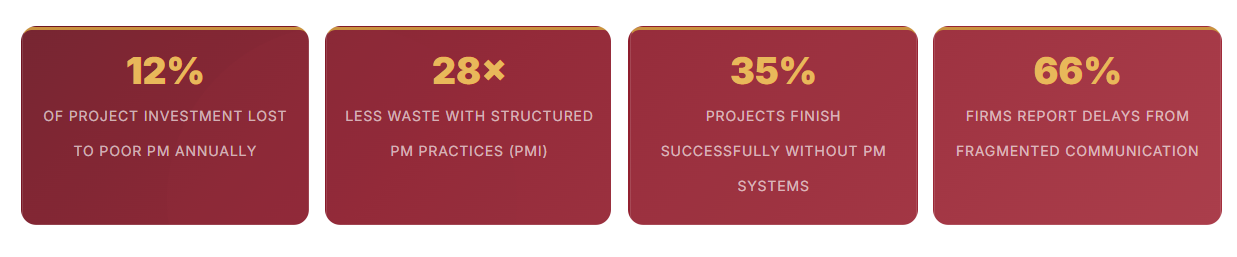
Before we name the signs, let’s name the number that explains why they matter: 12% of project investment is lost every year due to poor performance and miscommunication, according to PMI’s 2025 research. For a business generating $500,000 per year, that is $60,000 in wasted resources. For a $1 million operation, it is $120,000 per year – not in visible, dramatic failures, but in friction, rework, delays, and decisions made without the right information at the right time.
Organizations using proven project management practices waste 28 times less money than those operating without structured processes (PMI, 2025). Twenty-eight times. And yet only 35% of projects worldwide finish successfully, meeting all goals and timelines (Tempo Software, 2026 State of Strategic Portfolio Management). The rest either fail, go over budget, miss deadlines, or deliver something different from what was promised.
For small businesses, this is not abstract data. It is the client who went quiet after a missed deliverable. It is the team member who quit because they were tired of the chaos. It is the deal that fell through because the follow-up happened three days late. It is the recurring revenue that didn’t renew because the onboarding experience was fragmented. Manual project management has a ceiling, and you are reading this because you are approaching it, or you have already hit it.
CRITICAL STAT: 66% of organizations report frequent project delays caused specifically by unclear requirements and fragmented communication – not by a lack of talent or effort (Wellingtone, 2025). The problem is the system. Not your people. And a system problem requires a system solution.

In the Age of AI
You Gain the Advantage over Those Who Don't Step Up
The 10 Signs – Read Every One as a Diagnostic
These signs are not ranked by severity. The most dangerous ones are often the quietest. Your business is not broken; it has simply outgrown the containers it started in.
Modern AI-Powered Project Management
What It Actually Looks Like
The good news: the gap between where you are and where you need to be has never been smaller to close. By 2026, 80% of Project Management Offices are expected to use AI to support decision-making. AI-powered project management tools can now predict bottlenecks 2–3 weeks before they occur, auto-assign tasks based on team capacity, flag scope creep before it derails a timeline, and surface the three most at-risk items in your portfolio every Monday morning – without you asking.
Manual vs. AI-Powered Project Management – What Changes at Every Level
The Transition Roadmap: From Manual to AI-Powered PM
Phase 1 – Audit Your Current Chaos (Weeks 1–2): Before you choose a tool, map your reality. Where is project information currently living? Email threads, chat messages, sticky notes, individual spreadsheets, shared drives, individual memories. Document every place work gets tracked and every person through whom information flows. The gaps you find are exactly where work falls through the cracks — and they will tell you exactly what features to prioritize in any replacement system. An AI readiness audit as part of this process helps identify where AI-powered coordination would generate the highest immediate return.
Phase 2 – Centralize Before You Automate (Weeks 3–4): The single most important rule of any PM system migration: one source of truth first, automation second. Pick one platform. Get every active project, every task, every deadline, and every team member into that platform before you begin configuring integrations, automations, or dashboards. The businesses that fail at PM implementation almost always fail because they tried to automate before they had clean, complete data. Centralize first. Automate second. Optimize third.
Phase 3 – Establish the Non-Negotiable Rhythms (Weeks 5–8): Establish three non-negotiable rhythms before going live:
- every new task gets entered into the system within 24 hours — not tomorrow, not “when there’s time”;
- status is updated by task owners at least twice per week
- no status updates happen in meetings – all status is pulled from the system, and meetings are reserved for decisions and problem-solving only.
These three rhythms, enforced consistently for 30 days, transform your team’s relationship with the tool from “another thing we have to do” to “the thing that makes everything else easier.”
Phase 4 – Layer in AI and Automation (Month 3+): Once the system is populated and rhythms are established, AI amplifies everything you’ve built. Configure AI-generated weekly status summaries. Set up dependency alerts that warn team members when upstream delays affect their work. Enable capacity monitoring that surfaces overloaded team members before they miss deadlines. Connect your PM platform to your CRM, communication tools, and financial reporting so that business data flows automatically across systems. This is where the 28× efficiency advantage materializes – and compounds every month forward. Your comprehensive marketing plan and operational infrastructure should be built on the same connected foundation.
The Mistakes That Make PM Software Fail
Choosing the wrong tool is rarely the problem. These are the mistakes that actually sink implementations:
- Migrating without cleaning up first – importing your chaos into a new system does not organize it, it digitizes it. Clean your data and consolidate your active project list before migration.
- Expecting instant adoption without training investment – a new system requires deliberate behavior change, and behavior change requires leadership modeling. If the owner isn’t using the system, nobody will.
- Trying to use the tool for everything at once – start with the highest-friction two or three workflows and expand from there.
- Skipping the “why” conversation with your team – people don’t adopt systems they don’t understand the purpose of.
- Not assigning a system owner – without one person responsible for maintaining data quality and enforcing rhythms, entropy wins within 60 days.
Bottom Line: The Builder Finally Got His Blueprint
The master builder did not fail because he lost his skill. He failed because he tried to scale a mental model that was built for one house into an operation that needed to run ten. The skills were there. The craft was there. The reputation was there. What was missing was the infrastructure his growth demanded.
You are reading this because you are building something real – something that requires more people, more clients, more coordination, and more delivery precision than the system you started with was ever designed to handle.
The ten signs in this article are not failures. They are the growing pains of a business that has earned the right to need better infrastructure.
The question is not whether to build that infrastructure.
The question is how long you will let the cost of not having it compound before you decide the answer is now.
12% of your project investment is leaving through the cracks of manual systems. At least 65% of your active projects are at risk of not delivering fully on scope, budget, or timeline. And somewhere in your current operation, a ghost project is consuming team capacity that doesn’t show up in any plan.
MediaBus Marketing Group has spent over 25 years building operational frameworks for businesses that refuse to let their systems be the ceiling on their ambition. We help small businesses audit their current operational state, identify the highest-friction systems failures, select and implement the right AI-powered project management infrastructure, and build the rhythms that make that infrastructure sustainable.
📞 · Contact Us at MMG Today · 🌐
Tell us how many of the 10 signs you recognized – and let’s build the system your next level of growth demands.
AI-Powered Project Management FAQs
Q1: How do I know if I’ve truly outgrown manual PM — or if I just need more discipline?
Discipline is not the problem. If you are experiencing three or more of the ten signs described in this article – missed deadlines, duplicate work, bottlenecked approvals, unclear ownership, reactive problem discovery – the issue is structural, not behavioral. More discipline applied to a broken system produces more disciplined chaos, not better outcomes. The research is unambiguous: organizations with structured project management practices waste 28 times less money than those without. That difference does not come from trying harder. It comes from having a system that makes it structurally impossible for the most common failure patterns to go undetected. If your team is capable and your business is growing, the mismatch is almost always the tools – not the people.
Q2: What is the best first project management tool for a small business moving away from spreadsheets?
The best first tool is the one your team will actually use – which means simplicity and immediate value are more important than feature completeness. For small businesses (under 20 people) in 2026, the most consistently successful starting points are monday.com (visual clarity and fast adoption), Asana (structure and AI-powered work intelligence), ClickUp (breadth and customization), and Notion (for teams that need PM + documentation in one place). The most important decision is not which tool to use – it is committing to one tool and using it with discipline. Partial adoption of a perfect tool produces worse results than full adoption of a good one.
Q3: How long does it take to see real results from implementing proper project management?
Most teams report meaningful improvement within 30–45 days of full adoption. The first visible result is a reduction in status update meetings. The second is a reduction in missed handoffs. The third (most economically significant) is a reduction in client-facing errors and delays. Full financial ROI typically becomes clear at 3–6 months, when you can compare delivery performance, client retention, and team capacity against the pre-implementation baseline. The organizations that see the fastest results invest in the audit and centralization phases before going live – establishing clean data and clear rhythms before measuring improvement.
Q4: What is a “ghost project” and how do I find and eliminate them?
A ghost project is any commitment that has been made (to a client, team member, or stakeholder) that has not been formally captured in your project management system. To find them: ask every team member to list every active commitment they are personally responsible for, then compare that list against what is formally tracked in your system. The gap is your ghost project inventory. To eliminate them going forward: implement a formal intake rule requiring every new commitment to be entered into the system within 24 hours of being made, with a task, an owner, and a deadline. This single rule eliminates ghost projects entirely – and surfaces the true operational load your team is carrying.
Q5: How does AI project management differ from traditional project management software?
Traditional PM software shows you what is happening. AI PM software shows you what is about to happen – and tells you what to do about it before it becomes a problem. The key capabilities distinguishing AI-powered PM in 2026: (
- Predictive risk flagging – identifies projects at risk 2–3 weeks in advance
- Intelligent task assignment – matches tasks to team members based on workload and historical performance
- Auto-generated status reports – synthesizes task data into natural-language summaries without manual report writing;
- Capacity balancing – identifies overallocation before burnout
- Scope change detection – flags when new work will impact timeline or budget in real time.
By 2026, 80% of PMOs are expected to use AI for decision support – the organizations implementing earliest are building the most durable competitive advantage.
Action Items:
SHARE THIS STORY ANYWHERE YOU LIKE
SHARE THIS STORY ANYWHERE

Mastering AI Automation for Finance and Back Office
Mastering AI Automation for Finance and Back Office The back office that never forgets. Most back-office losses are [...]
Mastering AI Automation for Project and Task Management
Mastering AI Automation for Project and Task Management Your plan is a prediction. AI's best job is remembering [...]

AI Operations: Automating Supply Chain, Scheduling & More
AI Operations: Automating Supply Chains, Scheduling, & More The Most Profitable AI in Your Business Is Probably the [...]