

Active Learning vs. Lazy Thinking: How to Utilize the Power of AI
The Cognitive Divergence – How the Same Tool Produces Geniuses and Dependents, Depending Entirely on How You Use It
What You’ll Find in This Article
- The scientific evidence for “Cognitive Laziness” – what research shows is happening to critical thinking skills as AI use increases
- The AICICA phenomenon: AI-Chatbot-Induced Cognitive Atrophy – what it is, who it’s affecting, and how to recognize it in yourself
- The precise distinction between Active Learning and Lazy Thinking with AI – defined at the behavioral level, not the attitude level
- The 7 signs you are using AI the lazy way – and why polished output is the most dangerous disguise for cognitive decline
- The 7 Active Learning Practices that transform AI from a crutch into a compound growth machine
- How the best business leaders and marketers use AI to think better – not less – and the specific habits that make it possible
- Little-Known Gems – five counterintuitive insights about AI, thinking, and competitive advantage that most users never discover
- How to build an Active AI Learning culture in your business – so your team amplifies judgment instead of outsourcing it
We’ve Been Facing This for Some Time Now
The advances of technology are fantastic; to think that we are walking around with the tech that we only could dream about when we saw it in the likes of Star Trek (Tablets anyone?) or the abilities to have access to information without knowing the Dewey Decimal System (and all those cards you had to shuffle through to find the book or topic you wanted to find) or even yet the ability to have conversations with those miles away in an instant face to face on video…
And with all these technological advancements, there was something about having to work for the knowledge you wanted to have, the search for the morsels that could make the difference, or to stumble upon a writer or a poet, or a lyricist previously unknown to you that spoke to your heart, and enlivened your imagination – The conquering of that knowledge seemed to be able to establish stronger bonds to it, which made it more memorable, more life changing.
Like a scholarly man who uses too much of a palanquin in Roman or Ottoman times, those riding sled beds hauled around by big, burly men would eventually lose the ability to walk distances on their own, so it is when you use AI to do all your thinking for you. When you don’t have to work for something or keep yourself sharp and in shape, atrophy will inevitably set in to the body AND to one’s mind.
This is not a parable about technology. It is a parable about relationship. The scholar’s mistake was not using the palanquin – it was using it for every journey, including the short ones that would have kept his legs strong. The AI users who are thriving in 2026 are not the ones who use AI the most. They are the ones who use it most intentionally – keeping their cognitive legs strong while AI handles the distances their legs were never built for.
The Same Tool. Two Completely Different Results.
Here is the reality that the AI industry is not widely advertising: how you use AI is more consequential than which AI you use. Two people using identical tools, at identical frequency, for identical purposes can produce radically different outcomes – one emerging smarter, faster, and more capable than they were before AI; the other becoming demonstrably less capable of critical thinking, independent analysis, and creative problem-solving.
The difference is not talent, not education, not how much they use the tool. The difference is whether they use AI as a thinking amplifier or a thinking replacement. Active Learning or Lazy Thinking. And the distinction, once you see it clearly, is not subtle – it is one of the most important skill separators of the next decade.
A study by Michael Gerlich at SBS Swiss Business School, using a mixed-methods approach combining survey data with in-depth interviews, found that increased reliance on AI tools is linked to diminished critical thinking abilities. Statistical analyses demonstrated a significant negative correlation between AI tool usage and critical thinking scores (r = -0.68, p < 0.001). Frequent AI users exhibited diminished ability to critically evaluate information. This is not an edge case. It is a documented pattern intensifying as AI use increases. Phys.org
THE RESEARCH VERDICT: The Microsoft 2025 knowledge worker study found that higher confidence in GenAI’s ability to perform a task is directly correlated to less critical thinking effort. In other words, the more you trust AI to handle something, the less your own brain engages with it. Trust is the mechanism of cognitive offloading – and cognitive offloading, repeated habitually, produces measurable cognitive decline.
The Science of Cognitive Laziness: What Research Is Telling Us
The term is “cognitive offloading” – the process by which humans externalize cognitive tasks to external tools to reduce cognitive effort. Cognitive offloading has always existed. What is different about AI-driven cognitive offloading is its scope, its speed, and its feedback loop. When you write something down, you still have to think it. When AI writes something for you, especially when you accept its output without critical engagement, you may not have to think it at all.
Researchers have identified three compounding effects: Excessive use of AI products contributes to human laziness. Ye et al. (2025) link inert thinking – a form of lazy thinking – to increased ChatGPT dependence. When such behavior is repeated, it facilitates habitual cognitive offloading. While offloading may yield short-term performance gains, its habitual use, driven by metacognitive laziness, culminates in AI-overreliance, a mid-term behavioral pattern of systematic outsourcing. ScienceDirect
The result at scale is what the research literature has begun to call AICICA: AI-Chatbot-Induced Cognitive Atrophy – a measurable long-term decline in critical cognitive capabilities, including decision-making, critical thinking, and analytical reasoning.
A CHI meta-analysis of 17 studies finds that while AI yields large overall learning gains, these benefits are attenuated or negative for higher-order skills due to offloading. Translation: you produce better-looking outputs while your capacity for producing those outputs independently declines. You are increasingly unable to use your cognitive “legs” for the ‘uniquely yours’ moment, or twist of words, or turn of phrase. For a solopreneur or small business owner – where your personal judgment is your competitive advantage – this tradeoff is not abstract. It is existential. arxiv
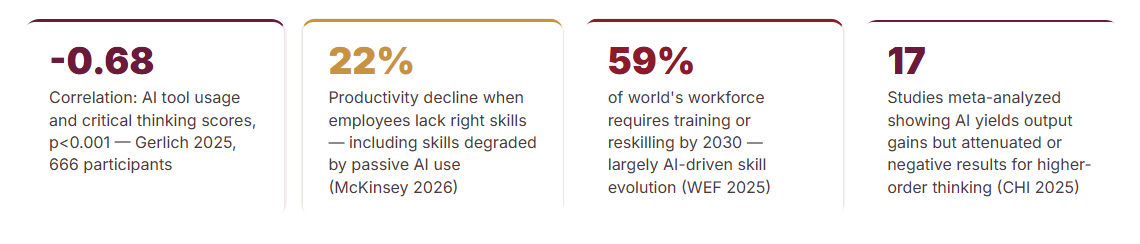
-0.68 — correlation coefficient between AI tool usage and critical thinking scores (Gerlich 2025, 666 participants, p<0.001)
22% — productivity decline when employees lack the right skills — including skills degraded by passive AI use (McKinsey 2026)
59% — of the world’s workforce will require training or reskilling by 2030 — largely due to AI-driven skill evolution (WEF 2025)

In the Age of AI
You Gain the Advantage over Those Who Don't Step Up
The 7 Signs You Are Using AI the Lazy Way
The Seven Active Learning Practices That Compound Growth
These are not AI techniques; they are thinking disciplines applied in the context of AI. Each one preserves and amplifies the cognitive capabilities that make human judgment valuable while leveraging AI for what it genuinely does better: speed, breadth, pattern recognition, and synthesis.
How the Best Business Leaders Use AI: The Pattern That Produces Compound Growth
The business owners and leaders building the most durable competitive advantage with AI are not using it more than everyone else. They are using it differently. Three patterns characterize their approach:
1) They use AI for breadth, their own judgment for depth. The highest-leverage division of cognitive labor: use AI to survey the landscape rapidly, then apply your own judgment, experience, and domain expertise to evaluate what the landscape contains. AI can cover more ground in an hour than you can in a month. What AI cannot do is apply the specific judgment that comes from your relationship history, your market knowledge, your company’s strategic position, and your read of your specific customers.
2) They use AI outputs as the beginning of their thinking, not the end. Leaders building genuine AI leverage treat every AI output as a first draft that reveals where the real thinking needs to happen. The AI produces the structure; they provide the substance. The AI maps the territory; they navigate it. The AI suggests the options; they make the decision.
3) They invest in AI literacy as a compound skill, not a one-time training. By 2030, 59% of the world’s workforce will require reskilling to remain relevant (WEF 2025). The leaders building durable advantage treat AI literacy as something they invest in incrementally, every week, through deliberate practice and reflective learning – not something they trained on once and consider complete. The model of AI is changing. The best practices for using it are evolving. The leaders who build the habit of continuous AI literacy are building a competency that becomes more valuable with every iteration of the technology.
Building an Active AI Learning Culture in Your Business
The cognitive dynamics at the individual level apply equally at the organizational level. A business where AI is used for Lazy Thinking produces homogenized output, declining team judgment, and increasing dependency on tools whose outputs no one in the team can confidently evaluate or improve. Here are the structural elements that distinguish Active AI Learning culture from Lazy Thinking culture:
- Define the boundary between AI-assisted and AI-generated: establish which tasks AI assists (team member does the thinking, AI accelerates the execution) versus which tasks AI generates (the output is acceptable as a starting point that the team member improves). This makes the cognitive engagement expectation explicit.
- Institute the Internalization Protocol as a team standard: before any AI-generated research or content is deployed externally, the team member should be able to summarize it in their own words. This is the organizational version of the Attribution Habit.
- Reward prompt quality, not output volume: the incentive structure that produces Active Learning recognizes the sophistication of the input to AI rather than the volume of outputs produced. Prompt quality is the proxy for cognitive engagement.
- Build in the Socratic follow-up as a team review step: when AI outputs are reviewed in team settings, the standard question is not “Is this good?” but “What is this output not accounting for? What assumptions is it making?” This prevents collective metacognitive laziness.
- Use AI to accelerate the right skills, not to replace them: the skills that AI accelerates, i.e., synthesis, pattern recognition, breadth coverage, are not the skills that create competitive advantage. The skills that create competitive advantage, i.e., judgment, creativity, relationship intelligence, strategic vision, are the skills that must be exercised, not outsourced. The MMG articles hub maps how to build these skills alongside every AI system in your business.
Bottom Line: The Palanquin Serves the Walker – Not the Other Way Around
The scholar’s mistake from the beginning of this article was not accepting the palanquin. The palanquin was a gift. The mistake was allowing the gift to make him less capable, which, in this example, allowed the convenience of transport to atrophy the very capacity that made him valuable before the palanquin arrived.
You are living in the most powerful moment for human cognitive amplification in history. The AI tools available right now can make your judgment sharper, your decisions better-informed, your understanding of your market deeper, and your execution faster than any tool that has ever existed for business. Or, used without discipline, they can make you a sophisticated processor of other people’s thinking – producing polished, plausible outputs that carry your name but not your mind.
The choice is not whether to use AI. The choice is whether to use it actively
Keeping your cognitive legs strong, using AI for the distances they were never built for … or passively, allowing your most valuable asset to atrophy while the technology performs for you.
Active Learning or Lazy Thinking. Both use the same tool. Only one builds the thinker.
MediaBus Marketing Group builds AI systems, strategies, and content workflows for businesses that want the amplification without the atrophy. We design human-AI collaboration architectures that keep your team’s judgment growing while AI handles the breadth and speed your judgment was never designed to cover alone. And we have a philosophy: AI that does not make your people smarter is AI that is being used wrong.
📞 · Connect with Us Here to Find Out How · 🌐
FILL OUT THE FORM BELOW and Let us help you build the AI integration that compounds your team’s intelligence — rather than replacing it.
Active Thinking FAQs
Q1: What is the difference between cognitive offloading and useful AI delegation?
Cognitive offloading becomes problematic when it is habitual, non-reflective, and covers cognitive tasks that, when done internally, produce learning, judgment development, and expertise you need to retain. Useful AI delegation covers tasks that:
(a) you already understand well enough to evaluate AI’s output critically
(b) do not require the exercise to maintain a skill you’ll need in AI-free contexts
(c) genuinely do not benefit from your personal thinking more than AI’s assistance.
The test is simple: after using AI for a task, are you smarter about that domain than you were before? If yes, you used AI as an amplifier. If no, you used it as a replacement. The 7 Active Learning practices are designed to consistently produce the “yes” outcome.
Q2: How do I know if my team is falling into cognitive laziness with AI?
The organizational signs parallel the individual signs, but at scale:
(1) Team outputs have become homogenized – they all sound the same and lack distinctive perspective or domain-specific insight
2) Team members cannot explain, in their own words, research or recommendations they are presenting
(3) The quality of questions the team brings to internal meetings has declined – they’re asking simpler questions because AI has been providing answers rather than stimulating inquiry
(4) Errors in AI outputs are being caught by clients rather than by the team, indicating verification and critical review are not happening
(5) Team members are less comfortable with ambiguous problems that require genuine judgment, because the habit of judgment has been replaced by the habit of AI consultation.
Q3: Is there an ideal ratio of AI-assisted to human-driven cognitive work?
No universal ratio applies, but useful principles:
First, cognitive tasks most critical to your competitive advantage (where your judgment, experience, and domain knowledge are the product) should remain primarily human-driven, with AI assistance only where it directly enhances (rather than replaces) the quality of that judgment.
Second, cognitive tasks that are process-intensive, breadth-requiring, and time-consuming but do not require the specific depth of your expertise are the highest-value AI delegation candidates.
Third: if you would be uncomfortable explaining your thinking on a decision to a skeptical stakeholder without reference to AI’s output, the thinking has not yet reached the level of internalization that consequential decisions require. Use this discomfort test as your calibration.
Q4: Can AI use actually become a form of ongoing professional development?
Yes – when structured with that intention. The distinction between AI as a professional development tool and AI as a cognitive shortcut is one of design, not technology. When you use the Deliberate Exposure Method to surface the edges of your professional knowledge and pursue those edges through primary sources and direct experience, AI becomes the catalyst for continuous professional development at a pace previously impossible. When you use the Socratic follow-up and Steel Man Practice to stress-test your professional judgments, AI becomes the high-quality thinking partner most professionals never have access to — one that will argue any position, consider any counterargument, and never grow impatient with the depth of your inquiry. Design your AI interactions to produce learning, and they will. Design them to produce deliverables, and deliverables are all you’ll get.
Q5: How do we build AI integration that amplifies team intelligence without creating dependence?
Four structural elements distinguish AI integration that amplifies from AI integration that replaces:
(1) Establish explicit cognitive engagement expectations – define for each AI-assisted task what the human is expected to contribute, evaluate, and own
(2) Build verification into the workflow as the final step before any AI-generated output reaches its destination – verification is the cognitive engagement point that prevents workslop
(3) Measure the quality of AI input (prompt sophistication, context richness, specificity of question) as well as AI output – teams rewarded for better prompts develop better thinking about their domains
(4) Preserve AI-free spaces (contexts and problem-solving sessions where the team is expected to think without AI assistance). This is where cognitive muscles are exercised, genuine judgment is developed, and the team builds the depth of domain expertise that makes their AI-assisted outputs worth more than any competitor’s.
Action Items:
SHARE THIS STORY ANYWHERE YOU LIKE
SHARE THIS STORY ANYWHERE

Mastering AI Automation for Finance and Back Office
Mastering AI Automation for Finance and Back Office The back office that never forgets. Most back-office losses are [...]

Mastering AI Automation for Project and Task Management
Mastering AI Automation for Project and Task Management Your plan is a prediction. AI's best job is remembering [...]

AI Operations: Automating Supply Chain, Scheduling & More
AI Operations: Automating Supply Chains, Scheduling, & More The Most Profitable AI in Your Business Is Probably the [...]