

Custom AI Agents Transform Niche Audiences at Scale
The businesses winning the next decade aren’t using generic AI – they’re deploying purpose-built agents that know their audience the way no human team ever could. Here’s the blueprint.
What You’ll Find in This Article…
Most businesses are using AI the way a surgeon would use a Swiss Army knife – technically functional, strategically wrong. The companies experiencing the most dramatic growth in 2026 aren’t the ones with access to better tools. They’re the ones who built AI agents specifically designed to serve a specific audience, speak their exact language, and take precise action on their behalf – around the clock, without burnout, without forgetting. This article is the blueprint for becoming one of those companies.
- Why is generic AI becoming worthless while custom niche agents are generating 4–7× higher conversions and commanding premium pricing
- The Vertical Agent Architecture – the four-layer system that transforms a general AI into a niche audience expert your competitors can’t replicate
- How custom AI agents unlock hyper-personalization at scale – and the specific ROI numbers McKinsey, HubSpot, and Salesforce have documented
- The 7 highest-performing niche agent types working right now across industries – with documented results and implementation insights
- Why niche agents become harder to unseat with every conversation they have – the compounding data flywheel that creates durable competitive advantage
- The 5-step Custom Agent Deployment Framework any SMB can execute in 60–90 days without a dedicated data science team
- The single most dangerous mistake businesses make when deploying AI agents for niche audiences — and the three-question test that prevents it
In 1936, Dale Carnegie published a book that sold 30 million copies and changed the trajectory of every salesperson, manager, and leader who read it. The entire thesis could be compressed into a single sentence: people respond to those who understand them. Not those who are loudest. Not those with the biggest budget. Those who demonstrate – specifically, credibly, memorably – that they understand who you are, what you want, what keeps you awake at night, and what would make your life measurably better. Seven decades later, technology finally caught up with that insight. Custom AI agents, built for specific niche audiences, do exactly what Carnegie prescribed – at a scale he could never have imagined. They know the language. They understand the pain. They remember every conversation. And they never have an off day.
The distinction between generic AI and a custom niche AI agent is not subtle. It is the difference between a tool and a team member. Between a brochure and a conversation. Between broadcasting to everyone and speaking directly to someone.
And today, that difference is showing up unmistakably in the data. The businesses deploying purpose-built AI agents for defined niche audiences are seeing 4–7× higher conversion rates, 30%+ faster pipeline growth, and customer engagement numbers that generic AI platforms cannot approach. This article gives you the complete framework – and MMG’s own AI Agents service and Ideal Buyer Persona development resources are built to help you start today.
The Problem With Generic AI
Let’s name the failure mode precisely, because it’s happening right now in thousands of businesses that believe they’ve adopted AI when they’ve actually only adopted the appearance of it.
Generic AI – the kind that comes pre-packaged with no niche context, no customer-specific training, no domain knowledge, and no audience intelligence – produces content and responses that are statistically average. By design. It is trained on the entire internet, which means it writes for no one in particular.
For example, digital marketing ensures that businesses can be found by people actively searching for services in a specific geographical area. Whether it’s optimizing for local SEO, advertising through social media, or engaging with customers via email, the reach and effectiveness of these techniques are unparalleled.
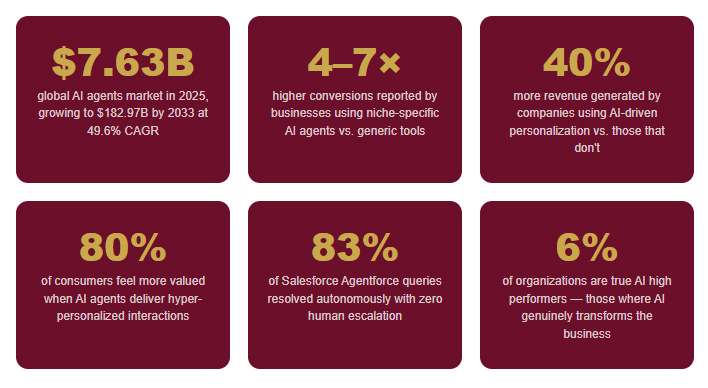
Read that last number again. Six percent. Eighty-eight percent of organizations now use AI in some function – but only 6% are seeing transformational business impact. The gap between those two numbers is not a technology problem. It’s a specificity problem. The businesses in the 6% have done what the 82% haven’t: they’ve built AI systems that know something the general tool doesn’t. They’ve given their agents a niche.
Related MMG Resources:
- MMG AI Agents — How We Build Custom Agents for Your Business
- Ideal Buyer Personas — The Foundation Every Custom Agent Is Built On
The Vertical Agent Architecture –
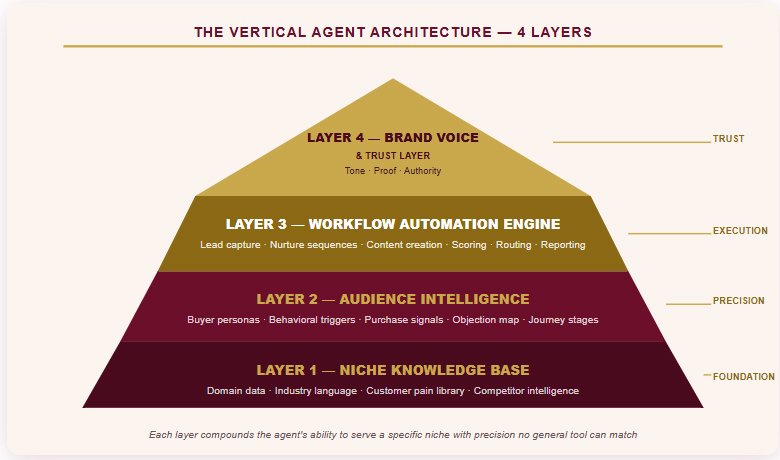
The Niche Audience Advantage –
Why Specificity Creates Compounding Returns
Here is the counterintuitive truth that most business owners resist until they’ve seen the data: the smaller you define your target audience, the more powerful your AI agent becomes. Not despite the narrowness. Because of it.
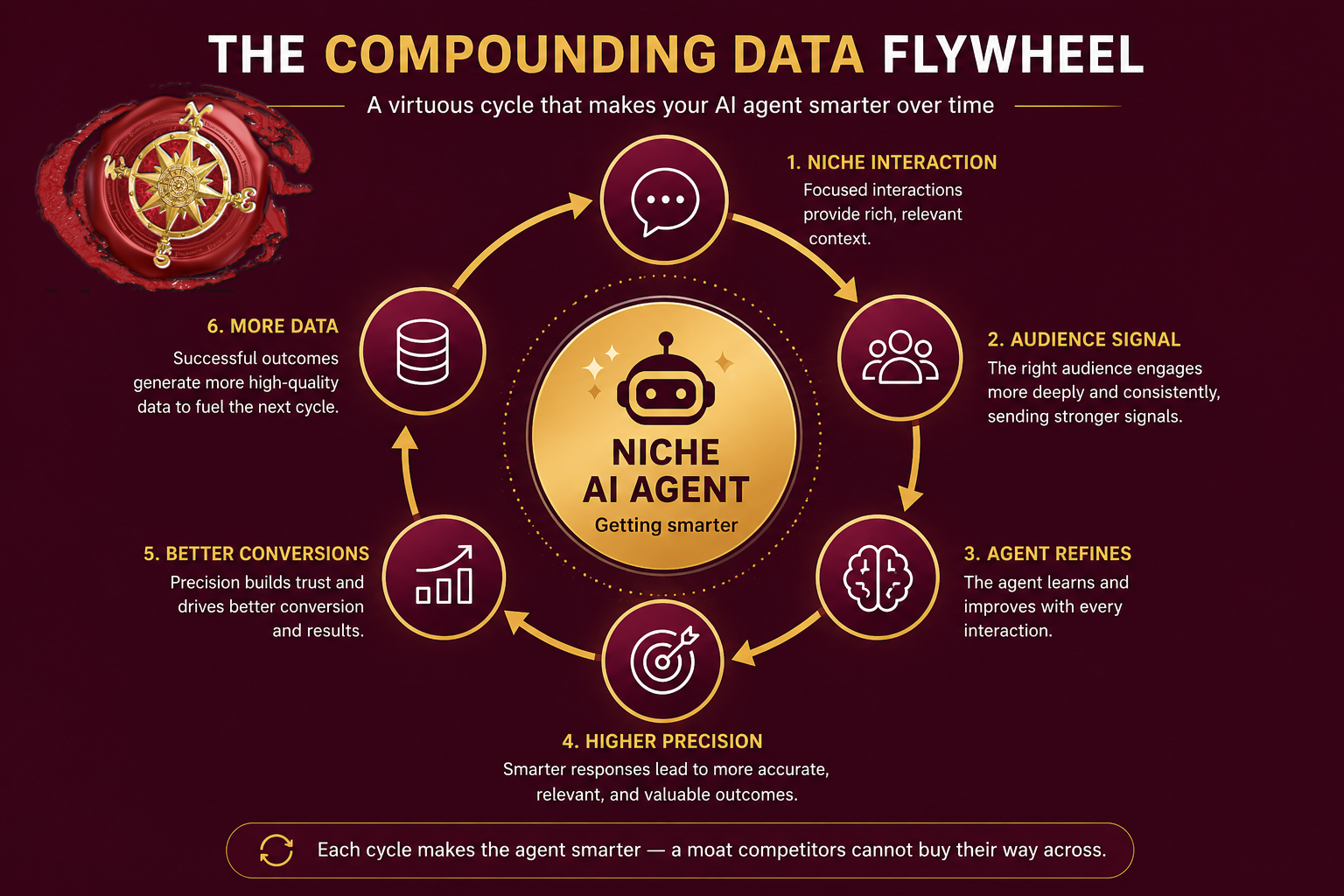
The reason is data density. When your agent is deployed to serve a specific niche, every interaction adds to its understanding of that specific audience. Every question asked, every objection raised, every topic that generates high engagement versus low engagement – all of this becomes a training signal that makes the agent’s next interaction more precise. The narrow focus creates a compounding data flywheel.
This compounding advantage is what makes early action so consequential. Vertical tools command higher prices and retain customers longer because they are closely integrated into specific workflows. The AI businesses that are scaling right now take a powerful foundation model and apply it with extreme precision to a specific audience’s specific problem – and charge outcomes-based pricing for doing so. You can spend more money to catch up on features. You cannot spend your way to the same depth of niche intelligence that an earlier-deployed agent has already accumulated.
The 7 Highest-Performing Custom Niche Agent Types
These seven agent types consistently produce the highest measurable returns across niche business categories – validated by deployment data from Salesforce Agentforce, HubSpot, Landbase, and independent case studies.
01 — The Niche Prospect Qualifier
Lead scoring · BANT qualification · Pipeline velocity · 24/7 operation
Unlike generic lead scoring, a niche qualifier is trained on the behavioral and firmographic patterns of your actual best customers. It knows that a veterinary practice owner who has attended two webinars, visited your pricing page, and used the phrase “we’ve been burned by this before” in a chat is six times more likely to convert than one who fits the same demographic profile but hasn’t shown those signals.
AI agents in sales see a 25–47% productivity increase from time savings on repetitive tasks, allowing teams to focus on selling activities. Use our Lead Gen Mapping process to identify the highest-leverage qualification touchpoints before building.
★ Documented Performance: 35% faster lead conversion. 25–47% sales productivity increase. Businesses report 4–7× higher conversions, 30%+ faster pipeline growth, and up to 70% cost savings compared to traditional SDR teams.
02 — The Niche Content Intelligence Agent
Content at scale · Voice-consistent · SEO + AI search optimized · Zero burnout
A niche content agent writes content that sounds like it could only have come from you — trained on your specific voice, your proven frameworks, your audience’s exact language, and the content that has historically driven results for your niche. JPMorgan Chase used AI to generate multiple ad copy variations and found the best-performing AI-written version lifted click-through rates by as much as 450% compared to human-written ads.
Enterprises using AI content agents report 10× content output without proportional headcount increases, and brands using clustering models saw a 26% increase in campaign conversion rates, with 49% of marketing teams now using AI to identify micro-segments based on behavioral patterns. Map your campaign structure before automating — smart sequencing amplifies output quality.
★ Documented Performance: 10× content output. 26% higher campaign conversion rates. 3.2× average ROI on AI content investment (McKinsey Global AI Survey).
03 — The Hyper-Personalization Engine
Individual-level messaging · Behavioral triggers · Lifecycle automation · Revenue lift
True hyper-personalization requires a system that knows what a prospect has consumed, where they are in their buying journey, what objection they’re most likely to raise next, and what message at what moment would most effectively move them forward. According to McKinsey, companies that implement such technologies report a revenue increase ranging between 3% and 15%, along with a 10% to 20% boost in sales ROI. Some have also slashed marketing costs by up to 37%.
Personalized emails deliver 6× higher transaction rates while AI-driven experiences increase customer lifetime value by 33%.
★ Documented Performance: 3–15% revenue increase. 6× higher transaction rates. 33% increase in customer lifetime value. 27% improvement in customer retention.
04 — The Niche Authority Builder
Thought leadership · AI search citation · Trust signals · Brand authority compounding
In 2026, being an authority in your niche means being cited by AI. This agent monitors the specific question clusters your niche audience is searching for, generates authoritative answer-first content, optimizes it for both traditional SEO and AI search citation, and tracks your AI share of voice.
The compounding nature of authority is what makes this agent uniquely powerful over time. The content it publishes this week trains AI systems to cite you next month. Use our AI Visibility Audit to get a baseline before deploying your authority-building agent.
★ Documented Performance: 65% of companies report improved SEO results through AI-assisted content strategies. Authority builders drive measurable increases in branded search volume within 60–90 days.
05 — The Niche Customer Success Agent
Retention · Upsell signals · Churn prevention · LTV maximization
The most expensive thing your business does is acquire a customer. The second most expensive is losing one. 75% of organizations have seen improvements in satisfaction scores post-AI agent deployment. 80% of consumers feel more valued when autonomous assistants deliver hyper-personalized interactions. Use our conversion metrics framework to identify which success milestones correlate most strongly with retention in your niche.
★ Documented Performance: 27% increase in customer retention. 15% reduction in churn over 6 months. 33% increase in customer lifetime value. 6.7% average boost in CSAT scores.
06 — The Niche Research & Intelligence Agent
Market signals · Competitor intelligence · Trend detection · Strategic advantage
Your niche is moving right now. Competitor pricing is shifting. A regulation is about to affect your audience’s purchasing behavior. A sentiment shift is emerging in the communities where your ideal customers talk. 58% of respondents cited research tasks and summarizing large volumes of information as their primary AI agent application. Pair with your incremental testing framework so intelligence signals translate directly into testable campaign hypotheses.
★ Documented Performance: 58% of organizations cite research as the primary AI agent use case. AI research agents reduce information synthesis time by 70–80%.
07 — The Niche Conversation Agent
Real-time engagement · Lead capture · BANT qualification · Booking · 24/7 revenue
Salesforce’s internal Agentforce deployment resolved 83% of customer service queries autonomously with no human escalation. Customer service conversations with AI agents grew at a compound monthly rate of 2,199% between January and June 2025 on the Salesforce Agentic Enterprise Index. When the conversational agent is trained on niche-specific context, those numbers improve further.
★ Documented Performance: 2.4× higher conversion vs. static forms. 55% more high-quality B2B leads. 83% autonomous resolution rate. 2,199% compound monthly growth in AI conversation adoption.
The 5-Step Deployment Framework for Custom Niche Agents
The distance between knowing and doing is the distance between who you are and who you will become. Here is exactly how to close that distance – in the right sequence, at the right depth, in the right 60–90 day window.
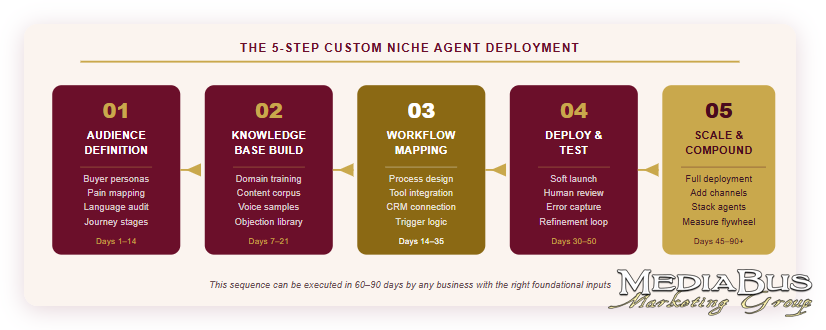
Step 1 — Days 1–14: Audience Definition
- Build or refine your Ideal Buyer Personas – not demographic shells, but behaviorally rich profiles that capture language, fears, aspirations, and decision triggers
- Conduct a language audit: gather 100+ examples of how your niche talks about their problems – from reviews, forums, sales call transcripts, and support tickets
- Map the complete customer journey – every stage from first awareness to loyal advocacy, with the specific questions, objections, and emotions at each stage
- Define your competitive position in this niche: what do you know or do that no competitor does? This becomes the agent’s authority signal.
Step 2 — Days 7–21: Knowledge Base Build
- Compile your institutional knowledge: past successful proposals, top-performing content, sales scripts that convert, support answers that satisfy
- Document your company baseline – your unique expertise, methodology, proof points, and differentiated insight
- Build your objection library: every objection your sales team encounters, with the response that most effectively resolves it
- Define your brand voice guidelines – specific examples of language you use and language you explicitly avoid
Step 3 — Days 14–35: Workflow Mapping
- Map every process using our workflow mapping methodology – redesign before you automate, not after
- Define trigger logic: what event causes what action? Be specific – vague triggers produce vague outputs
- Map the human handoff points: which moments require human judgment? Build the escalation path clearly
- Connect integrations: CRM, email platform, calendar, content management – the agent’s value compounds with each connected system
Step 4 — Days 30–50: Deploy and Test
- Soft launch to a controlled segment first – never release an untested agent to your full audience
- Install a Human Checkpoint process: review agent outputs weekly for the first 30 days
- Capture every failure mode as training data – every unanswered question is a refinement opportunity
- Measure against your pre-deployment baseline using your conversion metrics framework
Step 5 — Days 45–90+: Scale and Compound
- Expand to full audience deployment once quality thresholds are met – measured, not assumed
- Stack agents: the Prospect Qualifier feeds the Hyper-Personalization Engine, which feeds the Content Agent. Each compounds the others.
- Implement monthly incremental testing so the agent continuously improves rather than plateauing at initial performance
- Track your AI share of voice – how often your business appears in AI recommendations for niche-relevant queries

The One Mistake That Kills the ROI
The quality of your decisions is determined by the quality of the questions you ask before you make them. There is one question that almost every business skips before deploying a niche AI agent – and the skipping of it is responsible for most of the failed deployments, wasted budgets, and abandoned AI initiatives you hear about.
The Three-Question Test — Ask These Before You Build Anything:
Can you describe your niche audience in one sentence that no competitor could claim? If your answer is “small business owners” or “marketing professionals,” you haven’t defined your niche yet – you have a demographic. A niche is a specific audience with a specific problem in a specific context.
Can you document, in their own words, the five most common reasons someone in your niche fails to achieve what they most want? If you can’t, your agent will be built on assumptions rather than evidence. The knowledge base will be thin, and the outputs will be generic regardless of the technology.
Do you have a clear success metric for the agent – something measurable, not just “more engagement”? An agent deployed without a defined success criterion will be evaluated subjectively, which means it will never be refined correctly, and its ROI will never be correctly understood or defended.
These questions are not obstacles. They are the work that makes the difference between a niche AI agent that transforms your business and one that your team quietly stops using by month three. MMG’s customer profiling, company baseline, and workflow mapping processes are built precisely to produce these answers — so your agent launches on truth, not assumption.
The businesses that get this right don’t just get a tool. They get a strategic asset that learns their audience faster and more completely than any human team can, never burns out, never forgets a conversation, and becomes more valuable with every single interaction it has. That is not a technology outcome. That is a business outcome. And in 2026, it is available to businesses of every size that have the clarity and discipline to build it correctly.
Ready to Build Your Custom Niche AI Agent?
MediaBus Marketing Group designs and deploys custom AI agents for small and mid-sized businesses with defined niche audiences — built on your specific knowledge, tuned to your specific customer, and optimized for your specific revenue goals. Let’s build the agent that becomes your most productive team member.
👉 Start Your Custom Agent Strategy → Fill Out the Form Below
Free strategy session • We’ll map your niche agent architecture before you commit to anything (801) 893.1398 • info@mediabusmarketing.com
Custom Agent Strategies FAQs
Q1: How is a custom niche AI agent different from just using ChatGPT or another general AI tool?
The difference is the difference between a generalist and a specialist. ChatGPT and other general AI tools are trained on the entire internet – capable of discussing almost anything, but deeply expert on nothing specific to your audience. A custom niche AI agent is trained on your specific audience’s language, your industry’s domain knowledge, your company’s unique expertise, and the behavioral patterns of your actual best customers. When a prospect in your niche interacts with your agent, they feel understood in a way that a general tool simply cannot produce – and that feeling of being understood is what drives conversion. The ROI data reflects this starkly: businesses using generic AI see marginal productivity improvements, while those deploying purpose-built niche agents report 4–7× higher conversions and 30%+ faster pipeline growth. If you’re using a general AI tool and calling it your strategy, you’re using a Swiss Army knife in a market that’s starting to deploy surgical instruments.
Q2: How specific does my niche need to be before a custom AI agent makes sense for my business?
The more specific, the better – and more specific than you probably think. Many business owners worry that narrowing their niche will limit their market. The evidence consistently shows the opposite: the narrower and more precisely defined your audience, the more your agent can know about them, the more resonant its interactions become, and the higher your conversion rates and customer lifetime value climb. A useful test: if you can describe your ideal customer in a sentence that no competitor in your market could honestly claim, you have a niche precise enough to build a powerful agent on. Even a precisely defined niche of a few thousand ideal customers can generate transformational returns from a well-built custom agent, because the conversion rates and customer lifetime values that niche-specific engagement produces are dramatically higher than generic alternatives.
Q3: Do I need technical expertise or a dedicated development team to build a custom niche AI agent?
No – and in 2026, this barrier has been more thoroughly removed than at any previous point in the history of the technology. What you do need, and what most businesses underinvest in, is the foundational work: the audience definition, the knowledge base documentation, the workflow mapping, and the success metric definition. These are the inputs that determine agent quality — not the technology stack. The technology is a conduit for what you know about your audience. MMG handles the technical layer – training, integration, deployment, and maintenance – so you can focus on what only you know: your audience.
Q4: How quickly can I expect measurable results from a custom niche AI agent?
The timeline depends on which agent type you deploy first. For the highest-velocity use cases – the Niche Conversation Agent, Niche Prospect Qualifier, and Hyper-Personalization Engine – measurable results typically appear within 30–60 days because these agents directly touch conversion-critical touchpoints. For longer-compound use cases – the Niche Authority Builder and Niche Research Agent – meaningful results build over 60–120 days. The most important variable is the quality of your foundational inputs: the audience definition, the knowledge base, and the workflow design. Agents built on deep niche intelligence compound faster because they start from a higher quality baseline.
Q5: Can multiple niche AI agents work together, or does each one operate independently?
Multiple agents working together – a “multi-agent stack” – is the highest-value configuration in 2026. The individual agents are designed to be stackable: the Prospect Qualifier feeds the Hyper-Personalization Engine, which generates personalized content through the Content Intelligence Agent, which builds authority signals through the Authority Builder. Each agent makes the others more effective because they share a common niche knowledge base and a common understanding of the audience. Gartner projects that by the end of 2026, 40% of enterprise applications will include task-specific AI agents. The practical approach: start with one agent addressing your highest-priority business challenge, get it working and measured, then systematically stack agents that inherit the niche intelligence the first one has already built.
Action Items:
SHARE THIS STORY ANYWHERE YOU LIKE
SHARE THIS STORY ANYWHERE

Will AI Replace Employees or Help Them Accomplish More?
Will AI Replace Employees or Help Them Accomplish More? Two Companies, Same Year, Opposite Bets — and the [...]

Can Our AI Project Manager Stop Tasks from Falling Through the Cracks?
Can Our AI Project Manager Stop Tasks from Falling Through the Cracks? Two Verified Case Studies, the Real [...]

How Can AI Help Us Capture More Business and Handle More Work Without Immediately Hiring More People?
How Can AI Help Us Capture More Business and Handle More Work Without Immediately Hiring More People? The [...]