

How Do We Move from a Small AI Experiment to a Reliable Company-Wide System?
The 5-Stage AI Maturity Model, the 4 Infrastructure Requirements, and the Playbook That Separates the 14% Who Scale from the 86% Left Behind
What You’ll Find in This Article
- Why 95% of AI pilots never become company-wide systems – and why the failure is almost never a technology problem
- The Pilot Purgatory trap – why promising experiments stay frozen between proof-of-concept and production forever
- The 5-Stage AI Maturity Model – the defined progression from Experiment to Adoption to Integration to Governance to Flywheel
- The 4 infrastructure requirements that determine whether an AI experiment scales or collapses
- The governance architecture that keeps company-wide AI systems reliable, improving, and accountable
- What the successful 14% do differently – the three disciplines that distinguish scalers from stagnators
- The change management reality – why 70% of AI transformation value lives in people, not technology
- Little-Known Gems – five counterintuitive scaling truths the AI vendors are not telling you
- The transition playbook – the sequenced actions that move each maturity stage to the next
The Well That Never Became a River
Here’s a story that may be able to help you out with understanding the answers to the question above. There was once a village perched on the edge of a dry plain. For generations, its people had carried water from a distant spring, traveling for hours each day under a relentless sun. One season, a young engineer arrived and dug a well at the edge of the village. The water was there – pure, abundant, impossibly good. The villagers gathered around it and celebrated through the night.
But in the weeks that followed, something unexpected happened. The people nearest to the well drew from it every morning. Those on the far side still walked to the spring. The women who washed at the river still walked to the river. The fields that needed irrigation still went dry. The well had not solved the water problem. It had created a very successful, very celebrated, very small demonstration that water was available.
The engineer returned the following season and saw that the celebration had faded. “The problem,” he said, “was never finding the water. It was building the pipes.”
This is the AI story of 2026 for most small and mid-size businesses. The pilot works. The water is found. The proof of concept succeeds brilliantly in a controlled setting, with a small motivated team, using the tool intensively. And then – nothing scales. The AI stays at the edge of the village. The organization celebrates a successful experiment that changed almost nothing. This article is about building the pipes.
The Pilot Purgatory Problem
Pilot Purgatory is the condition in which an AI experiment has proven its value in a controlled setting and has completely stalled before becoming a company-wide system. It is the most common state of AI deployment in 2026 — and it is more expensive than most organizations realize.
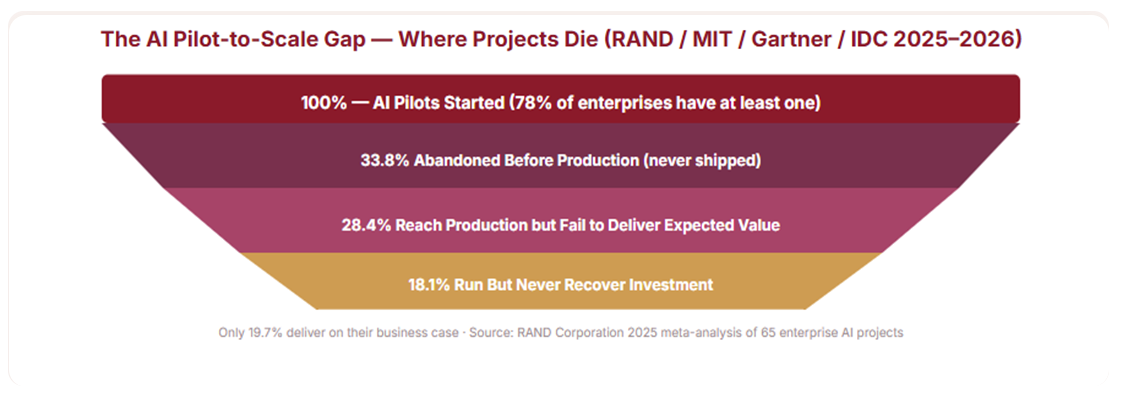
78% of enterprises have at least one AI pilot running. Only 14% have successfully scaled an AI agent to organization-wide operational use. 95% of AI pilots fail to scale to production deployment (MIT Sloan 2025). RAND Corporation research found that 80.3% of AI projects fail to deliver their promised business value – with 33.8% abandoned before ever reaching production, 28.4% reaching production but failing to deliver expected value, and 18.1% running but never recovering their investment. Only 19.7% deliver on their business case.
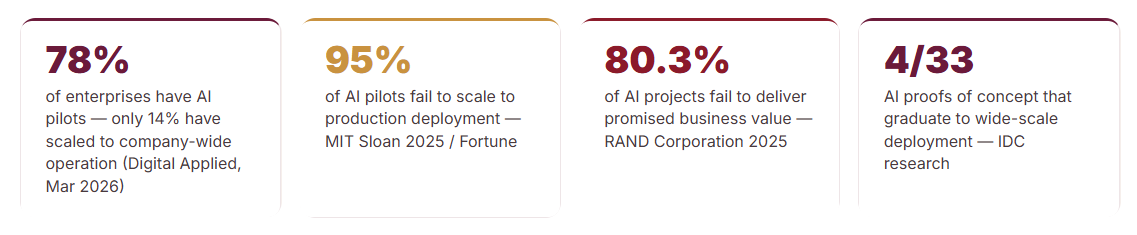
Only 4 out of every 33 AI proofs of concept graduate to wide-scale deployment (IDC). The average sunk cost per abandoned AI initiative reached $7.2 million in 2025. For a small business, the equivalent proportional cost is not seven million dollars – but the wasted hours, the organizational skepticism generated by visible failure, and the competitive positioning surrendered while competitors scale effectively are real costs that compound in every direction.
THE CRITICAL INSIGHT: The scaling gap is not primarily a technology problem. The models are capable. The tooling has improved dramatically. The gap is organizational and operational: most enterprises lack the evaluation infrastructure, monitoring tooling, and dedicated ownership structures needed to move a promising pilot into reliable production. This is the most important sentence in this article – because it redirects attention from the tool to the system around the tool.
W

In the Age of AI
You Gain the Advantage over Those Who Don't Step Up
The 5 Root Causes
Why Experiments Stay Experiments
Every AI pilot that stalls in Pilot Purgatory stalls for a predictable set of reasons. The technology is rarely among them:
The 5-Stage AI Maturity Model
Your Roadmap from Experiment to Flywheel
BCG’s AI maturity research shows: AI Stagnating (14%), AI Emerging (46%), AI Scaling (35%), AI Future-Built (5%). Future-built companies achieve 5× the revenue increases and 3× the cost reductions of stagnating companies – and the gap is compounding. Understanding which stage you’re in and what it takes to advance is the most practical thing you can do with this information:
The 4 Infrastructure Requirements for Company-Wide AI
Moving from experiment to company-wide system requires four infrastructure investments that most organizations make in the wrong order or skip entirely. These are not optional – they are the pipes that determine whether the water reaches the whole village or stays at the edge:
The Transition Playbook: Moving Through Each Stage
From Stage 1 to Stage 2:
- Document the pilot’s results in business terms.
- Name one owner for the AI system.
- Write one page defining authorized scope.
- Redesign the workflow for the two or three people who will use it next.
- Deliver two hours of role-specific training.
- Set two or three success metrics.
- Deploy to a small expansion team and monitor for 30 days before expanding further.
From Stage 2 to Stage 3:
- Identify the three other business systems the AI should connect to for maximum value (typically CRM, project management, and communication).
- Map the current workflow from end to end and identify the handoff points where information is manually transferred — these are your integration targets.
- Connect the AI system to the first integration target. Measure the time savings from automated data flow.
- Then expand. Integration is built one connection at a time.
From Stage 3 to Stage 4:
- Form the governance committee.
- Define the AI’s authorized scope in writing.
- Establish the exception-handling procedure.
- Set the performance review cadence: monthly for new systems, quarterly for mature ones.
- Assign one person to monitor output quality weekly.
- Build the feedback channel that allows team members to flag problems.
- The governance framework is operational when nobody is surprised by the AI system’s behavior – because the behavior was defined in advance.
From Stage 4 to Stage 5:
- Identify the data outputs from each governed AI system.
- Determine which outputs, if fed as inputs to another AI system, would improve that system’s performance.
- Build the first data pipeline between two AI systems.
- Measure the improvement.
- Document the pattern.
- Expand the pipeline network.
- The flywheel is built one data connection at a time – just as integration was.
The difference is that at Stage 5, you are connecting AI systems to each other, not AI systems to human workflows.
What the Successful 14% Do Differently
The survey also asked about investment levels. Organizations with production-scale deployments were not spending more on AI overall — their total AI budgets were comparable to stalled organizations. The difference was allocation: successful scalers spent proportionally more on evaluation infrastructure, monitoring tooling, and operational staffing, and proportionally less on model selection and prompt engineering. Three consistent practices distinguish them:
Practice 1: They Invest in Infrastructure, Not Models. The model is a commodity. The infrastructure that runs the model reliably, monitors its quality, and maintains it over time is the competitive advantage. Organizations that invest in the most sophisticated AI model without investing in the infrastructure to run it reliably will always underperform organizations with a simpler model and superior operations discipline.
Practice 2: They Define Success Before They Deploy. Not “we will see if it helps productivity” – but “we will reduce average invoice processing time from 4.2 hours to under 45 minutes, measured by the processing timestamp in our accounting system, reviewed monthly for the first 90 days.” Specific. Measurable. Tied to an existing data source. With a review cadence built in before the first line of code runs. This discipline is not natural – it requires resisting the pressure to “get started” before the metrics conversation is complete. Pair this discipline with an AI readiness audit that maps the baseline before you begin.
Practice 3: They Treat AI as Business Transformation, Not an IT Project. Organizations that classify AI as an IT project get IT project outcomes: technology delivered on time, within budget, functionally operational – and nothing changes. Organizations that classify AI as a business transformation get business transformation outcomes: workflows redesigned, people trained and incentivized, business metrics improved. The technology is identical. The classification determines everything else. A comprehensive marketing plan built on transformation thinking – integrating your online content strategy and AI systems as a unified business system – reflects this distinction in every element.
Little-Known Gems
What the Scaling Literature Reveals That the Vendors Won’t Tell You
The Mistakes That Keep Companies in Pilot Purgatory
- Announcing the company-wide AI initiative before the infrastructure exists – generating expectations the system cannot yet meet and creating organizational skepticism that survives even successful deployment
- Deploying to the entire organization simultaneously rather than in a sequenced rollout that allows for adjustment before scale creates irreversibility
- Skipping the workflow redesign step because it is slower than the technology deployment – ensuring the AI runs on processes that were not designed for it
- Treating governance as optional bureaucracy rather than the operational infrastructure that makes reliability possible at company-wide scale
- Measuring success by tool usage rate rather than by business outcome – creating a system that is actively used and produces no measurable value
- Letting pilot champions maintain sole ownership as systems scale – creating dependency on individuals rather than on organizational infrastructure that outlasts them
Bottom Line: Build the Pipes Before You Celebrate the Well
The engineer was not wrong to dig the well. The water was real. The value was real. What was missing was the structural commitment to take what had been proven in one place and make it available to the whole village – not through enthusiasm or repetition of the original experiment, but through the patient, unglamorous work of building the pipes.
78% of enterprises have an AI pilot. Only 14% have a company-wide AI system. That gap – the 64% of organizations currently celebrating the well while the village still walks to the spring – represents both the primary challenge and the primary competitive opportunity in business AI right now.
The organizations that move through the AI maturity model will not just be more efficient than those that don’t.
They will be running a different kind of business.
Future-built AI companies achieve five times the revenue increases and three times the cost reductions of stagnating companies. These are not marginal advantages.
They are existential differentials – the kind that determine market leadership a decade from now, built through decisions made in the next 12 months.
MediaBus Marketing Group builds AI systems that scale. Not tools – systems. We start with the data foundation. We build the ownership architecture. We establish the governance framework. We execute the change management program. And we build the connections that create the flywheel. Because the well is impressive. But the river is what changes everything.
📞 · Contact Us by Clicking Here · 🌐
Tell us which stage of the AI maturity model your business is currently in – and let us build the infrastructure to move to the next one.
FAQs
Q1: What is Pilot Purgatory and how do I know if my business is in it?
Pilot Purgatory is the condition in which an AI experiment has proven its value in a controlled setting and has completely stalled before becoming a company-wide system. Your business is in Pilot Purgatory if any of these are true:
- The AI tool is used consistently by the person who implemented it and inconsistently or not at all by everyone else
- The AI results are impressive in the hands of early adopters but cannot be reliably replicated by the broader team
- The AI system is technically operational but produces variable results with no defined process for identifying or correcting failures
- Nobody is clearly accountable for the AI system’s ongoing performance and improvement
- You have added AI tools multiple times, but business outcomes have not measurably changed.
If three or more of these are true, you are in Pilot Purgatory – and the path out is infrastructure, not better tools.
Q2: How long does it take to move from a small AI experiment to a reliable company-wide system?
The timeline depends primarily on organizational readiness, not technological complexity. For small businesses (under 20 people) moving from Stage 1 to Stage 4 with one AI system and focused implementation, the realistic timeline is 90–120 days. For businesses with more complex operations, multiple AI systems to integrate, and larger teams, the timeline extends to 6–12 months. The critical path elements: How clean is the data the AI system will operate on? How clearly is ownership defined? How thoroughly will workflows be redesigned? How comprehensive is the change management program? Organizations that rush these elements produce faster deployments with higher failure rates. The 14% who scale successfully are distinguished not by speed but by sequence – they do the right things in the right order.
Q3: What is the single most important thing we can do to prevent our AI experiment from stalling?
Define ownership before you expand. The single most common reason AI systems stall between experiment and company-wide use is no clear answer to: “Who now owns this system?” When the pilot champion is the only person who knows how the system works, who maintains it, who updates it when business conditions change, and who monitors its performance, the system is one personnel change away from collapse. Before expanding any AI experiment to a broader team, define one person as the system owner with specific accountability for performance monitoring, quality maintenance, and ongoing improvement. Build governance documentation that allows a successor to step into that role without the system degrading.
Q4: We already have AI tools deployed across several departments. How do we turn those into a company-wide system?
Audit before integrating. Before attempting to connect AI tools deployed independently across departments, conduct a systematic inventory: What AI tools are in use? Who owns each? What data does each touch? What workflow is each embedded in? What success metrics have been defined? This audit typically reveals that some tools are actively used and producing value, some are being used inconsistently, some have been quietly abandoned, and almost none have formal ownership or governance. From this audit, identify the two or three tools producing the most measurable value. Formalize ownership, governance, and performance monitoring for these first. Then build the first integration between them. The flywheel is built from connections, not from technology.
Q5: What role does AI play in helping move a business from experiment to company-wide system?
AI plays a supporting role in its own scaling – which is a useful and often overlooked dynamic. An AI-powered project management system can track the implementation milestones of the AI scaling program itself. An AI knowledge management system can capture the governance documentation, workflow redesign outputs, and training materials the scaling program produces. An AI monitoring system can watch the performance of newly deployed AI tools and surface quality issues before they become operational failures. The organizations that move fastest through the maturity model are frequently the ones using AI to manage the AI transition – creating a meta-level flywheel where AI infrastructure supports the build of AI infrastructure.
Action Items:
SHARE THIS STORY ANYWHERE YOU LIKE
SHARE THIS STORY ANYWHERE

Mastering AI Automation for Finance and Back Office
Mastering AI Automation for Finance and Back Office The back office that never forgets. Most back-office losses are [...]

Mastering AI Automation for Project and Task Management
Mastering AI Automation for Project and Task Management Your plan is a prediction. AI's best job is remembering [...]

AI Operations: Automating Supply Chain, Scheduling & More
AI Operations: Automating Supply Chains, Scheduling, & More The Most Profitable AI in Your Business Is Probably the [...]