Avoid These 5 Costly Mistakes When Starting with AI

September 3, 2026▪ ▪September 2, 2026▪ ▪Resources & Tools▪ ▪14.1 min▪ ▪
Share This Story, Choose Your Platform!

Avoid These 5 Costly Mistakes When Starting with AI

The Uncomfortable Truth Behind 95% of AI Deployments That Deliver Zero Measurable Return


What You’ll Find in This Article

  • Why 95% of AI deployments show zero measurable return – and why it’s a strategy failure, not a technology failure
  • Mistake #1: Chasing the Tool Instead of the Problem – the most common and most expensive starting error
  • Mistake #2: Ignoring Your Data Before You Build – the #1 cited obstacle to AI success
  • Mistake #3: Skipping the Team – deploying AI to people instead of with them
  • Mistake #4: Automating Without Guardrails – why 78% of AI failures go unnoticed until it’s too late
  • Mistake #5: No Owner, No Metric, No Review– the silent killer of every stalled AI initiative
  • What the successful 5% do differently – the six disciplines separating winners from the wreckage
  • Little-Known Gems – five costly errors most articles never mention

The Uncomfortable Truth About AI in 2026

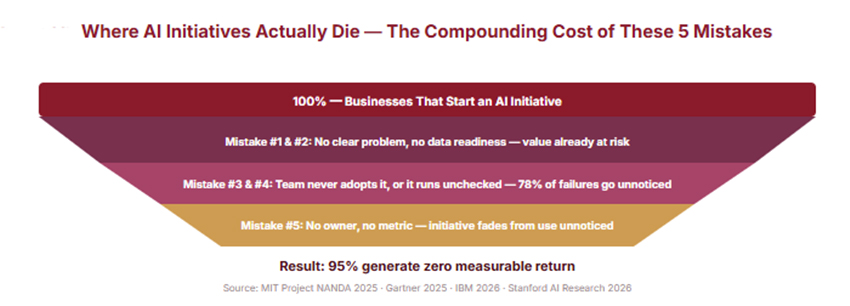
Here’s the number that should stop every business owner mid-scroll: MIT’s Project NANDA research, covering 300+ AI initiatives through practitioner interviews and structured surveys, found that 95% of organizations deploying generative AI saw zero measurable return. Not low return. Zero. The failure is almost never the model. It is data readiness, workflow integration, and the absence of a defined outcome before build starts.

Companies are burning through budgets set aside for AI faster than ever, with 42% now abandoning most of their AI initiatives; up from just 17% in 2024. LLM hallucinations alone cost businesses over $67 billion in losses during 2024 – not from spectacular, headline-making failures, but from the quiet accumulation of wrong answers, degraded trust, and abandoned projects that nobody noticed until it was too late.

THE CRITICAL REFRAME: These aren’t technology problems. They’re strategy and process problems. The good news buried inside the bad statistics: because the causes are predictable, they are also entirely avoidable.


In the Age of AI

You Gain the Advantage over Those Who Don't Step Up

The 5 Costliest Mistakes
Mistake #1: Chasing the Tool Instead of the Problem

Cost: Wasted licensing, zero business value, internal skepticism

This is the most common mistake and the root cause of most failed AI projects. A business buys an AI tool because it looks impressive, a competitor is using it, or it came up at a conference. One of the biggest mistakes businesses make is adopting AI because it is popular rather than because it solves a clearly defined problem. This usually leads to expensive tools being deployed without a direct link to business value.

When companies start with the technology, they often end up forcing AI into workflows where it is not needed or not ready to perform. The tool may work exactly as advertised- and still produce nothing of value, because it was never solving a problem that existed in the first place. This is the merchant buying the ship before knowing where he wants to sail.

The Fix: Before evaluating a single AI tool, write down the specific business problem in one sentence, the current cost of that problem in dollars or hours, and what “solved” looks like in measurable terms. If you can’t complete that sentence, you are not ready to shop for tools yet – you’re ready to define the problem.

Mistake #2: Ignoring Your Data Before You Build

Cost: Unreliable outputs, eroded trust, projects abandoned mid-build

Informatica’s 2025 survey identifies data quality and readiness as the #1 obstacle to AI success, cited by 43% of respondents. That’s ahead of a company’s technical maturity and skills shortages. Gartner predicts that 60% of AI projects lacking AI-ready data will be abandoned through 2026. That rate is already sitting at 42% of U.S. companies right now.

The pattern is consistent across industries: businesses connect an AI tool to scattered, inconsistent, or ungoverned data and then are surprised when the outputs are “almost right” but not quite trustworthy. High-performing organizations invest disproportionately in data readiness – 50-70% of their AI budget goes to infrastructure, quality, and governance, not to the flashy model itself.

The Fix: Audit your data before you audit vendors. Where does your customer, project, and financial data actually live? Is it centralized, formatted consistently, and governed by clear ownership rules? Data readiness is not optional groundwork. It is the foundation everything else is built on.

Mistake #3: Skipping the Team

Cost: Tools purchased but never used, shadow AI risk, wasted training spend

IBM’s 2026 Global CEO Study found that 83% of CEOs said AI success depends more on people actually adopting the technology than on the technology itself. Still yet, only 25% of employees given AI tools use them regularly, let alone properly. Rolling out a tool and driving a business result are two different milestones, and treating the first as evidence of the second is where a lot of AI budgets quietly get wasted.

Only 15% of US employees report that their workplace has communicated a clear AI strategy (Gallup). That means roughly 85% of businesses are asking their teams to adopt AI without giving them a clear reason or direction. And add to that the teams that don’t understand the “why” default to quiet non-adoption, or worse, unsanctioned workarounds. 57% of workers report hiding their use of AI tools from their employers, creating significant visibility and governance gaps (KPMG 2025). Meaning the tools are being used, just not the ones IT approved, and not with any proprietary governance or oversight.

The Fix: Communicate the “why” before the “what.” Involve the team that will actually use the tool in selecting and piloting it. Provide role-specific training, not generic onboarding. And explicitly address the job-security question rather than letting silence do the talking.

Mistake #4: Automating Without Guardrails

Cost: Errors that compound silently before anyone notices

Automation reduces manual work, but not every process should be fully automated. The real-world risk of over-automation is that errors propagate at scale before anyone catches them. 78% of AI failures go unnoticed, increasing the risk of unchecked errors in automated workflows, according to 2026 Stanford AI research. This is the single most dangerous mistake on this list precisely because it doesn’t announce itself – a broken process looks identical to a working one until the damage has already compounded for weeks or months.

A well-documented real-world scenario: an AI system drafted a supplier contract using an indemnity clause that had been superseded eight months earlier and was still circulating in an old email attachment. The model worked correctly – it followed its instructions precisely. The governance failed because oversight was built around what the model output rather than around the documents it was drawing from.

The Fix: Human review is not a weakness in the system – it is often what makes the first AI workflow safe enough for the team to trust. Start with a narrow-scope pilot that includes a human approval step, clear escalation rules for anything the AI is uncertain about, and a defined limit on what it’s authorized to do without sign-off.

Mistake #5: No Owner, No Metric, No Review

Cost: Quiet abandonment, sunk investment, no path to scale

Most AI pilots fail because the workflow, outcome, data, ownership, review points, and adoption plan are unclear before implementation starts. The tool may work, but the business process around it is not ready to sustain it. Without a named owner, nobody notices when quality begins to slip. Without a defined metric, nobody can say whether the initiative is actually working. Without a scheduled review, the tool simply fades from use… not through a single decision to abandon it, but through a hundred small decisions not to prioritize it.

95% of AI projects fail to deliver measurable financial returns, largely due to unclear objectives and poor implementation. This is the mistake that turns an otherwise well-scoped pilot into a permanent resident of “pilot purgatory”. Technically still running, practically forgotten, generating no return and no lessons for what to try next.

The Fix: Before launch, name one person accountable for the initiative’s performance. Define the specific metric that will determine success – tied to an existing data source, not a vague sense of “it feels more efficient.” Schedule a formal review at 30, 60, and 90 days.

What the Successful 5% Do Instead

Here’s what the statistics don’t tell you: these failures aren’t inevitable. They’re predictable. And predictable failures have predictable fixes. The companies that succeed with AI in 2026 share six common patterns:

  • They start with business outcomes, not technology – clear metrics, measurable impact, executive sponsorship from day one
  • They invest disproportionately in data readiness – 50-70% of budget on infrastructure, quality, and governance, not on the flashiest model
  • They pilot small and measure rigorously – quick, narrow wins build confidence and justify further investment
  • They build operational discipline before deployment – monitoring, retraining, and feedback loops as core features, not afterthoughts
  • They centralize governance while empowering execution – shared infrastructure, unified metrics, and cross-functional ownership
  • They design for adoption from the start – user involvement, explainability, real training, and genuine change management

Little-Known Gems: What to Watch Out For

Gem 1: The Demo Trap – Why Impressive ≠ Right Fit.

A common failure pattern across multiple 2026 studies is that organizations pick AI tools based on what’s impressive in a demo rather than what actually fits the problem they’re trying to solve. Demos are engineered for open-ended conversation and creative flourish – not for navigating the fragmented systems and high-stakes decisions inside a real small business. A tool that dazzles in a sales demo often operates on probabilistic guesses rather than the deterministic guardrails your actual workflow requires. When it hallucinates a price, a date, or a policy detail in production, it isn’t a minor glitch; it can stall an entire client relationship.

Gem 2: Shadow AI Is Already Happening in Your Business.

57% of workers report hiding their use of AI tools from their employers. If you have not formally rolled out AI, that does not mean your team isn’t using it; rather, it means they’re using it without oversight, without a security review, and potentially with sensitive client data flowing into tools your business has never evaluated. The absence of an official AI policy is not neutral ground. It is an active governance gap that grows every day it remains unaddressed.

Gem 3: Governance Built Around Outputs Misses the Real Risk.

Most AI governance efforts focus on monitoring what the model outputs, e.g., filtering language, checking tone, scanning for obvious errors. But a well-documented failure pattern shows the real risk often lives upstream: in the outdated documents, superseded policies, and stale data the model is drawing from in the first place. A model can follow its instructions flawlessly and still produce a dangerous result if what it was given to work with was wrong. Effective governance audits the inputs as rigorously as the outputs.

Gem 4: Messy Data Doesn’t Mean “Don’t Start” … It Means “Start Narrower.”

A common misconception is that a business with disorganized data should wait to adopt AI until everything is clean. The better answer: messy data means the first project should be designed carefully, not delayed indefinitely. Start with a workflow that uses human review, clear source material, and a narrow scope; not full customer-facing automation. The safest first pilot is usually a repeated internal workflow with a clear business owner, a visible time leak, available inputs, low customer risk, and a human approval step built in from day one.

Gem 5: The Real Cost Is Never Just the Software Bill.

The financial cost of AI failure goes far beyond the licensing fee. Enterprises and small businesses alike lose money through long implementation cycles, poor adoption, operational delays, duplicated work, consultant overuse, and solutions that never reach production value. On top of the direct financial loss, failed initiatives create internal skepticism – making the next AI attempt, even a well-planned one, harder to get support for. The true cost of these five mistakes compounds: one bad rollout doesn’t just waste a budget line; it poisons the well for every future initiative that follows it.

Bottom Line: Chart the Course Before You Buy the Ship

None of the five mistakes in this article are technology problems.

They are all planning problems

— and every one of them is entirely preventable with the right framework before you spend a single dollar on a tool.

The businesses that will look back on 2026 as the year AI paid off are not the ones with the biggest budgets. They are the ones who answered five simple questions before they set sail: What problem are we actually solving? Is our data ready? Is our team with us? Where are the guardrails? Who owns this, and how will we know it worked?

MediaBus Marketing Group helps small businesses answer all five  defining the problem first, auditing the data honestly, bringing the team along, building the guardrails, and assigning the ownership that turns a pilot into a lasting result.

📞 · Connect with MediaBus Today · 🌐 

Chart your course before you buy the ship by filling out the form below. Let’s talk before your next AI dollar is spent.


Top 5 AI Avoidable Mistakes FAQs

Q1: What’s the single most common reason small businesses fail with their first AI project?

Chasing the tool instead of the problem. A business buys an AI tool because it looks impressive, a competitor is using it, or it came up in a conversation, wholly without first defining the specific business problem, its current cost in dollars or hours, and what success would measurably look like. This is the single highest-frequency mistake and the root cause of most failed AI projects, because every subsequent decision – which tool to buy, how to configure it, how to measure it — gets built on a foundation that was never actually solving anything real. The fix costs nothing but time: write down the problem, the cost of the problem, and the definition of success before you evaluate a single vendor.

Q2: Should we wait until our data is clean before starting with AI?

No. Messy data means your first project should be designed carefully – not delayed indefinitely. Waiting for perfect data before starting is itself a costly mistake, because “perfect” rarely arrives and the business keeps losing the productivity AI could already be delivering on a narrower scope. The better approach: start with a workflow that includes human review, uses clear source material, and has a narrow scope; a repeated internal task with a visible time cost, available inputs, low customer risk, and a human approval step. This produces a real, safe win while your broader data cleanup work happens in parallel.

Q3: How do we know if our team is quietly using unsanctioned AI tools already?

Assume they are. 57% of workers report hiding their use of AI tools from their employers (KPMG 2025), which means the absence of a formal AI policy at your business almost certainly does not mean the absence of AI use. It means the absence of oversight over AI that’s already happening. The practical response is not punitive; it’s structural. Create a simple, approved list of AI tools that meet your security and data-handling standards, communicate clearly why the policy exists, and give your team a sanctioned path that’s at least as convenient as the unsanctioned one they’re currently using.

Q4: How much of an AI project’s budget should go toward the software itself versus everything else?

High-performing organizations invest disproportionately in data readiness, spending 50-70% of their AI budget on infrastructure, data quality, and governance; not on the model or platform itself. This runs counter to how most small businesses instinctively allocate spend, which is heavily weighted toward the license fee for the flashiest available tool. The practical implication: before signing an annual contract for an AI platform, budget separately and seriously for the data cleanup, integration, training, and review-cadence work that determines whether that platform ever produces a return. A cheaper tool with proper supporting investment consistently outperforms an expensive tool bolted onto unprepared systems.

Q5: What does a properly structured first AI pilot actually look like?

A properly structured first pilot answers every question the five mistakes in this article represent, before launch: it solves a specific, named business problem with a measurable current cost

(avoiding Mistake #1); it uses data that has been reviewed for quality and completeness, even if narrow in scope

(avoiding Mistake #2); it was selected and is being used with the direct involvement of the team who will run it, with role-specific training already delivered

(avoiding Mistake #3); it includes a human approval step and clear escalation rules rather than full unattended automation

(avoiding Mistake #4); and it has one named owner, a specific success metric tied to an existing data source, and scheduled reviews at 30, 60, and 90 days

(avoiding Mistake #5). A pilot missing any one of these five elements is not a smaller version of a good AI strategy — it is a different, much riskier project wearing the same name.

Action Items:

  • Determine Your Focus & Commitment

  • Give Us at MediaBus Marketing a Call

  • Begin Getting Your Local in Shape with Us

SHARE THIS STORY ANYWHERE YOU LIKE

SHARE THIS STORY ANYWHERE

LATEST NEWS

LATEST NEWS

Go to Top