

Will AI Replace Employees or Help Them Accomplish More?
Two Companies, Same Year, Opposite Bets — and the Data That Shows Which One Wins
What You’ll Find in This Article
- A business case study – two named companies, two opposite AI workforce strategies, in the same year
- The honest data on where AI displacement is real – and where the “AI is coming for every job” narrative overreaches
- Why 40% of companies choose automation over augmentation – and why that choice, not the technology, determines the outcome
- The augmentation advantage: the revenue, retention, and productivity data behind companies that chose to amplify their people instead of replacing them
- The Perception Gap – why executives consistently believe employees feel better about AI than employees actually do
- 6 best practices for augmentation-first AI deployment that actually works
- Little-Known Gems – five counterintuitive findings most AI workforce articles never mention
Two Companies. Same Year. Opposite Bets on Their People.
Yahoo Japan – the 11,000-employee survivor of the dot-com bust – made a company-wide decision in 2025 that most businesses are still afraid to make explicitly: every single employee would integrate generative AI into their daily workflow, with a stated goal of doubling company-wide productivity by 2028.
The company didn’t aim AI at headcount. It aimed AI at approximately 30% of the rote tasks eating employee time: drafting documents, summarizing meetings, tracking expenses, and pulling competitive market data. The explicit intent, stated by leadership, was that employees would use the reclaimed hours for higher-order thinking and problem-solving, not that the company would need fewer employees to do the same work.
Early rollouts of AI-assisted templates for agenda-setting, note-taking, and proofreading have already shown promising gains, turning AI into a support layer for human work, not a substitute for it. No mass layoffs. No “AI-first” memo. Just a specific, bounded, company-wide augmentation target with a real number attached to it.
11,000 employees, zero AI-driven layoffs announced. 30% of rote tasks targeted for automation, not 100%. 2028 target year to double company-wide productivity.
THE CONTRAST: Tata Consultancy Services (TCS). In that same year, TCS, a global IT outsourcing firm whose entire business model depends on other companies paying for tasks TCS’s employees perform, laid off 12,000 workers. TCS maintains the cuts weren’t explicitly due to AI. But the mechanism is not hard to trace: AI and AI agents now let TCS’s own client companies build cheap internal tools to do more or less what TCS employees were being paid to do. When your business model is “renting out routine human labor,” AI doesn’t have to replace your employees directly – it just has to make your clients stop needing to rent them.
Same year. Same underlying technology. Two completely different relationships between AI and the workforce. One company built a specific, bounded plan to amplify its people and reclaim their time for higher-value work. The other found itself on the losing end of a structural shift it didn’t fully control. The lesson isn’t that one industry is safe, and another isn’t; it’s that the decision of how to deploy AI against your workforce is a strategic choice with a measurable outcome, and most companies are making that choice by accident.
The Fork in the Road Every Company Is Standing At Right Now
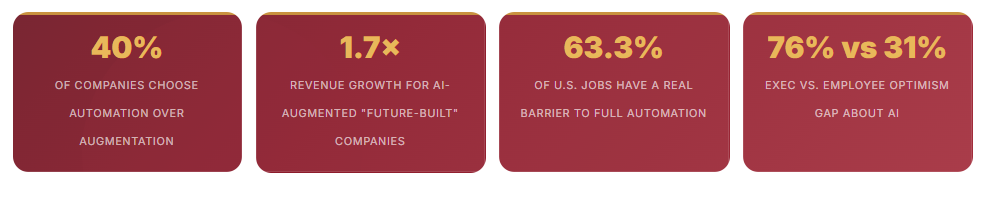
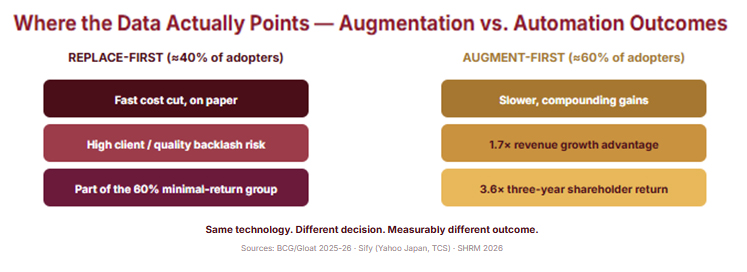
Nearly 40% of companies that adopt AI choose automation instead of using AI to support workers – which means roughly 60% do not. This is not a technology outcome. It is a decision, made explicitly or by default, in how the first AI project gets scoped. The technology itself doesn’t decide whether it replaces or amplifies a person. The company does. The two options in front of companies right now are:
- The Replace-First Path: AI deployed to eliminate a task category entirely, headcount reduced to match. Fast to model in a spreadsheet. Immediate cost reduction on paper. High risk of client-preference and quality backlash. Concentrated most heavily in entry-level, clerical, and highly rule-based roles.
- The Augment-First Path: AI deployed to remove friction from a specific role, hours reclaimed and redirected to higher-value work. Slower to show up as a line-item cost cut. Documented 1.7× revenue growth advantage for companies that do this well. Requires explicit workload governance so reclaimed hours don’t just become more assigned work.
The Honest Data: Where Displacement Is Real, and Where It Isn’t
An article that tells you AI will never touch anyone’s job is lying to you. At the same time, an article that tells you every job is at imminent risk is also lying to you, just in the other direction. Here is what the actual 2026 data shows, without picking a side to make you feel better or worse than the evidence supports.
US employers announced roughly 1.2 million job cuts in 2025 (up 58% over 2024) but only about 4.5% of those cuts explicitly cited AI as the cause, according to Challenger, Gray & Christmas tracking. Goldman Sachs estimates AI is currently displacing on the order of 11,000 to 16,000 US jobs a month – real and measurable, but small against a workforce of roughly 160 million. The headline “AI replaced our workers” case studies that made the news (Klarna’s “700 agents,” IBM’s “7,800 jobs,” Duolingo’s “AI-first” memo) have mostly been walked back or turned out to be more nuanced than the original announcement suggested.
Where displacement is genuinely concentrated: repetitive, rule-based work with clear correct answers, and entry-level positions specifically. Stanford’s Digital Economy Lab found a roughly 13% relative employment decline for 22-to-25-year-olds in the most AI-exposed occupations, and young software developer employment is down approximately 20% from its late-2022 peak; even as senior engineer employment has grown. Displacement in 2026 mostly looks like a hiring slowdown for juniors, not a layoff wave for people already employed.
4.5% of 2025’s 1.2 million job cuts explicitly cited AI as the cause. 11-16K net US jobs displaced per month, attributable to AI (Goldman Sachs). 13% relative employment decline for 22-25 year-olds in the most AI-exposed roles (Stanford). 63.3% of U.S. jobs have at least one real, nontechnical barrier to full automation (SHRM 2026).
THE BARRIER MOST “AI WILL REPLACE EVERYONE” PREDICTIONS IGNORE: 63.3% of U.S. jobs include at least one nontechnical barrier to displacement, legal requirements, licensing, client preference, or liability concerns that exist independent of whether the technology is theoretically capable. A model that can theoretically draft a contract is not the same as a business willing to let it sign one unsupervised.

In the Age of AI
You Gain the Advantage over Those Who Don't Step Up
What All These Stats Actually Mean
The Augmentation Advantage: What the Data Actually Rewards
Boston Consulting Group’s research across 1,250 companies found that only 5% are achieving AI value at scale, while 60% report minimal returns despite substantial investment – a productivity gap worth roughly $500 billion annually in the US alone. The companies succeeding aren’t simply deploying more AI tools. They’re building AI-augmented workforces where technology amplifies human capability rather than attempting to replace it.
The Study’s “future-built” companies – the ones orchestrating genuine human-AI collaboration rather than pursuing pure automation – generate 1.7 times more revenue growth than struggling competitors, 3.6 times higher three-year shareholder return, and 1.6 times better EBIT margin. This is not a soft, feel-good statistic about morale. It is a hard financial outperformance number attached to the augmentation strategy specifically.
The OECD’s research on small and medium companies found that SMCs using generative AI most often report improved employee performance, with the effect on headcount limited in the near term; reinforcing that for most businesses, the realistic near-term outcome of AI adoption is better output from the same team, not a smaller team. EY’s US AI Pulse Survey similarly found that many leaders are channeling productivity gains from AI into reinvestment: existing and new AI capabilities, R&D, cybersecurity, and employee retraining, rather than reducing headcount.

This is the argument business owners need to hear clearly: augmentation is not the compassionate choice at the expense of performance. It is the higher-performing choice. Companies choosing replacement over augmentation are not making a harder trade-off in exchange for better numbers — they’re making the harder trade-off and getting worse numbers, on average.
The Perception Gap: Execs vs. Employees Train of Thought
The Perception Gap: Why Leaders Think Employees Feel Fine About This
Bringing in the stats for this assertion as well! A 2025 survey by BCG Henderson Institute and Columbia Business School of nearly 1,400 executives, managers, and individual contributors found that 76% of executive leaders believed employees felt “enthusiastic and optimistic” about AI. However, only 31% of individual contributors actually reported feeling that way themselves.
This 45-point perception gap is not a rounding error; it is a leadership blind spot with real operational consequences. KPMG’s study with the University of Melbourne, surveying 48,340 respondents across 47 countries, found that 82% of workers are wary of misinformation or disinformation from AI, and 82% feared deskilling — becoming reliant on a tool at the expense of their own judgment. The harder AI adoption is “sold” from the top down without addressing this specific fear, the more reactance and quiet resistance build – the tendency for people to reject an idea specifically because they feel their autonomy is being overridden.
THE OVERWORK PARADOX: In one documented software engineering case, AI helped complete weeks of programming work in roughly 20 hours. It sounds like the perfect productivity story… until the employee felt overwhelmed, because more work simply arrived faster to fill the reclaimed time. If employees believe AI only means “you now owe the company more output,” they hide their AI use, resist adoption, or burn out. This is precisely why workload governance (explicitly deciding how AI-driven time savings get redistributed) belongs in the augmentation strategy from day one, not as an afterthought once burnout complaints start.
6 BEST PRACTICES for an Augmentation-First AI Strategy
Little-Known Gems: What Most “Will AI Replace You” Articles Never Mention
Gem 1: How You Deploy AI Determines the Outcome, Independent of Intent. Anthropic’s Economic Index found that consumer-facing AI chat use runs roughly 52% augmentation versus 45% automation, but business API-integrated use runs approximately 75% automation. The interface itself shifts the outcome: an employee having a conversation with an AI assistant tends toward augmentation almost by default, while the same underlying model wired directly into an automated business pipeline tends toward replacement almost by default. Before debating “will AI replace or augment,” ask a more precise question: are we deploying this as a conversational tool a person directs, or as an automated pipeline that runs without a person in the loop?
Gem 2: Most “This Job Could Be Automated” Analyses Ignore Nontechnical Barriers Entirely. 63.3% of U.S. jobs include at least one nontechnical barrier to displacement: legal requirements, licensing rules, liability exposure, or simple client preference. Technical capability and business reality are two different filters, and most alarming “AI could replace X% of jobs” headlines only apply the first one. Before assuming a role in your business is at risk because an AI model could theoretically do the task, ask whether your customers, your insurer, your regulator, or your own risk tolerance would actually allow it to run unsupervised.
Gem 3: A Business Can Get Replaced Without Anyone Getting Replaced. TCS’s exposure isn’t a story about TCS employees being individually swapped for chatbots. It’s a story about TCS’s clients no longer needing to pay for the routine labor TCS was selling, because AI let those clients build cheap internal equivalents. If a meaningful share of your revenue comes from selling routine, codifiable labor to other businesses, the augmentation-vs-replacement decision your clients make may matter more to your survival than the one you make internally.
Gem 4: The Skills Gap Inside AI-Exposed Jobs Is Growing Twice as Fast as Everywhere Else. PwC’s 2026 AI Jobs Barometer found that the skills required in AI-exposed jobs are changing more than twice as fast as in less-exposed jobs – with judgment, leadership, empathy, and creativity becoming more valuable specifically as AI absorbs the routine work around them. This makes deliberate reskilling, not just tool access, the real differentiator between an augmented workforce and a stagnant one.
Gem 5: The “AI Is Coming for Every Job” Narrative Is Itself a Business Risk. The 45-point gap between executive optimism (76%) and individual contributor optimism (31%) about AI doesn’t just represent a communication failure; it actively degrades the augmentation strategy’s chance of success. An employee who believes leadership is quietly building toward their replacement has no incentive to help that project succeed, and every incentive to quietly under-adopt, hide their AI use, or resist. The fear itself becomes the mechanism that makes replacement more likely, and augmentation less likely to work – regardless of which one leadership actually intended.
Bottom Line: Choose the Fork That Compounds
Yahoo Japan and TCS didn’t end up on opposite ends of this story because one had access to better technology. They ended up there because one made an explicit, bounded, augmentation-first decision, and the other found itself carried by forces it didn’t fully steer.
Your AI strategy is not something that happens to your business. It’s a decision your business makes – on purpose, or by default.
40% of companies choose replacement over augmentation and get measurably worse financial results for the trouble. 60% choose augmentation and capture a 1.7× revenue growth advantage. 63.3% of jobs have real, durable barriers to full automation that most doomsday predictions ignore entirely. The evidence isn’t ambiguous. The only open question is whether your business makes this decision deliberately or lets it happen by accident while everyone waits to see what happens.
MediaBus Marketing Group helps businesses make that decision deliberately:
-
Finding the real friction in specific roles
-
Setting bounded and measurable augmentation goals
-
Building the governance that keeps reclaimed time from becoming a burnout complaint six months later.
📞 · Contact MediaBus Marketing · 🌐
Build your augmentation strategy before the decision gets made for you.
AI Replacement FAQs
Q1: Is AI actually replacing jobs right now, or is that mostly media hype?
Both things are true at once, which is exactly why the honest answer is uncomfortable. Displacement is real and measurable; Goldman Sachs estimates roughly 11,000 to 16,000 net US jobs are being displaced monthly, and Stanford research found a genuine 13% relative decline in employment for 22-to-25-year-olds in the most AI-exposed occupations. But only about 4.5% of the 1.2 million job cuts announced in 2025 explicitly cited AI as the cause, and several of the most-cited “AI replaced our workers” headlines (Klarna, IBM, Duolingo) were later walked back or turned out to be more nuanced than reported. The realistic picture for 2026: AI displacement is concentrated and specific (entry-level, clerical, highly repetitive roles) not a broad layoff wave hitting people already employed across every industry.
Q2: If augmentation performs better than replacement, why do 40% of companies still choose replacement?
Mostly because replacement is easier to model and easier to sell internally in the short term. Cutting a task category and reducing headcount to match produces an immediate, visible line-item on a budget spreadsheet. Augmentation’s 1.7× revenue growth advantage is real, but it compounds over time and requires the harder work of observing specific role friction, setting bounded goals, and governing how reclaimed time gets used – none of which shows up as an instant cost reduction. Many companies default to replacement not because the evidence favors it, but because it’s the path of least resistance for a leadership team under pressure to show fast results from an AI investment.
Q3: How do I know if a specific role in my business is genuinely at risk, versus just AI-assisted?
Apply two separate filters, not one. First, the technical filter: is the work repetitive, rule-based, and does it have a clear correct answer that doesn’t require nuanced judgment? Second, and more often overlooked, the nontechnical filter: does a licensing requirement, legal restriction, liability concern, or client preference create a real barrier to letting AI run the task unsupervised? 63.3% of U.S. jobs have at least one such barrier. A role can pass the first filter (technically automatable) and still fail the second (not actually going to be automated any time soon), which is exactly why so many alarming “AI could replace X%” predictions overstate real-world risk.
Q4: We gave our team an AI tool and productivity didn’t really change. What went wrong?
This is the single most common augmentation failure pattern, and it has a specific, identifiable cause: a horizontal AI tool deployed without observing where any specific role’s real friction actually lives. A senior employee uses a generic AI assistant occasionally, then goes back to their actual workflow, because that workflow depends on context the AI tool was never given. The augmentation deployments that produce real, measurable gains are role-specific; they observe where a particular job loses minutes or hours to repetitive work, and integrate AI exactly there, not as a generic company-wide layer. If your team’s AI tool isn’t producing results, the fix is almost never “get a better tool” – it’s “observe the actual friction in a specific role before deploying anything.”
Q5: How do we introduce AI to our team without triggering the fear and resistance that undermines adoption?
Address the specific fears directly rather than leading with the feature list. Research shows 82% of workers fear deskilling, i.e., becoming reliant on AI at the expense of their own judgment, and there’s a documented 45-point gap between how optimistic executives believe employees feel about AI (76%) versus how employees actually report feeling (31%). Silence on the job-security and deskilling questions is read as confirmation of the fear, not neutrality. State explicitly what will and won’t change, set a bounded and specific automation target, and decide up front how the time AI saves will be redistributed between faster delivery, better quality, and genuine time back for the employee.
Action Items:
SHARE THIS STORY ANYWHERE YOU LIKE
SHARE THIS STORY ANYWHERE

Will AI Replace Employees or Help Them Accomplish More?
Will AI Replace Employees or Help Them Accomplish More? Two Companies, Same Year, Opposite Bets — and the [...]

Can Our AI Project Manager Stop Tasks from Falling Through the Cracks?
Can Our AI Project Manager Stop Tasks from Falling Through the Cracks? Two Verified Case Studies, the Real [...]

How Can AI Help Us Capture More Business and Handle More Work Without Immediately Hiring More People?
How Can AI Help Us Capture More Business and Handle More Work Without Immediately Hiring More People? The [...]