

Video Marketing Trends for 2026 – The Power Strategy for Scalable Growth
Why Video Marketing in 2026 Is No Longer Optional
Video marketing trends for 2026 signal a permanent shift, not a temporary spike. Video is no longer a supporting asset. It’s the operating system of modern marketing. Businesses that still treat video as an optional add-on will struggle to maintain relevance, reach, and trust.
In previous years, businesses could succeed by treating video as a supporting marketing channel. In 2026, that approach absolutely collapses. Audiences now expect video as the primary format for education, persuasion, and validation. Video now sits at the center of discovery, trust-building, education, conversion, and retention. It functions as the connective tissue between marketing, sales, and customer experience.
Text still matters, but video accelerates comprehension, emotional connection, and recall.
Consumers no longer ask whether a brand offers video content. They assume it does. When video is missing, it creates friction, doubt, and lost momentum. When video is present and well-executed, it compresses decision-making and accelerates trust. In 2026, brands that fail to operationalize video will find themselves invisible in algorithm-driven ecosystems.
Video-first indexing is becoming the norm. Algorithms reinforce this shift. Social platforms, search engines, and generative discovery tools prioritize formats that maximize engagement and comprehension. Video consistently outperforms text in both areas. As a result, video marketing trends for 2026 are tightly linked to visibility itself.
The strategic implication is clear: businesses must design video systems, not one-off campaigns.
Behavioral Shifts That Are Reshaping Video Consumption
Audience behavior has matured. Attention spans have not disappeared; they have become intentional and more selective. People will spend hours watching video content that feels relevant, authentic, and useful.
Video marketing trends for 2026 reflect this evolution. Consumers expect fast context upfront, followed by depth if interest is earned. This explains why short-form and long-form video now operate as complementary forces rather than competitors. Brands must design video journeys, not isolated clips.
Another major shift is trust orientation. In an era saturated with AI-generated text, video still acts as a credibility signal. Seeing a face, hearing a voice, and observing confidence in delivery create reassurance that static content cannot replicate. Even in the advent of deep fakes and “AI Cloning,” we still look for the real and the authentic, even if it is AI-generated.
Video also satisfies the modern preference for learning by observation. Demonstration, walkthroughs, and visual explanation reduce cognitive load. This makes video especially powerful for complex products, services, and ideas.
The Algorithm Economy and Why Video Wins
Algorithms reward behavioral outcomes, not intent. They respond to measurable behavior: watch time, completion rate, replays, comments, and shares signal value to all indexing spiders. In 2026, it shows that the LLMs (Perplexity, Gemini, Claude, Grok, and ChatGPT) are doubling down on that for their Authority and Sentiment measures. Because they correlate directly with user satisfaction. Video naturally generates more of these behaviors than static content.
This creates a compounding advantage. High-performing video earns more reach. More reach produces more engagement data. That data informs optimization, leading to even stronger performance.
Brands that understand this feedback loop treat video as an iterative system. They test hooks, analyze retention curves, refine structure, and scale what works. Those who don’t remain invisible, regardless of production quality.
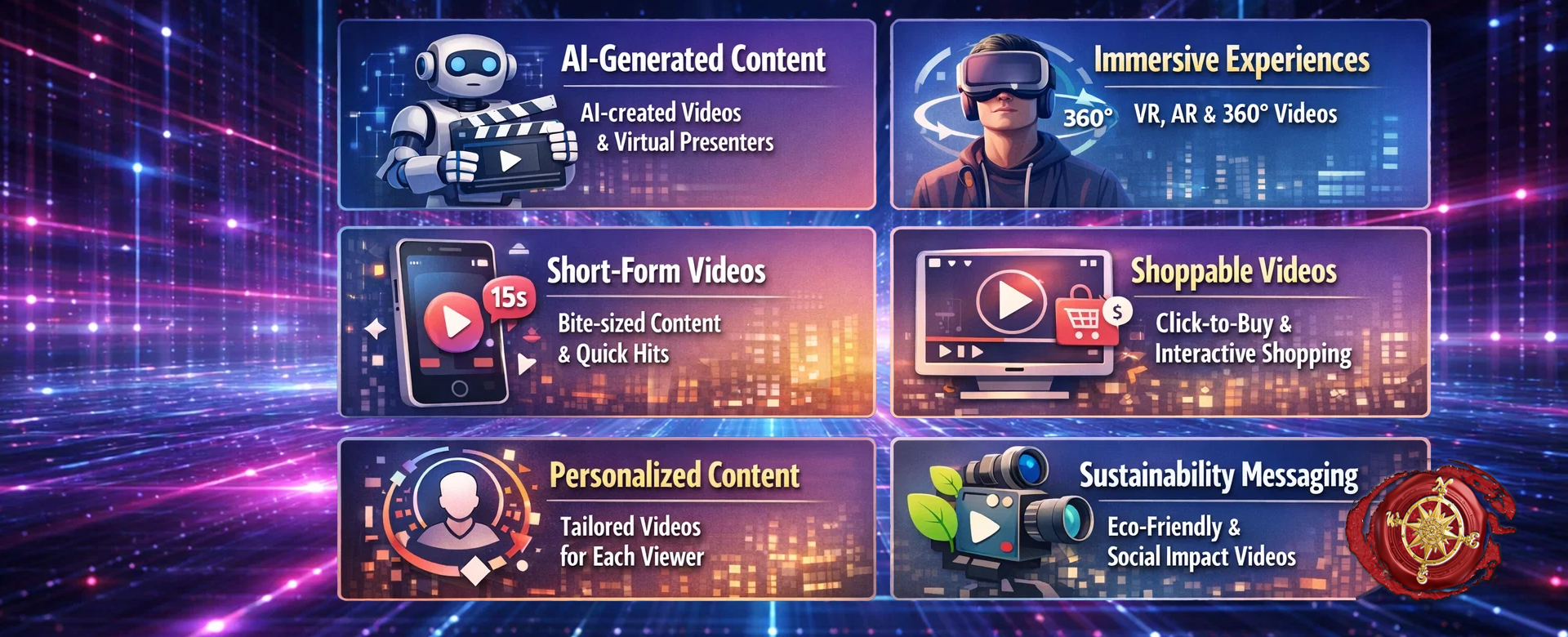
Trends to Adopt for Business
What you need to incorporate to bring your business to the forefront
AI-Powered Video Creation Standards
Operational Commonplace in 2026
Artificial intelligence is no longer an experimental novelty in video marketing. In 2026, it becomes an operational infrastructure baseline.
Video marketing trends for this upcoming year show AI integrated across the entire production lifecycle: ideation, scripting, editing, captioning, localization, and distribution. This dramatically reduces cost and turnaround time while increasing consistency.
However, AI does not replace strategic thinking. It accelerates execution. The brands that win are those that pair AI efficiency with human insight, context, and judgment.
Scripting, Editing, and Workflow Automations
AI-assisted scripting allows teams to generate structured drafts aligned with specific goals, such as education, persuasion, or retention. These drafts serve as scaffolding, not finished work.
Editing automation removes friction from post-production. Tasks like jump cuts, caption syncing, formatting, and resizing can now be handled automatically, freeing human creators to focus on message quality.
Workflow automation ensures repeatability. Video marketing trends for 2026 emphasize documented systems that allow teams to produce at scale without sacrificing clarity or brand voice.
Key Aspect of the 2026 Video Marketing Trends
Generative AI and Brand Consistency
One risk of AI is homogenization or sameness. Video marketing trends for 2026 emphasize guardrails. Brands winning in this space establish clear brand inputs: tone frameworks, messaging pillars, audience language patterns, and visual standards. These inputs train AI tools to produce content that feels distinct, not generic.
Consistency becomes a competitive advantage as volume increases.
Personalized Video at Scale
Personalization moves beyond inserting a name in the salutation. AI enables dynamic video that adapts messaging based on dynamic content, adapting based on viewer behavior, industry, role, and funnel stage.
Sales teams use personalized video to address objections directly. Customer success teams use it for onboarding and support. Marketing teams deploy it to guide prospects through complex decisions.
The result is relevance at scale, something traditional video could not achieve. In 2026, personalized video isn’t just for sales outreach. It’s embedded in onboarding, retention, and customer education.
Short-Form Video Becomes the Default Language
Short-form video is no longer experimental. It’s the front door that your consumers walk through, the primary discovery engine. It introduces ideas, brands, and solutions faster than any other format.
Video marketing trends for 2026 show short-form content optimized for clarity, not entertainment alone. The first few seconds communicate value, context, and relevance immediately. Production polish matters less than message precision. Authentic delivery often outperforms scripted perfection.
These videos aren’t about dancing or trends. They’re about clarity, relevance, and speed.
Platform-Native Content Strategies
Each platform has its own grammar. Vertical video, captions, pacing, and sound design vary. Repurposing without adaptation limits performance, and successful brands do not blindly repost content. They adapt pacing, framing, captions, and delivery style to match platform expectations.
Brands must design content specifically for TikTok, Instagram Reels, and YouTube Shorts, even if the core message stays consistent. Short-form video succeeds when it feels native, not recycled. This platform literacy becomes a core competency in 2026.
Hook Speed and Retention Metrics
Hooks are no longer clever lines. They’re value promises. Successful short-form video communicates “what’s in it for me” instantly.
Video marketing trends for 2026 emphasize retention analysis. Creators examine where viewers drop off and why. They refine openings, restructure pacing, and remove unnecessary filler. Retention curves guide optimization.
Optimization becomes continuous rather than occasional and favors creators who analyze drop-off points and iterate relentlessly.
Long-Form Video Evolves Into Authority Assets
While short-form attracts attention, long-form builds trust. Video marketing trends for 2026 position long-form video as digital real estate.
Position long-form content as the bedrock of your video efforts. Educational series, deep dives, and video podcasts establish expertise and credibility over time.
This content supports sales conversations, improves SEO, and reinforces brand positioning, and become evergreen assets that compound authority.
Educational and Thought Leadership Content
Audiences crave explanation, not hype; they increasingly seek explanation over promotion. Long-form video allows brands to demonstrate expertise, process, and perspective. How you tick in sympatico with those you serve.
This content feeds multiple channels: clips, articles, emails, and social posts.
Teaching builds trust. Transparency builds confidence. Together, they shorten buying cycles.
Video Podcasts and Knowledge Libraries
Video podcasts function as both media and infrastructure. They are media channels, content engines, and searchable knowledge libraries. They create searchable libraries of insight that power SEO, sales enablement, and PR.
A single long-form recording can be repurposed into dozens of assets, fueling an entire content ecosystem.
Interactive and Shoppable Video Experiences
Passive viewing is fading. Video marketing trends for 2026 highlight interaction as a growth lever.
Clickable overlays, in-video forms, and embedded commerce reduce friction and increase conversion.
Clickable elements, polls, and in-video CTAs turn viewers into participants that invite action without breaking immersion.
Designing Video for Conversion, Not Just Views
Every design choice influences the outcome. Design choices now influence revenue directly. Placement of buttons, timing of CTAs, and narrative flow all affect conversion rates and behavior.
High-performing teams treat video like a conversion asset, not just a branding tool.
Search, SEO, and Video Discoverability in 2026
Search engines increasingly surface video results. Video marketing trends for 2026 require SEO and video teams to collaborate closely.
Transcripts, metadata, and structured data improve discoverability. Video also feeds generative search summaries.
Video SEO and Generative Search
Generative engines favor authoritative, well-structured video content. Clear explanations and strong engagement increase citation likelihood. Generative search tools also favor authoritative video content when summarizing answers.
Measurement, Attribution, and ROI
Vanity metrics are fading. Video marketing trends for 2026 prioritize metrics tied to pipeline and revenue impact.
Watch time matters only when it correlates with action.
Performance Metrics That Matter
Key metrics include watch time, assisted conversions, and pipeline influence. Views alone mean little without context. These metrics align video performance with business outcomes.
Revenue-Centric Video KPIs
High-performing teams tie video engagement to CRM data, enabling clearer ROI attribution.
Ethics, Authenticity, and Trust Signals
As AI-generated video becomes common, transparency matters. Audiences value honesty over perfection.
Video marketing trends for 2026 emphasize ethical use of AI, clear disclosure, and authentic representation.
Email Marketing Strategies for Local Businesses
Building a Local Subscriber List
Email marketing is still one of the most effective ways to reach customers. By building a local subscriber list, businesses can keep their audience informed about upcoming promotions, events, or changes in store hours.
Personalizing Offers
One of the best things about email marketing is the ability to personalize offers based on customer behavior or preferences. Sending tailored promotions or reminders about services is a great way to keep your local customer base engaged.
Mobile Marketing and its Role in Local Business Growth
SMS Marketing
Many local businesses are turning to SMS marketing as a direct way to reach their audience. With open rates far exceeding those of email, SMS is an excellent tool for promoting flash sales or sending appointment reminders.
Location-Based Mobile Ads
Using location-based mobile ads allows businesses to target potential customers when they are in proximity to the business. This is especially effective for retail stores and service-based businesses looking to drive foot traffic.
The Takeaway
Video marketing trends for 2026 point to a decisive shift. Video is no longer a creative experiment. It is a core business function.
Brands that build scalable systems, measure impact, and prioritize trust will dominate attention and growth. Those who hesitate will struggle to be seen, heard, or remembered.
CLICK HERE to Get the Video Creation Protocol for 2026
Frequently Asked Questions
1. Why are video marketing trends for 2026 so important?
They reflect how audiences consume information and how algorithms distribute content, making video essential for visibility and trust.
2. Is short-form video enough in 2026?
No. Short-form attracts attention, but long-form builds authority and conversions.
3. How does AI impact video marketing trends for 2026?
AI increases speed, personalization, and scalability while requiring strong brand oversight.
4. Is video SEO really important in 2026?
Yes. Video is increasingly prioritized in both traditional and generative search results.
5. What platforms matter most for video in 2026?
TikTok, Instagram Reels, YouTube Shorts, and long-form platforms like YouTube remain critical.
5. How does video affect SEO in 2026?
Video improves engagement signals and visibility in both traditional and generative search results.
6. What’s the biggest mistake brands make with video?
Treating video as isolated content instead of a system tied to revenue and strategy.
7. How should businesses start adapting now?
By building repeatable video workflows aligned with strategy, not trends.