

How Do You Choose?…
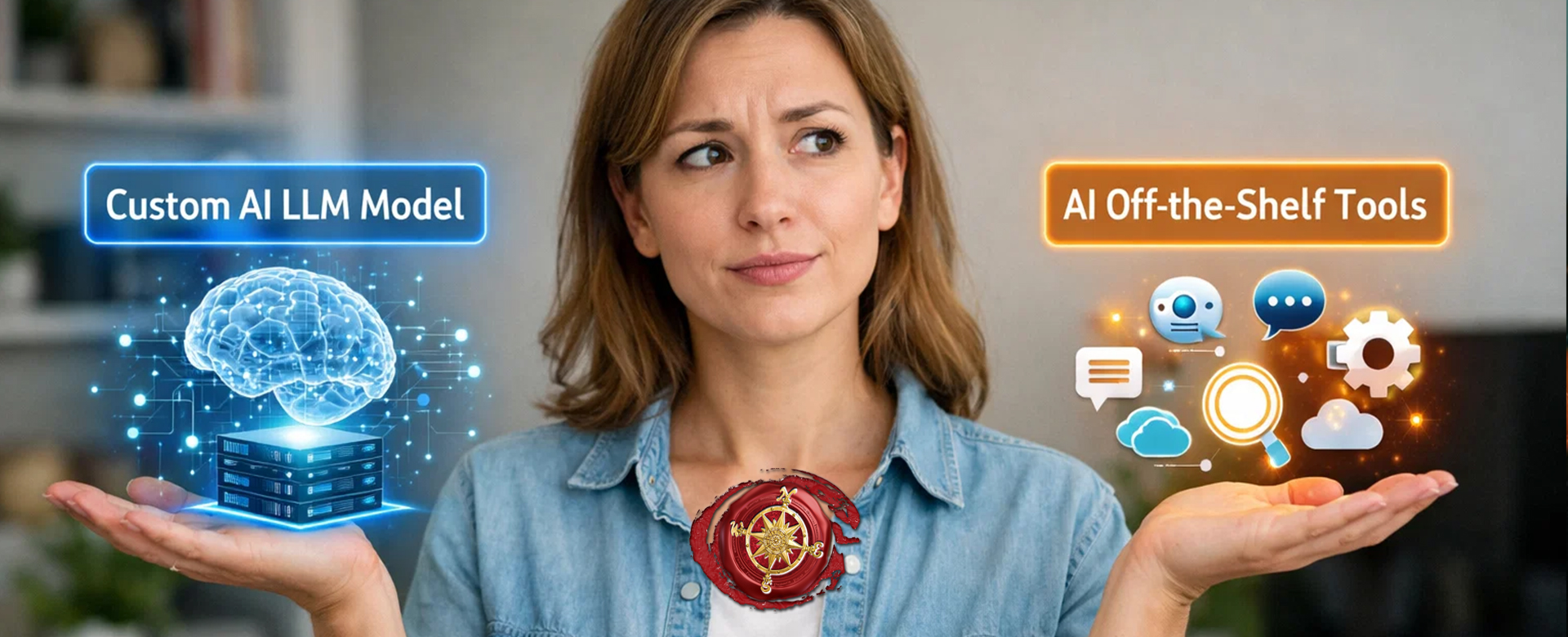
Choosing between building a custom AI model and using ready-made AI tools feels a bit like deciding whether to build your own house or buy a fully furnished one. At first glance, this feels like a technical decision. Under the surface, it’s a strategic one that quietly reshapes how your business competes, scales, and survives. Both can shelter you. Both can be upgraded. But the experience, cost, and commitment are wildly different.
AI is no longer a novelty layer. It’s becoming essential infrastructure. In the same way, websites and CRMs stopped being “nice to have,” and AI is now baked into customer expectations, operational efficiency, and competitive advantage. With artificial intelligence flooding every industry, this decision is no longer reserved for tech giants. Small businesses, agencies, startups, and even solo operators are facing it daily. Pick wrong, and you burn cash or momentum. Pick right, and you unlock leverage that feels almost unfair.
The real danger isn’t choosing the “wrong” option. It’s choosing too early, too late, or for the wrong reasons. This guide isn’t here to impress you with buzzwords. It’s here to help you choose with clarity.
Let’s break it down without the jargon fog.
Understanding the Two Paths at a Deeper Level
What Is a Custom AI Model?
A custom AI model is built specifically for your business, your data, and your goals. It can be trained from scratch or fine-tuned from an existing model using your proprietary data. A custom AI model is not just “AI, but yours.” It’s a system that has been shaped, constrained, and trained around your data, your processes, and your decision logic.
Think of it as training a specialist. It learns your language, your workflows, your customers, and your edge.
There are two common approaches:
-
Training from scratch, which requires massive datasets, deep expertise, and serious capital.
-
Fine-tuning or embedding intelligence, where an existing model is adapted using your data, rules, and workflows.
Training from scratch is expensive and rare. Fine-tuning is more common and far more practical.
Most businesses that say they want “custom AI” actually mean the second option, whether they realize it or not. Custom AI excels when the intelligence itself is the product or when your business runs on proprietary knowledge that competitors can’t access.
What Are Off-the-Shelf AI Tools?
Off-the-shelf AI tools are prebuilt platforms that already use large language models under the hood. You don’t train them. You configure them. You’re not buying intelligence. You’re renting leverage.
These tools already understand language, reasoning, and structure. Your role is to guide, configure, and integrate them into your workflows. They’re designed to solve common problems fast: writing, summarizing, analyzing, responding, scheduling, generating, and optimizing. For most organizations, these tools don’t replace thinking. They remove friction.
They’re plug-and-play. You sign up, connect data sources, tweak prompts, and start producing results fast.
The Business Lens Reality Check
Cost Considerations – Not Just Money, It’s Commitment
Custom AI comes with high upfront costs. Data preparation, engineering, training, testing, and deployment add up quickly. Ongoing costs follow for maintenance and retraining. Visible costs include development, infrastructure, security, testing, and deployment. Invisible costs show up later as retraining, debugging, model drift, and talent retention.
Off-the-shelf tools flip that equation. Low startup cost. Predictable monthly fees. Minimal risk. These types of tools flip that burden. You pay a subscription and trade absolute control for predictability.
If your AI initiative can’t clearly justify long-term ownership, renting almost always wins. And if cash flow matters, convenience usually wins.
Time to Value is the Silent Killer
Custom AI is a long-game play; it usually takes months. Even a well-scoped project can take months before producing usable outcomes. Sometimes longer. It’s an investment play.
Off-the-shelf tools deliver value almost immediately, usually in days or weeks. That speed creates learning loops. You see what works, what doesn’t, and what you actually need. You can test, iterate, and pivot fast.
If speed is your priority, this alone can decide it.
Scalability and Growth
Custom AI models scale beautifully once built. It gets smarter, it grows with you, not against you. Off-the-shelf tools scale horizontally. You add users, use cases, and integrations.
If growth depends on insight depth, custom matters. If growth depends on execution speed, tools shine. Prebuilt tools scale too, but you’re limited by their roadmap and pricing tiers.
Faces of Business Culture
Your Company Culture Can Be on Display for Others to Connect with.
Technical Complexity, Ownership, Privacy and Risk
What It Really Takes to Build Custom AI
Building custom AI means accepting that AI becomes a living system inside your business. You’ll need data scientists, ML engineers, infrastructure, and governance. Even with managed services, complexity doesn’t disappear. It just moves.
You’ll need:
-
Clean, structured data
-
Governance rules
-
Monitoring and evaluation
-
Ongoing iteration
-
People who understand both the tech and the business (the data scientists, engineers, etc.)
If you don’t already run a technical team, building AI becomes a second business. Even with vendors and managed services, responsibility doesn’t disappear. It concentrates.
What It Takes to Use AI Tools Well
Using off-the-shelf AI well is less about tech and more about clarity.
You need process clarity: Clear prompt inputs. Clear content outputs. Clear rules.
These types of tools don’t block the businesses that struggle. They’re blocked by messy processes.
Control Over Data Isn’t Binary
Custom AI gives you near-total control, but also total responsibility. Your data stays yours. Models behave exactly how you design them.
Off-the-shelf AI tools can vary widely. Some store data temporarily. Some retain it. Some use it for improvement. Some don’t. If data sensitivity is mission-critical, read the fine print carefully.
This isn’t about paranoia. It’s about alignment. Sensitive data demands stricter rules. Generic data doesn’t.
Compliance Is a Strategy Decision
Highly regulated industries (Financial, Insurance, Health-related, for example) often lean toward custom solutions, not because tools are unsafe, but because auditability and traceability matter more than convenience. They often lean toward custom solutions for compliance clarity. But many modern AI tools now offer enterprise-grade safeguards.
That said, modern AI platforms are rapidly closing this gap.
Customization vs. Convenience – The Trade Off Nobody Escapes
The Power of Deep Customization
Custom AI can encode your business rules, tone, values, heuristics, workflow SOPs, and decision logic frameworks. It becomes institutional memory and your company’s operating system.
That said, many businesses overestimate/underestimate how much customization they actually need. This is powerful, but also dangerous if poorly designed. Bad logic scales just as fast as good logic.
The Ceiling of Prebuilt Tools
AI tools give you flexibility within guardrails. You cannot necessarily change their core logic. You can guide behavior, but you can’t rewrite the engine. You adapt to them, not the other way around.
For most use cases, that’s not a limitation. It’s a safeguard.
Performance, Accuracy, and Context Depth
Where Custom AI Dominates
Custom AI shines when precision matters in niche industries more than creativity. Legal analysis, technical diagnostics, financial modeling, and proprietary workflows benefit enormously.
Where Off-the-Shelf AI Excels
General or broad reasoning, content creation, ideation, summarization, and communication are natural strengths of large language models.
Trying to outbuild these strengths is rarely worth it.
Maintenance Is Where Many AI Dreams Die
Custom AI Is Never Finished
There is always ongoing model training that is happening. Data shifts and changes. Language shifts and updates. Markets evolve. Models drift. Features disappear. Prices change.
Custom AI demands stewardship. Without it, performance degrades quietly.
AI Tools Improve While You Sleep
Off-the-shelf tools benefit from collective learning and frequent updates. You gain improvements without lifting a finger.
That convenience is often underestimated until it’s gone.
Vendor Dependency Risks
Using tools means relying on vendors. Pricing changes. Features disappear.
Custom AI avoids that, but replaces it with internal responsibility.
Talent, Teams, and Organizational Readiness
Custom AI Requires Builders
You need people with the skills who can bridge business logic and technical systems. You will definitely need that technical leadership, data governance, and continuous oversight. These people are scarce and expensive.
AI Tools Require Operators
The skills needed for Off-the-Shelf solutions require operators who can focus on outcomes, not infrastructure. They’re easier to hire, train, and scale.
This difference alone shapes long-term viability.
Clear Signals That Custom AI Makes Sense
-
Your data is proprietary and irreplaceable
- Your IP needs to be a ‘Competitive Moat’
-
AI is central to your value proposition, core to your product or service
- You operate in a regulated or sensitive industry
-
You require deep, domain-specific reasoning
-
You can support long-term ownership
If none of these are true, pause.
Clear Signals That AI Tools Are the Right Move
-
You need fast wins with your ROI
-
Your use cases are common and non-proprietary
-
You’re experimenting with validating ideas or markets
- You lack internal AI expertise
-
You want leverage, not liability
This is where most businesses belong and begin with.
The Hybrid Path Most Leaders Miss
You don’t have to choose extremes. The smartest organizations don’t choose sides. They sequence.
They start with tools. They learn. Fine-tuning existing or layering AI tools with automation gives you power with pain. They, then, identify gaps. And only then, they customize what truly matters.
This hybrid path approach minimizes risk while preserving upside. Delivering the best balance for your company.
A Practical Decision Framework
Five Questions That Cut Through Noise
-
Is AI core to my product or a multiplier for business operations?
-
Do I own unique data sets that others can’t replicate?
-
Can I afford to sustain long-term technical ownership for years?
-
How quickly do I need results?
-
What happens if this system fails or the tool vendor disappears?
Your answers reveal the path.
A Rule That Rarely Fails
If AI supports your business, use tools.
If AI defines your business, build model systems.
Where This Is All Headed
Custom AI is becoming more modular and will become easier and cheaper as the tech progresses. Tools are becoming more configurable and smarter. The middle ground is expanding fast.
The winners won’t be the ones who build the most. They’ll be the ones who choose deliberately.
Conclusion: Choose Leverage, Not Theater
Choosing between custom AI and off-the-shelf tools isn’t about ego or innovation theater. It’s about leverage. AI doesn’t reward ambition alone. It rewards clarity, timing, and restraint.
Most organizations don’t need custom intelligence. They win by starting simple, proving value, and only then investing deeper. They need better decisions, faster execution, and fewer bottlenecks.
Start where the value is obvious. Pick the path that fits your reality. Grow where advantage is earned. not where your ambition fantasy can take you.
That’s how AI becomes an asset instead of an anchor.
FAQs
Is building a custom AI model worth it for small businesses?
Usually no, unless AI is central to the product or the business owns highly valuable proprietary data.
Is custom AI more accurate than off-the-shelf tools?
It can be, but only when trained on high-quality, domain-specific data and actively maintained.
What’s the biggest risk of custom AI?
Underestimating long-term maintenance and talent requirements.
Can I mix AI tools with custom logic?
Yes. This hybrid model is often the most practical and scalable approach.
What’s the biggest risk of using AI tools?
Vendor dependency and data handling policies.
Do AI tools lock me into vendors?
There is dependency risk, but it’s often lower than the risk of maintaining custom systems without expertise.
Can I switch from tools to custom AI later?
Absolutely. Starting with tools often clarifies whether custom AI is even necessary.
How long before custom AI shows ROI?
Typically, months, sometimes longer. Tools often show ROI in weeks.
What’s the biggest mistake businesses make with AI?
Building too early or using tools without clear workflows.