

Here’s What You’ll Find in this Article…
This article will guide aspiring C-Suite executives and business owners through the essential journey of becoming an AI-first business. We’ll explore what it truly means to embed AI at the core of your operations, moving beyond simple tool adoption to a fundamental shift in strategy, culture, and innovation. You’ll gain insights into identifying key opportunities for AI integration, overcoming common challenges, and ultimately driving significant competitive advantage in today’s rapidly evolving digital landscape.
Importance of the Digital Transformation for Businesses
We’re living in a time where “digital transformation” isn’t just a buzzword; it’s the bedrock of business survival and growth. And at the heart of this transformation, increasingly, lies Artificial Intelligence. But what does it truly mean to become an “AI-first business”? It’s more than just slapping some AI tools onto your existing operations. It’s a complete reimagining of how you create value, serve customers, and operate internally.
The modern business organization is standing at a crossroads. On one side lies traditional (a.k.a. the old ways of digital) progressions. On the other hand is the AI-first business, a model that puts artificial intelligence at the center of strategy, operations, and growth. This shift isn’t hype. It’s happening now, and it’s changing how companies compete, even if they aren’t aware of it.
Think about it: from optimizing supply chains to personalizing customer experiences, from predicting market trends to automating mundane tasks, AI offers a canvas of possibilities. It’s about leveraging intelligent systems to make better decisions, faster. It’s about shifting from reactive problem-solving to proactive, data-driven innovation. An AI-first business doesn’t just use AI tools occasionally. Instead, it designs workflows, decision-making, and customer experiences around intelligent systems. As a result, businesses become more agile, more predictive, and more resilient. In the first stages of the digital transformation, companies focused on cloud adoption and automation. Today, AI-first business models go further by embedding learning systems into every layer of the organization.
What’s more, customers expect faster service, personalization, and consistency. AI makes that possible at scale. According to research published by McKinsey, organizations that adopt AI deeply across operations outperform peers on profitability and growth (McKinsey & Company). This clearly shows why the AI-first business approach is becoming the gold standard.
Throughout this article, you’ll learn what defines an AI-first business, why digital transformation now demands it, and how leaders can implement it responsibly. If you’re serious about long-term competitiveness, this mindset shift is no longer optional.
The good news is, you don’t need to be a tech giant to start this journey. What you do need is a clear vision, a strategic roadmap, and a willingness to embrace change. This isn’t just about technology; it’s about people, processes, and culture. It’s about empowering your teams with new capabilities and fostering an environment where experimentation and continuous learning are encouraged.
So, let’s dive into some of the questions that are likely on your mind as you consider making this pivotal shift.
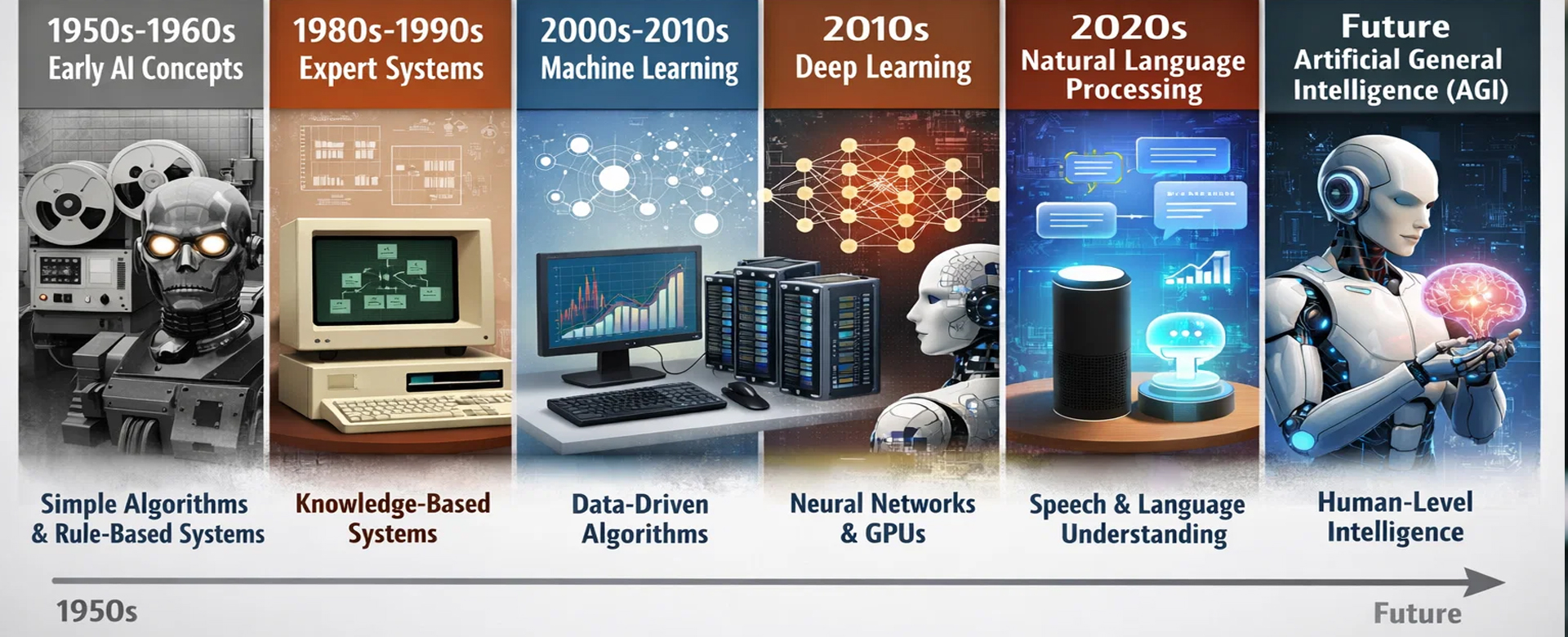
Faces of AI's Progression
How it has moved into what it is now
What Does ‘AI-First Business’ Really Mean?
An AI-first business is an organization that treats artificial intelligence as a core capability rather than a supporting tool. Instead of asking, “Where can we add AI?” leaders ask, “How should we design this process if AI is assumed from day one?”
Core Principles of an AI-First Business
At its foundation, an AI-first business follows several guiding principles:
-
Data as a strategic asset: High-quality, accessible data fuels all AI systems.
-
Automation with intelligence: Tasks are not just automated; they’re optimized through learning.
-
Continuous improvement: AI models evolve as new data flows in.
-
Human–AI collaboration: People and machines work together, not in isolation.
Because of these principles, the AI-first business model reshapes how value is created. Marketing teams rely on predictive analytics. Operations teams use AI for demand forecasting. Customer service teams deploy conversational AI to resolve issues faster. Over time, intelligence becomes embedded, not bolted on.
Importantly, adopting an AI-first business mindset requires executive commitment. Without leadership alignment, AI initiatives remain siloed. When leaders embrace the approach, however, digital transformation accelerates across departments.
Staying on top of all that is coming down the pike, let alone everything that has already hit the market, can make one’s head spin. You would be well-served to have someone in your company responsible for keeping up with all the advancements and how best to apply them to the business’s SOPs and workflows.
Why Digital Transformation Is No Longer Optional
A company’s digital transformation used to be a competitive advantage. Today, it’s the baseline. Markets move too fast for manual decision-making, and customers expect seamless digital experiences.
Strategic Benefits of Becoming an AI-First Business
Transitioning to an AI-first business delivers benefits that go far beyond just the automation. It fundamentally improves how organizations operate and compete.
Operational Efficiency and Cost Reduction
We’ve all heard that AI systems reduce manual work by handling repetitive tasks such as data entry, scheduling, and basic customer inquiries. Over time, this lowers operational costs and frees employees to focus on higher-value work.
For example, predictive maintenance powered by AI reduces downtime in manufacturing. In service industries, AI optimizes staffing and resource allocation. These efficiencies compound, creating a leaner and more resilient AI-first business.
Saying that and putting that into reality is another thing altogether. You need to be highly focused on the tasks at hand or they can get away from the original purpose and drift into something that is not recognizable or even wanted.
Data-Driven Decision Making
Traditional decision-making often relies on intuition and historical reports. In contrast, an AI-first business uses real-time insights and predictive models. Leaders can test scenarios, forecast outcomes, and adjust strategies quickly.
Because AI continuously learns, decisions improve over time. This creates a feedback loop where data informs action, and action generates better data. As a result, organizations become smarter with every cycle.
Building the Foundation for an AI-First Business
Becoming an AI-first business doesn’t happen overnight. It requires a strong foundation across technology, people, and processes.
Technology Stack and Infrastructure
A modern AI-first business relies on:
-
Cloud-based infrastructure for scalability
- Clear and established workflows for the essentials and externals
-
Data warehouses and pipelines for integration
-
Machine learning platforms for model development
-
Security and governance tools for compliance
Without these elements, AI initiatives struggle to scale. Therefore, investment in infrastructure is a critical first step in digital transformation.
Culture, Talent, and Leadership
Technology alone isn’t enough. Culture matters just as much. Employees need to trust AI recommendations and understand how to work alongside intelligent systems.
Leaders play a key role by promoting experimentation and continuous learning. Upskilling programs help teams adapt, while clear communication reduces fear and resistance. When people feel included, the AI-first business transformation gains momentum.
Implementation Roadmap for an AI-First Business
A structured roadmap reduces risk and increases the likelihood of success.
Step-by-Step Digital Transformation Plan
-
Assess readiness: Evaluate data quality, skills, and infrastructure.
-
Define priorities: Focus on high-impact use cases aligned with strategy.
-
Pilot projects: Test AI solutions on a small scale.
-
Scale responsibly: Expand successful pilots across the organization.
-
Measure and refine: Track outcomes and continuously improve models.
This phased approach allows organizations to learn as they go. Over time, the AI-first business model becomes embedded in everyday operations.
Risks, Ethics, and Governance in AI-First Businesses
While the benefits are significant, risks must be managed carefully. It can’t be a push, with no care for how to ethically (and sometimes morally) get them done, or have them utilized. The Guide Rails are always a good idea, and although Google has long laid it along the wayside, the mantra of “Don’t Be Evil” is a very good one to follow.
Responsible AI and Trust
An AI-first business must address concerns around bias, transparency, and data privacy. Ethical frameworks and governance structures help ensure responsible use.
Clear accountability is essential. As always, human oversight remains critical, especially in high-stakes (money or otherwise) decisions. When organizations prioritize trust, customers and employees are more likely to embrace AI-driven systems.
Real-World Examples of AI-First Business Success
Many organizations have already adopted the AI-first business approach. Retailers use AI for personalized recommendations. Financial institutions deploy AI for fraud detection. Healthcare providers rely on predictive analytics for better patient outcomes.
These examples demonstrate that AI-first business models are not theoretical. They’re practical, scalable, and proven across industries.
The Verdict: The Future of AI-First Business
The shift toward an AI-first business is redefining digital transformation. Organizations that embrace this model gain efficiency, insight, and adaptability. Those that resist risk are falling behind more agile competitors.
Ultimately, becoming an AI-first business is not about replacing people. It’s about empowering them with better tools and smarter systems. As AI continues to evolve, businesses that lead with intelligence will shape the future of their industries.
Contact us at MediaBus Marketing Today to get you started on the right journey for your business
Email Marketing Strategies for Local Businesses
Building a Local Subscriber List
Email marketing is still one of the most effective ways to reach customers. By building a local subscriber list, businesses can keep their audience informed about upcoming promotions, events, or changes in store hours.
Personalizing Offers
One of the best things about email marketing is the ability to personalize offers based on customer behavior or preferences. Sending tailored promotions or reminders about services is a great way to keep your local customer base engaged.
Mobile Marketing and its Role in Local Business Growth
SMS Marketing
Many local businesses are turning to SMS marketing as a direct way to reach their audience. With open rates far exceeding those of email, SMS is an excellent tool for promoting flash sales or sending appointment reminders.
Location-Based Mobile Ads
Using location-based mobile ads allows businesses to target potential customers when they are in proximity to the business. This is especially effective for retail stores and service-based businesses looking to drive foot traffic.
Frequently Asked Questions (FAQs)
1. FAQ: “What are the foundational pillars or key strategic areas a business must focus on to genuinely transition into an AI-first organization, beyond just adopting AI tools?”
Answer: To truly become an AI-first organization, a business must focus on several foundational pillars:
-
Data Strategy and Governance: AI thrives on data. An AI-first business needs a robust strategy for data collection, storage, quality assurance, accessibility, and ethical governance. This includes breaking down data silos and ensuring data integrity across the organization.
-
Talent and Culture Transformation: This involves upskilling existing employees in AI literacy, data science, and machine learning, as well as hiring new talent with specialized AI expertise. Crucially, it also means fostering a culture of experimentation, continuous learning, and comfort with data-driven decision-making, where failures are seen as learning opportunities.
-
Integrated AI Roadmap and Use Case Identification: Moving beyond ad-hoc projects, an AI-first business develops a comprehensive roadmap that aligns AI initiatives with overarching business goals. This involves identifying high-impact use cases across various departments (e.g., customer service, operations, marketing, product development) and prioritizing them based on potential ROI and feasibility.
-
Ethical AI and Trust Frameworks: As AI becomes central, establishing clear ethical guidelines for its development and deployment is paramount. This includes addressing biases, ensuring transparency, privacy, and accountability in AI systems to build and maintain trust with customers and stakeholders.
-
Scalable AI Infrastructure and MLOps: An AI-first approach requires a scalable and flexible technological infrastructure capable of supporting AI model development, deployment, monitoring, and maintenance. This includes cloud computing resources, robust data pipelines, and implementing Machine Learning Operations (MLOps) practices to streamline the AI lifecycle.
2. FAQ: “What are the most significant challenges C-Suite executives typically encounter when implementing an AI-first strategy, and how can these be effectively mitigated?”
Answer: C-Suite executives often face several significant challenges:
-
Data Silos and Quality Issues: Disparate data sources and poor data quality can cripple AI initiatives.
-
Mitigation: Implement a centralized data lake or warehouse, invest in data governance tools, and establish cross-functional data ownership teams. Prioritize data cleansing and integration early in the process.
-
-
Talent Gap and Resistance to Change: A lack of skilled AI professionals and employee apprehension about new technologies are common.
-
Mitigation: Develop comprehensive training programs for existing staff, partner with universities, and strategically recruit AI specialists. Communicate the benefits of AI clearly, involve employees in the transformation process, and highlight how AI augments human capabilities rather than replaces them.
-
-
Lack of Clear ROI and Strategic Alignment: Difficulty in demonstrating tangible returns or aligning AI projects with core business objectives.
-
Mitigation: Start with pilot projects that have clear, measurable KPIs and a direct link to business value. Develop a strong business case for each AI initiative, focusing on both short-term wins and long-term strategic impact.
-
-
Ethical and Regulatory Concerns: Navigating issues like data privacy, algorithmic bias, and compliance with evolving regulations.
-
Mitigation: Establish an internal AI ethics committee, develop a clear code of conduct for AI development, and consult legal and ethics experts. Prioritize explainable AI (XAI) and regular audits of AI systems.
-
-
Integration Complexity and Technical Debt: Integrating new AI systems with legacy IT infrastructure can be complex and costly.
-
Mitigation: Adopt a modular, API-first approach for new AI solutions. Prioritize cloud-native solutions for flexibility and scalability. Plan for gradual integration and modernization of legacy systems.
-
3. FAQ: “How can an AI-first approach specifically enhance customer experience and drive revenue growth for businesses in competitive markets?”
Answer: An AI-first approach can revolutionize customer experience and significantly boost revenue growth through:
-
Hyper-Personalization: AI enables businesses to analyze vast amounts of customer data (purchase history, browsing behavior, demographics) to deliver truly personalized product recommendations, marketing messages, and content. This drives higher engagement, conversion rates, and customer loyalty.
-
Predictive Customer Service: AI-powered chatbots and virtual assistants can provide instant, 24/7 support, answer common queries, and even proactively identify potential customer issues before they arise. Predictive analytics can route customers to the most appropriate human agent based on their likely needs, reducing wait times and improving resolution rates.
-
Optimized Pricing and Promotions: AI algorithms can analyze market demand, competitor pricing, and customer segmentation to dynamically adjust pricing strategies and tailor promotions in real-time. This maximizes revenue per customer and optimizes sales.
-
Enhanced Product Development: By analyzing customer feedback, social media sentiment, and usage patterns, AI can uncover unmet needs and inform the development of new products and features that are highly desired by the target market, leading to successful launches and increased market share.
-
Churn Prediction and Retention: AI models can identify customers at risk of churning by analyzing behavioral anomalies. This allows businesses to proactively engage with these customers through targeted offers or interventions, significantly improving customer retention and lifetime value.
4. FAQ: “What role does an organization’s data strategy play in the success of becoming AI-first, and what are the critical components of an effective AI-ready data strategy?”
Answer: An organization’s data strategy is the absolute bedrock of becoming AI-first. Without a robust data strategy, AI initiatives are likely to fail due to poor inputs or insufficient resources.
Critical components of an effective AI-ready data strategy include:
-
Data Collection & Sourcing: Identifying all relevant internal and external data sources (CRM, ERP, web analytics, IoT sensors, social media, third-party data). Establishing mechanisms for continuous, real-time data ingestion.
-
Data Storage & Infrastructure: Implementing scalable and flexible data storage solutions (data lakes, data warehouses, cloud-based platforms) that can handle diverse data types and volumes. Ensuring data accessibility for AI model training and deployment.
-
Data Quality & Cleansing: Establishing processes for data validation, de-duplication, error correction, and enrichment. High-quality data is essential to prevent “garbage in, garbage out” scenarios in AI models.
-
Data Governance & Security: Defining clear policies for data ownership, access control, privacy (e.g., GDPR, CCPA compliance), and security. This includes anonymization and pseudonymization techniques where necessary to protect sensitive information.
-
Data Cataloging & Metadata Management: Creating a comprehensive catalog of all available data assets with rich metadata. This helps data scientists and analysts discover, understand, and utilize relevant data efficiently, preventing redundant efforts.
-
Data Democratization & Accessibility: Making relevant, curated data readily available to authorized users across the organization through user-friendly tools and platforms, while maintaining strict governance.
-
Data Lifecycle Management: Defining policies for data retention, archival, and disposal, ensuring compliance and optimizing storage costs.
5. FAQ: “Beyond direct cost savings and efficiency, how does an AI-first mindset foster innovation and enable new business models or competitive advantages?”
Answer: An AI-first mindset goes far beyond mere efficiency, fundamentally fostering innovation and unlocking new business models in several ways:
-
Discovery of Hidden Insights: AI’s ability to process and analyze vast, complex datasets can uncover previously unseen patterns, correlations, and anomalies. This leads to profound insights into market trends, customer behavior, operational inefficiencies, and potential new opportunities that human analysis alone would miss.
-
Accelerated Experimentation and R&D: AI can simulate scenarios, test hypotheses, and rapidly iterate on product designs or service offerings. This significantly reduces the time and cost associated with traditional R&D, enabling faster innovation cycles and quicker time-to-market for new solutions.
-
Personalized Products and Services (Mass Customization): By understanding individual customer preferences at scale, AI allows businesses to move from one-size-fits-all to highly customized products, services, and experiences. This can differentiate offerings and create entirely new revenue streams based on tailored solutions (e.g., personalized health plans, custom-designed goods).
-
Predictive and Proactive Capabilities: Shifting from reactive to proactive strategies. AI enables predictive maintenance in manufacturing, proactive fraud detection in finance, or predictive inventory management in retail. This foresight leads to optimized resource allocation, reduced risks, and the ability to capitalize on emerging opportunities before competitors.
-
Creation of Intelligent Products and Ecosystems: AI can be embedded directly into products and services, making them “smarter” and more valuable (e.g., smart home devices, autonomous vehicles, intelligent industrial machinery). This can lead to entirely new product categories and interconnected ecosystems that create strong competitive moats.
-
Optimized Resource Allocation and Strategic Focus: By automating routine tasks and providing data-driven insights, AI frees up human capital from mundane work. This allows highly skilled employees to focus on strategic thinking, creative problem-solving, and truly innovative initiatives, channeling talent towards higher-value activities.
The journey to becoming an AI-first business is transformative, challenging, and incredibly rewarding. It’s not just about keeping up; it’s about leading the way. By embracing an AI-first mindset, you’re not just adopting technology; you’re cultivating a future-ready organization poised for sustained growth and innovation.